West Africa · Volume 06, The Atlantic Islands
Siga
Guinea-Bissau
Illustration
- Time
- 40 minutes
- Researched
- Researched from 115 sources in the brief
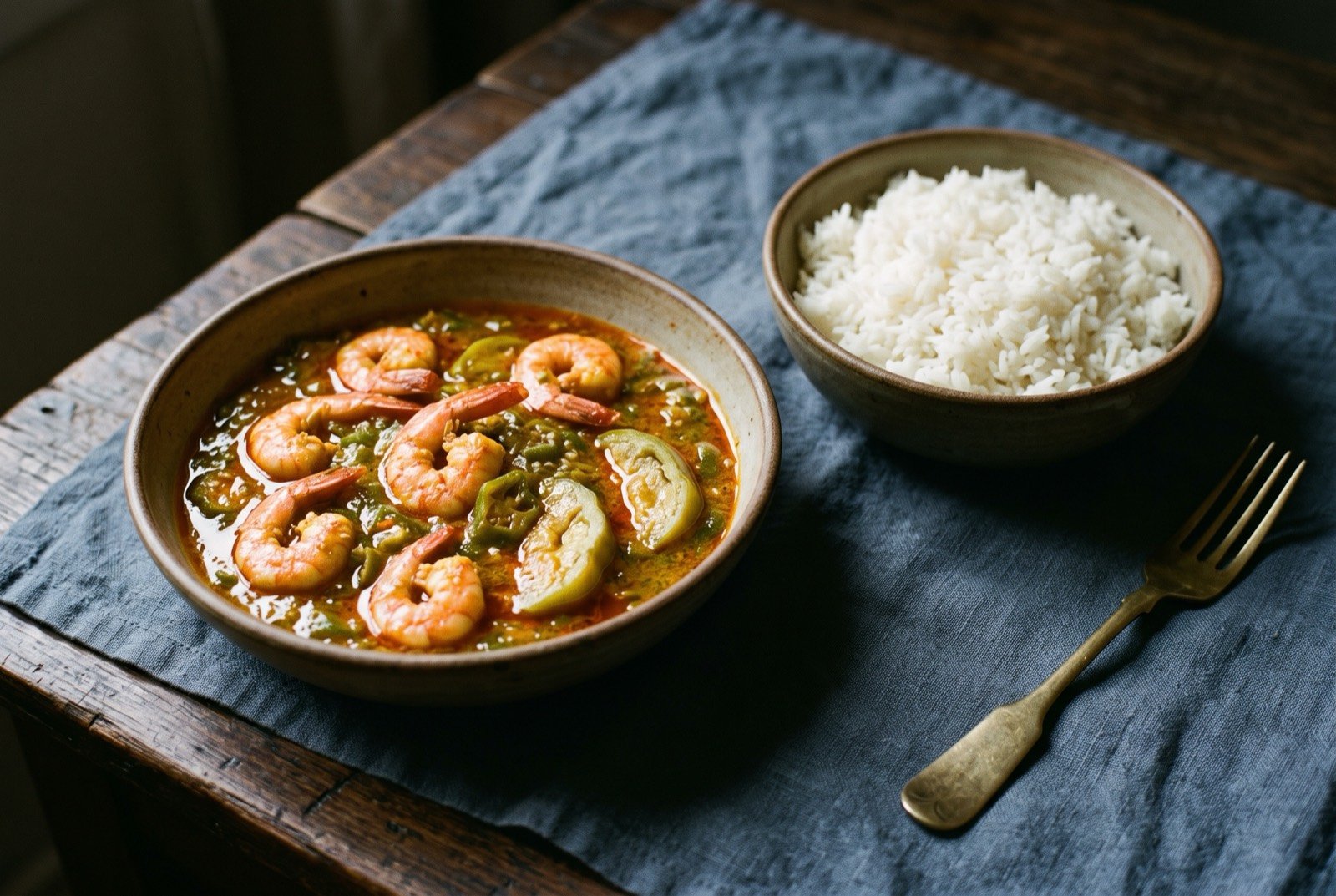
Siga is the mucilage dial pushed all the way to one end, and the clearest demonstration in this volume that okra is a structural ingredient rather than a vegetable. Thin slicing maximises the cut surface and therefore the release, and the protein is cooked first in minimal water so the mucilage meets a concentrated liquid rather than dispersing into a thin one. A cup of red palm oil to thirty pods is a genuinely high fat ratio and it should not be reduced. The fat is what carries the mucilage into a glossy sauce rather than a slimy one, because the polysaccharide network is stabilising an emulsion. Take the fat out and there is no emulsion to stabilise, only slime.
As tradition built it
Serves 4. About 40 minutes.
Ingredients
- 30 okra pods, thinly sliced
- 1 cup citi vermelho (red palm oil)
- 400 g raw prawns, or fish, or meat
- 1 onion, chopped
- 6 djagatu sinho, sliced
- 2 sukulbembe, one green and one red
- to taste salt, and white rice to serve
Method
- Cook the prawns in minimal water with the onion, salt and chillies. They should be barely covered.
- Add the sliced okra, the sliced djagatu, the palm oil and water.
- Cover and cook until the okra has given up its mucilage and the sauce is glossy.
- Serve hot with white rice.
Notes
After the Slow Food Foundation.
What a modern chef changes
Two cuts of okra, the palm oil late, and no acid until the plate
Rungs 6, 2 and 4
Method
- Cut the okra two ways and add it in two stages. Two thirds sliced thin and in early, to build the network and bind the sauce. One third in 2 cm lengths, added in the last 4 minutes, so it stays discrete and gives you something to bite. Rung 6 as a dial inside a single pot.
- Split the palm oil, two thirds at step two and one third stirred in off the heat. Rung 2: the sauce will be visibly more orange and will smell of the oil rather than of cooked oil.
- Nothing acidic goes in until the end, because prolonged acid breaks the polysaccharide network you have spent twenty minutes building. And serve the moment it is ready. A mucilage-thickened sauce held over a bain-marie is a different and much worse dish, because heat and shear degrade exactly the polysaccharide it exists for. This single fact explains most of what is wrong with okra-thickened food from a British takeaway counter.