West Africa · Volume 06, The Atlantic Islands
Caldo branco and caldo de citi
Guinea-Bissau
Illustration
- Time
- 30 minutes
- Researched
- Researched from 115 sources in the brief
- Reviewed
- Awaiting a reader from inside the tradition
- Cooked
- Awaiting a cook report
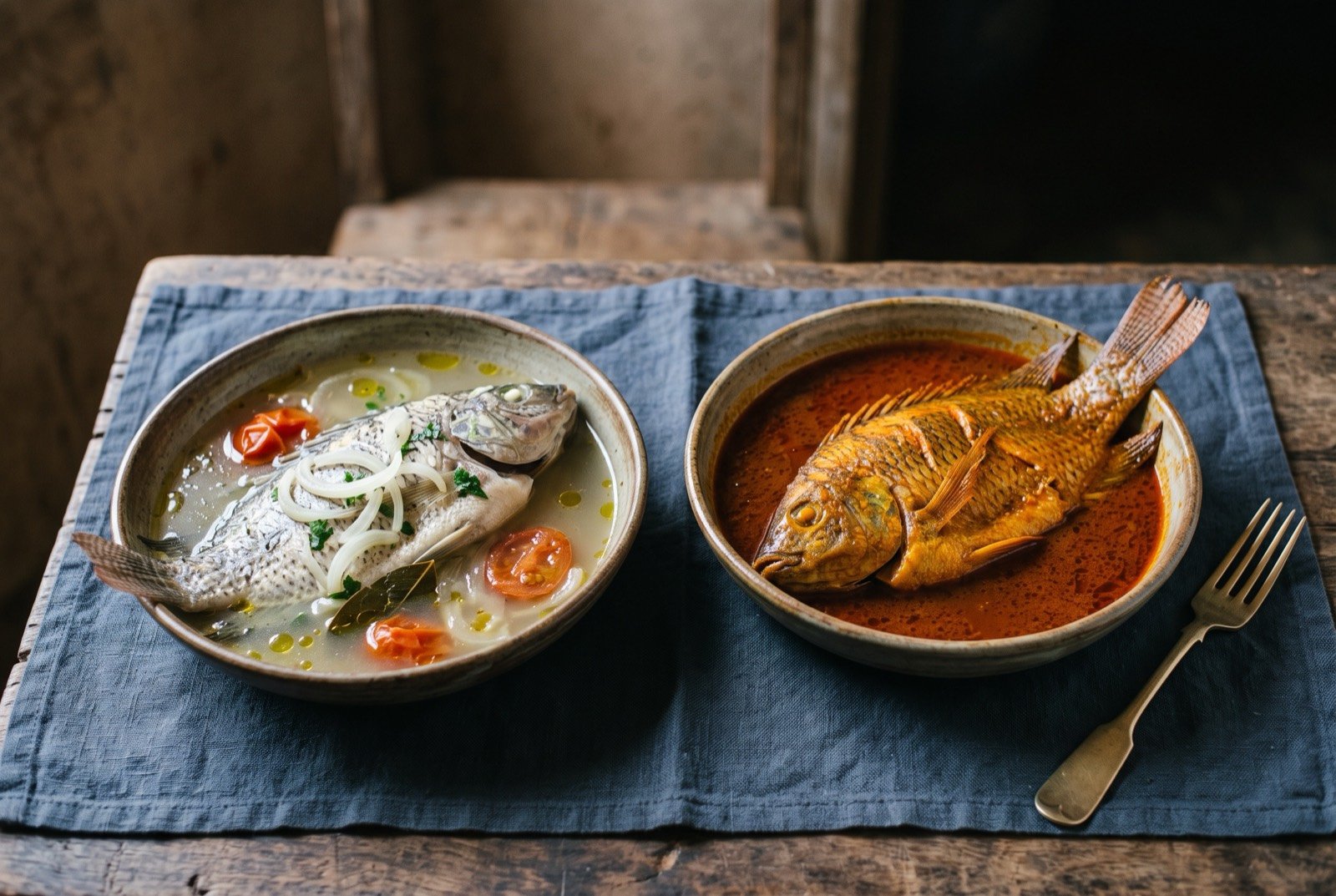
One entry, because they are the same dish twice. Same fish, same limes, same onions and tomatoes and chillies, same pot, same method. Caldo branco is built on 2 tablespoons of olive oil and is called white. Caldo de citi is built on a cup of red palm oil and is called red. And here is the tell. The palm-oil version also gets netetu. The olive-oil version does not. Fat and ferment travel together: the African fat arrives with the African umami attached, and the Portuguese fat arrives alone. Two complete flavour systems in the same kitchen, cooked by the same person on different days. The choice is not a choice of oil. It is a choice of which grammar the pot is speaking today.
As tradition built it
Serves 6. About 30 minutes.
Ingredients
The method as the tradition gives it, ingredients named but not yet weighed. Quantities follow as we verify them, lead dishes first.
- 6 medium fish, cleaned
- 2 limão-da-terra (limes)
- 2 onions, sliced
- 1 garlic clove, minced
- 1 to 2 sukulbebem
- a palmful of camate sinho, mashed
- 2 tbsp olive oil
- to cover water, salt
- 6 medium fish, mixed species acceptable
- 1 cup red palm oil
- 2 garlic cloves, 2 onions sliced
- 1.5 L water
- 1 to 2 sukulbebem, and a palmful of camate sinho
- 1 tsp netetu
- to taste salt
Method
- Heat the olive oil with the mashed tomato, garlic, onion, the sukulbebem and salt.
- Add the fish and simmer briefly.
- Pour in water to cover and cook about 20 minutes.
- Squeeze over the lime and serve hot with rice and baguitchi.
- Heat the palm oil with the mashed tomato, netetu, garlic, onion, the sukulbebem and salt.
- Sauté briefly.
- Add the water. After 10 minutes, add the fish.
- Cook about 15 minutes. Squeeze over the lime and serve.
Notes
The white version first, after the Slow Food Foundation.
And the red version, caldo de citi.
What a modern chef changes
Cook them side by side, once, and taste the argument
Rungs 2, 3 and 4
Method
- Make both on the same day, with the same fish. The one place in the book where the elevation is an experiment rather than an improvement. Halve everything, use two pans, taste them side by side. You will learn what netetu does, because one bowl has it and the other does not.
- Poach the fish rather than boiling it, in both. Bring the liquid up, take it off the heat, slide the fish in and hold at 75 to 80°C until just set, 8 to 12 minutes depending on thickness. Fish protein at a rolling boil contracts and expels moisture; at 80°C it sets and stays succulent. The traditional timings assume small whole fish and a fierce fire, and a British kitchen has neither.
- In the red version, hold back a third of the palm oil for the end, because twenty-five minutes of simmering is enough to dull it. And in the white version, resist the urge to add netetu. It will taste better and it will stop being caldo branco. The point of a paired dish is the pair.