West Africa · Volume 06, The Atlantic Islands
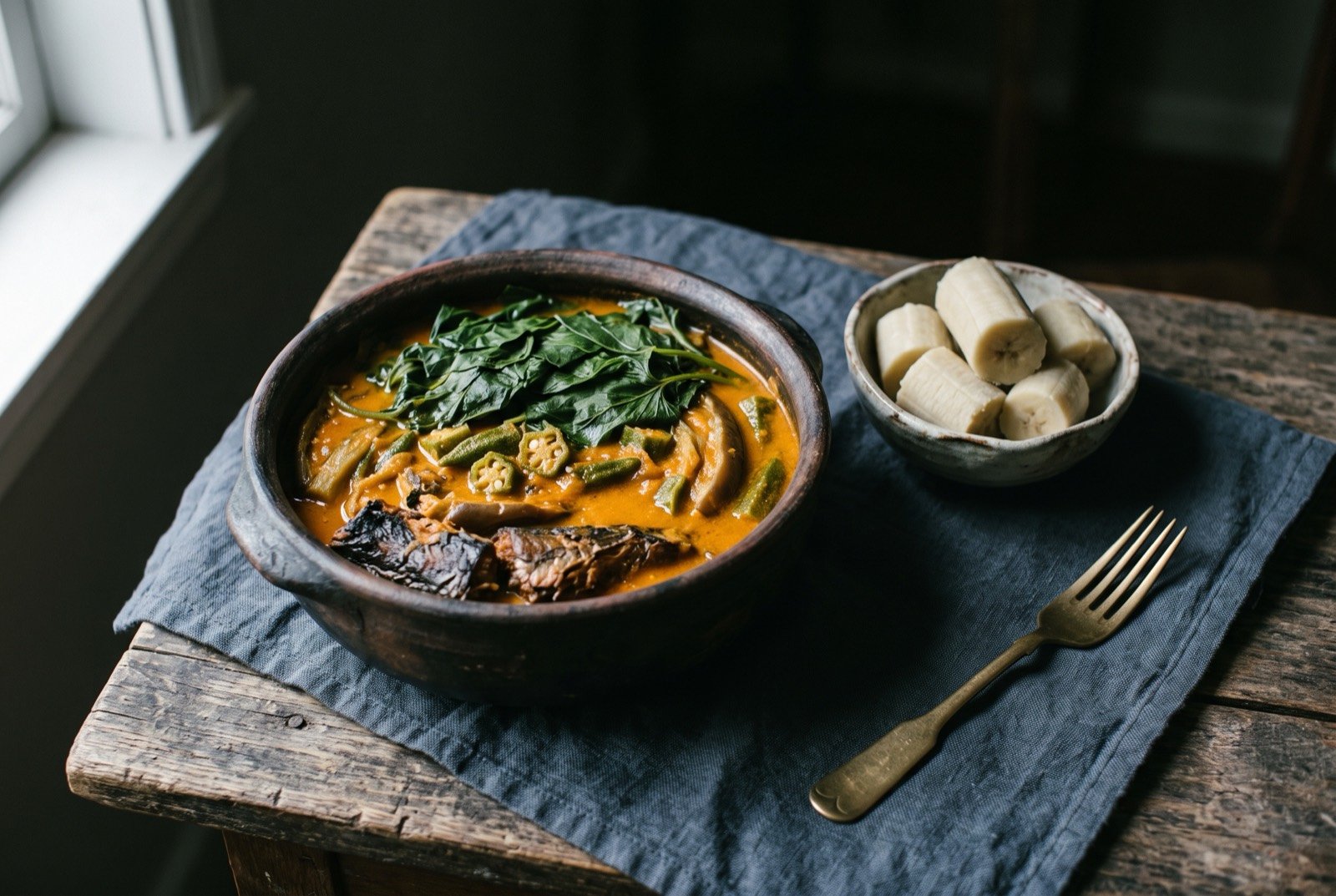
Calulu de peixe
São Tomé and Príncipe, the national dish
Illustration
- Time
- 2 hours
- Researched
- Researched from 115 sources in the brief
Calulu is not a sauté-then-simmer stew, and treating it like one is the standard failure. Everything goes in raw, together, with the palm oil and the water, and comes up as one. The aubergine collapses into the body, the okra releases into it, the smoked fish gives up its cure to the liquid, and the leaves give their volatiles late. Traditional calulu is recorded as taking around five hours, and why it is not stirred is Rung 6, three mechanisms at once. Two legitimate versions exist and this chapter prints both as one dish in two registers: the smoked-fish leaf version is the island's own, and the fresh-grouper, flour-thickened version is the one that travelled to Lisbon.
As tradition built it
Serves 6. About 2 hours.
Ingredients
The method as the tradition gives it, with the ingredients named. Quantities follow as we verify them, lead dishes first.
- 1.2 kg smoked fish
- 250 g mussua
- 1 bunch watercress
- 1 breadfruit, peeled and cut
- 1 dl red palm oil
- 2 tomatoes, 1 onion
- 5 okra, sliced
- 2 aubergines, in chunks
- 1 bay leaf, 1 ossame, 1 sprig erva mosquito
- folha de maqueque, folha de ponto, folha de tartaruga
- water, black pepper, salt, malagueta
Method
- Cut the mussua, watercress, tomatoes, onion, okra, aubergines, folha de maqueque, folha de ponto and folha de tartaruga and put them into the pot together with water, the palm oil, the bay leaf, the ossame, pepper and salt. Do not sauté anything first.
- Cook about 1 hour. Do not stir.
- Remove the breadfruit, mash it in a mortar, and return it with hot water. Continue boiling. This is the thickening step, and it is a starch rather than a flour.
- Add the erva mosquito and the smoked fish. Correct the salt and hold at a low simmer.
- Serve with angu, cassava flour, or plain white rice. For the angu, cook and mash two banana types together, breadfruit banana and plantain, and roll into cylinders or balls. Ten bananas serve six.
Notes
The island version, after Sabores de São Tomé e Príncipe.
The Portuguese-codified version, after Gastronomias: fresh grouper and prawns in place of the smoked fish, marjoram in place of the leaf stack, and 20 g of flour per kilo of fish slaked and stirred in at the end in place of the pounded breadfruit. Same cold start.
What a modern chef changes
Layers built as layers, the leaves substituted honestly, and the mucilage dialled
Rungs 6, 2 and 3
Method
- Build a genuine stack in a heavy casserole and do not touch it. Hard-smoked fish at the bottom, then fresh fish, then okra, aubergine, leaves, onion, tomato and garlic, then the palm oil poured over, then water to two thirds of the depth of the stack. Lid on, 150°C for 90 minutes, no stirring, no lid lifting. Greens above the waterline steam; everything below stews.
- Be honest about the leaves and blend for bitterness, not bulk. Mussua, maqueque, folha de ponto and folha de tartaruga are not identified botanically in any source I could retrieve and are not available in Britain under any name. What follows is an approximation and it is not calulu's leaf profile. Use roughly two thirds callaloo, amaranth or sweet potato leaf to one third something genuinely bitter: rehydrated dried bitter leaf, chicory or mustard greens. Spinach alone is the failure mode, because the bitterness was what balanced the palm oil, and without it the dish reads as greasy and the cook blames the oil.
- Dial the okra deliberately. Half sliced thin and in at the start to bind the sauce, half in large pieces laid on top for the last 15 minutes so it stays discrete. Rung 6.
- Hold back a third of the palm oil and pour it over at the pass. Rung 2. Ninety minutes at 150°C is already costing about 15 per cent of the beta-carotene in the pot. The reserved third arrives intact and is what makes the bowl smell of palm fruit rather than of cooked palm oil.