Africa · Volume 06
Cape Verde, Guinea-Bissau & São Tomé
The Atlantic Islands
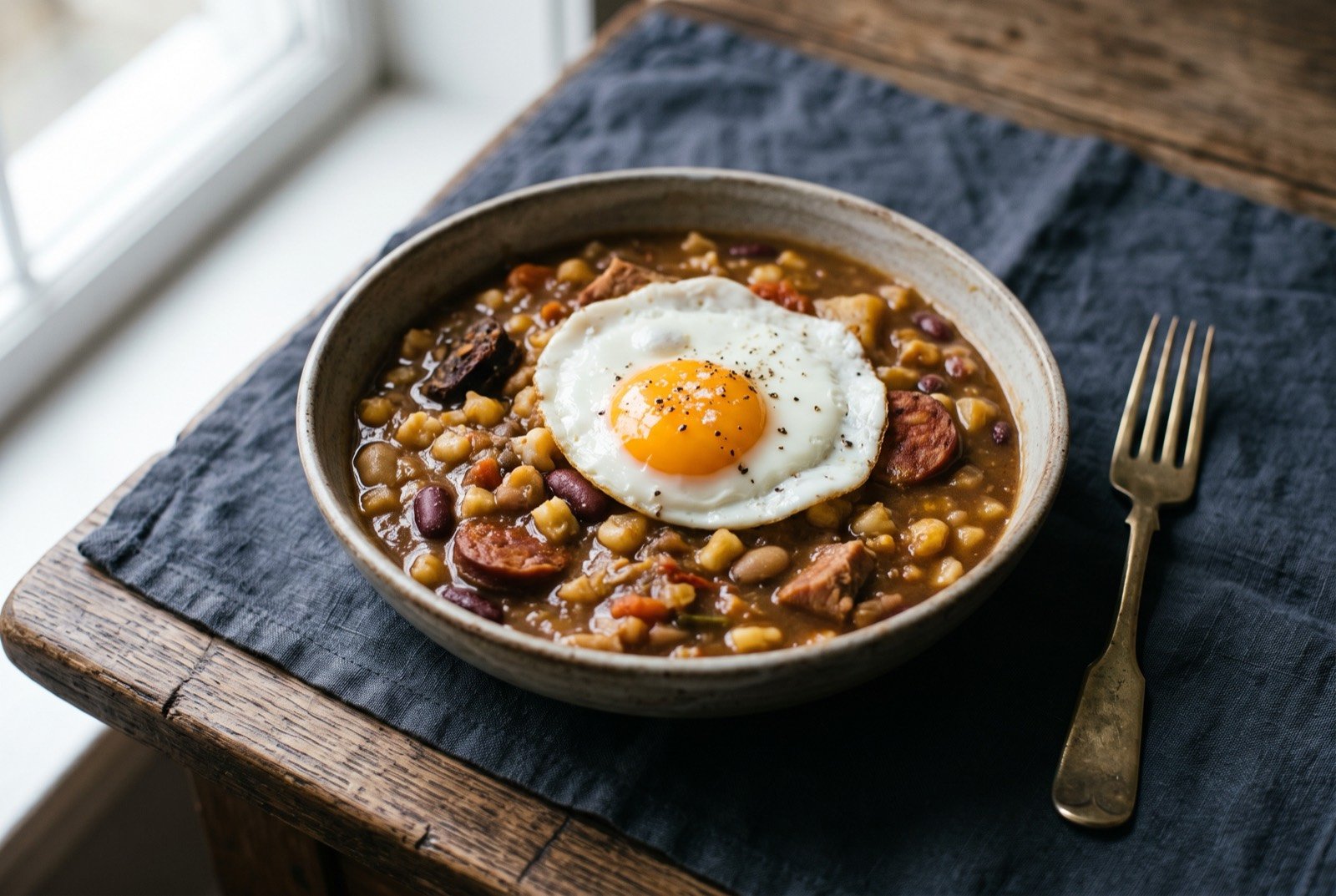
Three archipelagos and one mainland coast, taken seriously. Two of these places had nobody living on them until the ships came, so their cooking was assembled from nothing by enslaved and settler populations together. The traditional canon as it is actually cooked, a technique ladder built from the inside, and every dish as tradition built it, then what a modern chef would change.
Sources and review · What this chapter does not assert · How we research · Know this better? Tell us
A Sense of Place
Three passports, four kitchens, and one question no other volume in this book has to answer: what does a cuisine do when there is no substrate to build on?
Cape Verde and São Tomé and Príncipe had no cooking there. They had nobody there. Both archipelagos were uninhabited when Portuguese ships found them in the fifteenth century. Every plant, animal, pot, technique and person arrived by sea, most of them against their will. The creole is not a layer on top of something older. It is the whole building.
Guinea-Bissau inverts the case, which is why the three belong in one volume: its coast holds a mangrove rice civilisation that predates the Portuguese and outlasted them. Same empire, same trade, and in one place a deep indigenous foundation, in the other two none at all. Read the food that way and it stops being three national cuisines and becomes four fat-and-starch systems, plus a fifth that is purely about drink.
The hominy belt: Cape Verde
| Axis | Value |
|---|---|
| Fat | Pork fat (toucinho), olive oil where affordable. No palm oil |
| Thickener | Bean starch and corn starch, released by hours of simmering. Nothing added |
| Aromatic | Onion, garlic, bay, sweet paprika, tomato, coriander, malagueta. Portuguese refogado logic |
| Starch | Dry field maize hulled and cooked whole, plus cassava, sweet potato, squash, green banana |
| Protein | Salt pork, corned beef, chouriço, or in the poor form tuna head, dried fish and salt cod |
A semi-arid Sahelian archipelago with rain effectively restricted to August and September, arriving in a few large events in which most of the water runs straight off into the ocean. A cuisine built in those conditions is built on things that keep: dry maize, dry beans, salt meat, salt fish, cane spirit. It is the most European-technique-forward cooking in this volume and the least African in its aromatics, and that is the point rather than an embarrassment. Creolisation here ran through the pot, not through the spice rack.
Internal variation is real. Fogo has the volcanic Chã das Caldeiras, a wine called manecom from French vine stock introduced over 150 years ago, and its own corn-and-congo-bean djagacida. Santo Antão is the cane island: roughly 82 per cent of its arable land under sugar cane and around 80 per cent of national grogue. São Vicente, meaning Mindelo, is the port and the tavern, and its cachupa is made with tuna head. Santiago is the most deeply Africanised island and the capital of street cachupa.
The rice and palm coast: Guinea-Bissau
| Axis | Value |
|---|---|
| Fat | Red palm oil, Kriol citi vermelho, from Elaeis guineensis |
| Thickener | Three competing systems: pounded groundnut (mancarra), sliced okra mucilage (siga), and the pressed pulp of the palm fruit (chabéu) |
| Aromatic | Lime, djagatu, small tomatoes, fermented locust bean (netetu), fresh chilli, onion, garlic |
| Starch | Rice, overwhelmingly, from the mangrove paddy. Cassava, yam and maize secondary |
| Protein | Estuarine and marine fish, smoked and fresh; oysters; free-range chicken (frango da terra); goat |
A sauce cuisine rather than a protein cuisine: preparations are sauce-based, and meals are communal, shared from a single basin and eaten with the hands. Ethnic attribution here is functional. The Balanta are the mangrove rice specialists and give their name to the chicken-with-baguitchi preparation; the Manjaco are the coastal fishers and fish-smokers.
Notice what the thickener row is doing. Three separate systems, all indigenous, all doing the job a European kitchen gives to flour and a Cape Verdean kitchen gives to nothing at all. Three hundred miles of ocean separates a cuisine with three thickeners from a cuisine with none.
Offshore, the Bijagós are distinct enough to treat separately: eighty-eight islands, matrilineal society, an oyster-and-rice economy on mangrove, and a dish called katore, cooked fish dressed with palm oil. The travel-press framing of islands where women rule does not survive checking. See the final section.
The leaf and palm islands: São Tomé and Príncipe
| Axis | Value |
|---|---|
| Fat | Red palm oil (dendê), plus coconut oil |
| Thickener | A stack: okra mucilage, aubergine collapse, mashed breadfruit, and in the Portuguese-codified versions 20 g of slaked flour per kilo of fish |
| Aromatic | A leaf pharmacopoeia rather than a spice rack: micoco, mussua, ossame, pau-pimenta, maqueque, erva mosquito, grains of paradise, malagueta |
| Starch | Banana in many named cultivars, breadfruit, matabala (cocoyam), cassava flour, imported rice |
| Protein | Smoked and salted fish above fresh; prawns; snails; bat, on saints' days |
João Carlos Silva, who cooks at Roça São João dos Angolares and refuses the word chef in favour of cozinhador, puts the fat question in one line: "nossa gastronomia está grávida do óleo de palma." Our gastronomy is pregnant with palm oil. He attributes the depth of that habit to Angolan contract-labour influence, which matters, because it means creolisation on these islands did not stop in the eighteenth century. It was still running in the twentieth.
The same reporting describes calulu as built from dozens of different leaves. That is the technical signature of the island: flavour by leaf stacking, not by spice blending. It is also the part of this cuisine least identified botanically anywhere in print. The Tongas, descendants of contract labourers born on the plantations, remain at the margins of Santomean society, which is a present-tense fact rather than a historical one.
The drinks belt, and the fourth region
Two fermentation cultures that never meet. Cape Verde distils cane into grogue and sweetens it into ponche. Guinea-Bissau and São Tomé tap palms for vinho de palma, and São Tomé distils that into cacharamba. The political weight is easy to miss: Governor Carlos Gorgulho's prohibition of palm wine and gin sales was one of the grievances feeding the 1953 Batepá massacre.
The fourth region is Lisbon, not London: Casa da Morna e Semba, By Milocas, Cachupa da Tia Alice, Tambarina serving cachupa for breakfast and dinner with live music until two in the morning, Gingole for calulu. Boston and New Bedford hold the largest Cape Verdean population outside the islands. Britain has essentially none of this, and this chapter says so plainly rather than dressing up a directory listing as a scene.
The History in Layers
The foundation that only one of the three has
Cape Verde and São Tomé and Príncipe were uninhabited when the Portuguese arrived, and everything follows from that. What appeared over five centuries was assembled from Portuguese method, West African ingredients, American plants, and the labour of people taken from the mainland and shipped out.
That is not a softened way of saying slavery built the food. It is a precise way of saying it. Cachupa was invented under coercion, out of what stored and what would grow on marginal land in a drought archipelago, by people who were themselves the cargo of the trade that built the ports. Guinea-Bissau is the same history seen from the other end of the same ship.
The bolanha, and the Black Rice argument
The Bissau-Guinean mangrove paddy is the technical centre of gravity of this volume, and its numbers are those of a designed system rather than a subsistence workaround. A main dike blocks saltwater intrusion and secondary dikes subdivide the polder, and the Balanta build with a long plough called the radi, to which the agronomic literature attributes their superior water management directly.
- A newly cleared plot needs 3 to 5 years of rainfall leaching before it will grow rice, flushing seawater cations downward.
- Rice thrives only below about 5 mS/cm of salinity. Some plots peak at 53.75 mS/cm.
- Mangrove swamp rice outperforms upland rice by 15 to 60 per cent, at roughly 1,180 to 2,870 kg per hectare, on national output of about 180,749 Mg annually across 112,564 ha.
- Farmers grow both Oryza glaberrima, the African species with 2,000 to 3,000 years of cultivation behind it, and O. sativa. Fifty-four distinct varieties are documented, selected for salinity tolerance and eating quality, and fields are classified by a vocabulary with no English equivalent: bolanha novo, newest and most fertile, through to bolanha belhu, abandoned and sodic.
This is where the Black Rice debate lands, and this chapter prints both sides. Judith Carney argues that skilled rice farmers from the Upper Guinea Coast carried the technology that made eighteenth-century South Carolina and Georgia lowland rice possible. Eltis, Morgan and Richardson replied in the American Historical Review in 2010 that most Africans carried to those regions during the decisive plantation-building periods were not from Upper Guinea and had no prior knowledge of rice. The honest position: the bolanha is demonstrably an ancient, sophisticated, indigenous water-engineering system, and whether it is the direct technological parent of Carolina rice is contested. Both sentences are true and the second does not weaken the first.
The Columbian Exchange, and a cuisine rebuilt on an American plant
Cape Verde is the clearest case in African food history of a cuisine rebuilt on a plant from the Americas. The Cape Verdean press describes maize as carrying survival, cultural resistance and the persistence of farmers who cast seeds hoping for rain that comes or does not come. Also American and now central: cassava, sweet potato (the binder in the pastel dough), squash, groundnut by way of Brazil and now the thickener of the entire Guinean sauce canon, tomato and chilli. The counterflow carried oil palm, okra, African rice and the pounding-and-leaf technique west.
Sugar cane arrived around 1460, and by 1540 records list two working engenhos on Santiago. In the seventeenth century "aguardente, ao invés do açúcar, servia como meio de pagamento": brandy rather than sugar served as currency. Cane spirit was money in these islands before it was a drink.
Cape Verde: morgados, maize and engineered famine
The Portuguese established morgados, large entailed estates inherited by a single heir, leaving most of the population sharecropping with little incentive to improve the land. Officials pushed cash crops over subsistence and prioritised maize despite its high water requirement over drought-resistant millet and sorghum. The Estado Novo failed to improve access to fresh water or supply food aid.
| Years | Extent | Deaths |
|---|---|---|
| 1719 to 1723 | Maio, Sal and Boa Vista depopulated | not recorded |
| 1773 to 1775 | All islands | over 20,000 |
| 1830 to 1833 | All islands | about 30,000 |
| 1854 to 1856 | All islands | 25 per cent of the population |
| 1863 to 1866 | All islands | 20,000 to 30,000 |
| 1941 to 1943 | All islands | about 22,500. São Nicolau 28 per cent, Fogo 31 per cent mortality |
| 1947 to 1948 | All islands | about 22,500. Santiago lost 65 per cent of its population |
Two of those rows are within living memory, and the famine is the bridge between this volume's two archipelagos: several thousand islanders emigrated during them, many accepting contract labour on the cocoa plantations. Between 1900 and 1970 approximately 80,000 Cape Verdeans were sent to São Tomé and Príncipe. Cachupa is eaten on São Tomé because famine put it there.
São Tomé: the roça, the serviçais and the cocoa
1876 to 1900: 55,865 contract workers were shipped from Angola, women and children included, with recruitment running from Angola from 1879, Cape Verde from 1903, and Mozambique from 1908 to roughly 1961. Repatriation rarely happened, the barracks ran at 14 square metres per unit, and wages were often paid in scrip redeemable only at plantation stores, producing permanent debt. Serviçal means servant. The system it described was slavery with paperwork, sixty years after Portugal had formally abolished the trade.
Henry Nevinson's reporting and William Cadbury's investigation of 1908 to 1909 produced Cadbury's 1910 report Os Serviçaes de S. Thomé, and in 1909 German and British chocolate manufacturers boycotted São Tomé cocoa. The Portuguese response was cosmetic: hospitals built at the plantations to show the British that workers had adequate conditions, while the conditions did not change. Handle the rest carefully, because the sources have an interest: Cadbury-aligned accounts tell a version in which Cadbury acted, and Hugh Crosfield argues the boycott's public reach has been overstated. The eight years between the first reports and any action is the part nobody disputes. São Tomé led the world in cocoa in 1905; cocoa is now about 62 per cent of its exports, and it imports its rice.
Guinea-Bissau: groundnut, then cashew, and an agronomist
Groundnuts were introduced in the 1830s, and by the 1950s large parts of the coastal regions were under peanut, with centralised farm-gate pricing and compulsory planting schemes. Guinea-Bissau was rice self-sufficient through the 1950s and became an importer as a result of the colonial war of 1963 to 1974.
Amílcar Cabral, the agronomist who founded the PAIGC, ran the 1953 agricultural census from the Pessube experimental farm. Nominally an FAO requirement, he turned it into a survey of colonial agricultural damage, documenting soil degradation caused by imported European methods and recording indigenous knowledge, bolanha farming included, as knowledge rather than folklore. By 1969 he had concluded that peanut cultivation amounted to forced labour. The agronomy came first and the politics followed from it.
Then cashew. From just 330 ha in 1988, incentives drove explosive growth: between 1999 and 2013 production rose 90 per cent and yield per hectare 40 per cent. Cashew is now about 90 per cent of export revenue, driven by a state barter system in which farmers trade cashew for rice at ratios fixed annually. A rice civilisation now buys its rice by selling a tree crop, and salinity, rainfall variability and labour shortage are pushing abandonment of the bolanhas.
Ruptures, and the modern moment
São Tomé, 3 February 1953. Governor Carlos Gorgulho prohibited palm wine and gin sales and tripled the poll tax, while proposing to settle 15,000 Cape Verdeans on the island. Rumours spread that forro land would be seized for the newcomers and that forros would be forced into contract labour themselves. Hundreds of forros were killed, including 28 suffocated in a police cell and 20 burned on an estate, and no communist conspiracy was ever substantiated. The third of February is now Dia dos Mártires da Liberdade. A drinks ban was among the sparks of the founding atrocity of modern São Tomé. After independence the roças were nationalised, then declined, and roughly 15,000 Cape Verdeans left the island.
Francesca Orlandi, running the horticultural pilot at Roça Paciência, gave the Portuguese press the most useful line in the modern history of this food: "pessoas associam-na a um passado de escravidão." People associate agriculture with a past of slavery. That is why a fertile equatorial island imports its rice. Volume Four found that Abidjan's return to local ingredients began as import substitution and became an identity project afterwards. São Tomé has the opposite problem: the ingredients are there and the identity is the obstacle.
The Flavour Arsenal
If you buy nothing else, buy good unrefined red palm oil, properly smoked fish, real Portuguese chouriço and whole hominy corn. Four items, two African, two Portuguese, which is the volume in a shopping list.
The two fats, which are the whole volume
Every other volume in this book has one fat tradition. This one has two, bolted together, and they want opposite treatment.
The Portuguese fat is rendered cured pork, plus olive oil where affordable. It carries Maillard products and cured-meat volatiles, it is stable to heat, and it wants to go in early and hot in a refogado. Heat makes it better.
The African fat is unrefined red palm oil. Its value is in carotenoids and in fresh, faintly violet, faintly grassy volatiles, and heat destroys both. The figures are stark: heating red palm oil at 200°C for two hours loses 59 per cent of its beta-carotene, while at 150°C the loss over the same two hours is 15 per cent.
The two fats are on opposite schedules, and the commonest failure in diaspora kitchens is treating them the same: all the palm oil in at the start, then four hours at heat. That is Rung 2, and it recurs in nearly every dish below.
One warning belongs here rather than in the sourcing section, because it is about what the ingredient is. In February 2019 the Food Standards Agency issued alert FSA-PRIN-20-2018: Surya Foods recalled Mother Africa Pure Red Palm Oil and Mother Africa Zomi Palm Oil because they contained Sudan IV, an industrial dye that cannot be used in foods and is potentially genotoxic. Sudan dyes exist to make thin, pale, refined oil look like thick unrefined oil. The fraud exists because the visual marker of quality is easy to fake and the flavour marker is easy to miss in a spiced dish.
Cape Verde: the larder that stores
| Name | Identity | Notes |
|---|---|---|
| Milho / midju | Dry field maize, hulled whole kernel. Sold in the diaspora as yellow samp or hominy corn | Nutty, faintly sweet, holds shape for 3 to 4 hours. Soaked overnight and cooked in its own water, which is never discarded |
| Feijão pedra, feijão congo | Rock bean, and pigeon pea used green on Fogo. Navy bean is the diaspora substitute for the first | Firm and low-collapse: body without mush. Congo is the bean of the Fogo djagacida |
| Mel de cana | Cane honey, boiled cane syrup. Not bee honey | Sweetens cuscuz no binde, and ponche at 2 parts grogue to 1 part syrup |
| Toucinho, chouriço, morcela | Cured pork fat, paprika sausage, blood sausage | The whole fat and smoke system. Morcela gives cachupa rica its depth and its dark colour |
| Kamoca | Roasted cornflour | Chantre at 92 was still excited by the idea of a kamoca mousse. A Lisbon kitchen already serves one |
| Búzio | Large marine gastropod. Species not established in any source consulted | Dense and sweet. Needs 50 minutes of boiling before it will take a stew |
Guinea-Bissau: the sauce kit
| Name | Botanical | Flavour and dosing |
|---|---|---|
| Mancarra | Groundnut, Arachis hypogaea | Pounded to powder, worked with tomato into a paste, let down with water, then strained before it enters the pot. About 250 g per chicken |
| Chabéu | Fruit of the oil palm | Boiled whole until the pits release, pounded, sieved, reduced to a thick red broth. 500 g fruit to 1 litre water |
| Citi vermelho | Red palm oil | Fruits dried 1 to 2 days, boiled, seeds separated by hand. Stored in glass away from light, used within a year |
| Djagatu | Solanum aethiopicum | Small bright red aubergine, tomato-like, intense and slightly bitter. The leaves are cooked too |
| Baguitchi | Hibiscus sabdariffa | The white variety's leaves are sour. Boil 10 minutes, beat with a fork, work with cooked okra into a paste |
| Netetu | Fermented Parkia biglobosa seed | The West African miso. Aggressive raw, disappears aromatically on cooking, leaves the umami behind |
| Limão-da-terra | Citrus aurantifolia | A 30-minute marinade for grilled meat and fish, and the finishing acid for every caldo |
São Tomé: a leaf pharmacopoeia, mostly unidentified
This table is the most honest thing in the chapter and the most frustrating. These leaves are the actual flavour of Santomean food, and not one of them is botanically identified in any source I could retrieve.
| Name | Identity | Notes |
|---|---|---|
| Ossame | A leaf or seasoning. One reporter records it functioning as a malagueta substitute; a Santomean recipe blog uses it as a countable unit, "1 ossame" | Unresolved. Those two readings are not obviously compatible |
| Micoco, mussua, maqueque, folha de ponto, folha de tartaruga, pau-pimenta | Leaves, and a pepper bark. Mussua goes in at 250 g to 1.2 kg of fish; three micoco leaves season a three-egg omelette | All unresolved |
| Erva mosquito | Described as wild oregano-like; one Santomean source glosses it as marjoram | Added late. An aromatic finish, not a base note |
| Izaquente | Treculia africana, African breadfruit. Not Tetrapleura tetraptera, and the conflation is common | Fruit 10 to 15 kg. The pulp is not eaten; the seeds are extracted, dried, and made into a funge with salt, ossame and pepper. Ark of Taste endangered, squeezed between the timber value of the tree and the labour of seed extraction. Buy it in Britain as Nigerian ukwa |
| Matabala, fruta-pão, banana cultivars | Cocoyam, breadfruit, and banana-pão, banana-prata, banana-ouro, banana-maçã | The starch set. Breadfruit is boiled in the calulu, removed, pounded, and returned |
A working dose to hold on to: 1 dl of red palm oil to 1.2 kg of fish in a calulu. That is not a slick on top. That is the sauce.
Netetu is the umami spine of Guinea-Bissau, the same idea as Volume Four's soumbara and Volume Three's iru. The acid is lime, squeezed over the finished caldo off the heat. The heat is malagueta, added late or kept on the table. This is not a chilli-forward cuisine in the way the Gulf of Guinea is: heat here is a vector for acid as much as an end in itself, which is why a vinegar piri piri on the table is the correct format and a chilli boiled in the pot for three hours is not.
Part Two
The Technique Ladder
First, an honest problem
There is no Michelin star, no World's 50 Best entry and no James Beard award anywhere in the Cape Verdean, Bissau-Guinean or Santomean canon, as of August 2026. The Michelin Guide publishes no destination selection for any of the three countries, and repeated searching surfaced no starred or Bib Gourmand restaurant cooking these cuisines in Europe or North America either.
Volume Four had to say the same thing about Côte d'Ivoire, Togo and Benin. Here it is starker, and the contrast with Volume Three is the story. Nigerian and Ghanaian food got Ikoyi, Akoko and Chishuru. The Lusophone Atlantic got nothing equivalent, anywhere, and that absence is the most interesting fact in this chapter.
What exists instead is a small number of serious cooks working outside the awards system, and two of them matter for this ladder.
João Carlos Silva at Roça São João dos Angolares is explicitly anti-technical: "A cozinha é uma arte, é um esforço de criação, de improviso." Two details from him are load-bearing anyway. He admits his bean cookery is Angolan rather than Santomean, a legacy of seven years living in Angola, which is a chef telling you creolisation is still running. And his service is a long sequence of small dishes from the garden and the sea, at around fifteen euros: a tasting menu in everything but name, built from a kitchen garden rather than a supplier list.
Maria de Lourdes Chantre, who wrote Cozinha de Cabo Verde in 1979, supplies this chapter's single most useful restaurant-level detail, and it is nearly fifty years old: she separates the cachupa into components, corn, beans and sausage as the base, vegetables cut in strips over the top, parsley to finish, rather than serving an undifferentiated brown bowl.
So the elevations below are not copied from a starred kitchen, because there is not one. They are built from mechanism, and every rung is a technique this cuisine already contains, done deliberately and measured.
Rung 1. Cook the corn and each bean to its own endpoint, then marry them
Why it works. Maize endosperm starch gelatinises across roughly 62 to 74°C, but full hydration of a dehulled kernel takes hours, because water has to migrate into a dense, partly vitreous matrix. Butter beans, congo beans and kidney beans each have different seed-coat permeability and different cotyledon cell-wall pectin, so they reach the point where cell walls separate cleanly at wildly different times.
Cooked together, one component is always wrong. You get chalky corn or collapsed beans, usually both. Cooked apart and combined for the last stage, every component sits at its own optimum and the pot liquid stays a sauce rather than a starch slurry.
The traditional single-pot timing is the evidence for the problem: corn alone for 10 minutes, then beans, then an hour, then meats, then 90 minutes more, aromatics with an hour to go, squash in the last 30, then a mandatory 20-minute covered rest off the heat so that salt and seasoning are absorbed into the corn and bean.
That rest is not folklore. It is a diffusion step. Salt and dissolved flavour compounds equilibrate into gelatinised starch far faster at a plateau below boiling than while the pot is convecting, because convection keeps replacing the boundary layer at the kernel surface and does nothing to speed transport inside it. Twenty minutes off the heat is worth more than twenty minutes of extra boiling.
A pressure cooker on the corn alone is legitimate here and saves two hours. It is what makes this rung affordable on a weeknight.
Rung 2. Two fats, two moments
Why it works. The mechanism is in the arsenal above and the numbers decide the colour of every red dish in the chapter: 59 per cent beta-carotene loss at 200°C over two hours, 15 per cent at 150°C over the same two hours.
- Render the pork fat and build the refogado hot and early. That fat wants heat.
- Add most of the palm oil late and off the boil.
- Finish the plate with a spoonful of raw or barely warmed palm oil, for colour and top note.
A calulu that arrives orange-red and smelling faintly of violets and carrot has been treated this way. One that arrives brown-grey and smelling of nothing in particular has had all its oil in from the start and then sat over heat. Same recipe. Only one is the same dish.
Rung 3. Stack glutamate against inosinate deliberately
Why it works. Umami synergy is multiplicative rather than additive: free glutamate and 5' ribonucleotides potentiate each other by roughly an order of magnitude at the receptor. This cuisine already contains both sides by accident. Cured pork, long-cooked onion and tomato, and salt cod give glutamate. Dried and smoked fish give inosinate. Netetu gives glutamate in a concentrated form no European ingredient matches.
The move is to make the stack deliberate and separable. Keep three umami sources apart and dose them independently: a properly made smoked fish stock, steeped and strained and defatted; cured pork rendered on its own; and a finishing dust of blitzed dried shrimp or dried fish added at the pass, so its volatiles are not cooked away three hours before service.
The West African smoke-drying standard is a kiln run of 10 to 18 hours, which produces fish that is hard and needs rehydration. Hard-smoked fish therefore goes in early so it can hydrate and give up its cure; delicate dried fish goes in late so it does not shred; salt-cured fish needs its water changed at least twice.
And do not boil the stock. Boiling a lump of smoked fish extracts the good aromatic phenols, the coarse acrid high molecular weight smoke fractions and the already-oxidised fat all at once, and emulsifies the last of those into your sauce. That is the muddy, faintly bitter note in bad diaspora cooking, and it is a process failure rather than an ingredient failure.
Rung 4. Give a fat and starch heavy plate an acid vector
Why it works. Cachupa and calulu are both high in fat and high in gelatinised starch, and that combination coats the palate, physically slowing the delivery of aroma compounds to the retronasal receptors. The dish tastes progressively less of itself as you eat it, and the cook's instinct is to add salt.
Salt is the wrong axis. Acid cuts through by stimulating salivation and by shifting perceived saltiness upward, so a measured acid lets you use less salt and taste more.
Every good version of these dishes has an acid, and the tradition already knows where it goes. In Guinea-Bissau it is the lime squeezed over the caldo off the heat, which is not garnish: it is the acid that cuts a very fatty sauce and it is characteristic of the entire caldo family. In Cape Verde it is tomato in the refogado and vinegar in the meat marinade. Everywhere it is the malagueta in vinegar on the table.
Two disciplines follow. Salt in layers, each component seasoned at its own stage, which matters more here because Rung 1 has you cooking components separately anyway and because corn will not take up salt properly once the pot has cooled. And finish with a measured acid at the pass rather than hoping the tomato did the job three hours ago. Acid added at the start is acid that has boiled away, and in the okra dishes it is worse than that, because prolonged acid degrades the mucilage you are relying on for structure.
Rung 5. Build texture contrast on purpose, using the cuisine's own second cooking
Why it works. These are homogeneous dishes by nature. Everything is soft, the same temperature and roughly the same colour, and sensory fatigue sets in within four or five spoonfuls. That is a real perceptual effect rather than fussiness: receptor response to a constant stimulus declines, and there is nothing in the bowl to reset it.
The cuisine already contains the fix, and it is a whole named dish. Cachupa refogada, guisada or frita is yesterday's cachupa drained, dried out and fried until the corn exteriors take Maillard colour, topped with a fried egg and linguiça or with fried mackerel. Same logic as fried polenta, arancini or crispy rice: the first cooking makes the starch, the second makes the crust and the aroma.
A plate carrying both the soft stew and the fried crumb has a texture contrast a bowl of stew never will, and neither element is imported. Chantre's 1979 plating does the same job by different means. Fried green banana, crackled pork skin and toasted cassava flour all serve the same function, and so does a spoonful of gari on a Guinean caldo.
Rung 6. Layer, do not stir, and treat mucilage as a dial
Why it works. Calulu is built in layers and left alone: smoked fish down first, then fresh fish, then okra, greens, aubergine, onion, tomato and garlic, then the palm oil. Three mechanisms stack.
The fish stays intact because it is never agitated during the window in which its collagen is converting to gelatine and its muscle blocks are at their most fragile. A spoon through that pot at the wrong moment is the difference between pieces of fish and fish-flavoured sediment.
The greens cook largely in steam above the liquid line, so chlorophyll degradation is slower and they stay green rather than olive. Steam at 100°C in a saturated atmosphere is gentler on a leaf than the same temperature in agitated liquid, because the leaf is not being mechanically worked.
The okra gives up its mucilage gradually into a liquid already carrying dissolved fish gelatine, so the two work together as a stabiliser and hold the palm oil in a loose emulsion instead of letting it break out as a slick. That is why cornflour is not a substitute: it thickens without the acidic polysaccharide's stabilising effect on the oil, so the oil still splits.
And it is a dial, not an accident. For less slime, cut the okra into fewer, larger pieces and add them later. To bind the sauce, cut it small and add it early. Guinea-Bissau's siga is the same dial pushed to one end, thirty pods thinly sliced with a cup of palm oil, and that fat ratio should not be reduced: the fat is what carries the mucilage into a glossy sauce rather than a slimy one.
Part Three
The Ferment and Preserve Bench
Four things worth making or keeping, all of them methods this cuisine already runs on.
1. Netetu
The umami spine of Guinea-Bissau, and the process is why you buy it rather than make it: seeds sun-dried, washed and boiled 12 to 24 hours, hulled by hand, salted, boiled again for 1 hour, then packed into calabashes under banana leaves for a natural fermentation of about 3 days. Twelve to twenty-four hours of boiling before the ferment even starts is not a domestic proposition, and the product is cheap and widely sold in Britain as Nigerian iru or as sumbara.
How to judge it. It should smell aggressively of ammonia and cheese when the packet opens; if it smells of nothing, it is old and it will do nothing for you. The aroma disappears on cooking and leaves savour behind. Dose at 1 teaspoon per litre of sauce.
2. Molho di pimenta, the acid vector
The table condiment Rung 4 keeps asking for. Pack 100 g of fresh malagueta or bird's eye chillies, stems removed, into a sterilised jar with 2 crushed garlic cloves and 1 teaspoon of salt. Cover completely with white wine vinegar, seal, and leave in a cool dark place for 2 weeks. Blitz coarsely, or leave whole and use the vinegar as it stands. It keeps for months.
Why vinegar, and why on the table. The acid does half the work and the heat does the other half, and both are lost in a pot that then simmers for two hours. Capsaicin survives; the volatile esters that make a fresh chilli taste fruity rather than merely hot do not, and neither does the acetic acid. On the table both survive and the eater controls the dose. A second dish of lime wedges alongside is not redundant: vinegar reads sharp and steady, lime reads bright and fades.
3. Grogue and ponche, which you should buy
Cape Verde's Decreto-Lei 11/2015 gives unusually hard parameters: 38 to 54 degrees GL at 20°C; fermentation at 25 to 30°C, never above 34°C, for a maximum of 15 days, exclusively natural, with no accelerants or added sugar; cuts of 5 to 10 per cent heads, about 80 per cent heart, 10 to 15 per cent tails, the tails discarded; and aguardente velha at a minimum of 12 months in wood. The process is an animal-traction trapiche, fermentation in wooden barrels, distillation in a wood-fired copper still.
And the politics. The Confrérie du Grogue de Santo Antão lobbied from 2008 for stricter regulation against poor quality and subsidised imported sugar. At the 2015 inspection, only 6 of 191 production units met the legal requirements. Enforcement then forced many small distilleries to stop. Rules written to protect craft grogue removed exactly the producers most likely to be using traditional methods.
Ponche is simple and the ratio is firm: 1 litre of grogue to 0.5 litre of mel de cana, with lemon peel or a cinnamon stick, shaken in a bottle.
Do not distil spirits at home in Britain. It requires an HMRC licence and it is a criminal offence without one. And do not expect to buy grogue here: the one UK category page checked returned zero products in stock in August 2026. Substitute a rhum agricole blanc, or Haitian clairin, because those, like grogue, are distilled from fresh pressed cane juice rather than molasses and carry the same grassy, olive-brine, vegetal ester profile. Molasses rum is not a substitution.
4. Salt and smoke your own fish
Rancidity in bought smoked fish is the single largest quality problem in this chapter. Red palm oil, smoked fish and groundnut paste are all high in unsaturated fat, all have enormous surface areas, and are all routinely stored at ambient temperature in a warm shop for months. Oxidative rancidity produces hexanal, nonanal and related aldehydes well below the level at which a diner can consciously name them, and well above the level at which the dish registers as stale. Most British diners who say they do not like African food are describing rancidity, not cuisine.
Brine 500 g of mackerel or herring fillets in a 6 per cent salt brine for 90 minutes, rinse, and air dry uncovered on a rack in the fridge for 4 hours until the surface is tacky. That pellicle is what the smoke adheres to. Hot smoke over oak at 80°C for 45 to 60 minutes, or cold smoke under 30°C for 4 hours and then dry at 50°C for 8 to 12 hours for the hard product that goes into a pot early. And freeze whatever you buy, immediately.
Sourcing in Britain
Verified August 2026. Where a supplier could not be confirmed, that is said rather than smoothed over.
Two shopping trips, which is why nobody here cooks this properly
You need a Portuguese grocer for chouriço, morcela, bacalhau, Portuguese beans and olive oil, and an African grocer for palm oil, smoked fish, groundnut paste, green banana, ukwa and leaves. Those two shops are rarely on the same street, and no supermarket carries either half well.
In London: Portuguese on South Lambeth Road, Stockwell and Vauxhall, anchored by Lisboa Patisserie at 147 to 149 South Lambeth Road, plus Golborne Road, W10; African on Ridley Road Market, Dalston, Rye Lane in Peckham, East Ham High Street North and Deptford High Street. Elsewhere the market areas hold up even where individual businesses could not be verified: Moss Side and Cheetham Hill in Manchester, the Bull Ring Indoor Market in Birmingham, Kirkgate Market in Leeds, Stapleton Road in Bristol, Govanhill in Glasgow, Spital Hill in Sheffield, Lodge Lane in Liverpool, Grainger Market in Newcastle. In Cardiff I could not verify a single named African or Portuguese grocer, so work the City Road strip in person.
Verified trading, nationwide
- Portugalia Wines and Food, portugaliaonline.co.uk, Unit 4, 7 Whitby Avenue, Park Royal, London NW10 7SE, 020 8965 8970. Free delivery over £74.95 UK-wide. Chouriço from several producers, a full dried and tinned bean range, Portuguese olive oil. Salt cod and morcela were not visible in the listings, so confirm by phone before you build a recipe around them. Your primary source for the Portuguese half of the cachupa pot.
- Niyis African Supermarket, niyis.co.uk, Unit 8, Sentinel End, Reading RG2 0BF. Over 1,000 lines, nationwide, next day if ordered before 11am from £10.99. Frozen goods shipped with ice packs, which matters for smoked fish. Your best verified all-rounder for the African half.
- Afrobuy, afrobuy.co.uk, Manchester. Best verified palm oil selection: Tropical Sun from £2.99, Olu Olu £2.99 to £5.99, Banga Red Palm Oil £7.99 to £14.99, KTC Unrefined £2.99.
- Afrifoods, afrifoods.co.uk, 58 Ridley Road, London E8 2NR. Ghana Taste Peanut Paste Smooth at £6.99, no additives or sugar. The best verified source for pure groundnut paste.
Reported but not independently verified: Supermercado Portugal, Delícias UK, Zaonmart, CC Continental, London Grocery, and the South African retailers listing Iwisa Samp 1 kg, the closest commercial analogue to milho para cachupa. Flagged as unavailable: grogue; izaquente under that name, so buy Nigerian ukwa; Corallo and Diogo Vaz chocolate; and the entire Santomean leaf set.
The ranked list: what decides great from grim
- Unrefined red palm oil, fresh and correctly handled. The aroma of two of the three national dishes, degrades fast, and the ingredient most often faked, bleached or rancid.
- Smoked or dried fish, bought fresh and frozen immediately. It supplies the inosinate that makes everything else taste of more. Stale, it makes everything taste of cardboard.
- Milho para cachupa, correct type, correctly soaked, separately cooked. Get the corn wrong and there is no cachupa, only stew.
- Real Portuguese chouriço and morcela. The Portuguese half of the creolisation. Substitute them and you have a West African bean stew.
- Groundnut paste that is 100 per cent peanut. Sugar or stabiliser turns caldo de mancarra into satay in one step.
- A proper mix of beans, current season. Old beans never soften, because the pectin in their cell walls has cross-linked, and one bean type flattens the texture.
- Bacalhau in thick loin, desalted 24 to 48 hours in the fridge with three or four water changes. Thin tail pieces disintegrate; rushed desalting leaves it inedibly saline.
- Bitter and sour leaves, not just spinach, because bitterness balances the palm oil in calulu, plus okra cut to purpose, your only native emulsion stabiliser, and a vinegar chilli on the table, the acid vector that stops a fat-heavy plate closing down the palate.
Quality markers
- Red palm oil should be opaque, deep orange-red, and semi-solid below about 25°C. Fresh, it smells sweet, faintly floral, of violets and carrot. Rancid, it smells of old crayons, putty or cardboard. A uniform translucent ketchup red is the warning sign.
- Hominy corn should be dry, loose and uniform, with no flour dust in the bottom of the bag, because dust means the kernels have been abrading each other and the bag is old. Older corn needs a longer soak, not more heat.
- Groundnut paste: the ingredients list should read "peanuts" and nothing else, and oil separation on top is a good sign, because it means no emulsifier.
- Smoked fish should smell of smoke and sea rather than ammonia or old oil, and should snap or flex rather than crumble. A yellow-brown greasy sheen on the cut surfaces is oxidised fish oil.
- Bacalhau should be creamy white to pale straw, firm, dry rather than tacky, thick through the loin. Chouriço for cooking wants a coarse grind and visible fat, and Spanish chorizo is a different animal.
- Okra should snap cleanly; bendy okra is old. Frozen leaf packets should rattle, not be a single block, which means they thawed and refroze. Cassava snapped in the shop should be pure white and crisp with a woody central fibre.
Kit that earns its place
Four things: a pressure cooker of 6 litres or more, which is what makes Rung 1 affordable; a heavy enamelled casserole of 7 litres or more for calulu, which needs mass so the bottom layer does not scorch while the top steams; a digital probe, because 85 to 90°C in a groundnut sauce cannot be judged by eye; and a chinois for the smoked fish stock.
Voices and Sources
From inside the tradition
- Maria de Lourdes Chantre, born in Mindelo, author of Cozinha de Cabo Verde (1979), the first comprehensive book on Cape Verdean cooking, still working at 92 in 2022. The intellectual spine of this cuisine and the source of its best plating idea. Her reported repertoire: cachupa with vegetables cut in strips and chopped parsley; prawn broth with banana and sweet potato; dried fish caldeirada with coconut; fried corn pastéis. Her book should be sourced by anyone serious about this food.
- João Carlos Silva, Roça São João dos Angolares. Refuses the word chef in favour of cozinhador, runs a workshop training young Santomeans, and holds that gastronomy is transversal. He inherited the trade from his father, who ran a restaurant called Teia de Aranha in the capital, and spent seven years in Angola absorbing methods not native to São Tomé. Author and presenter of Na Roça com os Tachos.
- Molé Cabral da Cunha, Enterramento, Bissau. The best named contemporary Bissau-Guinean cook found in this research, framed as a case of gastronomy as female economic independence. She also names the class prejudice she works against: many people assume that whoever sells food does so because they have no academic qualifications.
- The Lisbon houses: Casa da Morna e Semba (Tito Paris), By Milocas (Maria Andrade, whose philosophy is cooking as a way of advancing Cape Verde with dignity, work and memory), Cachupa da Tia Alice (Alice Conceição, with kamoca mousse by her son Cláudio Duarte), Tambarina, and Gingole for calulu.
- Cláudio Corallo, Italian agronomist, who bought the abandoned 120-hectare Terreiro Velho estate on Príncipe in 1992. He diagnosed local cocoa bitterness as a processing, moisture-storage and heat problem rather than a genetic one, and rebuilt fermentation, roasting and winnowing accordingly. His chocolate carries no vanilla and no lecithin, so the fermentation and the roast have nowhere to hide.
- CECAB, the organic cocoa cooperative founded 20 July 2004 at the encouragement of the French chocolate house Kaoka. By 2023 it had around 3,000 farmers in 42 associations. In 2018 its president reported cocoa theft at 40 per cent of total production.
One technical hook worth carrying away. São Tomean cacao is Amelonado-descended, planted from the same nineteenth century stock that later seeded the entire Gold Coast cocoa industry. That is why an island of this size matters to the global chocolate story, and it is the volume's pattern again: the islands as transfer point.
The gap, named
There is no verifiable Cape Verdean, Bissau-Guinean or São Tomean restaurant of note in the United Kingdom. The only verified UK business cooking near this repertoire is Verde in Forest Gate, a family-run Portuguese restaurant describing its food as Portuguese and PALOP style. The reason is demographic: the 2021 census records 9,009 Portuguese speakers in Lambeth, mostly Madeiran and continental in origin with a growing Portuguese African and Brazilian population, and that growing population has not yet produced its own restaurants.
The structural history is best stated in Jimi Famurewa's terms. African dining in Britain traces back to the West African Students' Union canteen founded in Camden in 1933, a sanctuary for the homesick serving inexpensive dishes made from indigenous ingredients. For most of the following ninety years the African restaurant here existed to be functional and affordable for a diaspora, not to be judged on technique by outsiders. The food was never bad because the cuisine is bad. It was formatted for a completely different job. What changed in the 2000s was a generation of African heritage chefs using food to reframe their roots. That generation reached Nigerian and Ghanaian food. It has not yet reached this food anywhere in Britain.
And the reason the diaspora versions taste the way they do is structural rather than cultural. Hot holding: cachupa held for six hours shears its gelatinised corn to mush, keeps degrading the carotenoids, and disintegrates the smoked fish; the same pot at 40 minutes is a good dish. Ingredient economics: every high-impact ingredient here is expensive relative to its calories, so it is the first thing squeezed. Rancidity and adulteration, both covered above. And technique loss under labour cost: every rung on this ladder costs labour, and a restaurant selling a large portion at British takeaway prices can afford none of it. That is an economic outcome rather than a failure of skill.
Things this chapter has deliberately not asserted
The section that makes the rest of it trustworthy.
- The botanical identity of the Santomean leaves. Ossame, micoco, mussua, maqueque, folha de ponto, folha de tartaruga and pau-pimenta are the actual flavour of Santomean food, and not one of them is identified botanically in any source I could retrieve. The readings also conflict: one reporter glosses ossame as a malagueta substitute, while the recipe sources treat "1 ossame" as a countable unit, which suggests a fruit or a pod rather than a leaf. The Herbarium of São Tomé and Príncipe would settle it.
- Where the name "pastel com o diabo dentro" comes from. Everywhere in English-language listicles, glossed as the devil being the chilli in the filling. No Cape Verdean source consulted explains it, and the Balai recipe page does not mention the phrase at all. Chantre, or the Museu da Gastronomia on Boa Vista, would settle it.
- What búzio actually is. Cape Verdean recipes give a kilo of it and a fifty-minute boil, and nobody names the animal. Candidates from adjacent West African literature include Cymbium species, the volutes called yeet in Senegal, and Lobatus or Strombus conchs. That is why the dish is described in the arsenal here and not printed as one of the eleven.
- Whether cachupa maize is nixtamalised. English sources translate the corn as hominy, which in North America implies alkaline treatment. Nothing in the Cape Verdean sources describes lime or ash treatment, and the diaspora labelling describes stamped or pearled corn. This chapter asserts the negative on that basis, and does not assert any positive description of the traditional pounding process.
- Djagacida, and which version is original. Fogo's corn-and-congo-bean dish and the diaspora rice-and-beans dish share a name and almost nothing else: the Fogo version contains no rice at all. This chapter treats that as a genuine regional split rather than one version being a corruption of the other.
- Whether calulu is Angolan, Santomean, or both. Claimed as a national dish by both countries, and the two versions differ. Given that Angolan contract labour built São Tomé's kitchens, and that João Carlos Silva is on record connecting Santomean palm oil use to Angolan influence, the direction of transmission is a real historical question rather than trivia. This chapter does not settle it.
- Ponche resting time, grogue's real strength, and trapiche fermentation in practice. The 1 to 0.5 litre ratio is firm; whether ponche is rested is not stated anywhere found. The law specifies 38 to 54 per cent and caps fermentation at 15 days, but given that only 6 of 191 units were legally compliant at the 2015 inspection, the legal figures may not describe what is in the bottle. The commonly repeated two to three day ferment is not asserted here.
- The reach of the 1909 Cadbury cocoa boycott. Cadbury-aligned sources present decisive action; Hugh Crosfield argues there was no real consumer movement against blood cocoa at all. This chapter asserts only what both sides agree on.
- The "Bijagós matriarchy" framing. Every Anglophone travel source repeats that these are the islands where women rule and choose their husbands. No academic or Guinean source consulted supports that phrasing. Bijagó society is matrilineal and women hold major religious authority, which is a different and better-documented claim.
- Lagosta com mancarra, Cape Verdean lobster in groundnut sauce. Listed in a Portuguese recipe index, and the recipe itself could not be retrieved. If it is genuine it is the most chapter-worthy dish in the Cape Verdean canon for the creolisation argument, West African sauce technique on a Cape Verdean luxury protein, and it is absent only because I could not get the method.
- That there is a Michelin-starred restaurant cooking this food. There is not, anywhere in the world, as of August 2026, and no World's 50 Best entry and no James Beard award either. The Michelin destination index could not be loaded directly, so treat that as a strongly supported negative rather than a documented one. The elevations here are built from mechanism and from the cooks named above, not from a starred template. As in Volume Four, that constraint made the chapter better rather than thinner.
Volume Six of Not Just Stew. Research briefs: vol06-tradition.md and vol06-modernist-sourcing.md. Sourcing verified August 2026.
Cook the corn and each bean to its own endpoint, then marry them
Why it works. Maize endosperm starch gelatinises across roughly 62 to 74°C, but full hydration of a dehulled kernel takes hours, because water has to migrate...
Two fats, two moments
Why it works. The mechanism is in the arsenal above and the numbers decide the colour of every red dish in the chapter: 59 per cent beta-carotene loss at 200°C...
Stack glutamate against inosinate deliberately
Why it works. Umami synergy is multiplicative rather than additive: free glutamate and 5' ribonucleotides potentiate each other by roughly an order of...
Give a fat and starch heavy plate an acid vector
Why it works. Cachupa and calulu are both high in fat and high in gelatinised starch, and that combination coats the palate, physically slowing the delivery of...
Build texture contrast on purpose, using the cuisine's own second cooking
Why it works. These are homogeneous dishes by nature. Everything is soft, the same temperature and roughly the same colour, and sensory fatigue sets in within...
Layer, do not stir, and treat mucilage as a dial
Why it works. Calulu is built in layers and left alone: smoked fish down first, then fresh fish, then okra, greens, aubergine, onion, tomato and garlic, then...
The dishes
- Cachupa rica Cape Verde, the national dish
- Cachupa refogada Cape Verde
- Pastel com o diabo dentro Cape Verde
- Cuscuz no binde Cape Verde, Santo Antão especially
- Caldo de mancarra Guinea-Bissau, the national stew
- Caldo de chabéu Guinea-Bissau
- Siga Guinea-Bissau
- Caldo branco and caldo de citi Guinea-Bissau
- Calulu de peixe São Tomé and Príncipe, the national dish
- Soo de matabala São Tomé
- Omelete à moda da terra São Tomé
Sources and review
- Researched
- Researched from 115 sources in the brief
- Reviewed
- Awaiting a reader from inside the tradition
- Cooked
- Awaiting a cook report
Where this volume comes from
4 research briefs on file for this volume, researched to the rules on How we research. Published 26 August 2026. Last changed 15 September 2026.