Africa · Volume 03
Ghana & Nigeria
The Gulf of Guinea
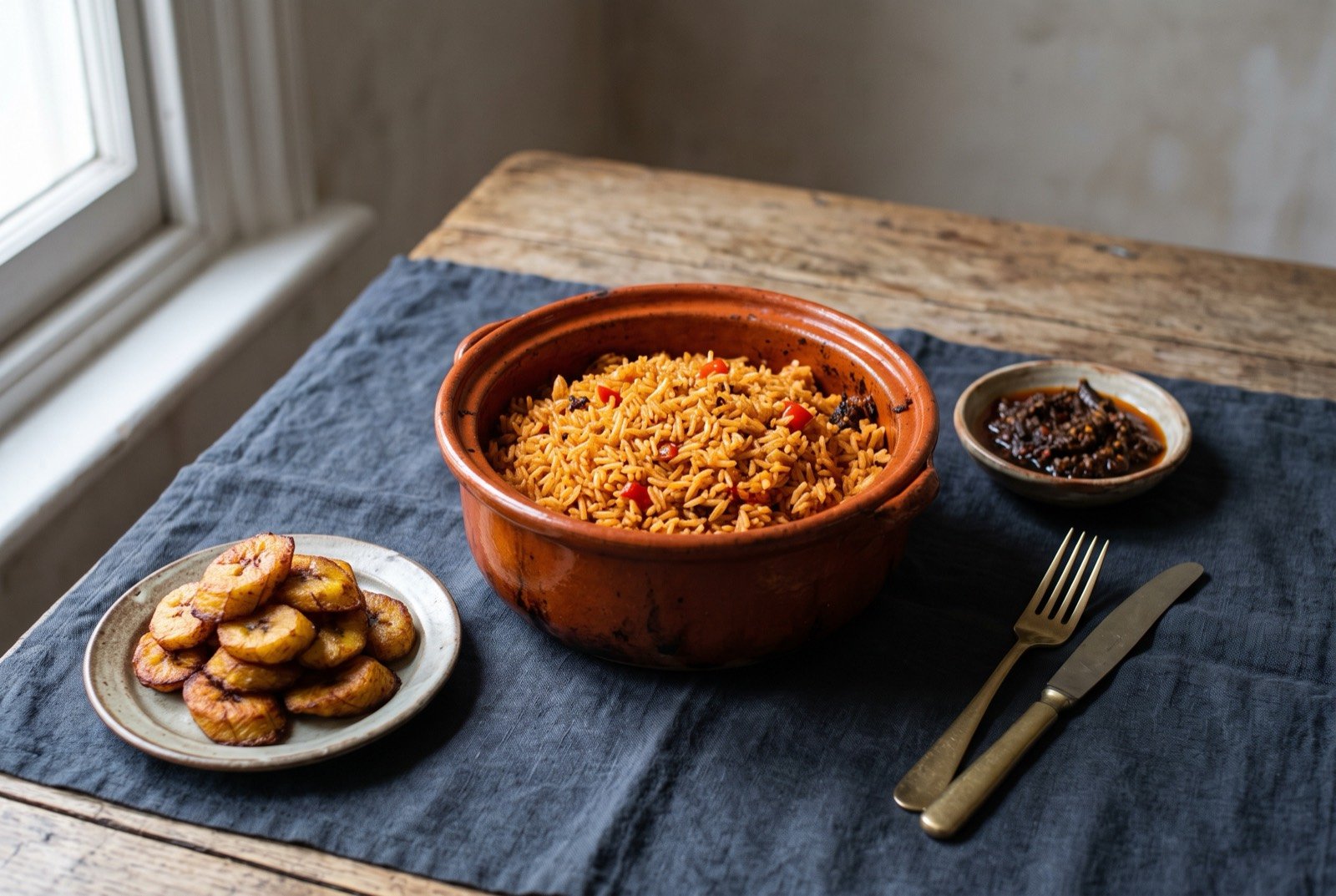
Ghana and Nigeria, taken seriously. The traditional canon as it is actually cooked, the technique ladder that separates a two‑Michelin‑star kitchen from a bad takeaway, and every dish as tradition built it, then what a modern chef would change.
Sources and review · What this chapter does not assert · How we research · Know this better? Tell us
A Sense of Place
Two nations, roughly a dozen distinct cuisines, and one continuous culinary zone that the national borders cut straight across rather than along.
The single most useful thing to understand before you cook any of this: Ghana and Nigeria are not two cuisines. They are a coastline, a forest belt and a savanna, and the food changes as those change, regardless of which flag is flying.
The Gulf of Guinea is the great southward-facing curve of West Africa, running from Côte d'Ivoire through Ghana, Togo and Benin into Nigeria and on towards Cameroon. Three ecological bands stack north to south, and every one of them cooks differently.
The coast is fish, salt, smoke and fermentation. Ga fishing quarters in Accra, the Fante ports, the Cross River estuary at Calabar, the creeks of the Niger Delta. Here you get smoked sardinella, dried prawns, periwinkles, fermented maize dough, and the palm that grows nowhere better.
The forest belt behind it is the world of yam, cocoyam, plantain, oil palm and green leaves. This is Ashanti Ghana and the Yoruba, Igbo and Edo lands of southern Nigeria. It is where the palm-oil stews live, where the swallows are pounded, and where a soup is named after its leaf.
The savanna north is a different world entirely, and it is the one British readers miss. Grain rather than tuber: millet, sorghum, maize, rice. Groundnut and shea butter rather than palm oil. Dry-heat cooking, grilling and sun-drying, which barely exist in the south. Dairy, because the Fulani are pastoralists. Halal slaughter and the rhythms of Ramadan. Northern Nigeria and northern Ghana were plugged into the trans-Saharan trade for a thousand years while the south faced the Atlantic. They are structurally different cuisines that happen to share a border.
The peoples whose kitchens you are entering
| People & place | Defining logic | The dishes that carry it |
|---|---|---|
| Yoruba SW Nigeria, Lagos | A fried pepper base (obe ata) as mother sauce; fermented locust bean as the umami spine; the most developed party and canteen food culture in Nigeria | Jollof, efo riro, ayamase, amala with ewedu and gbegiri, asaro, moin moin, dodo |
| Igbo SE Nigeria | Yam as sacred crop; soups thickened with starchy binders (cocoyam, achi, ofo) rather than seed pastes alone; ogiri as the fermented note; the leaf names the soup | Ofe nsala, ofe onugbu, ofe akwu, oha soup, ofe Owerri, abacha, nkwobi |
| Hausa & Fulani N Nigeria, N Ghana | Grain, groundnut and dairy; dry heat, grilling and sun-drying; the Sahel corridor rather than the Atlantic | Suya and tsire, kilishi, masa, tuwo, miyan kuka, miyan taushe, fura da nono, kunu |
| Efik & Ibibio Calabar, SE coast | A rainforest and estuary larder, unusual codification, and a stock discipline that refuses the bouillon cube | Edikang ikong, afang, abak atama, ekpang nkukwo, afia efere |
| Edo & Delta S-S Nigeria | Palm fruit rather than palm oil; alkaline emulsions; extracted cassava starch as swallow | Black soup, banga, owo, fisherman soup, kekefia, native rice |
| Akan Ashanti & Fante, Ghana | Forest and coast; a broth culture alongside the fat-rich soups; fufu as the national swallow | Light soup, abenkwan, nkatenkwan, kontomire, ampesi, aprapransa |
| Ga Accra | Fermented maize and preserved chilli; the fried-fish economy of the fishing quarters | Kenkey, shito, kpokpoi, red red, fried fish and pepper |
| Ewe Volta & Togo | The deepest fermentation complex in the region; cassava as cultural marker, its name glossed as "there is life" | Akple with fetri detsi, yakayake, agbeli kaklo, abolo |
| Dagomba & the north N Ghana | The unfermented counterweight; millet and sorghum; shea butter; guinea fowl | Tuo zaafi with ayoyo, tubaani, koko |
Ghana's National Commission on Culture states the structural principle plainly: a Ghanaian main dish is organised around a starchy staple, which goes with a soup or sauce containing a protein source. The same holds across Nigeria. Once you stop looking for "main and side" and start reading every meal as swallow plus soup or grain plus stew, the entire repertoire falls into order.
The same dish, four names, one zone
The clearest proof that the borders are the wrong map: fermented maize dough is banku in Accra, akple among the Ewe, akoumé in Lomé and akassa in Cotonou. Steamed fermented maize is kenkey in Ghana and akpan in Benin. Grated fermented cassava granules are attiéké in Côte d'Ivoire, akyeke in western Ghana and yakayake among the Ewe. Fermented locust bean is dawadawa in Hausa, iru in Yoruba, ogiri okpei in Igbo, soumbala in Burkina and netetou in Senegal, which is where we met it in Volume One.
And there is a lovely structural joke hiding in Benin. Ghanaian banku cooks maize flour into water. Ghanaian aprapransa cooks maize flour into palm nut soup. Beninese amiwo cooks maize flour into tomato stew. Same manoeuvre, three liquids, three countries. Learn the manoeuvre and you have all three.
The History in Five Layers
Almost everything a British reader thinks of as characteristically West African is younger than the Tudors. That is not a diminishment. It is the story.
Layer one: the indigenous core
Before any Atlantic contact, the region had already domesticated a serious larder of its own: yam, the prestige crop and the one still governed by ritual; African rice (Oryza glaberrima), domesticated in the inland Niger delta thousands of years before Asian rice arrived; pearl millet, sorghum and fonio in the savanna; cowpea, which means akara, moin moin, gbegiri, koose and tubaani are all older than Columbus; the oil palm; African locust bean; egusi melons; okra; fluted pumpkin, waterleaf, bitterleaf and jute mallow; shea; kola; and the whole aromatic set of grains of paradise, grains of Selim, calabash nutmeg and aidan fruit.
Two technologies from this layer deserve to be called achievements rather than folklore. The first is alkaline Bacillus fermentation, the process behind iru, ogiri and dawadawa, invented independently here in exact parallel with Japanese nattō. The second is wet-processing detoxification of bitter tubers, a body of applied chemistry that would later be turned on cassava with total success.
Yam is the crop you are not permitted to eat until permission is ritually granted. The Igbo Iri ji, the Akuapem Odwira, the Ewe Asogli Te Za: all of them impose a ban on the new harvest until the ancestors have been served. Maize and cassava carry no such prohibition anywhere. That asymmetry is the clearest surviving evidence of which crops are native and which arrived.
Layer two: the trans-Saharan corridor
From roughly the eighth century, Kanem-Bornu, the Hausa city states and later the Sokoto Caliphate wired northern Nigeria and northern Ghana into North Africa, and through it into the Mediterranean and Indian Ocean. What travelled south: Islam, and with it halal slaughter and the calendar of Ramadan and Eid; wheat; dates; cloves and black pepper; sugar; tea culture; Asian rice; and, critically, preservation technologies suited to caravan travel. Kilishi's ancestor is a caravan food. So is fura. So, arguably, is waakye, which came south to Accra with Hausa settlers as shinkafa da wake, rice and beans.
Ghana's three great grain street dishes all came down the same Sahel corridor: waakye, chichinga and, by one well-supported account, jollof itself, carried by the Djula Muslim trading diasporas out of the old Mali empire.
Layer three: the Columbian Exchange, which rewrote everything
From the late fifteenth century, Portuguese traders brought American crops to the Guinea coast, and the transformation was total.
- Chilli. Before Capsicum, heat here came from grains of paradise, grains of Selim, Ashanti pepper and black pepper: aromatic and warming rather than burning. The scotch bonnet rewrote the entire flavour architecture of the south.
- Tomato. No obe ata, no jollof, no stew as anyone now understands it.
- Maize. Reached the coast in the sixteenth century and became the basis of kenkey, banku, kpokpoi, ogi, kunu, masa and agidi. The historian Marvin Miracle's caution is worth keeping: the routine claim that the Portuguese brought maize from the New World "cannot be documented at this juncture". What is documented, and grim, is that maize was scaled up in part as a provision for slave ships between Liberia and the Niger Delta.
- Cassava. The largest single change, and the best story in the chapter. The plant arrived long before the knowledge of how to make it safe. In Ghana it was actively resisted for centuries and only became universal in the late nineteenth century, when soil exhaustion and labour scarcity made a crop that tolerates poor ground and stores in the earth irresistible. In Nigeria the processing knowledge came back across the Atlantic with the Agudás, Afro-Brazilian returnees to Lagos and Badagry, carrying the Amazonian technique behind farinha de mandioca.
A South American crop, processed by an Amazonian technique, carried back across the Atlantic by formerly enslaved West Africans, that became the most-eaten staple in the most populous country in Africa. It is the entire Atlantic world in a bowl.
The displacement story deserves to be told honestly. Maize and cassava did not erase yam and millet. They demoted them, from daily food to ceremonial and regional food. Yam kept the prestige and the festivals. Millet kept the north and the ritual: the strictest observance of Homowo still makes kpokpoi from millet. Maize and cassava took the everyday.
Layer four: the colonial economy
British rule left less on the plate here than French rule left in Senegal, but what it left is structural rather than decorative. Wheat bread, including Agege bread from the Brazilian-returnee bakery tradition. Meat pie and puff-puff. Curry powder and dried thyme, which are near-universal in Nigerian stews and jollof and are an inheritance of Empire kitchen goods rather than of India directly. Tea, which in Nigeria now usually means Milo or Bournvita with condensed milk.
The deeper effect was economic. In Ghana, cocoa, brought from Fernando Po by Tetteh Quarshie in 1876, was a smallholder crop grown on forest land by farmers who had previously grown food. Within fifty years the Gold Coast was the world's largest producer, and household land, labour and time had shifted from food crops to a cash crop, increasing dependence on purchased and imported staples. Colonial policy actively favoured export agriculture. The finding from the nineteenth-century coastal record is the one to hold onto: imported food was absorbed, but identity food was defended.
And the post-colonial layer that everyone argues about: the bouillon cube. Maggi and Knorr arrived after independence and displaced dawadawa and iru by doing the same job in industrial form. Almost every serious Ghanaian and Nigerian food writer notes this with some ambivalence, which is exactly the right register.
Layer five: the reckoning, and the restaurants
Nigeria's civil war (1967 to 1970) is the most important twentieth-century event in its food history. The federal blockade of Biafra produced mass famine; kwashiorkor entered global usage through the coverage; and the crisis effectively created the modern airlift NGO model, including Médecins Sans Frontières. It also deepened and sentimentalised the Norway to Nigeria stockfish trade, which had in fact been running since the late 1800s.
Michael Adé Elégbèdé, who spent six months travelling Nigeria's regions before opening ÌTÀN Test Kitchen in Lagos, names the long consequence directly: "The post-colonial mentality didn't allow us to talk about our food, our culture and our history." The correction is happening now, in Lagos, Accra and London simultaneously, and it is the reason this chapter can be written at the level it is.
Why It Tasted Horrific
A specific, structural, non-cultural diagnosis of the bad Nigerian takeaway, because you cannot fix what you have not correctly named.
You already know you like this food. You like suya, you like jollof. So the problem is not the cuisine and it is not your palate. It is a supply chain and a service model, and every failure below is mechanical.
Start with the history, because it explains the economics. West African food businesses in Britain largely grew out of bars that served food and stayed open late to replicate home, not out of restaurants. Emmanuel James of 805 Restaurants describes the founding customer attitude: "why would I pay for something I could get at home?" A sector priced and formatted as cheaper-than-home has no margin for stock-making, no margin for waste, and every incentive to cook once and hold.
Akwasi Brenya-Mensa of Tatale puts the market gap in one line: "When I started Tatale, there were fine-dining representations of my heritage and there were takeaways, but there wasn't much in between."
The hot-holding trap, which is the single biggest cause
UK law requires hot food to be held at 63°C or above. That is a food safety rule and it is correct. It is also, unavoidably, a flavour tax, and here is exactly what it takes:
- 63°C for four hours is a slow continued cook. Meat protein keeps contracting and expelling water. Goat that was tender at noon is stringy by four.
- Volatile aromatics evaporate continuously from an open bain-marie. The terpenes in ginger, uziza, ehuru and uda go first. What survives is exactly the non-volatile fraction: salt, glutamate and capsaicin. That is the flavour you were served: salt and heat, and nothing above them.
- Lipid oxidation accelerates. Palm oil held hot and aerated develops aldehydes. That is the stale crayon note in old stew.
- Rice retrogrades. Gelatinised starch re-crystallises as it sits. Held jollof manages to be dry-grained and gluey at the same time.
The other five failures, ranked
The cube as the only savoury axis
Nestlé's own published composition for West African Maggi lists iodised salt first. Senegal became the first country in the region to regulate cube composition in 2017, capping salt at 55 per cent, which tells you what the unregulated norm was. A cube gives you salt, free glutamate and a fixed aromatic signature. It cannot give you gelatin, nucleotides or a spread of Maillard products. Two dimensions, no third.
Ingredient economics
Egusi has been recorded in London Nigerian food shops at £7 a kilo, more expensive than most meat. A kitchen selling a nine-pound box cannot use much of it. The substitution ladder is predictable: less egusi, less crayfish, less stockfish, less iru, more cube and more oil, because those are the cheap sources of "flavour" and "richness".
Palm oil handled without intent
Palm oil is around half saturated fat with a melting range of 33 to 39°C, which straddles mouth temperature. Under-worked, un-emulsified palm oil re-solidifies on your tongue. That heavy, waxy, mouth-coating finish is not what palm oil tastes like. It is what unmanaged palm oil feels like.
No acid anywhere
This cuisine is fat-heavy and salt-forward. Fat coats the tongue and slows flavour release; acid cuts through by stimulating salivation, which physically resets the palate. A dish with salt and heat and no acid has no reset button, so every mouthful tastes more tiring than the last. That is precisely the sensation of a bad takeaway.
Soft on soft on soft
Stew on rice, soup on swallow. That is a legitimate tradition and it is not a fault at a family table. In a foil tray, twenty minutes into a delivery, with nothing crisp and nothing cold, it is texturally inert. Every starred kitchen in this chapter adds one crisp element per plate, and it is the cheapest upgrade available to you.
Over-boiled, then held
Collagen-rich cuts need three to five hours around 80 to 90°C to convert collagen to gelatin. Past that, and especially held afterwards, myofibrillar protein keeps expelling water and the meat goes dry and fibrous while sitting in liquid. Akoko's answer is the one to steal: 18 hours slow, then grilled to order. The long cook and the finishing step are separated.
Not one of these failures is a failure of the cuisine. Every technique in Part Four has an indigenous ancestor here: the ferments, the seed emulsions, the smoke, the layered dried-protein umami, the spice roasting. Elégbèdé's line is the fairest framing there is, and it should close the argument: "Fermentations, ghees, and a lot of techniques that are synonymous with western cuisines are all practised in the middle of the village in remote regions in Nigeria."
The Technique Ladder
Fourteen rungs, ordered by return on effort. This is the whole argument of the chapter: what a two-star kitchen does that a home kitchen usually does not, and why each thing works.
First, an honest word about Ikoyi
Ikoyi holds two Michelin stars, sat at number 15 on the World's 50 Best list in 2025 as its Highest Climber, and in April 2026 was named the best restaurant in the world by Food & Wine's Global Tastemakers. It is 28 covers on the Strand, tasting menu only, currently £395 at dinner.
It is also, on its own account, not a West African restaurant. The site describes "spice-based cuisine around British micro-seasonality", with a spice collection "particularly sourcing from sub-Saharan West Africa". Jeremy Chan has been consistent and quite pointed about this:
"If you view Ikoyi as West African, you are missing the point. It exists to express the totality of my life."
Jeremy Chan, to the World's 50 Best
That deserves to be reported straight rather than argued with. The origin genuinely is Nigerian: Iré Hassan-Odukale, the co-founder, was born in Ikoyi, Lagos, and originally intended to open a Nigerian restaurant. Chan, who is half-Chinese and half-Canadian, was subjected to some ugly racialised criticism in the early years, and the retreat from the label is part aesthetic and part response to that. Food & Wine split the difference by calling the restaurant sui generis.
So if you want the Ikoyi feeling in your kitchen, take Chan's own advice to home cooks, which he states in the book: many ingredients "will be difficult or at times impossible to procure", so take inspiration from individual elements rather than attempting whole recipes. That is exactly how this chapter is built.
The other three kitchens worth knowing
The ladder itself
The Flavour Arsenal
Arm the cupboard before you cook. These are the ingredients that move a dish from "inspired by" to "actually right", described precisely enough that you know what you are reaching for.
Buy whole, buy small, toast before grinding. Every spice in the first table is terpene-dominant, which means a shop's pre-ground version has been losing its identity since the day it was milled. A 30g bag of whole ehuru will last two years and be better on day 700 than pre-ground was on day 30.
Seeds, pods and barks
| Name | What it is | How it tastes | How to use it |
|---|---|---|---|
| Uda grains of Selim, hwentia, negro pepper | Xylopia aethiopica. Black, long, twisted bean-like pods | Powerful, smoky, almost musky. Resinous and faintly medicinal, with a bitter woody edge and a cool eucalyptus lift. Nothing in a British spice rack replaces it | Toast the pods, crush, use the pod and discard the bitter inner seeds, or bruise whole and fish out before serving. Requires restraint. It is also what flavours Senegal's café Touba |
| Ehuru calabash nutmeg, African nutmeg, wedeɛ aba | Monodora myristica | Warm, nutty, slightly earthy. Recognisably nutmeg-like but more intense, more resinous, less sweet: nutmeg meeting clove meeting pine | Roast, crack the shell, grate the kernel. Backbone of pepper soup; essential to nkwobi and abacha; goes into Ghanaian kelewele blends |
| Prekese aidan fruit, uyayak | Tetrapleura tetraptera. A four-winged ridged brown pod | Sweet-savoury, molasses and liquorice, deeply perfumed. Unmistakable once you know it | Use the sugary aromatic pulp, not the seeds. Roast the pod lightly, drop it whole in the pot, fish it out. One pod flavours a whole soup. Central to Ghanaian light soup, Calabar afia efere and Delta banga |
| Alligator pepper atare, efom wisa, grains of paradise | Aframomum melegueta, seeds in the pod | Potent floral heat with ginger and cardamom behind it. Numbing-warm rather than burning | Ground into soups and stews. Also ceremonial: served with kola nut at Igbo welcomes. Grains of paradise sold loose are the same seeds |
| Uziza seed Ashanti pepper, esoro wisa, iyere | Piper guineense, a true pepper with 5 to 8 per cent piperine | Sharp pungent heat with a complex, almost floral note. Best described as a cross between allspice and black pepper, fresher and more herbaceous than cubeb | Toast lightly, then grind and use like black pepper. Into ogbono, nsala, Hausa koko and grilled meat |
| Oburunbebe stick | A Delta aromatic wood | Resinous, tea-like perfume | Added whole near the end of banga and reused from pot to pot. Genuinely one of a kind |
"West African pepper" in English can mean any of three completely different spices: grains of paradise, grains of Selim, or Ashanti pepper. In Twi, efom wisa is grains of paradise (Aframomum melegueta) and esoro wisa is Ashanti pepper (Piper guineense). Ghanaian usage is not perfectly stable and some vendors swap the two, so buy by botanical name where you can.
The green vocabulary
In Igbo cooking especially, the leaf names the soup. These are not interchangeable and there are no clean supermarket substitutes for most of them, though frozen versions from an African grocer are perfectly good.
| Leaf | Botanical | What it actually contributes |
|---|---|---|
| Uziza leaf | Piper guineense | Fresh herbaceous brightness with a slight bitterness, peppery and faintly citrus. Added at the very end, 30 to 60 seconds. Nsala, ofe akwu, black soup, fisherman soup |
| Utazi | Gongronema latifolium | Very sharp, bitter and sweet at once, with a menthol-tea quality. Used sparingly and usually raw, sliced into fine ribbons as garnish on nkwobi, isi ewu, abacha, nsala |
| Bitterleaf (onugbu, ewuro) | Vernonia amygdalina | Aggressively bitter. Washed and squeezed repeatedly until acceptably mild; in ofe onugbu, lightly sunned first so the leaves do not disintegrate. The residual bitterness is the point: it frames the palm oil's richness |
| Scent leaf (efirin, nchanwu, nunum) | Ocimum gratissimum, clove basil | Clove and thyme, more medicinal and less sweet than sweet basil, with a peppery finish. Pepper soup, ofe akwu, kekefia, Ghanaian chicken light soup |
| Ugu (fluted pumpkin) | Telfairia occidentalis | Dark, slightly bitter-mineral, spinach-adjacent but with far more body and none of the oxalate squeak. Holds its texture. The backbone green of edikang ikong |
| Waterleaf (gbure) | Talinum triangulare | Succulent, mucilaginous, mild, faintly sour. Its function is water: it collapses and releases liquid, which is exactly why edikang ikong needs none added |
| Afang (okazi, ukazi) | Gnetum africanum | Tough, papery, glossy and near-tasteless. Its contribution is texture and chew, which is why it is shredded to hair-fineness and often pounded. No substitute exists |
| Oha (ora) | Pterocarpus mildbraedii | Delicate, faintly nutty-astringent. Torn by hand, never cut with a knife, which is said to blacken it |
| Atama (beletientien) | Heinsia crinita | The single most useful comparison for a British cook: it smells and tastes like tarragon. Banga, abak atama |
| Ewedu / ayoyo | Corchorus olitorius, jute mallow | Mucilaginous, mild, faintly grassy-bitter. The same plant as Egyptian mulukhiyah. Beaten or blended, cooked two minutes only, or you kill both the colour and the draw |
| Kontomire | Cocoyam (taro) leaf | Earthy, spinach-plus. Must be cooked through for 20 minutes or more: raw taro leaf is an irritant |
| Kuka | Dried baobab leaf, northern Nigeria | Mucilaginous, faintly sour-green. Powdered into miyan kuka and eaten with tuwo |
The savoury engine room
| Ingredient | What it is | What it does, and how to handle it |
|---|---|---|
| Iru / dawadawa | Alkaline-fermented African locust bean, Parkia biglobosa. Iru woro is whole and firm; iru pete is mashed and pungent | Deep fermented savouriness nothing else replicates. Should smell aggressively of ammonia and old cheese: that is correct. Freeze it, or it goes dusty in weeks and perfumes your entire cupboard |
| Ogiri | The same alkaline process on castor or melon seed. Ogiri isi is the most pungent of the family | Igbo soups. Use a pea-sized piece. Ogiri egusi is the milder, more available version |
| Crayfish | Ground dried shrimp, despite the name | The single most characteristic Nigerian seasoning after palm oil. Two to three tablespoons per pot. Buy whole and grind yourself: pre-ground goes stale fast and is often bulked out |
| Stockfish (okporoko, panla) | Norwegian air-dried cod, traded to Nigeria since the late 1800s. The Igbo name is onomatopoeic: the sound the hard fish makes knocking in the pot | Gelatinous depth. Soak 12 to 24 hours in cold water, changing it two or three times, then simmer 20 to 40 minutes. Keep every drop of the soaking and simmering water. That is stock, and it is the free umami most cooks pour away |
| Smoked catfish / dried herring | Wood-smoked in the Chorkor oven, a stackable smoker developed in the early 1970s by Ghana's Food Research Institute with the women of Chorkor village and now used across West Africa | The smoke layer. Pour boiling water over, stand 10 to 15 minutes, then pick out every bone before it goes in the pot. Add in the last ten minutes so it holds shape |
| Momone / koobi | Ghanaian fermented salted fish (literally "stinking fish") and salted sun-dried tilapia | Aggressive, funky, deeply savoury. 10 to 20g for a family pot and no more. Okro soup, palava sauce, garden egg stew |
| Ponmo / wele | Cow skin, processed by roasting, boiling or smoking. White is softer and milder; brown or Ijebu is smoked and tougher | Almost pure collagen and water. Its job is texture, not nutrition. Wash, scrape, soak in hot water 15 minutes |
| Egusi / agushi | Ground melon seed, roughly 50 per cent oil by weight | That oil content is the whole problem: rancid egusi is the commonest reason a homemade soup tastes bitter or soapy in a way the cook cannot identify. Buy whole, grind in 20 seconds, freeze the rest |
| Ogbono | African bush mango kernel, Irvingia gabonensis. Roughly 63 per cent fat | Its entire job is draw. Test it: stir half a teaspoon into two tablespoons of warm water. It should go visibly slimy and stringy almost immediately. If it just makes cloudy water it will never draw in your pot, whatever you do |
| Potash (akanwu, kaun, kanwu) | A naturally occurring alkaline salt of the trona and potassium carbonate family | Dissolved in water and strained (never use the sediment), then whisked into palm oil, which curdles, thickens and turns bright yellow-orange. The alkali saponifies some free fatty acids, creating an emulsifier in place. Nkwobi, abacha dressing, owo, ewedu, waakye |
Chillies, and why the fruit matters
| Chilli | Character | Job |
|---|---|---|
| Ata rodo / scotch bonnet Capsicum chinense, 100,000 to 350,000 SHU | Fruity, apricot and floral above the heat, with a faint smokiness | The fruitiness is the point. Cayenne is not a substitute; it gives you burn with none of the perfume |
| Tatashe long red sweet pepper | Sweet, mild, fleshy | Colour, sweetness and bulk. Substituting UK red bell peppers is fine. Substituting more chilli is not, and is the classic error |
| Shombo long thin cayenne type | Clean heat, little body | Adds heat without adding bulk. Use to adjust after the base is built |
| Kpakpo shito small round Ghanaian chilli | Moderate heat but an intensely floral, almost perfumed aroma | Used green, ground raw into fresh sambals or dropped in whole. It is the signature smell of Accra and genuinely hard to source fresh in Britain |
Swallows, and what goes with what
The cultural pairings are real rules, not arbitrary preference. As Zikoko puts it: "Amala and ewedu have been a couple since time immemorial", and "Pounded yam belongs with efo riro. No more, no less."
| Swallow | Made from | Character | Classic pairing |
|---|---|---|---|
| Iyan (pounded yam) | Boiled white yam, pounded | Smooth, elastic, faintly sweet. The prestige swallow | Efo riro, egusi, ofe onugbu, ofe Owerri, nsala |
| Amala | Elubo, dried yam flour (parboiled and dried, which is why it browns) | Dark brown to near-black, silky, slightly tangy | Ewedu, gbegiri and buka stew together: abula |
| Eba | Garri plus hot water | Grainy, sour-edged, the everyday swallow | Okra, egusi, ogbono, edikang ikong |
| Fufu / akpu | Wet-fermented cassava, sieved and pressed | Soft, distinctly sour; nicknamed "six-to-six" for its staying power | Ogbono, onugbu, oha, nsala |
| Starch (usi) | Extracted cassava starch cooked with palm oil | Translucent, amber, stretchy, glossy. Unique to the Delta | Banga, owo |
| Banku / akple | Fermented maize dough plus cassava dough, roughly 3:1 | Sour, smooth, elastic, glossy | Okra stew, palm nut soup, ayoyo, grilled tilapia with fresh pepper |
| Kenkey (kɔmi, dokono) | Fermented maize dough, half cooked out and half raw, steamed in husk or leaf | Assertively sour, dense, faintly alcoholic | Fried fish and shito, or a fierce fresh pepper grind |
| Omo tuo | Overcooked rice, mashed and moulded | Soft, plain, absorbent | Groundnut soup and palm nut soup, especially on Sundays |
| Tuo zaafi | Corn flour plus cassava flour (traditionally millet). Deliberately unfermented | Smooth, a shade firmer than banku, and not sour: the northern counterweight | Ayoyo, miyan kuka, miyan taushe, with shea butter drizzled over |
The Ferment Bench
Four projects, in ascending order of patience. This is the rung most home cooks never climb, and it is where the biggest gap between your kitchen and a two-star kitchen actually sits.
The framing that matters, from Michael Adé Elégbèdé: these processes are not being imported into African cooking. They are being formalised. "Fermentations, ghees, and a lot of techniques that are synonymous with western cuisines are all practised in the middle of the village in remote regions in Nigeria."
1 · Fermented maize dough
Five days. The gateway project. This one dough gives you banku, akple, kenkey and kpokpoi.
Steep 500g whole maize (or coarse cornmeal) in water for 24 hours. Drain, mill or blend to a stiff dough with a little of the soaking water, cover with a cloth and leave at room temperature for three to five days, depending on how warm your kitchen is. It should smell sharply sour, faintly yeasty and clean. If it smells of solvent or looks fuzzy, start again.
The microbiology is well characterised in Ghanaian food science: heterofermentative Lactobacillus fermentum dominates the bacteria, working alongside the yeasts Saccharomyces cerevisiae and, crucially, Candida krusei. The aroma studies are clear that L. fermentum plus C. krusei gives the balanced profile people actually score highest. So the flavour of kenkey is not "sour maize"; it is a specific yeast and lactobacillus partnership, and Candida krusei is the character actor.
For banku: combine roughly 3 parts maize dough to 1 part fermented cassava dough, cook and beat hard, stirring continuously for five minutes, then covered with a little water poured into holes made in the surface for 10 to 15 minutes, then beaten again uncovered for five. Watch for the colour to go from white to translucent white and the grain to disappear.
For kenkey, learn the aflata trick, which has no European equivalent. Cook half the dough out with water into a stiff paste, then knead the raw fermented half back into it, roughly 50 / 50. You get a dumpling that is half gelatinised, so it holds shape and steams evenly, and half raw and live, so it keeps souring and tastes of the ferment. Wrap in maize husk (Ga, salted, sharper) or plantain leaf (Fante, unsalted, milder and greener) and steam for an hour.
2 · Fermented scotch bonnet
Seven to fourteen days. The fastest return. Chishuru cook hogget on a fermented locust bean stew; Ikoyi dress ikejime trout with a fermented scotch bonnet dressing. This is the version you can have by next weekend.
Weigh your chillies, stemmed, with a couple of garlic cloves and a shallot. Add 3 per cent of that weight in non-iodised salt. Pack into a jar, submerged under the brine that draws out, with a weight on top. Burp daily. Ferment at room temperature 7 to 14 days, until it smells sour and lactic rather than raw and green, and the bubbling has slowed.
Blend smooth with a splash of the brine. It will keep months refrigerated. Where to use it: whisked into a vinaigrette for anything fatty; folded into the bone marrow emulsion in Dish Three; stirred into shito at the end for a fresh acid note against the cooked one; or simply on eggs.
Safety, briefly and properly: keep everything under the brine, use 3 per cent salt minimum by weight, and use non-iodised salt and non-chlorinated water. Kahm yeast (a flat white film) is harmless and can be skimmed. Fuzzy coloured mould means bin it, no debate.
3 · Egusi miso
Eight to twelve weeks. The Ikoyi move. Ikoyi serve turbot with what they call egusi miso, and aubergine glazed with field pea miso cut with garum, malted barley honey and African palm wine. The principle is not "add koji to African food". It is running African seeds through miso logic.
Toast 400g of egusi and grind it coarse. Combine with 400g of rice koji (buy it: growing your own is a separate hobby) and salt at 6 per cent of the total weight. Add water to a stiff-paste consistency, pack hard into a jar to exclude air, weight the surface, cover, and leave somewhere around 20 to 25°C for two to three months. Longer is darker and deeper.
Why it works: koji (Aspergillus oryzae) supplies proteases, which give you glutamate, and amylases, which give you glucose and maltose. So a koji ferment delivers savoury and sweet simultaneously, which is exactly why miso glazes read as complete. Egusi is high in both protein and fat, which makes it an excellent substrate.
Use it as a glaze on aubergine or plantain, whisked into the egusi sauce in Dish Five for a second, deeper register, or thinned with stock as a dressing for grilled fish.
4 · Crayfish garum
Six to eight weeks at 60°C. The one that changes your cooking. A garum is an enzyme-driven protein hydrolysis in high salt, and it is the cleanest way to add depth to a sauce without adding solids or thickness.
Combine 500g of prawn heads and shells (or dried crayfish, rehydrated) with 100g of rice koji and salt at 12 per cent of the total weight. Add just enough warm water to make a loose slurry. Hold at 60°C in a water bath or a low oven with a probe, in a sealed but not airtight vessel, for six to eight weeks, stirring weekly. Then strain through muslin and refrigerate.
You will end up with a dark, clear, intensely savoury liquid that does to a West African stew what fish sauce does to a Thai one, only closer to home. A teaspoon at the end of egusi, pepper soup or palm nut soup, off the heat, will make people ask what you did.
Note on the salt: 12 per cent is not negotiable at 60°C. That salinity, plus the temperature, is what keeps the process safe while the enzymes work.
You do not have to make iru. Fermented locust bean is boiled for 12 to 24 hours, dehulled by hand, boiled again to strip tannins, wrapped warm and fermented aerobically for three to five days at around 30 to 35°C. It is genuinely laborious, the raw beans are hard to source in Britain, and the shop version is excellent. Buy it, and freeze it. Spend your fermentation effort on the four projects above, where the shop cannot help you.
Sourcing in Britain
Verified August 2026. Everything below was checked; anything that could not be confirmed is flagged as such. Prices are indicative.
The twenty ingredients that decide great from grim
Ranked by how much the dish changes when you get them right. If you buy nothing else, buy the first six.
| # | Ingredient | Why it decides the dish |
|---|---|---|
| 1 | Genuine unrefined red palm oil | The flavour and colour of half this repertoire. Refined palm oil gives you the dish with the soul removed |
| 2 | Fresh scotch bonnet | Fruit and aroma, not just heat. Powdered chilli gives burn with none of the perfume |
| 3 | A real stock, including stockfish soaking water | The difference between food that tastes seasoned and food that tastes built |
| 4 | Iru or dawadawa | Deep fermented savouriness nothing replicates. Its absence is why most diaspora efo riro tastes thin |
| 5 | The right rice for the right jollof | Parboiled long grain for Nigerian, aromatic basmati for Ghanaian. The wrong one guarantees failure regardless of your sauce |
| 6 | Non-rancid egusi | Rancid melon seed poisons a whole pot with a bitterness cooks usually blame on the pepper |
| 7 | Ogbono with live draw | The entire identity of the soup. Dead ogbono makes brown water |
| 8 | Stockfish and dried fish, and their liquor | The marine umami layer that makes a soup taste like Lagos rather than Leeds |
| 9 | Plantain at the right ripeness | Stage four caramelises into dodo. Stage two fries into disappointment |
| 10 | Dried prawns, ground fresh from whole | Background sweetness and depth. Pre-ground and stale, it adds dust |
| 11 | Tomato purée, properly fried out | Removes tinny acidity and builds the dark jammy base. The commonest jollof error is skipping it |
| 12 | Grains of Selim (uda, hwentia) | Without it, pepper soup is spicy broth. With it, it is pepper soup |
| 13 | Ehuru, calabash nutmeg | The warm resinous top note that makes nkwobi and nsala smell right |
| 14 | Onion, in quantity, cooked long | The sweetness that balances chilli and acid. Most home cooks use a third of what they should |
| 15 | Palm nut concentrate, simmered until the oil breaks | Straight from the tin it tastes metallic. Cooked out properly it is silken and profound |
| 16 | Kuli kuli in your yaji | The de-oiled roasted groundnut is what makes suya taste like suya rather than chilli-rubbed steak |
| 17 | Prekese | One pod turns a light soup from thin to layered. Almost nothing else does so much for so little |
| 18 | Fresh ginger and garlic, in real quantity | The aromatic floor under nearly every stew. Powders are a different, flatter ingredient |
| 19 | Bouillon as one seasoning among many | Control salt separately. This is the discipline that stops every dish tasting identical |
| 20 | Waakye leaves, or hibiscus plus a pinch of bicarb | Colour, tang and bean texture in one. Food colouring gets you the look and none of the taste |
Online, shipping UK-wide
| Retailer | Best for | Notes |
|---|---|---|
| Niyis | Fresh yam, plantain, frozen meat and fish, a single big restock | The most polished operation. Free shipping England and Wales over £120. Fresh yellow plantain 5kg £19.99, puna yam 5kg £31.99, goat 1kg £13.99. Also sells fresh kenkey |
| Wosiwosi | Breadth of dry goods, bulk rice, Cameroon pepper, honey beans | Explicitly ships to all UK postcodes, 2 to 4 working days. Very deep catalogue, segmented by country |
| Ogbongeh | The specialist Nigerian long tail: spices, seeds, sack-sized garri | Belvedere, Kent. Ground egusi 200g £3.49, Trofai palm nut £2.69, Ijebu garri in 10kg and 20kg sacks, uziza seed, prekese, suya yaji |
| Ofoodi | Value bulk dry goods | Stoke-on-Trent. Cheapest per unit of the group. Kokonte 2kg £2.99, yaji suya spice 70g. No walk-in shop |
| Aftrad Village Kitchen | The Ghanaian specialist. Shito, waakye leaves, kenkey | London, free mainland delivery on bulk orders. Runs scheduled "Kenkey Care Package" dispatches. Priced as artisan product, and worth it |
| African Delight Foods | Single-spice packs and a whole 5-spice mix (ehuru, uda, uziza, clove, alligator pepper) | The efficient way to start a West African spice cupboard from nothing |
| Ocado | One genuinely useful line | Tropical Sun Golden Sella Rice 5kg, £10. That is your Nigerian jollof rice, arriving with your normal shop |
| Wing Yip | Dried shrimp and prawns, whole dried chillies, MSG, carbon steel, sacks of rice | Four superstores: Birmingham, Manchester, Croydon, Cricklewood. In person only, the online store has closed. Dried shrimp here costs a fraction of African-grocer prices for an identical product |
Several retailers commonly recommended online could not be verified as trading: Afrisco, Kwatoo, Amamzi, "Naija Food Store", "Ghana Food Store", Ekaette. ricenspice.co.uk is a parked domain for sale. Mama Cass is a Nigerian restaurant chain, not a UK grocery brand. Yolélé, the fonio company, is US-only with no UK route: buy fonio from a UK African grocer instead. Aduna is real but wellness-positioned and expensive; buy baobab there if you want it and nothing else.
In person, city by city
| City | Where | What you will find |
|---|---|---|
| London | Peckham, Rye Lane and High Street. Kumasi Market and New Kumasi Market | The densest concentration in Britain, widely called Little Lagos. Near-wholesale pricing on yam, plantain, palm oil and dried fish. The single best day trip in the country for this cooking |
| Dalston, Ridley Road Market | 150-plus stalls, now open Sundays. Best in London for fresh leaves: ugu, waterleaf, bitterleaf. Live snails, scotch bonnets by the bagful, Ghanaian stalls with momone and kenkey | |
| Brixton, Electric Avenue and Brixton Village | Africa Shopping Centre (West African specialities, Ivorian attiéké), Bims African Food Store (alligator pepper, pounded yam, ogi, garri) | |
| East Ham (Queen's Market), Barking, Tottenham | Imported smoked and dry-salted fish, yam, fufu flour, garden egg, live snails. Queen's Market is heavily South Asian too, so bulk spices and rice in the same trip | |
| Manchester | Moston Lane, Harpurhey (not Moss Side) | Manchester's Little Lagos. Kether African for dried and smoked fish, Spices African Cuisine, Moston Superstore. The area has had licensing friction and several closures, so call ahead |
| Birmingham | Handsworth and Soho Road; Bull Ring Open Market | African Food Store on Soho Road; Cape Market Oguaa, the Ghanaian specialist of the city and one of the better bets for momone and kpakpo shito. Bull Ring Open Market for the cheapest yam and plantain in the Midlands, best late afternoon |
| Leeds | Chapeltown | CC Continental Supermarket is the anchor. Also Aunty Pheby Foods and Afrikan Market Leeds. Kirkgate Market for cheap produce |
| Liverpool | Lodge Lane and Granby, Toxteth | Aisosa Unique African Foods, Madam P African Store. Expect one good shop rather than a strip |
| Bristol | St Pauls and Easton, around Stapleton Road | Victory Stores, BRB Supermarket |
| Glasgow | Pollokshaws Road corridor | Solly's African Village is the main supermarket. Note Scottish shipping surcharges: a Niyis order over £150 ships free and may beat the drive |
| Cardiff | City Road | Afro-Ethnic Continental at 209, Xquisite Africa, Havens Foods |
| Sheffield | Moor Market and around | Alaoma Food Hub inside the Moor Market is the convenient one. Also Zaonmart and Nxtion Food Market |
| Newcastle | Thin on the ground | Osas African Food Shop is the one verifiable grocer. Realistically the North East is an online-order region |
Two useful directories: afroko.co.uk and africanstores.co.uk. Cross-check any shop against the FSA hygiene ratings before a long journey: it confirms the business is registered and currently trading. Elephant & Castle, Woolwich, Nottingham and Leicester all have real concentrations but no shop I could individually verify, so search on the day.
Buying well: the ingredients where it actually matters
Red palm oil
What to buy. Olu Olu (UK company, Leyton E10; 1L £4.99, 2L £7.99) is the one to default to. Tropical Sun (1L £3.89) is the best value mainstream option. Omoluabi 2L £8.99 if you want a big tin. Ghanaian zomi, which is red palm oil further heated and clarified, is worth buying as well as, not instead of.
The adulteration issue, honestly. Because red is what customers pay for, dyed oil is a documented category risk. In 2019 the FSA recalled specific batches of Mother Africa red palm oil and zomi for containing Sudan IV, an industrial azo dye with no permitted food use. Ghana's own FDA has issued the same warning. Those were 2017-packed batches, long expired, and the brand is currently sold in Tesco. It does not condemn today's product. It does tell you the category needs judgement.
How to tell. Genuine oil is opaque orange-red and lightens as it warms and clarifies; dyed oil is often a flat scarlet that stays put. Rub a drop on white kitchen paper: carotenoid colour spreads with the oil as a soft halo, dye leaves a sharper ring that does not travel. Real red palm oil goes semi-solid and pale-orange in a cold British kitchen and re-melts clear; oil that stays evenly liquid and red at 12°C has probably been cut. It should smell of something: violets, hay, a faint savoury funk. And sanity-check the price: genuine 1L runs £3.50 to £5.00.
Sustainability, straight. The deforestation crisis is overwhelmingly industrial refined palm oil from Southeast Asia going into processed food, cosmetics and biofuel. West African red oil is largely smallholder, from long-established groves, for domestic and diaspora consumption; Nigeria is a net importer. RSPO itself now argues boycotts are counterproductive. Buy West African red oil in the quantities a home kitchen uses and do not lose sleep.
Egusi and ogbono
Buy whole seed, never ground, for both. Egusi is roughly half oil by weight and starts oxidising the moment it is milled; ogbono is around 63 per cent fat and loses its draw as it ages. Both grind in twenty seconds.
Egusi quality. Whole seed should be uniform pale cream to ivory, flat, with no grey or yellow-brown discolouration and no shrivelling. Taste one raw: clean and mildly nutty, no bitterness, no catch at the back of the throat. If ground egusi smells of old nuts, crayons or paint, it is rancid and it will ruin the pot.
Ogbono quality. Kernels should be pale beige to light brown, plump, slightly oily, and snap rather than crumble. Very dark, blackened or dusty kernels are old. Then run the five-second test in Part Five.
Avoid Amazon for both. You cannot see stock turnover, and slow-moving oily seed in a warehouse is precisely the failure mode. Storage for both: whole in an airtight jar in the dark, ground in the freezer, and use ground within three months.
Bouillon, and MSG
Take the MSG question off the table first. Monosodium glutamate is the sodium salt of an amino acid abundant in tomatoes, Parmesan, mushrooms and seaweed. Your body cannot tell it apart from the glutamate in a tomato. EFSA and the major food safety bodies assess it as safe, and the 1968 "Chinese restaurant syndrome" literature that created the panic has not survived controlled trials; the episode is now widely understood to have had a strong racialised component. MSG is not the problem with bouillon cubes.
The problem is salt and homogenisation. A cube is roughly 50 to 60 per cent salt. When three cubes are the entire seasoning of a dish, the salt sets a ceiling on how much you can season for flavour, and every dish in the repertoire converges on one background taste.
The professional move: buy pure MSG (Wing Yip, about £2 for 500g) and add a quarter teaspoon. You now control salt and glutamate independently, which is exactly what a restaurant kitchen does. Then stack the natural glutamates on top: iru, dried prawn powder, ground stockfish, fried-out tomato purée, dried mushroom powder.
Brands: Maggi is the Nigerian standard and the crayfish cubes are genuinely useful; Knorr's Nigerian chicken cube is slightly rounder and is what most cooks reach for in jollof; Onga Classic comes as a powder, which is more useful because you can dose it in fractions.
Chillies, fresh and frozen
Scotch bonnets are reliably available year-round at Ridley Road, Peckham, Brixton, Queen's Market, Bull Ring and Moston Lane, at roughly a quarter of the supermarket price. Imports from Jamaica, Uganda and the Netherlands mean there is no true off-season, but quality peaks late summer into autumn and dips in February and March. Choose glossy, taut, heavy-for-size pods with a green stem; a limp stem means a fortnight in transit.
Freeze them whole and unblanched in a bag when they are good. They keep twelve months and blend from frozen straight into a pepper base. For a cooked stew this is functionally indistinguishable from fresh, and it should be your standard practice. Ready-blended frozen pepper mix from a grocer is over-diluted with bell pepper and watery: make your own and freeze it in ice cube trays.
Kpakpo shito is genuinely hard fresh in Britain. Try Ghanaian stalls at Ridley Road in summer or Cape Market Oguaa in Handsworth, or grow it. Habanero alone loses the floral note; scotch bonnet plus a little lime zest gets you closer.
Growing your own is the highest-return move here and works in a conservatory, greenhouse or sunny windowsill. C. chinense needs a long season: sow January or February under heat (25 to 28°C to germinate reliably, and it can take three weeks), pot on, harvest August to October. Suttons, GrowSeed and Roots Plants all sell scotch bonnet in the UK.
Rice, three ways
Nigerian jollof: long-grain parboiled. Parboiling gelatinises the starch inside the intact husk and re-dries it, which is why the grain survives a long steam in heavy sauce. Tropical Sun Golden Sella 5kg £10 on Ocado is the best value-to-quality intersection in the country. Tolly Boy Easy Cook, Tilda Golden Sella, Asli and Aani are all correct. Do not use plain white basmati.
Ghanaian jollof: aromatic basmati, because the perfume is part of the dish. Tilda Pure Basmati or Seamoon Jollof Pure Basmati. Do not use parboiled sella here: you lose exactly the thing that distinguishes it.
Waakye: long-grain, non-aromatic, parboiled. Basmati perfume fights the earthiness of the leaves.
Ofada is a different thing entirely: local, unpolished, brown-flecked, with a pronounced funky aroma. Essential for ayamase, useless for jollof. If the smell is too much, wash several times, soak briefly rather than for days, and cook with onion and bay.
Palm nut concentrate, and the awkward extras
Palm nut cream. Ghana Fresh 800g is thicker, pulpier and more fibrous: best for Ghanaian abenkwan, where it has to carry goat and smoked fish. Trofai is looser and smoother, the value pick and the most commonly stocked. Praise is thinner and more oil-forward: better for Nigerian banga, where you want the oil to separate and the spice to lead. Check the tin is not dented at the seams and the contents are homogeneous orange-brown rather than a grey plug under clear oil.
Kenkey is available: Niyis ship fresh 450g nationwide, Aftrad run scheduled care packages, and Nkulenu's shelf-stable Fanti kenkey comes in packs of twelve. Ghanaian shops in Peckham, Ridley Road and Handsworth have fresh Ga kenkey in the chiller on Fridays and Saturdays. Freeze it, and reheat by steaming, never microwaving.
Waakye leaves are easier than people think: Aftrad sell them 3 × 50g, Afrifoods stock them for London delivery, and powder versions exist. If you are stuck, the best substitute by some distance is 1 tablespoon of dried hibiscus plus an eighth of a teaspoon of bicarbonate of soda per 500g of rice: hibiscus gives the red, bicarb gives the alkalinity and the bean-softening. Food colouring, beetroot and paprika are not substitutes.
Gari: coarse for eba, fine for drinking. Ijebu gari is the connoisseur's choice, fermented longer so distinctly sour, and its sourness is a feature rather than spoilage.
Kit That Earns Its Place
In order of impact per pound spent, not in order of glamour.
| # | Kit | What it actually changes |
|---|---|---|
| 1 | A high-power blender | The pepper base has to be genuinely smooth. A cheap jug blender leaves it grainy and watery, which is why home jollof so often tastes thin. A Vitamix or top-end Ninja does in 60 seconds what a cheap blender never does. Budget alternative that is arguably better at it: an Indian wet-grinder mixie (Preethi, Butterfly) from any Asian supermarket, £80 to £120, purpose-built for exactly this kind of wet spice paste |
| 2 | A fine chinois | Quietly transformative and only £25 to £40. Straining the blended pepper base before reducing removes tomato seeds and pepper skins, gives you a glossy restaurant texture instead of a gritty one, and lets you reduce further without bitterness. Second-highest impact in this list |
| 3 | A heavy pot with a tight lid | Ranked above the exotic items deliberately. Jollof lives or dies on a long, low, undisturbed steam, and a thin pan burns the base before the top grains cook. Cast iron or thick-based stainless, 5 to 6 litres |
| 4 | A spice grinder kept only for spices | £20, and it makes the "buy whole, grind fresh" rule actually possible. Given that uda, ehuru, uziza and grains of paradise are all terpene-dominant, this is not a refinement, it is the difference between having those flavours and not |
| 5 | Your Big Green Egg | Already the best piece of West African equipment you own. It solves the jollof smoke problem outright; it runs hot enough and close enough for real suya if you raise the grate on fire bricks; and it gives you controlled wood smoke for oils, chillies and shallots. Lumpwood, never briquettes, and be sparing with wood chunks: a ceramic kamado concentrates smoke far more than a kettle |
| 6 | A granite mortar and pestle | Not a substitute for the blender on pepper base: you would be there an hour. It is essential for bruising uda pods, cracking ehuru, pounding iru pete, and making nkwobi and isi ewu pastes where you want fibrous texture rather than purée. A heavy Thai-style one, about £30 |
| 7 | A dehydrator | Not for the obvious things: you can buy dried fish. Where it earns its place is drying your own scotch bonnets into a flake with a fruit note supermarket chilli lacks, drying ugu, uziza and bitterleaf when you find them fresh, making your own crayfish powder from good prawns, and drying tomato and tatashe into a paste-intensifier. Also every dust in Part Six |
| 8 | Sous vide | Worth it for exactly two jobs. Goat and beef shin at 65 to 68°C for 18 to 24 hours, which gives meat that is completely tender but still sliceable, unachievable by stewing without it falling into threads. And chicken for suya at 62°C before a 60-second sear. Most West African braises actively want the collagen breakdown of open simmering, so do not over-apply it |
| 9 | Flat metal skewers, 30cm | Round skewers spin and the meat rotates with them. Flat ones do not. £8 and it fixes suya |
| 10 | Ice cube trays and a lot of freezer bags | Almost every quality answer in this guide ends with "freeze it": pepper base, stock, iru, egusi, ogbono, scotch bonnets, dried fish, skimmed palm oil |
A Twelve Week Programme
An order of attack. Each week builds on the last, and by the end you will have a freezer that makes weeknight cooking of this food genuinely fast.
| Week | Cook | Build the larder |
|---|---|---|
| 1 | Obe ata, traditional. Then jollof from it on the same day, so you taste the base and its child together | One big shop: palm oil, iru, crayfish, egusi, ogbono, uda, ehuru, prekese, uziza, golden sella rice, scotch bonnets. Freeze half the chillies whole |
| 2 | Obe ata again, elevated. Chinois, staged onions, bloomed spices, acid at the end. Cook them side by side if you can face it. This is the week the argument lands | Roast bones and make your first proper stock. Freeze in 500ml portions. Start the fermented scotch bonnet |
| 3 | Suya, traditional, on the Egg. Make yaji from scratch with real kuli kuli | Buy kuli kuli, grind and blend fresh. Start dry-ageing a sirloin in the fridge on Wednesday for next week |
| 4 | Aged sirloin suya with bone marrow emulsion, pickled onion and dried chilli. Compare directly with week three | Dry your own scotch bonnet flakes. The fermented chilli is ready: use it in the emulsion |
| 5 | Pepper soup, traditional, with the blend toasted and ground yourself. This is your spice cupboard's exam | Start the egusi miso. It needs eight to twelve weeks, so it will be ready in week thirteen. Start the crayfish garum too |
| 6 | Three-stock pepper soup with torched mackerel. Cold-infuse the aromatics the night before | Make and freeze a large batch of the three stocks separately. This is the week your freezer starts paying you back |
| 7 | Egusi, fried method, traditional. Get the oil quantity right and watch for the seed oil surfacing at 30 minutes | Grind whole egusi fresh. Freeze the rest ground, in a sealed bag |
| 8 | Egusi emulsion with turbot and burnt scotch bonnet oil. Blend it far longer than feels sensible | Make a jar of smoked scotch bonnet oil. It keeps for months and improves everything |
| 9 | Ayamase, traditional, including bleaching the palm oil properly. Windows open | Buy ofada rice. Start an 18-hour hogget shoulder on Saturday morning if you want next week to be easy |
| 10 | Hogget ayamase with crisp tripe and pickled chilli. The sieve and the spinach trick are the whole lesson | Make shito. A full jar, properly, with the oil layer on top |
| 11 | Ghana week. Abenkwan, traditional, then kelewele alongside it. Two very different techniques from one country in one evening | Start the fermented maize dough on Monday, so you have banku by the weekend. Make Shito XO |
| 12 | The dinner. Plantain with smoked scotch bonnet and raspberry to start. Smoked jollof with crab custard on the Egg, carried to the table lidded. Ogbono caramel with mango to finish | Nothing. Everything you need is already in the freezer, which is the entire point |
Cook the traditional version first, always, and eat it properly before you touch the elevated one. Bakare's whole thesis is that the food is the same food and the presentation is what changes. If you cannot make the traditional version taste right, the elevated version will just be a badly seasoned dish with a dust on it.
Voices and Sources
Prioritising writers from inside the tradition. If you buy three books, buy the first three.
Books
- Ozoz Sokoh, Chop Chop: Cooking the Food of Nigeria (2025). One hundred recipes across all six geopolitical zones with real historical context. A New York Times best cookbook of 2025, and in July 2026 it won the James Beard Award for Emerging Voice in Books, the first Nigerian cookbook to win a James Beard. Her blog, Kitchen Butterfly, is the best free resource in English on palm oil, cassava, stockfish and the history of jollof. Start here.
- Yemisi Aribisala, Longthroat Memoirs: Soups, Sex and Nigerian Taste Buds (2016). The essential literary book on Nigerian food, and the best writing anywhere on the Calabar kitchen. Not a recipe book. Read it anyway.
- Fran Osseo-Asare & Barbara Baëta, The Ghana Cookbook. Baëta ran Ghana's first professional catering school and is the most-cited Ghanaian culinary authority of the twentieth century. Osseo-Asare's free companion archive, BetumiBlog, is rigorous and recipe-tested.
- Jeremy Chan, Ikoyi: A Journey Through Bold Heat with Recipes (Phaidon, 2023). 256 pages, around 40 recipes, each with an essay of 300 to 1,000 words. Written cover to cover by Chan during lockdown, "like a novel, or personal essay". The recipes come straight from the restaurant's kitchen files. He states up front that many ingredients will be difficult or impossible to procure, and advises taking inspiration from individual elements. £45, and the only place in print where these methods exist at restaurant-file accuracy.
- Zoe Adjonyoh, Zoe's Ghana Kitchen. The entry point for British cooks, and the necessary counterweight to Chan. Her line on the Western cookbook format being "inherently racist" for stripping out storytelling and African method is worth sitting with.
- John Nott, Between Feast and Famine: Food, Health, and the History of Ghana's Long Twentieth Century (UCL Press, 2025). Open access. The serious social history.
- James C. McCann, Stirring the Pot: A History of African Cuisine (2009) and Judith Carney, Black Rice for the deep history of grain, trade and the Atlantic.
Where to eat, in Britain
- Ikoyi, 180 The Strand. Two Michelin stars, 28 covers, tasting menu only, £395 dinner and £180 for the short lunch. Book the lunch. It is the cheapest way into the most technically interesting kitchen in this chapter.
- Akoko, Fitzrovia. One star. The wood-fired grill and the jollof-from-stock principle in action.
- Chishuru, Fitzrovia. One star. The three-stock pepper soup, and the clearest demonstration that restaurant technique applied to home dishes is a complete philosophy on its own.
- Tatale, the Africa Centre, Southwark. Pan-African, largely plant-based, and the antidote to any lingering idea that this food needs elevating.
- And for the version that made you like it in the first place: 805 Restaurants, The Gold Coast in South Norwood, 19FiftySeven on the Old Kent Road, Asafo on Brixton Hill. Go hungry and order the whole fish.
Things this chapter has deliberately not asserted
Because a guide that tells you which claims it does not trust is more useful than one that does not:
- That suya was "invented in 1852". The date circulates widely and has no source behind it.
- That "Ayamase" means "Mase's wife". Folk etymology, repeated everywhere, unsupported.
- That the Norway-to-Nigeria stockfish trade was created by Biafran war relief. The trade is documented to the late 1800s. The war almost certainly deepened and sentimentalised it, which is a different claim.
- That ofada rice is Oryza glaberrima. It is a group of local varieties and the identification does not hold up.
- That the Portuguese demonstrably brought maize to tropical Africa. Marvin Miracle's caution stands: it "cannot be documented at this juncture".
Build a real stock. Demote the cube.
This is the highest-return change available to you, and it costs almost nothing but time.
Stack glutamate against nucleotides
Umami is not additive, it is multiplicative, and the effect is enormous.
Use the ferment, not the shortcut
Iru, dawadawa, ogiri and ogiri okpei are all alkaline Bacillus subtilis fermentations, the same family of process as nattō and cheonggukjang.
Fry the pepper base properly, and stop calling it a step
"Frying the stew" is not a step in making obe ata.
Control your palm oil deliberately
There are three legitimate states and you must choose one on purpose.
Emulsify. Do not just float.
Egusi soup and groundnut soup are seed emulsions.
Toast and bloom your spices, and grind them yourself
Ozoz Sokoh's method for a pepper soup blend is the template: toast each spice separately over low-medium heat for five to six minutes until fragrant, cool...
Get the rice technique right
Jollof is decided before the sauce is. The rules, from Ozoz Sokoh's fundamentals and Akoko's practice:
Smoke on purpose, not by accident
Ikoyi's smoked jollof is timed "to the second" and served in a lidded vessel.
Impose salt and acid discipline
Look at where acid sits on these menus. Raspberry dust on plantain and red gooseberries against four-month-aged beef at Ikoyi. Pickled daikon in abàchà and...
Consider a cold infusion instead of a boil
The most surprising technique on this list, and one nobody expects from West African cooking.
Dehydrate into powders and dusts
Ikoyi's raspberry salt is dehydrated raspberry with cloves, smoked paprika, cinnamon and dried scotch bonnet, dusted on at the last second.
Age and cure as seasoning
Ikoyi: 120-day sirloin, four-month Angus, 70-day shorthorn, 10-day sea bass, week-cured trout.
Design the plate, and keep the table
Atadika's rule: plated or family style, never buffet.
The dishes
- Obe Ata Yoruba, southwest Nigeria
- Party Jollof Nigeria, by way of the Jolof Empire
- Suya Hausa, northern Nigeria
- Ayamase Yoruba, Lagos
- Egusi Pan-Nigerian
- Pepper Soup Pan-Nigerian, with a Ghanaian cousin
- Abenkwan Akan and Fante, Ghana
- Plantain Ga, Accra · and Ikoyi, the Strand
- Shito Ga, Accra
- Waakye Nationwide, Ghana, out of the Zongo
- Ogbono and Mango The sweet end
Sources and review
- Researched
- 11 sources cited
- Reviewed
- Awaiting a reader from inside the tradition
- Cooked
- Awaiting a cook report
Where this volume comes from
2 research briefs on file for this volume, researched to the rules on How we research. Published 26 August 2026. Last changed 15 September 2026.