Africa · Volume 04
Côte d'Ivoire, Togo & Benin
The Attiéké Coast
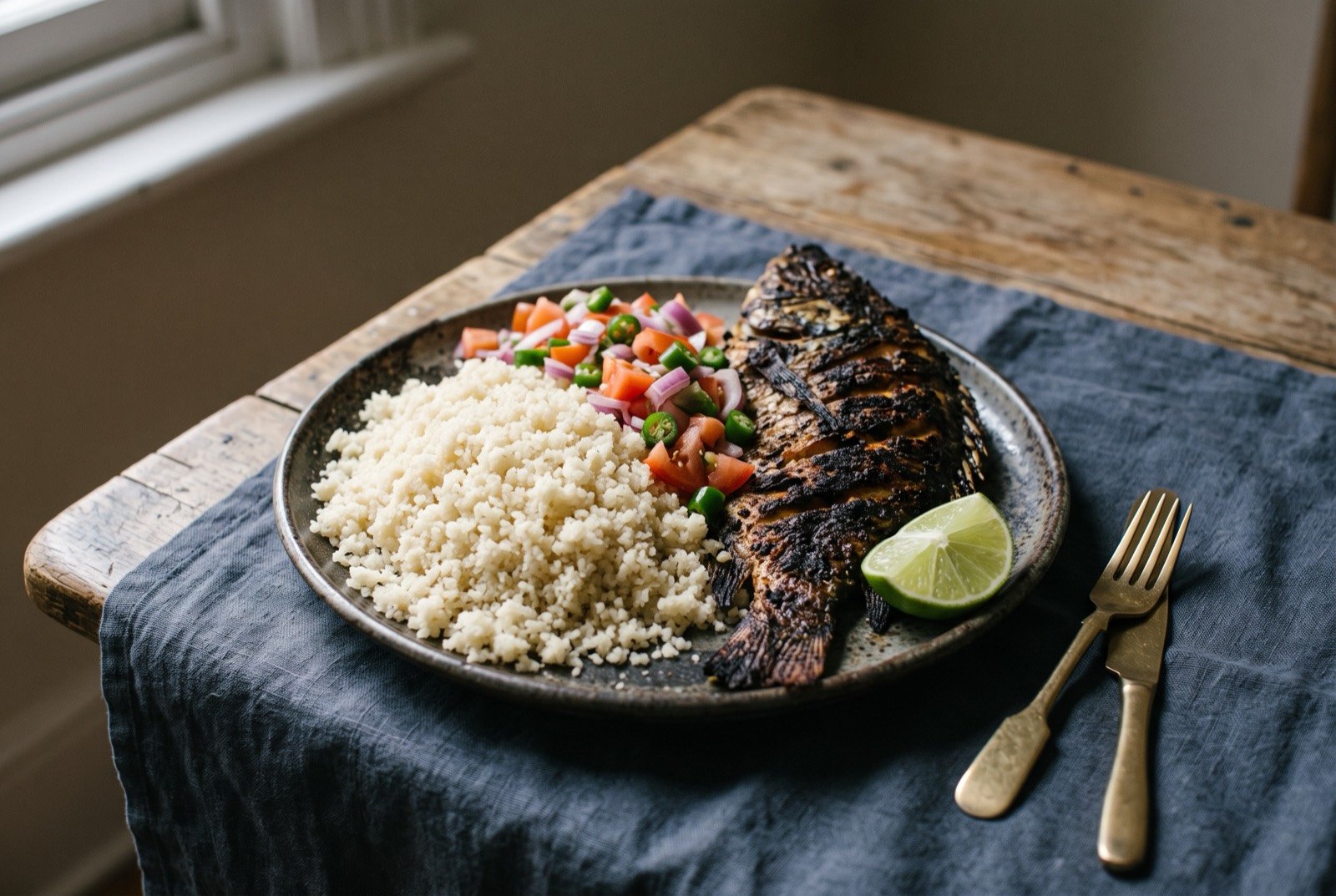
Côte d'Ivoire, Togo and Benin, taken seriously. The traditional canon as it is actually cooked, a technique ladder built from the inside rather than borrowed, and every dish as tradition built it, then what a modern chef would change.
Sources and review · What this chapter does not assert · How we research · Know this better? Tell us
A Sense of Place
Three countries, one lagoon, and a cuisine that is best understood as a set of arguments about what to do with cassava.
Volume Three ended at the Nigerian border and treated the Gulf of Guinea as three ecological bands stacked north to south. That reading holds here, and this volume adds a second axis to it. Côte d'Ivoire, Togo and Benin are not three national cuisines. They are a lagoon system, a forest interior, a partitioned Ewe and Fon coast, and a savanna north, and the most coherent single cuisine in the volume is the one the colonial border cuts in half.
The lagoon belt
A chain of brackish lagoons runs behind the coast from Abidjan eastward. The peoples of that water, Ebrié, Adjoukrou, Alladian, Avikam, Abidji, Ahizi, Attié, Abbey, Aboure, are the people who invented attiéké, and everything about it is a lagoon technology: cassava grated, fermented, pressed dry, granulated by hand, and then steamed. That last step is what separates it from every other cassava product in Africa. Gari is roasted. Fufu is pounded. Placali is boiled. Attiéké is steamed, and steaming is why the grains stay separate and slightly springy rather than collapsing into paste.
The lagoon also supplies the fish, the crab and the snails, and it supplies adjuévan, a fermented fish that does the same job in this cuisine that iru does in Volume Three.
The Akan forest interior
Inland and east, the Baoulé, Agni, Abron and Attié live in the forest that the Akan brought their food grammar into. The Baoulé arrived after an Asante succession dispute around 1750, when Queen Abla Pokou led her followers northwest into what is now central Côte d'Ivoire. Britannica describes the society they built as remarkable for its blending of Akan and local traditions, and the kitchen shows it precisely: kedjenou and placali are Baoulé, and so is the word alloco.
The forest is yam and plantain country, and it is oil palm country. The palm gives four separate products that this volume uses as four separate ingredients: the fruit pulp for sauce graine, the expressed red oil, the sap fermented as bandji, and the sap distilled as koutoukou or sodabi.
The Kru and western forest
West towards Liberia, the Bété, Dida, Guéré, Wobé, Neyo, Yacouba and Toura cook a noticeably different repertoire. This is where sauce djoumblé lives, built on dried okra powder rather than fresh okra, and it is where the rice country around Danané keeps the memory of Oryza glaberrima, the rice that was domesticated in West Africa and not imported into it.
The Ewe, Mina and Fon coast
This is the volume's argument in one stretch of coastline. Southeast Ghana, southern Togo and southern Benin are one cuisine. The Ewe and the Fon both descend from the Adja kingdom of Tado, near the Mono river, and left Notsé in waves. The Fon founded Dahomey in 1625, centred on Abomey, with Ouidah as its port.
Then, after the First World War, Eweland was partitioned. Roughly a third of Togoland including much of Eweland went to the Gold Coast, and the remainder became French Togo. That line runs straight through the middle of the most internally consistent cuisine in this book.
So when you see akoumé in Togo, akple in Ewe Ghana and banku in Accra, you are not looking at three similar dishes in neighbouring countries. You are looking at one dish, and the border is the anomaly, not the resemblance. The same is true of djenkoumé and amiwo across the Ewe and Fon line.
The northern savannas
North of the forest, the Senoufo, Malinké and Lobi in Côte d'Ivoire, the Kabyè, Tem, Bassar and Losso in Togo, and the Bariba, Somba and Peul in Benin cook a savanna repertoire: millet and sorghum, tô and kabato, shea butter rather than palm oil, and the fermented seed condiments that arrived down the Dyula trade routes. Northern Benin is also where the Fulbe make wagashi, which is one of the very few fresh cheeses in West African cooking and is coagulated with the sap of a wild plant.
Abidjan as its own ecology
Abidjan deserves treating as a food region rather than as a capital. The cocoa and coffee economy built it: by 1939, Africans grew 90 per cent of the colony's cocoa and 80 per cent of its coffee, and the labour that grew it came from as far as Upper Volta, which was administratively attached to the colony in 1933.
That city produced three institutions this chapter cares about. The maquis, the open-air grill restaurant. The allocodrome, a whole square of fried plantain vendors. And the garbadrome, the stand where Hausa and Nigerien men sell garba, which is attiéké of a deliberately sour, small grain with hot fried tuna on top. It is the cheapest serious meal in the city and it is one of the great street dishes anywhere.
There is a Lebanese layer too, which is baseline Abidjan infrastructure rather than an exotic addition. Lebanese migration began in the 1920s, later than elsewhere in West Africa, and by the late 1980s estimates ran from 60,000 to 120,000 Lebanese and Syrians. They were among the first to develop hotels and restaurants in the interior. The chawarma counter and the Lebanese-run bakery are now simply part of how the city eats.
The History in Layers
The indigenous foundation
Yam and oil palm are the two poles, and both are indigenous. Yam is the ritual crop, and the yam festival calendar still governs when ceremonial foutou is eaten. The Ivorian lexicon keeps the folk memory plainly: yam historically saved peoples from famine, which is why it has festivals dedicated to it.
Rice belongs here too. Oryza glaberrima was domesticated in West Africa, and the western Ivorian rice country is where that inheritance is most audible.
The Columbian Exchange
Maize was carried by the Portuguese in the sixteenth century, arriving via Cape Verde and São Tomé, where it was called wheat of Portugal. By the late seventeenth century it was established enough that some populations treated it as indigenous, but the language kept the receipt: in Kongo it was mazza manputo, Portuguese grain.
Here is the argument this chapter wants to make about that. Every one of the great Ewe and Fon maize pastes, akassa, akpan, mawè, ablo, lio, amiwo, djenkoumé, is a technology built on a plant that has been here roughly five hundred years. But the techniques applied to it, lactic steeping, wet milling, leaf wrapping, steam cooking, are older than the grain. Maize did not bring its own methods. It arrived and was fitted into a grammar that already existed.
That is why cassava, arriving on the same ships, ended up in the same grammar on the lagoon: fermented, pressed, granulated, steamed. The Americas supplied the plants. West Africa supplied the cooking.
States, migrations and trade
The Akan interior was made by movement. Kong, the Dyula commercial and Islamic centre, was established as a new dynasty under Sekou Ouattara and his sons in the early eighteenth century, and destroyed by Samory Touré in 1897. Bouna was founded in the late seventeenth century by Bounkani, migrating from present-day Ghana. Gyaman, the Abron kingdom founded by Tan Daté, was the most powerful Akan state in the area until Asante conquered it in the 1730s and held it until 1875.
The savanna towns grew around Dyula trading communities, and that is the route by which soumbara, tô, kabato and the whole Islamic north-to-south grain and shea axis reached the forest.
The colonial economy
French coastal presence in Côte d'Ivoire was long confined to slaves and ivory. From the 1830s, Bouët-Willaumez negotiated treaties for forts and posts, and the merchant-explorer Arthur Verdier imported the first coffee plants. The colony was formally claimed in 1893 and its borders finalised in 1898 after Samory's capture.
Both the Ewe and the Fon were heavily involved in the Atlantic trade, as sellers and as victims, and this chapter is not going to soften that. Dahomey was an expansionist slaving state and it was also, later, a conquered one.
Prohibition as a food story
The best documented story in this volume is about alcohol, and it is worth telling properly because it shows how completely colonial economics reached into a kitchen.
Dahomeans learned distillation from French peasants during the First World War, probably while serving or working behind the lines. The alembic, a barrel with copper piping into a collection vessel, produced about 20 litres in three hours. Unlike palm wine, the spirit kept and travelled, which made it tradeable. That spirit is sodabi.
In 1907 Governor Marchal decreed a ban on felling palms. In 1931 sodabi itself was explicitly banned, with fines of 2,000 francs and three to six months in prison.
What drove production was the Depression. Between 1929 and 1933, palm oil prices fell by 91.25 per cent while colonial head taxes stayed fixed. People distilled in order to pay tax. Sodabi also replaced expensive imported European spirits in ceremonies, which meant the ban fell on ritual as much as on commerce, and the record shows repeated arrests of people carrying alcohol to funerals.
By 1943 the British Gold Coast had legalised private palm liquor production, so the identical product was legal on one side of a line drawn in 1919 and a criminal offence on the other. Sodabi was finally legalised in 1975, in the newly renamed Benin.
One colonial claim does not survive checking, and it is instructive. Administrators said distillers were destroying the palm groves. The fine records show the opposite: people sacrificed old palms first and preserved the others where they could, and palm grove area actually increased during the 1930s. The ban was revenue protection dressed as conservation.
The practice of pouring sodabi on the ground for the ancestors before drinking survives.
The modern moment
The current Ivorian restaurant turn has a cause that is more interesting than the usual identity story, and the chefs themselves say so. According to N'Cho Yapi, founder of an association of Ivorian chefs, cooks had previously offered Western dishes with imported products, and rising import costs pushed them back to local ingredients.
That is worth sitting with. The move to cook Ivorian food seriously in Abidjan began as import substitution and became an identity project afterwards, not the other way round.
The Flavour Arsenal
Nine tenths of what makes this food taste like itself is in this section. If you buy nothing else, buy soumbara, akpi and red palm oil.
The fermented condiments, which are the umami spine
This cuisine builds savour from fermented protein rather than from stock cubes, and the difference between a good Ivorian sauce and a flat one is almost always here.
| Name | Where | What it is | Flavour | How to use it |
|---|---|---|---|---|
| Adjuévan | Baoulé, Akan Côte d'Ivoire | Salt-fermented sun-dried fish, 25 to 35 per cent salt | Ammoniacal, sharp, deeply savoury. Closer to Thai pla ra than to anchovy | A thumbnail piece dissolved into the base. The Akan use it in nearly all dishes |
| Lanhouin | Fon and Ewe, Benin and Togo | The same idea, fermented salted fish | Slightly rounder than adjuévan | Goes in early, with the potash |
| Soumbara, also afitin in Benin, iru in Yoruba | North, now national | Fermented néré seeds, Parkia biglobosa | Powerfully funky, sulphurous, meaty. Melts into a broth | 1 teaspoon per pot. This is the single most important one |
| Kplo | Côte d'Ivoire | Cleaned, lightly smoked beef skin, pre-cooked | Gelatinous and smoky. A texture ingredient as much as a flavour | Into sauce graine and the thick sauces |
| Grégré | Côte d'Ivoire | Pre-smoked ray | Dense, smoky, faintly ammoniacal | Foutou and djoumblé sauces |
| Zèkrè | Dida and Bété country | Dried caterpillars | Nutty, mushroomy, protein dense | 100 g for four in djoumblé. Soak cold, rinse, sort, cook 10 minutes |
The forest spice kernels
These are the aromatics that have no European equivalent, and they are what will make your cooking taste Ivorian rather than generically West African.
Akpi (Ricinodendron heudelotii, njangsa) is the important one. The kernel is roasted and then crushed. It tastes oily and nutty with a faint bitterness and a savoury lift, somewhere between hazelnut and mustard seed. A little perfumes a chilli paste. A lot emulsifies into sauce akpi, which reads like a groundnut sauce but sharper and more resinous.
Pèbè (Monodora myristica, calabash nutmeg) is nutmeg with a resinous pine edge. Toast the seed before cracking it, and grate it over a sauce at the end rather than cooking it in.
Kaklou (dika nut, Irvingia gabonensis) thickens and darkens a sauce and brings a rich, slightly mucilaginous, mango-stone bitterness. It is a western Ivorian and Bété speciality.
Kablé is an Akan leaf used to perfume red oil and grain sauces. Three or four leaves maximum, removed before serving. One source describes it as dried turmeric leaf and another simply as an Akan leaf, and I have not resolved that. See the final section.
The greens, and what they are actually for
The crucial distinction in this cuisine is between greens that draw and greens that do not.
| Local name | Botanical | Character | Use |
|---|---|---|---|
| Kplala, adémè, crincrin, ewedu | Corchorus olitorius, jute mallow | Mucilaginous, faintly grassy and bitter | Chopped coarse, cooked in almost no liquid, then beaten for 10 minutes to draw |
| Gboma | Solanum macrocarpon leaves | Bitter, spinach-like but firmer | Base of gboma dessi. Does not draw |
| Brombrou | Amaranthus cruentus | Mild, mineral, earthy | Classic partner for groundnut sauce |
| Dah | Hibiscus sabdariffa leaves | Sour, sorrel-like | The only souring green. Cuts the richness of groundnut sauce |
| Gnagnan | Solanum torvum, small bitter eggplant berries | Sharply bitter | Fresh or dried, with foutou or rice |
| Sira mougou | Baobab leaf powder | Mucilaginous, faintly sour, herbal | Northern, chiefly with tô |
Note that jute mallow is molokheya. The same plant, cooked to the same slippery texture, runs from Cairo to Abidjan. That is not a coincidence and it is not borrowing in either direction.
Chilli, alkali and the rest
The chillies run from bird's eye through bon envoyé to soubaga froto, the Bambara sorcerer's pepper, which is yellow and extremely hot. Makoun flolo is light green and not hot at all, used purely for aroma, which is a distinction British cooks rarely make and should.
Kankankan is the dry spice powder served with choukouya grilled meat. The Nigerien vendors' formula is cola powder, ground chilli, powdered onion, a crumbled stock cube, and sometimes ginger. The cola nut is the part outsiders miss. It brings tannin and a bitterness that stops the whole thing tasting like paprika.
Potash, called akam or kanwa, is the alkali that governs the draw sauces. The traditional Ivorian source is ash of dried green banana peel.
Zomi is the Beninese and Togolese term for red palm oil that has been cooked out and spiced, and treated thereafter as a finished condiment rather than as a raw fat. Hold on to that idea. It is Rung 2.
Kponan is the prized Ivorian yam, slightly sweet, the one used for foutou and for steaming.
Part Two
The Technique Ladder
First, an honest problem
Volume Three could hang its elevations off Ikoyi and Akoko. Two Michelin stars and one, in London, cooking food with a direct line back to the Nigerian and Ghanaian canon, with published dishes and interviews to argue with.
There is no Michelin-starred Ivorian, Togolese or Beninese restaurant anywhere in the world. Not in Abidjan, not in Lomé, not in Cotonou, not in Paris, not in London. That is the position as of the 2026 guides, and it is not a gap in this chapter's research. It is the actual state of the world.
Three separate things exist and it would be dishonest to blur them into one.
One: a real ambitious restaurant scene in Abidjan and Grand-Bassam. Charlie Koffi at Villa Alfira, open since 2017, French-trained, whose signature is gouagouassou, the Ivorian aubergine and tomato sauce, made with rabbit rather than beef and served in an individual cassolette rather than a communal bowl. Hermence Kadio and Matthieu Gasnier at La Maison Palmier. Valérie Rollainth, trained at Institut Paul Bocuse, whose criticism of her own national cuisine is the most technically useful sentence anyone in this volume has said out loud: that Ivorian dishes use too few vegetables and are systematically overcooked. Christelle Vougo at Saakan on the Plateau, open since 2012, who won three awards at the first Abidjan Restaurant Awards in 2017 and cooks a yam and tuna millefeuille. And Roze Traore at La Fourchette de Roze in Grand-Bassam, open since January 2023, who cooked at Eleven Madison Park before returning, and who plates sole with African eggplant, leek purée and crisp skin.
Two: a Beninese-born chef who won a star in France for food that is not Beninese cuisine. Georgiana Viou, born in Cotonou in 1977, self-taught, won a star at Rouge in Nîmes in 2023 and was described as the first Black female chef in France to hold one. She insists her cooking is not fusion but a personal synthesis: Mediterranean and Provençal cooking carrying Beninese memory. She left Rouge in June 2025, and this chapter does not assert what her position is now.
Three: the London West African fine-dining movement, which is overwhelmingly Nigerian and Ghanaian in its reference points. Ikoyi, Akoko and Chishuru are landmarks and none of them is cooking this volume's food.
So the elevations in this chapter are not built by copying a starred kitchen. They are built from technique, and the person who states the principle most clearly is not a starred chef at all.
The argument, from inside
Paule Beke is a Franco-Ivorian chef, French-trained, working in London under the name Douceurs d'Ivoire. Her position, stated in an interview in June 2025, is the whole thesis of this series arriving from inside the tradition without anyone prompting it:
that traditional Ivorian methods, fermentation, sun-drying and salting, are already modernist practices and do not need importing from Copenhagen.
That is the ladder. Every rung below is a traditional Ivorian, Togolese or Beninese technique done deliberately and measured, rather than a French or Nordic technique bolted on.
Rung 1. Treat fermentation acidity as a measured variable, not an accident
Good attiéké has a specification. The CGIAR state of knowledge report gives it: pH 4.3 to 4.8, total acidity 4.2 to 7.5 per cent, moisture 48 to 50 per cent, granules around 1,250 micrometres, with roughly 64 per cent of granules between 0.5 and 2 mm and about 16 per cent floury fraction.
The ferment runs at 8 to 10 per cent inoculum for 12 to 18 hours, and across it the pH falls from about 6.05 to 4.21 while titratable acidity rises from 0.5 to 4.8. The organisms are known: Lactococcus lactis subspecies lactis dominates, with Leuconostoc mesenteroides and Lactobacillus brevis, and yeasts led by Candida krusei and Candida norvegensis.
Here is what a cook does with that. Attiéké at pH 4.3 is already supplying most of the acid a plate needs. That is why garba works with nothing on it but fried tuna, raw onion and chilli, and it is why squeezing lemon over a sauce served with correct attiéké usually pushes the whole plate thin and sour.
The failure runs the other way too. Dry, old, diaspora-grade attiéké that has lost its acidity leaves a flat plate, and cooks then reach for salt and stock cube to fix it. That is the wrong axis. The plate is not short of salt. It is short of acid, and the acid was supposed to be in the grain.
And the same fermentation is the safety mechanism. It drops cyanogenic potential from 8.6 ppm to 0.07 ppm, and free cyanogenic acid from 1.7 ppm to 0.064 ppm. Detoxification, texture and flavour are happening in one process. That is the argument for calling the granule a technology rather than a peasant workaround.
Rung 2. Manage red palm oil as a pigment and a flavour, not as a frying medium
Red palm oil's colour and much of its aroma are carotenoids, and carotenoids are heat-labile. The published figures are stark: 59 per cent beta-carotene loss at 200°C over two hours, against only 15 per cent loss at 150°C over the same two hours. Beta-carotene degrades faster than alpha-carotene, and deep frying degrades both faster than an oven at equal duration.
So every hour a palm oil sauce sits over heat, it travels from orange-red towards brown-grey, and from fruity and floral towards flat and faintly waxy.
This reframes something traditional cooks already do. The endpoint for sauce graine, that a layer of red oil rises to the surface, is a readiness signal, not a doneness signal. It is not telling you to keep boiling. It is telling you to stop.
What a restaurant does with it. Either hit that point and serve immediately, or break the sauce deliberately, skim the coloured oil off, hold the base separately, and re-marry the two at the pass. That is the single biggest visible difference between a restaurant sauce graine and a takeaway one, and it costs nothing but attention.
Add the oil in two stages: a little early for depth, the rest stirred in near service for colour and aroma. This is what the Beninese and Togolese already encode in the word zomi, palm oil cooked out and spiced and treated as a finished condiment rather than as a raw fat.
Rung 3. Build a smoked fish stock instead of adding smoked fish
Smoked fish delivers three things that behave completely differently. Free amino acids and nucleotides, which is glutamate and inosinate multiplying each other exactly as Volume Three's Figure 3 showed. Phenolic smoke compounds, which are aromatic. And fat that is already partly oxidised, which is not.
Dropping a lump of smoked fish into water and boiling it for an hour extracts all three indiscriminately, emulsifies the rancid fat into the sauce, and carries the grit and skin with it. That is why home versions go muddy and slightly bitter.
Extract instead. Steep at controlled temperature, strain, defat, reduce. You pull the umami and the good aromatic phenols and leave behind the coarse, acrid, high molecular weight smoke fractions and the oxidised fat. Then use that stock as the liquid in every sauce in this chapter.
Do that and you will not reach for a stock cube, which is the reflex that flattens this entire cuisine.
One caveat worth stating. Traditionally smoked West African fish carries a documented polycyclic aromatic hydrocarbon load. That is a further argument for controlled extraction, and for buying fish that has been properly dried rather than heavily blackened.
Rung 4. Sealed vessel, no added water: the kedjenou principle
Kedjenou is cooked in a canari, an unglazed clay pot, sealed with leaves or a dough luting, set over low fire or buried in embers, and shaken periodically rather than opened and stirred. No water. No fat.
Three mechanisms stack.
No added water means the finished liquid is entirely rendered out of the bird and the vegetables, so it arrives already concentrated. No reduction step is needed, and no reduction step means no extra time at temperature, which protects everything Rung 2 just said about carotenoids.
The seal keeps the internal atmosphere near saturation, which holds the temperature at or just under 100°C and stops the surface drying and the protein toughening that an open pot produces.
Shaking rather than stirring keeps the pieces structurally intact. A spoon in a soft, long-cooked stew shreds fibre and turns aubergine to pulp, which is precisely the textural failure of the diaspora version.
The pot itself matters. Unglazed clay has low thermal conductivity and high thermal mass, so it heats and cools slowly and evens out an uneven fire.
Translation for a British kitchen. A heavy cast iron casserole, the lid sealed with a flour and water luting paste or a double layer of foil under the lid, at 140 to 150°C, agitated by lifting and swirling the whole pot every fifteen minutes. Never lift the lid.
Rung 5. Alkali and mucilage discipline in the draw sauces
Okra's draw is a water-soluble, highly branched acidic polysaccharide, a rhamnogalacturonan, which forms a shear-thinning, weakly cross-linked network. Jute mallow works the same way.
That network is pH sensitive, and this is the part worth knowing: mild alkalinity strengthens the polysaccharide network and increases viscosity. Acid and prolonged high heat break it down. Potash, called akam or kanwa, is doing structural chemistry, not seasoning.
I am quoting the mechanism rather than the numbers here deliberately. The most recent study reports absolute viscosity values that are internally inconsistent, with the no-additive control reading higher than every additive, so the direction of the effect is trustworthy and the figures are not.
The consequences are practical and they are the opposite of British instinct.
- Acid goes into a draw sauce at the very end, or on the side. Never at the start.
- The greens hit the pot last, not first.
- Cook them briefly. Long cooking is not gentle here, it is destructive.
- Every reheat in a bain marie destroys the exact quality the dish exists for. A gombo sauce held for service is a gombo sauce that no longer draws.
Rung 6. Starch craft, which is three separate skills
Foutou, attiéké and alloco are three different starch problems with three different targets, and treating them as one is why diaspora versions of all three disappoint.
Foutou is an elasticity problem. It is pounded in a large mortar, plantain with yam or plantain with cassava, and the target is very elastic, almost like modelling dough. That elasticity comes from mechanical work developing a continuous gelatinised starch network. A blender shears that network and gives you a sticky, short paste instead. This is why the machine version is worse, and why the answer is either to pound properly or to use a low-shear, high-torque dough action rather than a blade.
Attiéké is the opposite: a separation problem. Maximum granule separation, no clumping, minimum floury fraction. The grading is real and worth learning. Garba grade is a short ferment at around 3 per cent inoculum with no granulating or winnowing step, so it is fibrous, sticky and floury, and that is not a defect, it is what garba is supposed to be. Standard attiéké sits in the middle. Abodjama is calibrated by successive mesh sieving into small, medium or coarse with minimal residual fibre, and it is the best of them.
The consumer criteria recorded in Côte d'Ivoire are worth quoting because they are a complete quality spec in one sentence: conspicuous grains, a characteristic attiéké smell, a salty-sweet taste, a yellow chick colour, and the absence of fibres and grains of sand.
A restaurant sieves rehydrated attiéké to a single grade before steaming. That is the closest a British kitchen gets to abodjama, and it takes four minutes.
Alloco is a caramelisation problem, and it is a completely different theory of flavour from its Ghanaian neighbour. Alloco is very ripe plantain fried in red palm oil and seasoned essentially afterwards and minimally, letting the fruit's own converted sugars and the palm oil carry it. Kelewele takes the same fruit and marinates it first in ginger, chilli, grains of Selim, cloves and salt, so the spice penetrates the flesh.
Alloco flavours the fruit from outside and afterwards. Kelewele flavours it from inside and before. Same plantain, two philosophies about where flavour should live.
Part Three
The Ferment and Preserve Bench
Four things worth making, all of them the traditional methods this cuisine already runs on.
1. Zomi
Not really a ferment, but the foundation of everything else and the thing that separates a good Beninese or Togolese kitchen from a mediocre one.
Warm 250 ml unrefined red palm oil to 140°C, no hotter. Off the heat, add a quartered onion, 4 crushed garlic cloves, a thumb of bruised ginger, 2 bay leaves and a whole scotch bonnet. Leave to infuse until cold, then strain into a jar.
Do not fry in it. Rung 2 again: this is a finishing fat, and the moment you take it past 150°C for any length of time you have thrown away most of what you just made. Keep it dark and cool. It will hold a month.
2. Adjuévan, approximated
The real thing is fish salted at 25 to 35 per cent and sun-dried for weeks, and it is ammoniacal and sharp, closer to Thai pla ra than to anchovy. You are not going to make that in a British kitchen and you should buy it if you can find it.
What you can make is a serviceable stand-in. Bury 200 g of mackerel fillet in 70 g of coarse salt in a non-reactive box, refrigerate 5 days, rinse, and dry in a dehydrator at 40°C for 18 to 24 hours until leathery and translucent. It gives you the salt and the concentration. It does not give you the fermentation, and the ammoniacal top note that is the whole point of adjuévan will be missing. Use it as salt-and-savour, not as a substitute for the flavour.
3. Lacto-fermented brine for acid restoration
Referenced repeatedly in the elevations above, and worth keeping permanently.
Half-fill a jar with cabbage or cucumber, cover with a 3 per cent salt brine, weight it under the liquid, and leave at room temperature 5 to 7 days until it is pleasantly sour and gently fizzing. Strain and keep the liquid.
Why this and not lemon. Attiéké that reaches Britain has almost always lost acidity in transit, and its original acidity was lactic, from Lactococcus lactis and Leuconostoc mesenteroides. Lactic acid tastes round and slightly dairy; citric acid tastes sharp and bright. Restoring lactic acidity with citric acid puts the number back and gets the flavour wrong, and that mismatch is exactly why so much diaspora attiéké tastes subtly off even when it is fresh.
4. Sodabi, which you should buy rather than make
Included because the history is worth knowing and because you will be offered it.
Distilled from oil palm sap. Dahomeans learned the method from French peasants during the First World War, and the still, a barrel with copper piping, made 20 litres in three hours. It was banned in 1931 with fines of 2,000 francs and up to six months in prison, and legalised only in 1975.
Do not distil spirits at home in Britain. It requires a licence from HMRC and it is a criminal offence without one. Buy it.
The practice of pouring a little on the ground for the ancestors before drinking survives, and it is a courtesy worth observing if you are given a glass.
Sourcing in Britain
Verified August 2026. Where a supplier could not be fully confirmed, that is said rather than smoothed over.
The one that decides everything
Attiéké is the ingredient this chapter lives or dies on, and it is the hardest to buy well. Nothing else supplies both the granule and the acidity, and no substitute exists. Couscous is not a substitute. Neither is gari.
- Everfresh Butchers (Milton Keynes, everfreshbutchers.co.uk) is the best-verified source found: frozen attiéké, 1 kg, £3.99, confirmed in stock, nationwide next-day capability. Frozen is better than dried, because it has not lost as much acidity. Lead with this one.
- Adepa Food (26 The Market Square, Edmonton Green, London N9 0TZ, 020 8617 9101) stocks Attiéké Super at £3.50, £7 flat rate delivery.
- Afrobuy lists Tasty Food attiéké 500 g at £1.99, but its stock field read negative at the time of checking, so treat it as available to order rather than in stock.
General African grocers, verified trading
- Niyis (niyis.co.uk, Reading warehouse). The strongest verification in this list. Nationwide, £7.99 standard, next day from £10.99 before 11am, free over £120. Click and collect at Reading.
- Ofoodi UK (ofoodiuk.com). Trading, confirmed August 2026, click and collect by appointment only, no walk-in. Delivery coverage was not stated on the page, so check before you rely on it.
- AYT Foods (aytfoods.com). Trading, 547 product lines, palm oil £3.99 to £10.99. Nationwide delivery unconfirmed.
The ranked list: what decides great from grim
- Attiéké. Granule size and pH 4.3 to 4.8 acidity at once. Nothing substitutes for both.
- Unrefined red palm oil. Colour, aroma and mouthfeel of three central dishes. Most likely of anything here to be rancid or dyed. Buy small, buy dark glass, store cool.
- Smoked and dried fish. The umami spine. Strained, defatted stock versus a lump in water is the difference between depth and mud.
- Fermented locust bean, soumbara, afitin or iru. The Bacillus complexity a stock cube crudely imitates. Its absence is why diaspora cooking tastes one-dimensionally salty.
- Plantain at the correct stage. Three dishes here need three different ripeness stages. One stage for all three guarantees two failures.
- Palm nut concentrate for sauce graine. Decides silky and orange against thin and brown.
- Fresh scotch bonnet. The heat here is aromatic and fruity. Dried and powdered lose exactly the volatile esters that make it Ivorian rather than generically hot.
- Jute mallow. Frozen molokhia from any Middle Eastern grocer is easy to buy in Britain and vastly better than the dried leaf most people default to.
- Fermented maize dough. Unfermented cornmeal gives you the shape of akoumé with none of the sourness that makes it a dish.
- Grains of Selim. The one spice where leaving it out is more honest than substituting.
Quality markers
- Red palm oil should be opaque, deep orange-red, and smell fruity and faintly violet. Brown, dull or smelling of crayon means oxidised. It should be solid or semi-solid at British room temperature, and if it is a clear liquid it has been refined and the carotene is gone.
- Attiéké, per the consumer criteria recorded in Côte d'Ivoire: conspicuous grains, a characteristic smell, a salty-sweet taste, a yellow chick colour, and no fibres or grains of sand.
- Smoked fish should be pale gold to mid brown, dry and firm. Heavily blackened fish is not better smoked, it is worse, and it carries a higher polycyclic aromatic hydrocarbon load.
- Soumbara should smell aggressively of ammonia and cheese when the packet opens. If it smells of nothing, it is old and it will do nothing for you.
Voices and Sources
From inside the tradition
- Paule Beke, Douceurs d'Ivoire, London. Franco-Ivorian, French-trained. The clearest statement anywhere of this series' argument, made from inside the tradition: that Ivorian fermentation, sun-drying and salting are already modernist practices and do not need importing from Copenhagen. Interview published 26 June 2025.
- Sikatio, 5 Brockley Cross, London SE4 2AB. London's most substantial Ivorian restaurant. Poulet braisé over wood, kedjenou de pintade, deep-fried tilapia with alloco and attiéké. The origin story matters as much as the menu: the owners, Beble and Assemian, began by selling frozen sauce gombo and kedjenou out of their grocery shop, Akwaba Market in Deptford. Vittles is explicit that owning the shop was the enabling condition, because it gave them a direct supply chain. That single fact is the structural answer to why most British West African restaurants cannot cook like this.
- Charlie Koffi, Villa Alfira, Abidjan, open since 2017. On why he went back to the dishes of his childhood: it was almost an obligation as a chef. His gouagouassou with rabbit, served in an individual cassolette, is the Abidjan plating argument in one plate.
- Valérie Rollainth, trained at Institut Paul Bocuse. The most useful internal criticism in the volume: that Ivorian cuisine uses too few vegetables and overcooks systematically.
- Christelle Vougo, Saakan, Plateau, Abidjan, open 2012, three awards at the first Abidjan Restaurant Awards in 2017. On her method: she loves African dishes deeply, and that is why she enjoys revisiting them.
- Roze Traore, La Fourchette de Roze, Grand-Bassam, open January 2023. Eleven Madison Park and Soho House before returning. A joint project with his mother.
- N'Cho Yapi, founder of an association of Ivorian chefs, whose account of why the turn happened is the least romantic and most convincing: import costs rose, and chefs who had been cooking Western food with imported products went back to local ingredients.
- Sedjro Ahouansou, Chill N Grill, Cotonou, whose stated aim is to transform familial cuisine into gastronomic cuisine, and whose piron rebuilt as a maki-shaped dessert is a genuinely transferable idea. Valérie Vinakpon, Saveurs du Bénin, Cotonou, chef and cookbook author. Both were profiled in 2021 and their current trading status is unverified.
- Georgiana Viou, born Cotonou 1977, self-taught, author of Le goût de Cotonou: ma cuisine du Bénin (2021). Won a Michelin star at Rouge, Nîmes, in 2023. She left Rouge in June 2025.
- Monique Biarnès, La cuisine ivoirienne (1974), the standard early written reference and the source for the kedjenou parameters used here.
The gap, named
I could not verify a single named Togolese chef working at restaurant level with a documented philosophy and documented technique, in Togo or anywhere in the diaspora. Lomé restaurant listings exist. Chef attribution and technique reporting do not.
That is worth stating rather than hiding, and it makes a real point. Togolese cooking, akoumé, djenkoumé, sauce adémè, gboma dessi, fetri dessi, is arguably the least documented major West African coastal cuisine in world food media. Which is precisely why this volume exists.
Things this chapter has deliberately not asserted
The section that makes the rest of it trustworthy.
- Where the word "garba" comes from. Two mutually exclusive accounts survive checking equally well. One says it is from Garba, a common Nigerien surname, reflecting the Hausa men who sell it. The other says it is from Dicoh Garba, an Ivorian fisheries administrator who in the early 1970s authorised the recovery of tuna offcuts at Abidjan's port for people who could not afford fish, so that déchet de thon Garba became the shorthand. He is quoted as saying he had no idea it would become so big. The dates do not reconcile either: one source dates the dish's rise to around 1990 with zouglou and the Yopougon garbadromes, another to the 1970s and 1980s. This is a genuinely good piece of reporting waiting to be done, and it would be settled by an archive search of 1970s Fraternité Matin, or by the fisheries ministry record, or by an interview with the family.
- What "kedjenou" literally means. Three glosses circulate: kan kan mi, Baoulé for stir inside; kédjé to shake plus nou inside; or simply shake. The French Wikipedia article on the dish gives no etymology at all, which is telling. This chapter says only that the name is generally explained as Baoulé for shaking the pot, which is as far as the sources support.
- What abodjama precisely is. One source calls it the largest-grain, premium, funeral-grade attiéké. Another defines it as high-quality attiéké reserved for household consumption rather than sale. Those can be reconciled as a grade too good to sell, but the "largest grain" claim specifically is unsupported by the second source, and the folk etymology offered for the word is the kind that is usually wrong.
- The three ethnic starter names. Mangnan (Ebrié), lidjrou (Adjoukrou) and bèdèfon (Alladian) come from one source. The UNESCO nomination text does not contain them. Peer-reviewed microbiology does confirm that the Adjoukrou, Ahizi and Ebrié ferments are genuinely distinct and separately named, so the underlying claim is sound; the specific spellings are not confirmed.
- What kablé is. One source says only "an Akan leaf." Another calls it dried turmeric leaf. Those are very different claims with very different flavour implications, and I have not resolved them, so the chapter names it without botany.
- Three botanical identifications. Foué is given in one Ivorian source as Solanum sparsipilum, which is an Andean wild potato and is almost certainly wrong for a West African leaf vegetable. Gnagnan is given as Solanum torvum, but the bitter berry in kedjenou is very often Solanum aethiopicum and the two may be conflated. Akpi is given under the obsolete name Ricinodendron africanus; this chapter uses the accepted R. heudelotii.
- The sodabi origin story. The popular account credits Bonou Kiti Sodabi, a village chief's son, with bringing the first alembic to Dahomey around 1926. The scholarly account notes that his name first appears in a Dahomean newspaper in 1937, not in contemporary archival records, and suggests he may have been chosen later as a local hero, whether real or fictional. This chapter tells the verifiable part, that Dahomeans learned distillation from French peasants during the First World War, and treats the man as a story rather than as history.
- That wagashi's red rind comes from a sorghum-leaf dye bath. Widely repeated, not verifiable from a primary source, so not asserted here.
- That the approximated wagashi in this chapter is wagashi. It is not. Calotropis procera is not available in Britain, and papaya or fig protease gives a cheese of similar behaviour and different flavour. Saying otherwise would make the recipe sound better and the book worse.
- That there is a Michelin-starred restaurant cooking this food. There is not, anywhere in the world, as of the 2026 guides. The elevations in this chapter are built from technique and from the Abidjan and London cooks named above, not from a starred template. That constraint made this a better chapter, not a thinner one, because it forced every elevation to justify itself mechanically rather than by pointing at somebody's tasting menu.
Volume Four of Not Just Stew. Research briefs: vol04-tradition.md and vol04-modernist-sourcing.md. Sourcing verified August 2026.
Treat fermentation acidity as a measured variable, not an accident
Good attiéké has a specification. The CGIAR state of knowledge report gives it: pH 4.3 to 4.8, total acidity 4.2 to 7.5 per cent, moisture 48 to 50 per cent...
Manage red palm oil as a pigment and a flavour, not as a frying medium
Red palm oil's colour and much of its aroma are carotenoids, and carotenoids are heat-labile.
Build a smoked fish stock instead of adding smoked fish
Smoked fish delivers three things that behave completely differently.
Sealed vessel, no added water: the kedjenou principle
Kedjenou is cooked in a canari, an unglazed clay pot, sealed with leaves or a dough luting, set over low fire or buried in embers, and shaken periodically...
Alkali and mucilage discipline in the draw sauces
Okra's draw is a water-soluble, highly branched acidic polysaccharide, a rhamnogalacturonan, which forms a shear-thinning, weakly cross-linked network.
Starch craft, which is three separate skills
Foutou, attiéké and alloco are three different starch problems with three different targets, and treating them as one is why diaspora versions of all three...
The dishes
- Attiéké Côte d'Ivoire, the lagoon peoples
- Kedjenou de poulet Akan and Baoulé
- Sauce graine Côte d'Ivoire
- Placali Baoulé and general Ivorian
- Foutou banane Akan and Kru
- Alloco Côte d'Ivoire
- Garba Abidjan
- Akoumé with sauce adémè Ewe and Gen, Togo
- Djenkoumé Togo
- Amiwo Fon, Benin
- Wagashi Fulbe, northern Benin
Sources and review
- Researched
- Researched from 104 sources in the brief
- Reviewed
- Awaiting a reader from inside the tradition
- Cooked
- Awaiting a cook report
Where this volume comes from
4 research briefs on file for this volume, researched to the rules on How we research. Published 26 August 2026. Last changed 8 September 2026.