West Africa · Volume 04, The Attiéké Coast
Garba
Abidjan
Illustration
- Time
- 15 minutes
- Researched
- Researched from 104 sources in the brief
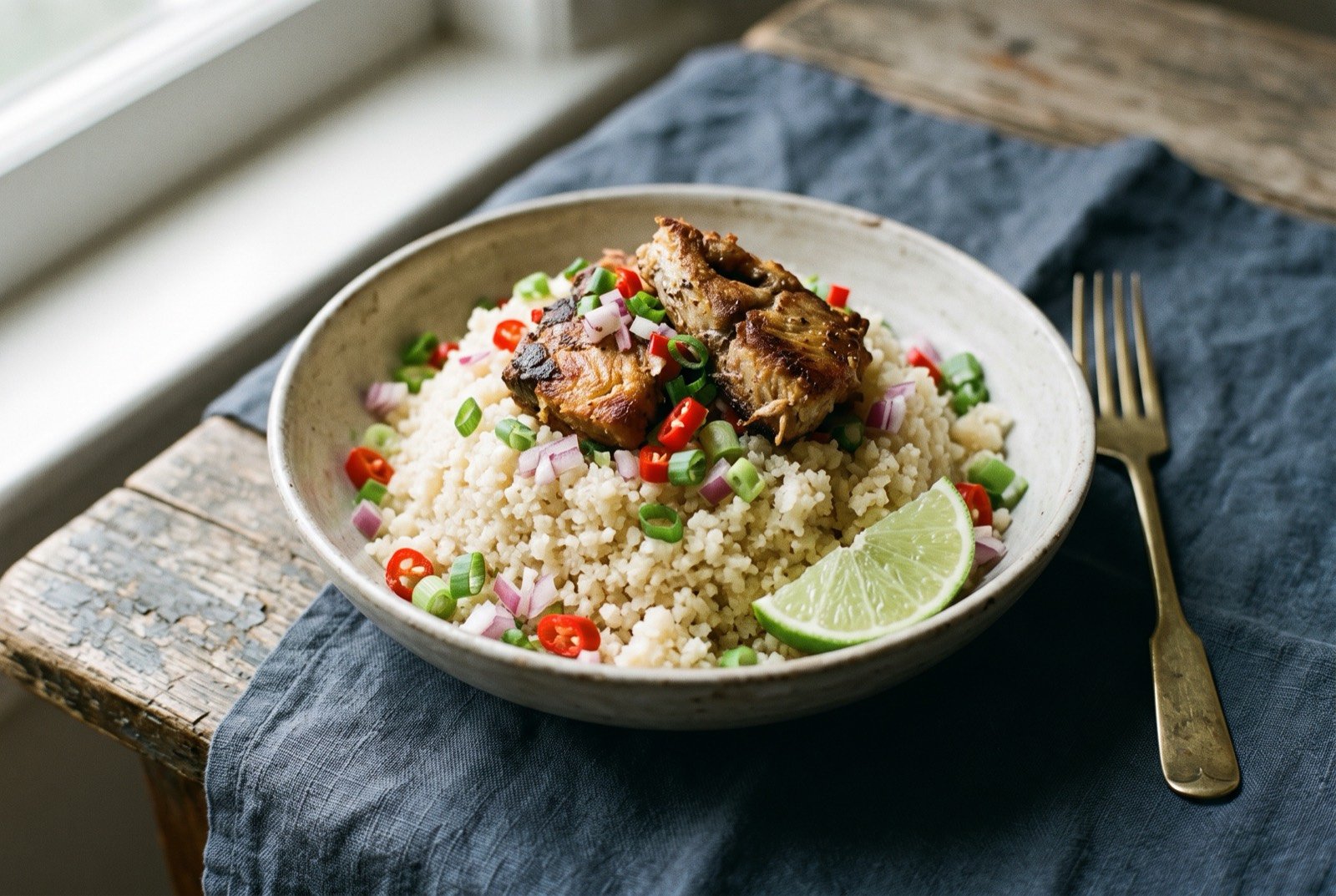
Attiéké of the deliberately sour, small-grain garba type with hot fried tuna on top, raw chilli and onion, sometimes tomato, a crumbled stock cube. Sold from small stands, the garbadromes, mostly by Hausa and Nigerien men. Reported at 400 to 700 XOF at the low end, which is under a pound. It is worth understanding why garba grade attiéké is different rather than worse. It is a short ferment at around 3 per cent inoculum with no granulating or winnowing step, so it stays fibrous, sticky and floury, and it is markedly more sour. That sourness is the whole plate's acid. There is no lemon and there does not need to be. The Abidjan slang for it is extensive, which tells you what the dish means to the city: zéguen, foin, guéro, ganguatte, béton, dur, zeh. Its origins are contested and this chapter does not settle them. See the final section.
As tradition built it
Serves 2. 15 minutes.
Ingredients
- 300 g attiéké, rehydrated as in dish one but not sieved
- 400 g fresh tuna, thick cut
- 2 cm deep neutral oil for frying, 2 cm deep
- 1 onion, chopped raw
- 2 scotch bonnets, chopped raw
- 1 tomato, chopped (optional)
- to taste salt
Method
- Rehydrate and steam the attiéké. Do not sieve it. You want the fibrous, slightly clumping texture.
- Cut the tuna into thick chunks, salt them, and fry hard in hot oil until the outside is properly browned and the inside is just past raw. It should be aggressive, not delicate.
- Pile the attiéké, put the hot fish on top, scatter over the raw onion, scotch bonnets and tomato.
- Eat it with your hands, standing up, while it is too hot.
What a modern chef changes
A better fish, its own oil, and the sourness restored
Rungs 1 and 3
Method
- Keep the format and improve the fish. The temptation is to make this elegant and it must be resisted: garba's roughness is not a deficiency to be corrected. So do not plate it delicately. Do use a better piece of tuna, and take it off at 45°C in the centre.
- Fry it in an oil that has done some work. Warm the neutral oil to 70°C with 30 g dried shrimp and a piece of smoked fish for 30 minutes, strain, then fry in that. Rung 3 in miniature: the coating on the fish now carries umami it did not have.
- Restore the sourness properly. Most attiéké that reaches Britain is not garba grade and is not sour enough. Take 50 ml of the rehydration water, add a tablespoon of lacto-ferment brine, and use that as the wetting liquid. Rung 1: you are rebuilding the specification, not disguising its absence.
- Crumble no stock cube. The street version uses it because it is cheap and it works. You have a smoked fish stock. Reduce 100 ml of it to a syrup and spoon a teaspoon over. Same job, done properly.