West Africa · Volume 04, The Attiéké Coast
Wagashi
Fulbe, northern Benin
Illustration
- Time
- 1 hour 30
- Researched
- Researched from 104 sources in the brief
- Reviewed
- Awaiting a reader from inside the tradition
- Cooked
- Awaiting a cook report
Made almost exclusively by women of the Fulbe minority. Men own the cattle; women own and sell the dairy, and that division is the reason the knowledge exists at all. The Fulbe arrived roughly three centuries ago and practised what one account calls dairy diplomacy, exchanging dairy for grain and goodwill with settled neighbours. The coagulant is not rennet. It is the crushed leaves of Calotropis procera, the sodom apple, a plant protease.
As tradition built it
Makes about 20 small rolls. About 1 hour 30.
Ingredients
- 5 L fresh whole milk
- 10 g leaves of Calotropis procera, crushed
Method
- Heat the milk slowly in a large pan over a low fire.
- Crush the leaves, mix them into a bowlful of the warmed milk, strain that, and return the strained liquid to the pan.
- Hold at a low boil about one hour, until white curds separate cleanly from yellow whey.
- Skim the curds into strainers. Flip them several times as they drain.
- Lay them in the sun about 15 minutes.
Notes
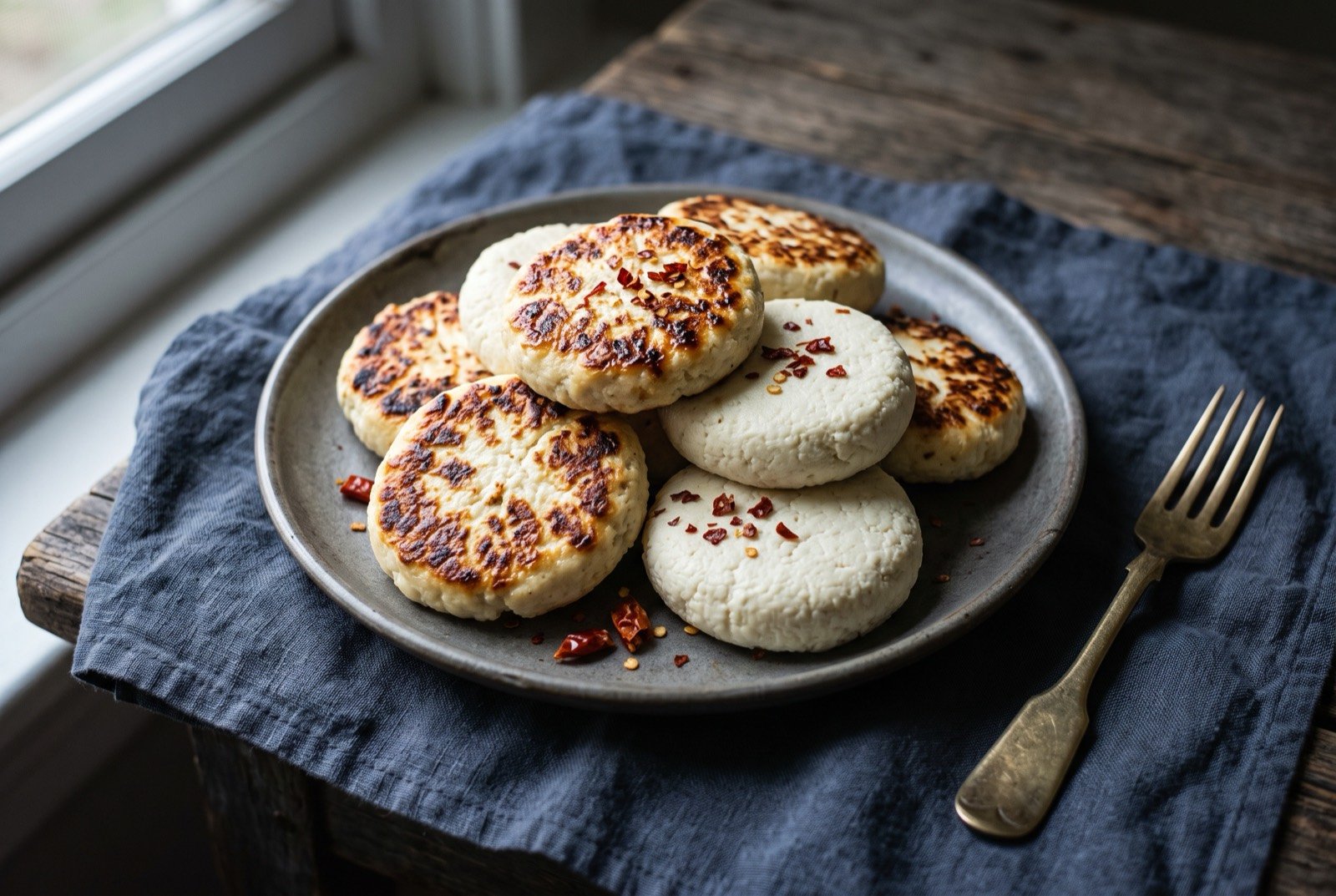
Eaten grilled, or fried so the surface caramelises while the interior stays squeaky and moist, or cooked into a sauce as gboman.
A note on availability and honesty. Calotropis procera is not sold in Britain and this chapter is not going to pretend otherwise. What follows is an approximation that produces a cheese of the right texture and behaviour, and it is not wagashi. The distinction matters and I am not going to blur it to make the recipe sound better than it is.
What a modern chef changes
An honest substitution, and the frying understood
Rung 6
Method
- For the coagulant, use a vegetable rennet or, closer in behaviour, the juice of unripe papaya, which is also a plant protease (papain) and gives a similar slightly grainy, squeaky curd. 2 tbsp of strained green papaya juice per 5 litres, added at 40°C. Fig latex works too. None of these is Calotropis, and the flavour is not the same.
- Press lightly and briefly. Wagashi is not a pressed cheese. Ten minutes under the weight of a plate is enough; longer and you get halloumi's density, which is the wrong texture.
- Understand why it fries the way it does. These plant proteases cut the casein differently from animal rennet, and the curd that results has a high melting point, which is why the cheese browns without collapsing. It is the same physics as halloumi and paneer, arrived at independently in northern Benin with a wild plant.
- Fry, do not grill, if you want the best of it. A shallow pan of neutral oil at 180°C, 90 seconds a side. The surface caramelises hard and the inside stays moist. Finish with kankankan, which is the cola-and-chilli powder from the arsenal section, and a squeeze of lime.
Notes
Part Four