West Africa · Volume 03, The Gulf of Guinea
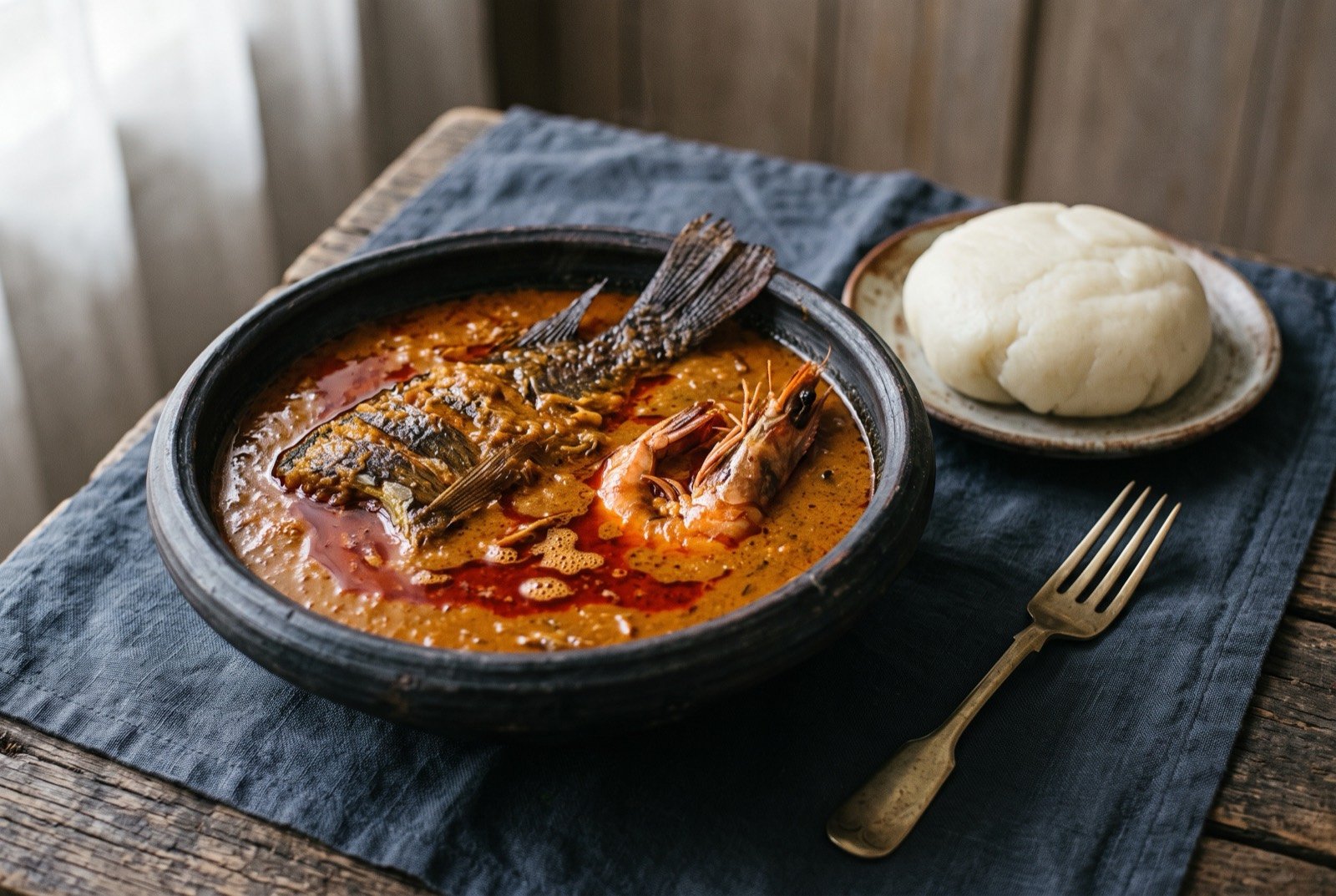
Abenkwan
Akan and Fante, Ghana
Illustration
- Time
- 1 hour 40
- Researched
- 11 sources cited
Three different things come from the oil palm and they are not interchangeable. Red palm oil (zomi, amoa) is pressed from the orange flesh of the fruit. Palm kernel oil comes from the kernel inside the stone and is a different fat entirely, which you do not want. Palm nut cream is the whole boiled and pounded flesh suspended in water. Abenkwan is made from the third one. It is emphatically not soup with palm oil in it.
Traditionally you boil the fresh fruits until soft, pound them in a mortar to strip the pulp from the fibre and the stone, work in hot water, and strain out the solids, leaving an opaque orange-red liquor. In Britain you buy a tin, and there is no shame in it: Esther Ocloo, who founded Nkulenu Industries in the 1940s and later co-founded Women's World Banking, industrialised exactly this so that people far from a palm grove could eat it.
Palm pulp is an oil-in-water emulsion held together by the fruit's own fibre and protein. Long open simmering breaks it, and the red oil rises as a slick. Ghanaian cooks read that slick as the signal the soup is ready, and skim it off to save for other cooking. Ivorian cooks say the same of sauce graine: "a layer of red oil will rise to the surface, this is normal." Never use palm nut cream straight from the tin. Un-simmered, it tastes metallic and raw.
As tradition built it
Abenkwan with goat and smoked fish
Serves 6 · 1 hour 40
Ingredients
- 800g tin palm nut cream (Ghana Fresh or Trofai)
- 1kg goat or oxtail on the bone
- 1 onion, plus 3cm ginger and 3 garlic cloves, blended
- 2 scotch bonnets
- 1 large aubergine, peeled
- 4 garden eggs, halved (or 1 more aubergine)
- 1 prekese pod, lightly roasted
- 2 hwentia (grains of Selim) pods, bruised
- 100g smoked fish, boned
- 2 tbsp ground dried shrimp
- 1.2L water, roughly one and a half tins
Method
- Steam the meat first. Put the goat in a pot with the blended onion, ginger and garlic, a good pinch of salt and just 100ml of water. Lid on, medium heat, 15 minutes, until it has given up its own juices. This liquor is the base of everything.
- Boil the peeled aubergine and one scotch bonnet in a little water until completely soft, then blend smooth. This is the traditional thickener and it matters more than people expect.
- Whisk the tinned palm nut cream into the water until smooth and add it to the meat pot with the blended aubergine, the roasted prekese and the bruised hwentia.
- Simmer uncovered for 45 minutes. Do not rush it and do not cover it. You are waiting for the red oil to break and rise.
- Add the smoked fish, ground shrimp and garden eggs, and cook 20 minutes more.
- Skim the risen oil into a jar and keep it. Fish out the pods. Season. Serve with fufu, omo tuo or plain rice.
What a modern chef changes
Palm nut, langoustine, prekese, skimmed oil back on top
Rungs 02, 06, 07, 10 · Serves 4
Method
- Build a shellfish stock first and use it instead of water. Roast langoustine or prawn heads and shells hard at 220°C until they smell of caramel, then simmer 25 minutes with fennel seed and a bruised uda pod. Strain. You have now stacked shellfish nucleotides against the palm fruit's own glutamate.
- Simmer the palm nut base for a full hour, uncovered, and skim all the risen oil into a jar. Then pass the soup through a chinois. It should be opaque, silken and completely smooth, closer to a bisque than a stew.
- Make the skimmed oil into a finishing oil. Warm it gently with a roasted prekese pod, a strip of orange peel and a pinch of dried scotch bonnet for ten minutes, then stand it for an hour and strain. It is now the most concentrated flavour on the plate and it goes back on at the last second, in droplets, not stirred in.
- Cook the shellfish separately and briefly. Langoustine tails, 90 seconds in the soup off the boil. Never cook them in a soup that has been simmering for an hour.
- Plate. Soup poured at the table. Langoustine in. Droplets of the prekese oil. A spoonful of charred garden egg, blistered on the grill and roughly crushed, for the smoke and the bitterness. Lime zest over. Fufu or a piece of grilled bread on the side.
Notes
Why this works and a fancier version would not: nothing here has been added from outside the tradition. The oil was always skimmed, the prekese was always roasted, the aubergine was always the thickener. All that has changed is that each step is done deliberately and the components are kept apart until the last moment.