France and the Alps · Volume 13, Wine, Mustard and the Fifth Quarter
Quenelle de brochet with sauce Nantua
Lyon and Nantua, Ain
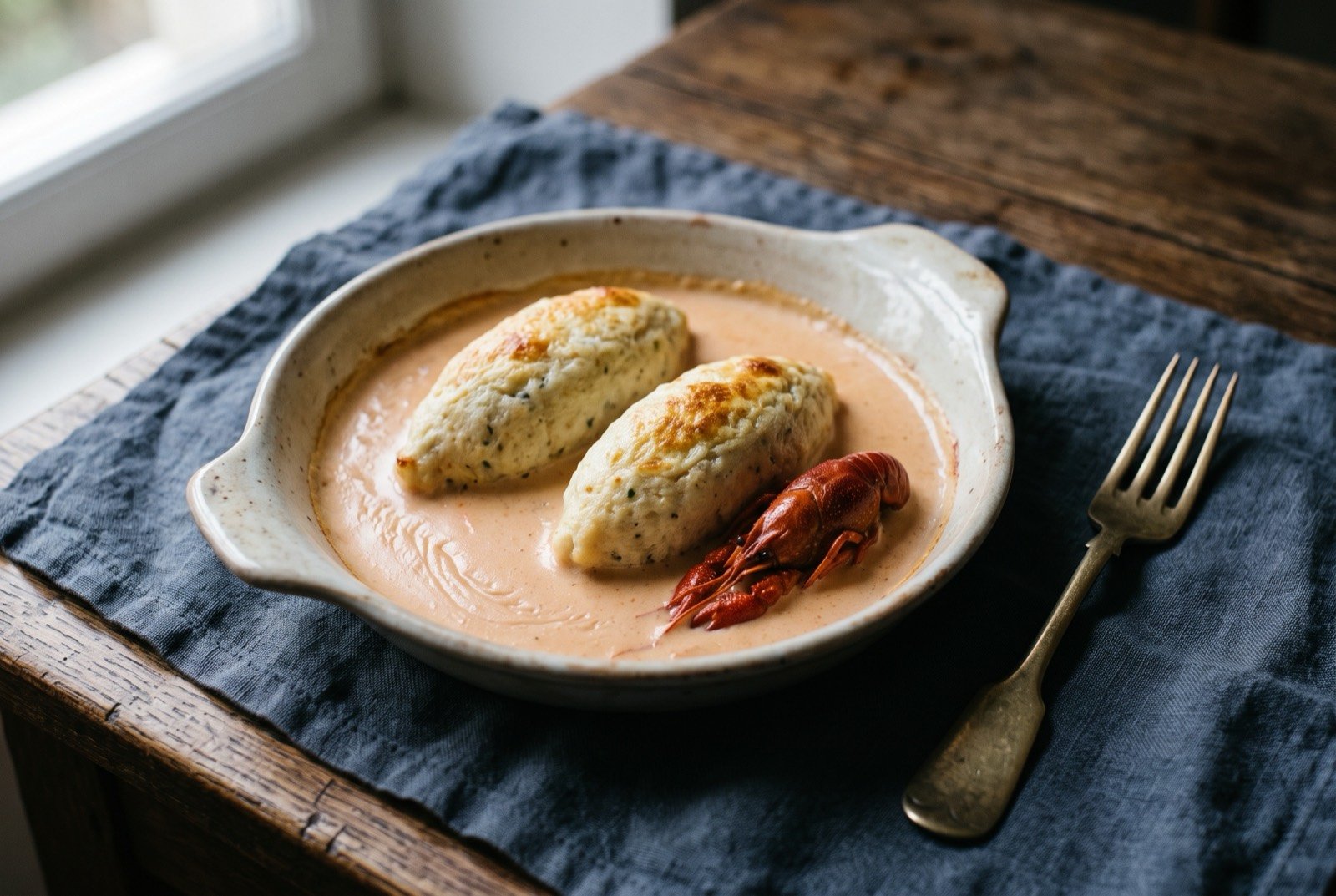
An illustration of the dish, not a photograph of it cooked.
- Time
- Not statedNo source states a time and the atlas has too few comparable dishes to estimate one.
- Researched
- No outside sources linked
- Reviewed
- Not yet reviewed from inside the tradition
- Cooked
- Not yet cooked and reported
Traces, per Félix Benoit's account, to a pastry chef named Charles Morateur around 1830, who bound pike flesh from the Saône with a choux-pastry-style panade; the first written mention of the dish dates to 1890. A genuinely distinct second tradition should not be confused with it: in 1880 at Bourg-en-Bresse, Joseph Moyne revived a different, semolina-based quenelle, the ancestor of today's industrial "quenelle nature", made with durum semolina and butter rather than pike, a real and separate lineage. Sauce Nantua is named for the town of Nantua in the Ain, whose lake historically held abundant red-clawed crayfish; the popular legend crediting the Béchamel family with its invention is treated by French sources as legend, the more grounded account a genuinely local Bugey creation on a béchamel base. The crayfish species question deserves real weight here, not a passing caveat. Astacus astacus is now on France's red list of threatened species; in the 1970s, the introduced American signal crayfish was deliberately released in France hoping it would compensate for the native crayfish's decline, and instead carried the fungus causing crayfish plague, to which the native species has no immunity, decimating it further. None are now found in Lake Nantua itself. Most sauce Nantua made in France today is already made with substituted crustacean, langoustine, farmed crayfish, occasionally lobster, not the named native species, which means a British cook reaching for a substitute is not doing anything the French kitchen has not already done.
As tradition built it
Chill the panade at least 1 hour; poach the quenelles 10 to 12 minutes, then bake 20 to 35 minutes.
Ingredients
For the panade
- 25cl milk
- 50g butter
- 125g plain flour
For the quenelle mixture
- 1kg pike flesh, carefully picked free of its fine, troublesome intramuscular bones
- 20g fleur de sel, approximately
- to taste pepper and nutmeg
- 2 egg whites
- 4 whole eggs, added one at a time
- 100g butter, softened
For the sauce Nantua
- 10 crayfish
- 1 shallot
- 30g butter
- 2 tbsp cognac, to flambé
- 1 tbsp tomato concentrate
- 200g crème fraîche
- 500ml, or to taste a béchamel base
Method
For the panade
- Bring the milk and butter to the boil, tip in the flour off the heat, beat in fast, then dry the paste over very low heat, stirring constantly, until it pulls into a smooth firm ball exactly as for choux pastry.
- Cool, then chill the panade for at least an hour.
For the quenelles
- Process the pike flesh to a fine paste, season with the fleur de sel, pepper and nutmeg.
- Work in the egg whites, followed by the cold panade, then the whole eggs one at a time, then the softened butter, until smooth, emulsified and light.
- Chill again before shaping.
- Shape between two dessertspoons, poach in barely simmering, never boiling, salted water for ten to twelve minutes, watching for the quenelles to visibly puff and rise as a doneness cue.
- Bake in a dish with the sauce Nantua at 180 to 200°C for twenty to thirty five minutes, spaced at least two centimetres apart to allow for further swelling, until the sauce is coloured and the quenelles have puffed further.
For the sauce Nantua
- Sauté the crayfish with shallot in butter, flambé with cognac, add tomato concentrate, then shell.
- Pound the shells with butter to extract beurre d'écrevisses, strain through a chinois.
- Finish with crème fraîche and a béchamel base.
What a modern chef changes
A chilled high-power blender purée, a double-strained beurre d'écrevisses, and signal crayfish
Method
- Purée the pike in a chilled, high-power blender rather than by hand or in a standard processor, working in short pulses rather than one continuous blend, and keeping the bowl and blades genuinely cold throughout, since a high-power blender's extra torque raises the mixture's temperature past the point at which the fat-and-protein emulsion breaks (roughly 4°C is the classical ceiling for forcemeat), turning the texture grainy rather than silky; this is a technique that raises the achievable ceiling and simultaneously raises the risk of ruining the batch through carelessness, and it should be treated with real respect rather than blind enthusiasm.
- Pound the crayfish shells and butter together, again in the high-power blender rather than by hand mortar, for a finer, more thoroughly extracted beurre d'écrevisses, then double-strain through a chinois, once directly and once through a cheesecloth-lined sieve, for the silkiest possible sauce.
- Source signal crayfish rather than a French écrevisse substitute or imported langoustine: it is the same invasive species now displacing native crayfish in French rivers as it did at Nantua itself, and buying it from a British trapper is not a lesser version of the dish, it is the same substitution the French kitchen has already made.
- Finish the gratin under a Big Green Egg run hot with the lid down rather than a domestic grill, for genuinely even, all-round heat and a proper colour across the whole surface of the dish.