France and the Alps · Volume 13, Wine, Mustard and the Fifth Quarter
Boeuf bourguignon
Burgundy
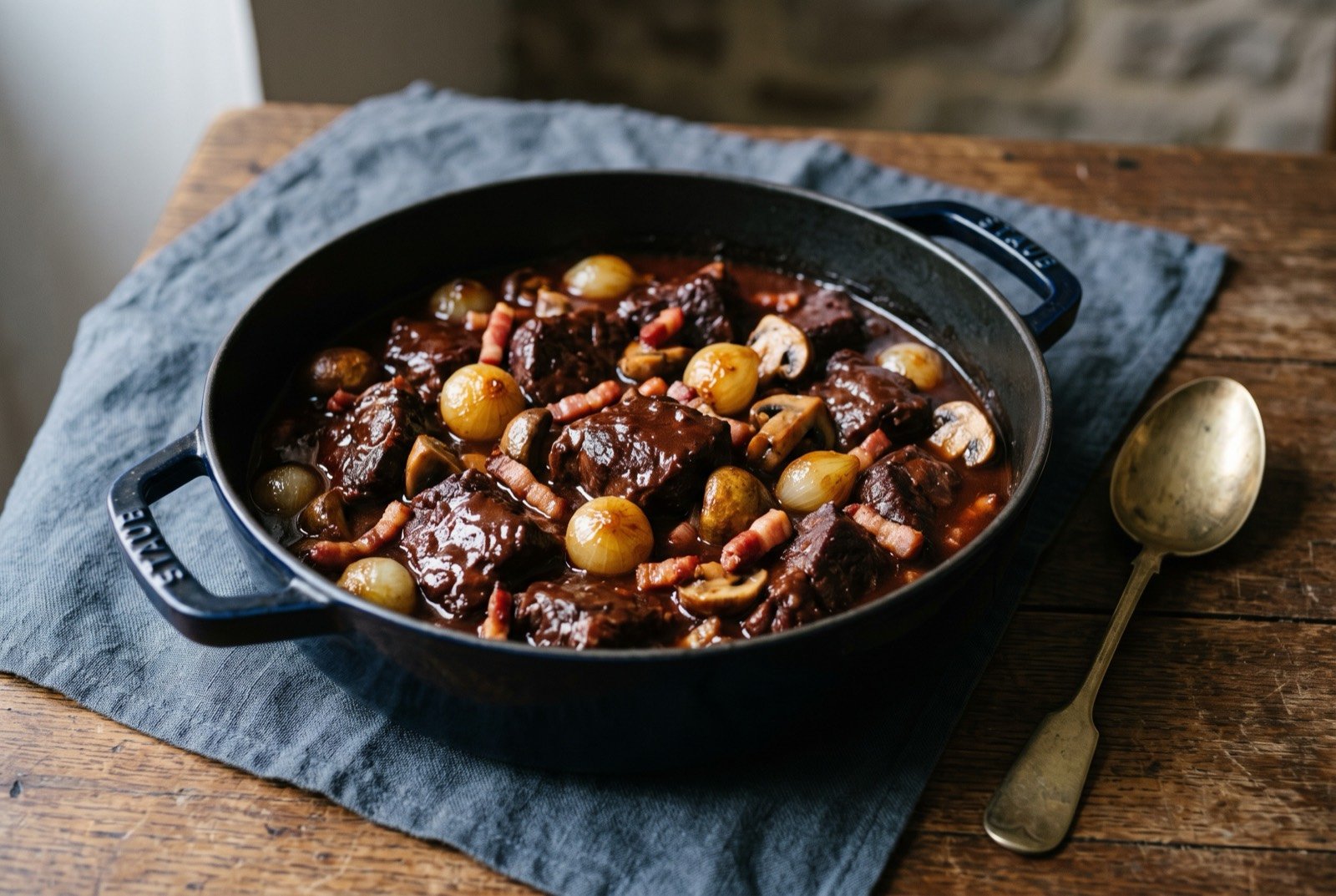
Illustration
- Time
- 3 hours
A dish worth being honest about before cooking it. The term first appears in print in Paris in 1867, in Larousse's dictionary, as an example of "à la bourguignonne" wine-braised cookery generally, not a named dish. It ran through Parisian bistro menus in the 1880s and was codified by the Paris-based Auguste Escoffier in 1903, who fixed lardons and button mushrooms as standard garnish. The name did not reach Burgundy itself until 1905, on a Dijon railway buffet menu, stayed absent from lists of regional specialities between 1912 and 1927, and was still described as late as 1936 as "much more made in Paris" than in Burgundy. This lines up with Gaston Gérard, Dijon's mayor through the 1920s and France's first Under-Secretary of State for Tourism, who ran an explicit regional-gastronomy branding campaign from 1921. Boeuf bourguignon is, in other words, a nineteenth-century Parisian dish that Burgundy adopted and rebranded as its own during an interwar tourism drive, not an ancient peasant recipe carried down from the ducal court. That does not make it a lesser dish. It makes it an honest one, once you stop pretending otherwise.
As tradition built it
In the oven at a gentle heat, 2.5 to 3 hours in total.
Ingredients
- 2kg paleron (chuck), cut into roughly 70g pieces, three to four centimetres across
- 200g lardons, cut from demi-sel pork belly
- as available flour, for dusting
- 1 litre genuine, drinkable Côte-de-Nuits or Mercurey-style red Burgundy
- to cover stock, to top up
- 200g pearl onions, glazed à brun (see the technique ladder)
- 200g button mushrooms, quartered and sautéed
- to taste a knob of cold butter, to finish
Method
- Blanch the lardons in cold-started water: bring to the boil, boil one minute, drain and rinse. This removes much of the curing salt and lets them brown properly rather than merely release fat.
- Render the lardons in a heavy cocotte, then remove and reserve.
- Sear the beef in batches, small enough that the pan floor stays mostly visible around each piece, since a crowded pan steams the meat in its own moisture instead of browning it, and there is no fond, and therefore no base flavour, without a proper sear.
- Return the lardons, dust lightly with flour, toss to coat and cook two to three minutes over low heat so the flour itself lightly toasts.
- Deglaze in stages with the red Burgundy, scraping the pan to lift the fond, and reduce properly before topping up with stock.
- Cover and braise in a 200°C oven for two and a half to three hours, at a bare simmer rather than a hard boil, since a rolling boil toughens the meat rather than tenderising it.
- Separately, glaze the pearl onions à brun and quarter and sauté the mushrooms; fold both in only in the final minutes, never from the start.
- Finish by blending a small amount of the cooked vegetables back into the sauce to thicken it, in place of a flour-based roux, following Bernard Loiseau's own method, or mount the sauce with a knob of cold butter off the heat for gloss.
What a modern chef changes
Big Green Egg sear, sous vide braise, chinois-strained sauce and a porcini dust
Method
- Sear on a Big Green Egg run hot and dry, direct, with the meat genuinely spaced out on the grate rather than crowded on a raised rack, giving at least as deep a crust as a domestic hob and real smoke character from the coals.
- Braise sous vide at 68°C for sixteen to eighteen hours, a genuine middle path between a traditional falling-apart texture and a refined, sliceable one; because a sous vide bag will not reduce, the wine and stock must be pre-reduced on the hob before bagging, a real departure from tradition that has to be built in deliberately rather than assumed. State plainly to anyone eating it that this produces a different, not simply better, dish from the classic spoon-tender version, and that the traditional overnight wine marinade some cooks swear by has no settled evidence behind it either way, French technique sources genuinely disagree on whether it does anything beyond surface flavour.
- Finish the sauce through a chinois for a properly silky, grit-free consistency before mounting with butter.
- Dust with dehydrated porcini or dried shallot powder, made in the dehydrator, stirred through at the end for a concentrated umami note in place of the cream some modern versions reach for, a legitimate depth-building trick rather than a substitute for the reduction itself.