France and the Alps · Volume 13, Wine, Mustard and the Fifth Quarter
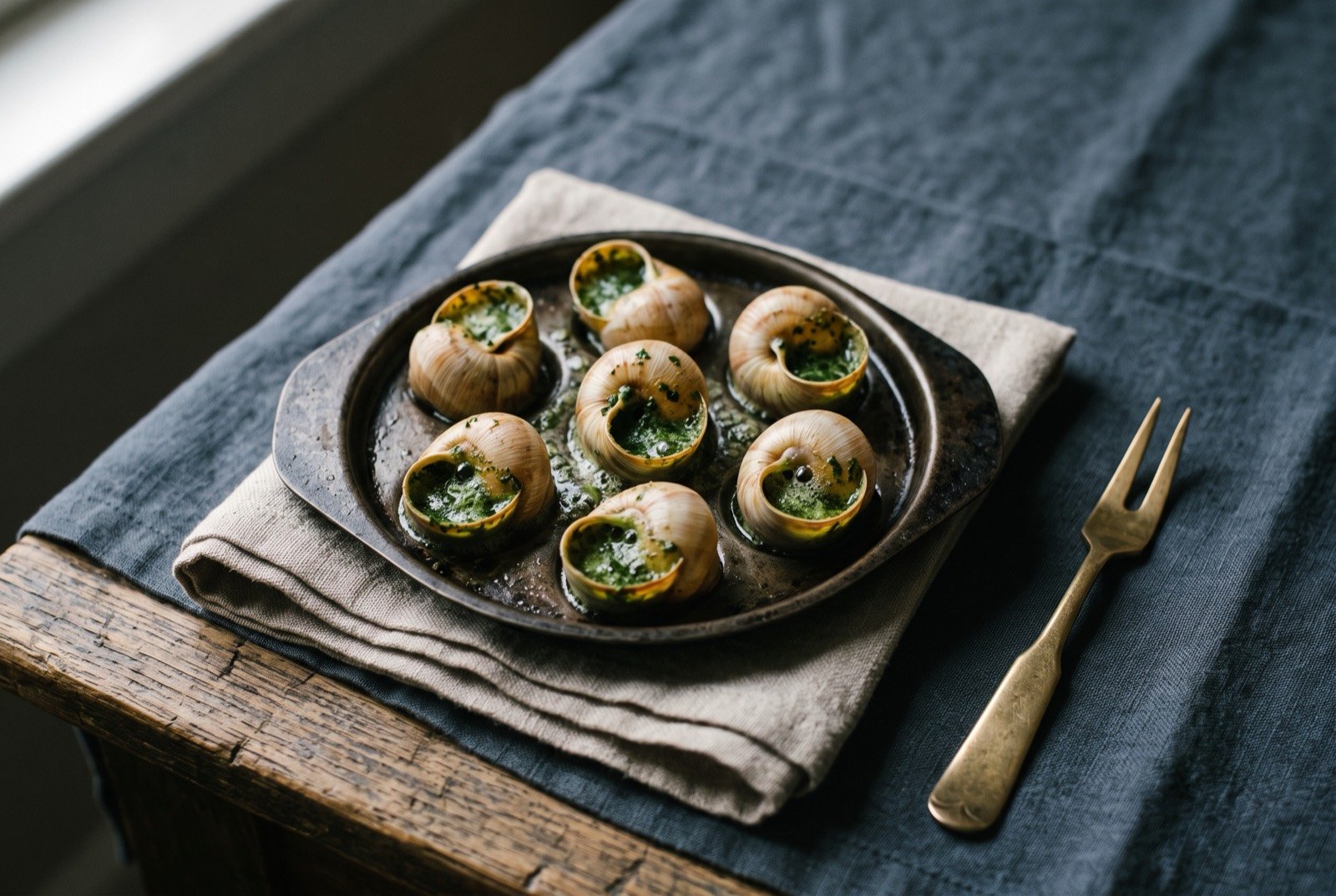
Escargots de Bourgogne
Burgundy
Illustration
The dish with the sharpest real controversy in the whole chapter, and it deserves saying plainly rather than smoothing over. "Escargots de Bourgogne" is not a protected geographical name. It legally describes only the recipe and species convention, garlic-parsley butter served on Helix pomatia, the true Burgundy snail, not where the snail was actually raised or gathered. That snail has been protected in France since 1979 or 1980 (sources give both years) and takes three to five years to reach maturity, which makes it essentially uncommercial to farm at scale; French heliciculturists largely switched decades ago to the faster-maturing gros gris, or simply stopped competing with imports. France now consumes roughly sixteen thousand tonnes of snails a year, and estimates of the imported share run from over ninety to ninety five per cent, chiefly from Poland, Hungary, Romania, Ukraine and Bulgaria, cooked and packaged in France and legally entitled to carry "Produit de France" labelling, which the French consumer group Foodwatch has specifically criticised: the term names the species, not the origin. This matters directly for a British cook, because the most widely available tinned brand in the UK, discussed under sourcing below, sells not Helix pomatia but Helix lucorum, the Turkish land snail. The dish and the preparation are entirely authentic. The species, for almost everyone who cooks this at home, usually is not, and this chapter would rather say so than let the label do the lying for it.
As tradition built it
Purge snails a minimum of 48 hours; bake at 160°C for 8 to 10 minutes.
Ingredients
The method as the tradition gives it, with the ingredients named. Quantities follow as we verify them, lead dishes first.
- live or farmed snails, purged a minimum of forty eight hours (wild-gathered snails need far longer, commonly cited at eight to ten days, sometimes longer still in older tradition)
- 1000g butter, softened
- 150g garlic, finely minced
- 35g shallot, finely minced
- 90g parsley, washed and thoroughly dried, then finely minced
- 25g salt
- 5g pepper
- 1 tbsp a spoon of dry white wine, optional, for a real acidic counter-note
Method
- Purge live or farmed snails for a minimum of forty eight hours to clear the digestive tract; wild-gathered snails need far longer, commonly eight to ten days.
- Work the softened butter to creamy with a fork, then beat in the garlic, shallot, parsley, salt and pepper. A spoon of dry white wine adds a real acidic counter-note some kitchens use; one genuinely old-tradition variant uses garlic alone, no parsley or shallot at all, a small but real complication of the standard story worth knowing even if this recipe follows the fuller modern version.
- Shell the snails, half-fill each shell with the parsley butter, replace the snail, then fill over the top, pressing gently with a small spoon.
- Bake at 160°C for eight to ten minutes, no hotter, specifically so the parsley does not scorch and turn bitter.
What a modern chef changes
An honest tin, a chilled blender pulse, dehydrated parsley and a mustard-sharpened liquor
Method
- Source with eyes open: the honest recommendation is a well-handled tin, warmed gently rather than overheated (the standard failure mode with tinned snails, since they arrive already cooked and only need bringing up to temperature, not cooking again from cold), paired with a British-farmed Helix aspersa where a fresher product is wanted, rather than chasing a Helix pomatia that is almost never genuinely what it claims to be.
- Replace hand-mincing the garlic and parsley with a brief, cold pulse in a high-power blender, chilled beforehand, to keep the butter from softening and splitting under blade friction, giving a finer, more even distribution of aromatics through the butter than most hand-chopped versions achieve.
- Dehydrate a portion of the parsley to a fine powder and dust it over the finished, baked snails at the table, a way of getting a concentrated, slightly toasted parsley note on top of the fresh green one already inside the butter, genuinely additive rather than a garnish for its own sake.
- Finish the plate with a spoon of the reduced snail-cooking liquor, sharpened with a touch of Fallot mustard worked in off the heat, so the mustard's volatile heat survives rather than cooking away.