France and the Alps · Volume 13, Wine, Mustard and the Fifth Quarter
Jambon persillé de Bourgogne
Côte-d'Or, Burgundy
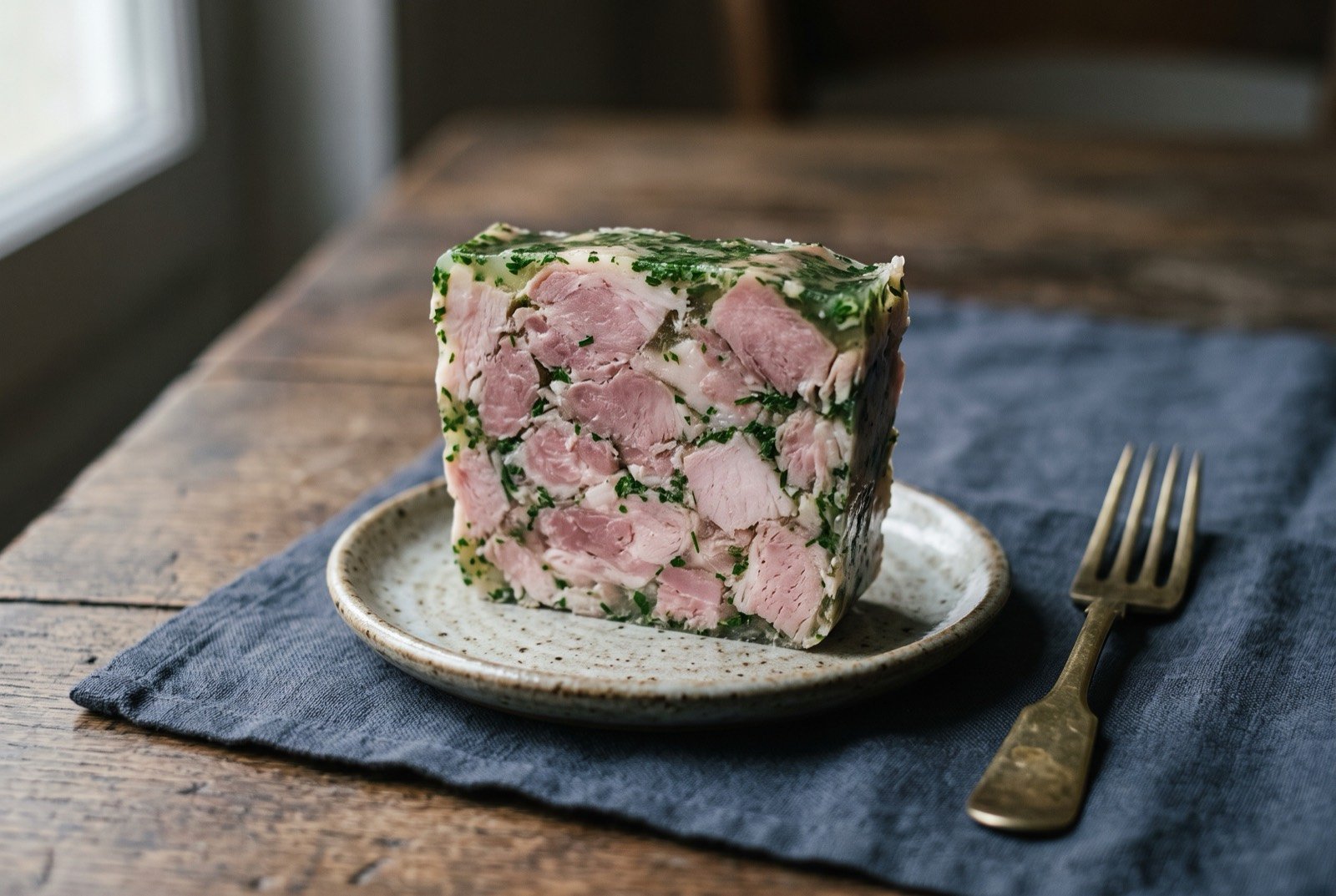
Illustration
Traditional narrative places its origin in the fourteenth century, in Côte-d'Or, prepared for Easter using ham that had been kept salted through the winter, a plausible medieval preservation-driven origin, though this rests mainly on tourism retellings rather than an academic source. Production has grown from roughly 150 tonnes in 1988 to around 2,500 tonnes today, and it was recognised as an IGP by the national INAO committee in June 2026, meaning protection is essentially brand new.
As tradition built it
Rest the terrine 24 to 48 hours before slicing.
Ingredients
- 2.5kg shin or knuckle of ham
- 2 pig's or veal's trotters, for natural gelatine
- 2 carrots, 1 leek, 1 onion, and a bouquet garni carrots, leeks, onions and a bouquet garni
- 500ml white wine (Aligoté is the wine specifically named by the official producers' association)
- to cover water, to top up
- 2 large bunches a generous handful of parsley, chopped
- 4 cloves garlic, chopped
Method
- Cook the ham and trotters together with the carrots, leeks, onions and bouquet garni in a large pot, topped with the white wine and water, at a bare simmer for roughly three hours.
- Strain the broth, stir through the chopped parsley and garlic while it is still warm.
- Tear the cooked meat by hand into strips, never cut with a knife, and set it into a terrine with the parsley-flecked jelly poured over.
- Rest the terrine in a cold larder or fridge for twenty four to forty eight hours before slicing.
- Serve cold, in thick slices that show the jelly and meat in separate, distinct layers, with a young Chablis alongside, its tension and minerality cutting through the richness rather than being dominated by it.
What a modern chef changes
A sous vide stock, twice-clarified through the chinois, and a properly weighted press
Method
- Cook the ham and trotters sous vide at a gentle 80°C for twelve hours in a bag with the aromatics, extracting a cleaner, less cloudy stock than an open-pot simmer typically achieves, then reduce that stock hard on the hob afterwards to concentrate the gelatine, since a sous vide bag will not reduce anything on its own.
- Strain the reduced stock through a chinois twice for total clarity before setting the terrine, giving a jelly that reads as genuinely translucent rather than merely clear.
- Blitz the parsley to a very fine, almost powdered green in a high-power blender rather than hand-chopping it, distributing it more evenly through the jelly for a marbled rather than speckled finish.
- Press the terrine under a proper weight overnight rather than simply chilling it loose, giving cleaner, denser slices that hold their shape at the table.