Europe · Volume 13
Burgundy, Lyon and the Rhône
Wine, Mustard and the Fifth Quarter
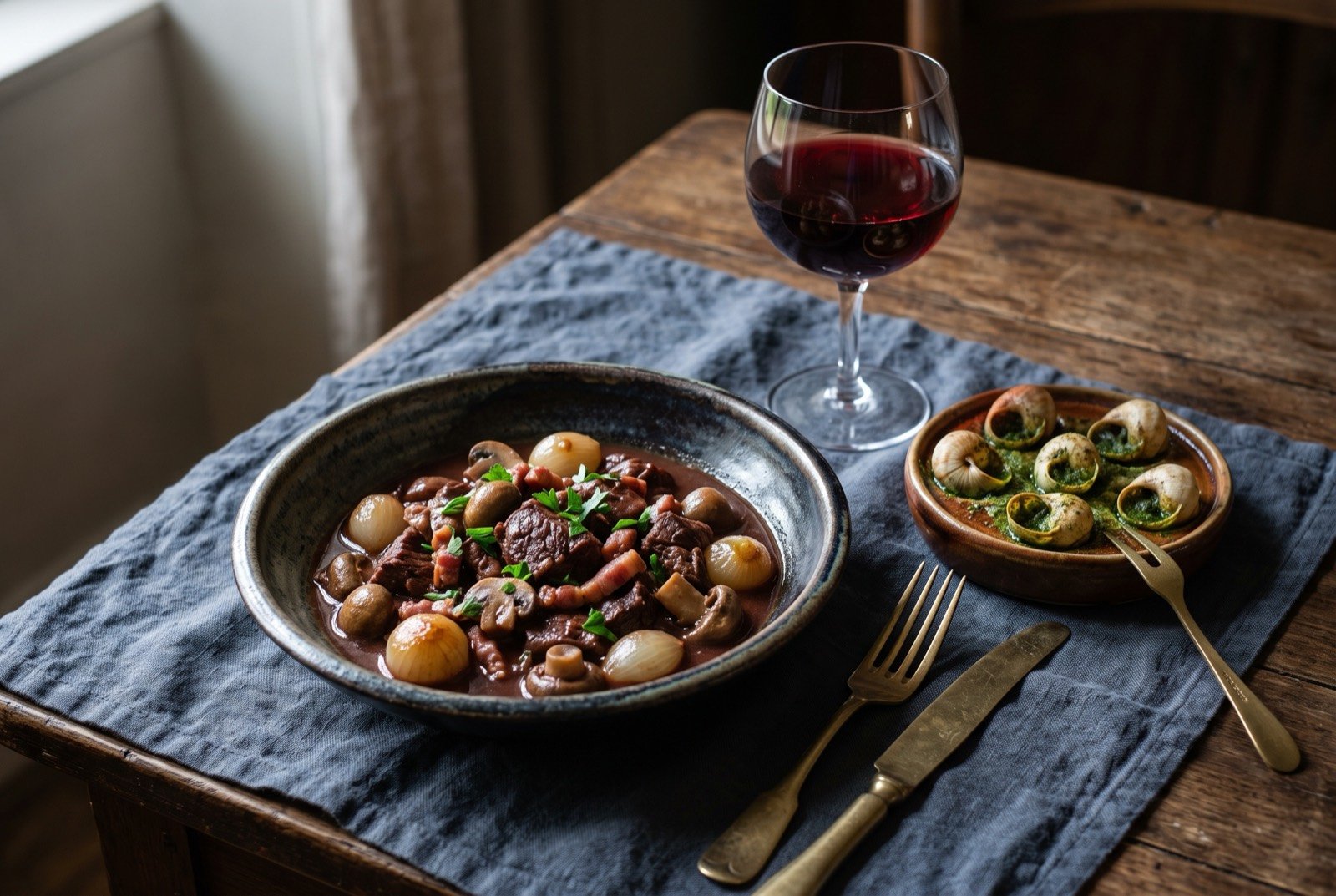
Burgundy's wine country and Lyon's bouchon tables, taken as one continuous world of cattle, vines and offal, cooked long and finished with wine: a parcel-by-parcel obsession with provenance, and a fifth-quarter economy that fed silk workers in Lyon the way it fed slaughterhouse workers in Rome. Every dish as tradition built it, then what a modern chef would change.
Sources and review · What this chapter does not assert · How we research · Spotted something wrong?
A Sense of Place
Burgundy's food thinking is organised, almost obsessively, around the same logic as its wine: a small patch of ground matters more than the region it sits in. The vineyard runs along the Côte d'Or escarpment and its outliers, Chablis to the north in the Yonne, the Mâconnais and Chalonnais to the south, a narrow limestone and marl band, while the flatter, wetter land to the west, the Charolais, the Nivernais, the Morvan's granite uplands, is cattle and forest country. Burgundian wine is classified on four tiers, from the base up: régionale, village, Premier Cru, roughly 640 plots, and Grand Cru, only 33, nearly all on the Côte de Nuits and Côte de Beaune. The underlying unit is the climat, a single, named, historically bounded parcel, 1,247 of them across the Côte d'Or, each defined by its own orientation and soil composition. This is a hillside sliced thin enough to argue over, and it is the same mentality that later gets applied to food: a single-village ham, a single-commune mustard, an insistence that provenance argued down to the parcel or the producer is the thing worth arguing about at all.
Charolais cattle's heartland is the triangle of Semur-en-Brionnais, Charolles and Paray-le-Monial in southern Burgundy, with selective breeding for muscle and meat quality from the eighteenth century and formal herd-book organisation from 1864. Bœuf de Charolles carries AOC since 2010 and AOP since 2014, its cahier des charges requiring animals born, raised, fattened and slaughtered within the defined area, grazing at least two hundred days a year, no more than five finished animals per hectare of meadow, winter feed grown entirely within the zone. Usefully for this volume's own argument, the wider Charolais breed's territory actually spans parts of Saône-et-Loire, Loire, Rhône and Nièvre, sitting on both the Burgundy and Rhône-Alpes sides of what follows, a small confirming data point that this is one culinary region rather than two bordered ones.
Burgundy sits in France's butter belt, not its olive-oil belt, that starts further south, in the Rhône and Provence. Braises finish with butter, whisked in cold off the heat to emulsify and gloss a sauce without flour, and use lard and lardons as the base browning fat; the aromatic base is the standard French mirepoix and bouquet garni, the one regional inflection being that the braising liquid itself is the region's own red wine rather than stock or beer. Dijon was the administrative, judicial and financial capital of the medieval Duchy of Burgundy, which at its height ran north to the present-day Netherlands, and its mustard trade is attested from the thirteenth century, formalised with the first guild statute for vinegar-makers-cum-mustard-makers in 1634.
Lyon sits at the confluence of the Rhône and the Saône, a position that made it capital of Roman Gaul and, much later, one of the most important commercial cities in Europe. Under Louis XI, Lyon was granted four annual trade fairs in 1463, drawing merchant bankers from Italy, branches of the Medici, Gondi and Capponi families among them, and making the city a springboard into the Renaissance economy. Silk became the dominant driver of the city's wealth in the nineteenth century, growing Lyon's economy at roughly four per cent a year against a French national average of about one and a half, the value of silk exports rising from sixty million francs in 1832 to four hundred and fifty four million by 1860. The link between that money and Lyon's eating culture is real but indirect, and worth stating carefully rather than romantically: silk wealth created a bourgeois merchant class large enough to employ private household cooks, and those cooks, trained over years in wealthy Lyonnais kitchens, later opened their own establishments, which became the ancestors of the bouchon. The wealth did not go directly into restaurants. It went into households, and it is the household cooks who carried that cuisine out into public over several decades, not in one crisis-driven wave, a point this chapter returns to below.
A bouchon lyonnais is a small, traditionally family-run restaurant serving Lyonnais home cooking: checked tablecloths, close-set tables, saucissons hanging as decoration, pork and offal heavy dishes, local wine served in the pot lyonnais, a heavy-bottomed forty six centilitre bottle. The word is generally explained as deriving from the old French bousche, a bundle of branches innkeepers hung outside to signal their premises, rather than from bouchon meaning cork. The offal-forward logic of the whole city follows directly from Lyon's historic status as a major meat-trading and slaughtering city: its central municipal slaughterhouses were, before relocation to Perrache from 1836, among the most important in France, and the abats trade, the fifth quarter left over once a carcass's four noble cuts were sold, has been a defined trade since the thirteenth century, surviving today chiefly in Paris and Lyon. Read end to end, this volume's grammar runs from the vineyard's obsessive parcel-by-parcel logic through Charolais beef and butter-and-lard braising in Burgundy, into Lyon's silk-built bourgeois household kitchens and the offal economy of a meat-trading river city. It is one continuous world, cattle, vines and the fifth quarter, cooked long and finished with wine, whichever side of the old departmental line you happen to be standing on.
The History in Layers
Monks, dukes and a mustard controversy
Two Benedictine-descended monastic orders shaped the Côte d'Or in direct rivalry. Cluny, founded 910, built a wealthy, centralised, treasure-accumulating monastic economy. Cîteaux, founded 1098 some fifteen kilometres south of Dijon by Robert de Molesme specifically as a reaction against Cluniac opulence, built its economy on poverty, manual labour and self-sufficiency, and it is the Cistercians, not the Cluniacs, credited with the real technical work on the vineyard: identifying and codifying pinot noir and chardonnay as the region's two defining grapes, walling and naming individual parcels, meticulously recording the results of different plots and methods. The Cistercians built the Château du Clos de Vougeot in the twelfth century as a wine cellar and grange, which remains the physical symbol of the system they built.
Under Philippe le Bon, duke from 1419 to 1467, the Burgundian court reached the peak of its wealth and ceremonial display in medieval Europe, most famously at the Banquet du Faisan at Lille in 1454 and at the multi-day festivities for his marriage to Isabella of Portugal at Bruges in 1430, both used as instruments of political theatre as much as hospitality. A specifically food-focused academic study exists of what the ducal court actually ate, drawn from its account books, but only the seminar abstract was reachable for this chapter, not the full text, so what follows leans more on how the dukes performed wealth than on what filled their kitchens day to day.
The mustard trade's real history is more interesting, and more contested, than the tourist version. The received story, that a Naigeon family of Dijon gave Dijon mustard its "lettres de noblesse" in the eighteenth century by substituting verjus for vinegar, with a specific attribution to a Jean Naigeon in 1747 or 1752, appears repeatedly across French recipe-history and tourism sites but does not appear at all in French Wikipedia's own, more cautious article, which gives a vaguer thirteenth-century origin and no Naigeon family. Treat the Naigeon date as a widely repeated but under-sourced folk-history detail rather than settled fact. What is solid is the guild of vinegar-and-mustard-makers, documented from 1634.
The seed-sourcing question is real, current, and exactly the kind of thing this project exists to check rather than gloss over. "Moutarde de Dijon" carries no geographical protection at all: a 1937 decree fixed it as a generic method and recipe designation, meaning it can legally be made anywhere, with seed grown anywhere. "Moutarde de Bourgogne", by contrast, has held an IGP since 24 November 2009, and its cahier des charges requires seed actually grown, harvested, stocked and ground within Burgundy, blended with a Burgundy or Beaujolais AOC white wine. Mustard cultivation largely disappeared from Burgundy after the Second World War, and estimates of how much of Dijon mustard's seed is now imported, chiefly from Canada, range from roughly half to four fifths depending on year and source, with French domestic seed production covering only about a third of national demand. This became acute and newsworthy in 2022: a June 2021 Canadian drought cut Canadian mustard seed production by roughly twenty eight per cent, compounded by the war in Ukraine, the world's fourth largest mustard seed producer, invaded by the world's second largest, Russia, producing a genuine shortage on French supermarket shelves and prompting a reported revival of French domestic mustard-seed contracts. One Beaune producer, Fallot, was the driving force behind that revival, a point this chapter returns to under sourcing.
Phylloxera, a root aphid native to the eastern United States, arrived in France in 1863 and was confirmed in Burgundy, in Saône-et-Loire, in 1875, then spread north through the region. France lost more than half its vineyard area nationally between 1875 and 1900. After insecticides failed, the solution adopted from 1888 was grafting French vines onto naturally resistant American rootstock, still used today; reconstitution of the vineyard ran roughly 1880 to 1900, aided by tax incentives and the formation of cooperatives.
The mères, the canuts, and Bocuse's real relationship to nouvelle cuisine
The mères lyonnaises movement's origin lies in nineteenth-century Lyon, where silk fortune created a bourgeois class large enough to employ live-in household cooks, typically women of modest rural origin. Two figures anchor the tradition with real biographical documentation. Françoise Fillioux, born Françoise Fayolle in 1865 in Puy-de-Dôme, one of six daughters of modest farmers, went into service as a teenager, then worked ten years for a wealthy Lyonnais insurer, learning traditional Lyonnais cooking, before opening a wine merchant's shop serving traditional mâchons and becoming known above all for her poularde demi-deuil, truffled under the skin. She is credited as the figure who launched the reputation of the mères as a movement, nicknamed "l'Impératrice des Mères". Eugénie Brazier, born 1895 in La Tranclière, Ain, orphaned young, cast out by her father after becoming pregnant at nineteen, trained as a young cook under Mère Fillioux, then in 1921 opened her own restaurant, and in 1928 a second at the Col de la Luère outside the city. In 1933 she became the first person to hold six Michelin stars simultaneously, three at each restaurant. Paul Bocuse cycled to the Col de la Luère in 1946 to be taken on as her apprentice.
Several tourism-adjacent French sources attribute the wave of mères opening their own restaurants specifically to the 1929 economic crisis forcing bourgeois families to let staff go. This is chronologically inconsistent with the two best-documented cases: Fillioux was established well before 1929, and Brazier opened in 1921, eight years before the crash. Treat the 1929 crisis as, at best, a partial explanation for a later cohort, not the movement's origin. The more defensible account is the slower one: silk wealth building bourgeois households large enough to train cooks over years, who then went independent across decades, not in one crisis-driven wave.
The canuts, the silk weavers concentrated in the Croix-Rousse district from the early nineteenth century, were, per several sources, unusually politically engaged, the 1831 and 1834 canut revolts against eighteen-hour working days, and self-consciously discerning about food despite modest means. Cervelle de canut, "silk worker's brain", is not brain at all but a seasoned fresh cheese, dressed and whipped vigorously, standardly explained as standing in for the calf's or lamb's brain a canut could not afford. The mâchon, a substantial mid-morning meal eaten in a bouchon before or during a working day, built from cochonnaille and tripe precisely because they were cheap, is the other direct canut inheritance.
Paul Bocuse's relationship to nouvelle cuisine is more complicated than the popular shorthand suggests. Born in Collonges-au-Mont-d'Or in 1926, trained directly in the mères lineage under Eugénie Brazier, his cooking is described by French sources as deeply territorial, Saône fish fries, Bresse poultry, Dombes pike and frogs. He earned his first Michelin star in 1958, a second in 1962, a third in 1965, which his restaurant retained for fifty five unbroken years, until it lost its third star in the 2020 guide, two years after his death in 2018, a genuinely controversial moment in the French culinary press. He is widely credited as nouvelle cuisine's chief precursor, championing lighter cooking and sparing sauce use, but multiple French sources note that Bocuse himself rejected the nouvelle cuisine label and grew openly critical of the movement's excesses once it became fashionable in the 1970s. He is more accurately a co-founder among several, alongside Michel Guérard and the Troisgros brothers, who became increasingly sceptical of where it went. His restaurant's day-to-day cooking is no longer the reference it was under him; his wider institutional legacy, the culinary school he founded in 1990 (rebranded Institut Lyfe in 2023), the Bocuse d'Or competition, and the chefs' guild he belonged to, still is.
That guild, the Toques Blanches Lyonnaises, founded 1936, is a chefs' fraternity of 128 active members, not a restaurant-facing quality mark. It should not be confused with Les Bouchons Lyonnais, a separate label created in 2012 by Christophe Marguin, then president of both the Lyon tourism commission and the Toques Blanches, together with the Lyon tourist office, specifically to certify genuine bouchons against imitators trading on the name; its audit runs to roughly twenty criteria across five categories, and twenty three establishments carried the label as of November 2024. Tribune de Lyon has covered open friction between this and an older, separate 1997 scheme, "Authentique Bouchon Lyonnais", and the Lyon tourist office itself acknowledges that nothing visually distinguishes a genuine hand-made bouchon from an industrial tourist trap, which is precisely why the labels exist at all.
Bresse poultry's own history is one of the better-documented threads in this chapter, backed directly by INAO's own record. It appears in municipal records of Bourg-en-Bresse as early as 1591; the production zone was first legally delimited by a tribunal judgment in 1936, and the AOC itself was established by a law signed by President René Coty on 1 August 1957, making Volaille de Bresse the first poultry appellation in the world, and it remains, per multiple sources, the only poultry AOC in France or, by extension, in Europe.
The Flavour Arsenal
Cattle, wine and the vineyard's own vocabulary
Boeuf de Charolles AOP: Charolais cattle from a defined bocage territory spanning Saône-et-Loire, Loire, Rhône and Nièvre, born, raised, fattened and slaughtered within the zone, grazing at least two hundred days a year, finely marbled and tender. Pinot Noir and Chardonnay, the Côte d'Or's two defining grapes, codified by the Cistercians centuries before either became internationally famous varieties. Gamay noir à jus blanc, a natural cross of Pinot Noir and Gouais, planted on ninety seven per cent of Beaujolais's vines. Aligoté, Burgundy's naturally high-acid, historically undervalued white grape, dating to the seventeenth century, rated on a par with Chardonnay until the nineteenth, then falling to a cheap, ordinary reputation before partial rehabilitation from 1974, when three growers created the AOC Bourgogne Aligoté de Bouzeron. Its acidity is exactly what balances the sweetness of cassis liqueur, the practical logic underneath the kir story, addressed below.
Mustard, cheese and cassis
Moutarde de Dijon, ground brown or black mustard seed macerated in verjus, white wine, vinegar and water with salt, traditionally stone-milled cold so the paste never heats up and the volatile aromatics survive; carries no geographical protection whatsoever. Moutarde de Bourgogne IGP, the narrower, less internationally famous designation that actually guarantees Burgundy-grown seed. Époisses AOP, a washed-rind cow's cheese created in the sixteenth century by Cistercian monks at Époisses, passed to local farming women, its rind washed regularly with marc de Bourgogne, the naturally occurring bacterium Brevibacterium linens responsible for the orange-red colour and pungent aroma, not any added colourant; near collapse after both World Wars (down to around a hundred producers by 1945), revived from 1956. Crème de cassis, invented in Dijon in 1841, macerated cold for at least three weeks per infusion to at least twenty five per cent alcohol by volume, the finished crème needing at least four hundred grams of sugar per litre and at least fifteen per cent alcohol under the INAO's own specification.
Fish, offal and poultry
Brochet, pike, from the Saône, the base of the Lyonnais quenelle. Écrevisses à pattes rouges, Astacus astacus, the native red-clawed crayfish that gave sauce Nantua its name and is now on France's red list of threatened species, discussed at length below. Gras-double, the smooth membrane of the beef rumen, the base of tablier de sapeur and gras-double à la lyonnaise alike. Poulet, poularde and chapon de Bresse AOC, the only poultry appellation in France, reared free-range with a minimum ten square metres per bird, fed from three weeks old exclusively on non-GMO maize and dairy products, finished in an épinette, a small individual wooden cage, for two to four weeks, a traditional force-finishing technique producing the notably tender, fine-grained flesh the appellation is known for. Andouillette, tripe sausage, its most respected informal endorsement the AAAAA diploma, discussed below.
The Technique Ladder
Six rungs, each doing real work in this cuisine, each explained for why it works rather than merely described.
Rung 1. Blanching lardons before rendering
Blanching lardons before rendering. A brief boil in cold-started water removes much of the curing salt and gives an initial firming pre-cook that lets the fat render and the meat brown properly in the pan afterwards, rather than releasing fat and shrivelling without ever colouring.
Rung 2. Glaçage à brun, glazing pearl onions to a caramelised brown
Glaçage à brun, glazing pearl onions to a caramelised brown. Onions cooked gently in butter, salt, sugar and just enough water to cover, under a buttered paper cartouche, until the water fully evaporates; the onions then roll in the resulting butter-sugar syrup, which caramelises around them. Added at the very end of a braise, never simmered with it from the start, since early addition collapses them to flavourless mush before they have had the chance to glaze.
Rung 3. Monter au beurre, mounting a sauce with cold butter off the heat
Monter au beurre, mounting a sauce with cold butter off the heat. Whole cold butter whisked into an already-reduced sauce away from direct heat, right before service, thickens by emulsifying the sauce's fat and gives it sheen and a silkier body, without the raw, pasty edge a flour-thickened sauce risks if the flour has not been properly cooked out first.
Rung 4. The panade, and drying it exactly as for choux
The panade, and drying it exactly as for choux. Milk and butter brought to the boil, flour beaten in off the heat, then the paste dried out over low heat, stirring constantly, until it pulls cleanly from the pan sides into a smooth firm ball. This is the base of the quenelle, worked cold into raw fish paste; done properly it behaves exactly like a choux base, and a home cook who has made choux pastry already understands the visual and textural cue to work towards.
Rung 5. Purging and preparing snails and crayfish for a clean finished flavour
Purging and preparing snails and crayfish for a clean finished flavour. Farmed, already-conditioned live snails need a minimum forty eight hour fast to clear the digestive tract; wild-gathered snails need far longer, commonly cited at eight to ten days. Crayfish shells, once the tails are removed, are pounded with butter to extract beurre d'écrevisses, the base of sauce Nantua, then strained through a chinois for a silky, grit-free finish.
Rung 6. The rolling-boil paradox in a long braise
The rolling-boil paradox in a long braise. Multiple French technique sources state this explicitly, and it is the single most useful, most counter-intuitive point in the whole cuisine: at a hard boil, meat contracts, toughens and dries out, because the muscle fibres expel moisture faster than collagen can convert to gelatin to compensate. A home cook who turns the heat up to speed a braise along produces a tougher result than patience would have, not a faster-cooked equivalent. The correct target for boeuf bourguignon, coq au vin or a pochouse-style stew is a bare, barely-moving simmer, held for hours, not a rolling one held for less time.
The Ferment and Preserve Bench
This is not a heavily fermented cuisine in the way Ethiopia's teff or West Africa's cassava traditions are, but it is a genuinely preserving one, and the preserving methods themselves are worth taking as seriously as the dishes they feed. Dijon mustard's cold-milling keeps the paste from ever heating up between the stones, preserving the volatile pungency that heat destroys, and stands as a real, indigenous ancestor to the modern instinct to keep a spice grinder cold before use, exactly the kind of thing this atlas argues elevation should mean, doing the traditional thing more deliberately rather than importing a foreign method. Époisses' washing regime, the rind sponged regularly with marc de Bourgogne through its affinage, is a living technique any home cheese-lover can watch happen in real time on a bought wheel, the rind visibly deepening in colour over days as the bacterium does its work. Crème de cassis's cold maceration, blackcurrants steeped in alcohol for a minimum of three weeks per infusion under the INAO's own rules, is a genuinely simple, replicable technique for a home cook with a demijohn and patience, no different in principle from any other fruit liqueur maceration, just specific in its fruit, its minimum time, and its minimum strength. Rosette de Lyon and saucisson de Lyon's air-drying, favoured for centuries by the relatively dry, temperate Rhône climate, are harder to replicate safely at home without real charcuterie experience and equipment, and this chapter would rather say so plainly than pretend otherwise; treat cured sausage-making here as a project for a reader who already has that grounding, not a beginner's weekend task.
Sourcing in Britain
Verified August 2026.
Charolais beef. The correct cut for a long braise is a working muscle rich in collagen: chuck (paleron), shin or, less commonly, cheek. Charolais is a common commercial suckler breed in the UK, so Charolais-cross beef chuck is not hard to find from any good butcher who will confirm the breed on request; the British Charolais Cattle Society's own producer list is the authoritative place to trace a breed-specific seller. True French AOP Charolais beef, by contrast, does not appear to be purchasable through UK retail at all; buy well-reared UK Charolais-breed beef instead, and treat the AOP designation itself as something you cannot currently buy in Britain.
Escargots. The single most important honesty check in this chapter. Helix pomatia has been on Schedule 5 of the Wildlife and Countryside Act since 2008 in England and Wales, protecting it from intentional taking and sale, so UK farms overwhelmingly raise Helix aspersa instead, even when marketing copy says "Burgundy snail" loosely. One Herefordshire farm, L'escargot Anglais, claims to farm genuine Helix pomatia, though its legal basis for doing so was not independently confirmable and is worth a direct call before relying on the claim. The realistic default for most home cooks, tinned imports, are very often not Helix pomatia either: Sabarot, the best-known widely stocked UK brand (via Sous Chef), sells its standard tin as Helix lucorum, the Turkish snail. Buy the tin honestly, as this chapter's own recipe above does, or seek out a British-farmed Helix aspersa for a fresher product, rather than chasing a species almost nobody selling to home cooks in Britain is actually offering.
Dijon mustard. Buy Fallot (Edmond Fallot, Beaune, established 1840), the one house whose plain Dijon and wholegrain mustards carry the "Moutarde de Bourgogne" IGP, made from Burgundy-grown seed under a real geographical designation, and stocked in the UK by Sous Chef and edélices.co.uk. Maille, the large industrial brand widely available in UK supermarkets, carries no such protection, closed its historic Dijon factory in 2009, and relies heavily on imported, chiefly Canadian, seed; this is not brand snobbery, it is a straightforwardly checkable difference in what you are buying.
Époisses. Genuine AOP Époisses, washed in marc de Bourgogne, is stocked by La Fromagerie, La Petite France and Cured & Cultivated, the latter two both carrying Berthaut's, one of the two principal AOP producers.
Crème de cassis. Both major genuine Burgundian houses, Védrenne (Nuits-Saint-Georges, 1923) and Gabriel Boudier (Dijon, 1874), are straightforwardly available in the UK through Majestic, The Wine Box, Rusty Nail Spirits and The Wine Society, roughly £20 to £25 for a 70cl bottle. No substitution issue here at all.
Pike and crayfish. Fresh pike is genuinely available from The Fish Society, though as a special-order item rather than counter stock, and needs careful, tweezer-picked bone removal before mincing, a real skill cost worth budgeting time for. Signal crayfish is the ingredient where the ethical-substitution framing genuinely holds up. It is illegal to buy, sell or possess live signal crayfish in Great Britain, so what a home cook can legally buy is always pre-killed, fresh chilled, fresh cooked or frozen, from suppliers including Kennet Crayfish Company and Simply Crayfish, the latter's stock genuinely seasonal and sometimes out of stock. Buying it is a defensible, enjoyable choice on flavour and on not depleting a diminishing native species; the stronger claim, that eating them functions as effective conservation, is not well supported by the ecology research and should not be oversold.
Tripe, offal and andouillette. Honeycomb tripe is genuinely available from specialist and halal butchers including Broughs Butchers and Heys Tripe; ask specifically for gras-double, the smooth stomach lining, rather than honeycomb, for tablier de sapeur. Real French andouillette, chilled, is genuinely importable, better news than the sourcing brief for this chapter expected, from Epicerie Corner, BonneBouffe and Chanteroy among others, though none of these were individually confirmed as carrying the AAAAA endorsement specifically.
Poulet de Bresse. More available than expected, though never fresh in Britain, only frozen. Fine & Wild sells genuine AOC birds, confirmed directly, for roughly £55, frozen and oven-ready. For a fresh, comparable-philosophy substitute, Label Anglais, a slow-grown, oat-fed, free-range breed programme deliberately modelled on the French Label Rouge system, is stocked by Forman & Field.
Wine. A genuine village-level Burgundy Pinot Noir, from Berry Bros. & Rudd or Yapp Brothers, in the £20 to £35 range, is the correct cooking wine for boeuf bourguignon and coq au vin, not a supermarket "cooking wine". Cru Beaujolais, Fleurie or Morgon rather than Beaujolais Nouveau, is the correct pairing for the Lyonnais dishes here, stocked by Loki Wine and Shrine to the Vine among others.
Kit. A chinois is genuinely load-bearing in this cuisine, not an optional extra, doing real work in both sauce Nantua and a properly finished sauce bourguignonne. Sous vide has a defensible role throughout, provided the wine and stock are pre-reduced before bagging, since the bag itself will not reduce anything. The dehydrator, honestly, is largely off duty here; treat any use of it in this chapter's elevations as a genuine but marginal modernist flourish, not a load-bearing traditional technique.
Voices and Sources
Burgundy. Bernard Loiseau (d. 2003), three-Michelin-star chef, Relais Bernard Loiseau, Saulieu, the source for this chapter's boeuf bourguignon ratios, known through his life for lightened technique, water-based deglazing and sauces built without flour. William Frachot, two-star chef, Hostellerie du Chapeau Rouge, Dijon, practising contemporary terroir cuisine from a Burgundian family. Angelo Ferrigno, CIBO, Dijon, starred within four months of opening, sourcing within two hundred kilometres and describing his own cooking as familiar regional product "rediscovered through technique and condiment", a genuinely close cousin to this whole atlas's argument that elevation means deliberate technique on indigenous material, not imported grandeur. Gaston Gérard, mayor of Dijon through the 1920s and France's first tourism minister, whose regional-branding campaign this chapter treats as the likely real engine behind boeuf bourguignon's adoption as Burgundian.
Lyon and the Rhône. Paul Bocuse (1926 to 2018), whose institutional legacy, the school he founded, the Bocuse d'Or, the Toques Blanches Lyonnaises he belonged to, outlasts his own restaurant's current Michelin standing. Eugénie Brazier and Françoise Fillioux, the two best-documented mères lyonnaises. Joseph Viola, Daniel et Denise, Meilleur Ouvrier de France, widely cited as the clearest living reference for quenelle de brochet at the highest level within the bouchon format itself. Christian Têtedoie, MOF, president of the Maîtres Cuisiniers de France since 2011. In Britain: Henry Harris and Dave Strauss's Bouchon Racine, named the UK's Best Restaurant at the 2026 National Restaurant Awards for a menu that is genuinely, specifically Lyonnais rather than generically French; and Claude and Lucy Bosi's Josephine Bouchon, built on dishes Claude Bosi's own Lyon-born grandmother cooked him, as close to first-generation diaspora transmission as this cuisine gets in the UK.
Things this chapter has deliberately not asserted
- That boeuf bourguignon is an old Burgundian peasant dish. It is a nineteenth-century Parisian codification, only adopted and promoted as Burgundian from the early twentieth century onward.
- That coq au vin descends from a documented Vercingétorix-and-Caesar episode. It does not, and this chapter states that as false rather than merely doubtful.
- That Canon Félix Kir invented the kir. He popularised and lent his name to a drink already documented from 1904, four decades before he touched it.
- That escargots sold as "de Bourgogne", in France or in Britain, are in most cases genuinely Burgundian in species or origin. They are not; the name protects a recipe convention, not a place, and the great majority of snails eaten in France, and the specific UK brand named in this chapter's sourcing section, are not the named species at all.
- That the Naigeon family's specific 1747 or 1752 verjus substitution is documented history rather than a widely repeated but under-sourced claim absent from more cautious reference sources.
- That Maréchal de Castellane's role in renaming "tablier de Gnafron" to "tablier de sapeur" is anything more than the story usually told, since no period document supporting it was found.
- That the AAAAA andouillette diploma carries any legal or geographic-indication status. It does not; it is an informal, respected trade endorsement, not a regulated certification.
- That grenouilles de la Dombes served today are meaningfully sourced from the Dombes itself. Hunting has been banned there since 1980, and the great majority of frog legs served in France are now imported.
- That sauce Nantua's Napoleon III and 1858 railway origin story is documented history; it could not be verified and is not repeated here as fact.
- That Beaujolais Nouveau, as the globally marketed festival with its fixed release date, is an old folk tradition rather than a mid to late twentieth century commercial creation layered onto a genuinely older, humbler practice of drinking new wine off fermentation.
- That the mères lyonnaises movement originated in the 1929 economic crisis. The two best-documented mères were both established well before it.
- That Paul Bocuse's own restaurant remains, today, the technical benchmark it was during his lifetime. It lost its third Michelin star in 2020, even as his wider institutional legacy continues to matter.
- That eating UK signal crayfish functions as effective, measurable conservation for British rivers. The ecology research does not support that stronger claim; it supports a more modest one, that it is a defensible, enjoyable choice that does not deplete a diminishing native species.
- Precise cahier-des-charges figures (exact affinage duration, exact washing frequency) for Époisses beyond what this chapter states in general terms; the full legal specification document was not reached in the research behind this chapter.
Blanching lardons before rendering
Blanching lardons before rendering. A brief boil in cold-started water removes much of the curing salt and gives an initial firming pre-cook that lets the fat...
Glaçage à brun, glazing pearl onions to a caramelised brown
Glaçage à brun, glazing pearl onions to a caramelised brown.
Monter au beurre, mounting a sauce with cold butter off the heat
Monter au beurre, mounting a sauce with cold butter off the heat.
The panade, and drying it exactly as for choux
The panade, and drying it exactly as for choux.
Purging and preparing snails and crayfish for a clean finished flavour
Purging and preparing snails and crayfish for a clean finished flavour.
The rolling-boil paradox in a long braise
The rolling-boil paradox in a long braise.
The dishes
- Boeuf bourguignon Burgundy
- Escargots de Bourgogne Burgundy
- Jambon persillé de Bourgogne Côte-d'Or, Burgundy
- Oeufs en meurette Burgundy
- Coq au vin Burgundy (also claimed by the Auvergne, with variants across Alsace, Franche-Comté, Bresse and Champagne)
- Quenelle de brochet with sauce Nantua Lyon and Nantua, Ain
- Tablier de sapeur Lyon
- Poulet de Bresse demi-deuil Bresse
- Salade lyonnaise Lyon
Sources and review
- Researched
- No outside sources linked
- Reviewed
- Not yet reviewed from inside the tradition
- Cooked
- Not yet cooked and reported
Where this volume comes from
3 research briefs on file for this volume, researched to the rules on How we research. Published 28 August 2026. Last changed 8 September 2026.
The brief's own account of its sources
Roughly 67 web searches were run across both passes (27 for Burgundy, roughly 40 for Lyon and the Rhône), plus 8 direct page fetches for Burgundy and several official-source fetches (INAO, three Wikipédia FR articles) for Lyon and the Rhône, two of which (a Cairn.info academic essay and a patrimoine-lyon.org page) returned HTTP 403 and could not be read.