Europe · Volume 14
Gascony, the Southwest and the French Basque Country
The Duck and the Border
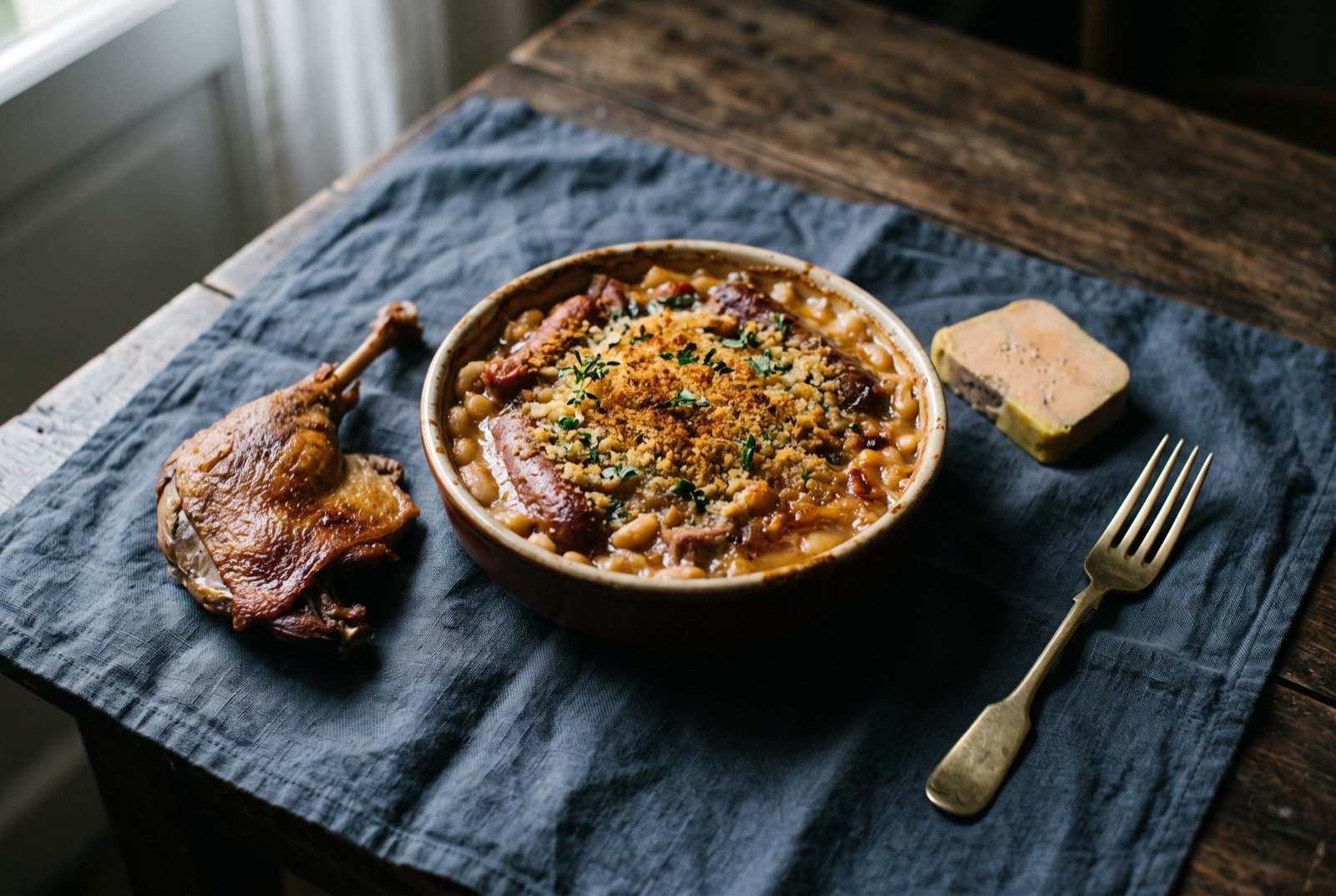
Toulouse, the Landes, Béarn and Armagnac country, and the French, north-of-the-Pyrenees Basque Country, treated as one Southwest larder built on duck fat as its organising medium, with the Basque material given as one half of a food world whose other half, the Spanish Basque Country, is EU-04. Every dish as tradition built it, then what a modern chef would change.
Sources and review · What this chapter does not assert · How we research · Know this better? Tell us
A Sense of Place
This volume's Basque material is written as one half of a whole, not as a self-contained tradition. Basque cooking runs across the Pyrenees on both sides, and EU-04, the Cider and Cod Coast, already treats the Spanish side, Gipuzkoa and Bizkaia, in full: Nueva Cocina Vasca, pil-pil, txokos, the Basque cod trade to Newfoundland and the pre-Columbus legend that does not survive checking, Idiazábal cheese, txakoli. This chapter does not re-derive any of that. Where the topic is genuinely shared, language, general Basque identity, the coastal fishing economy in outline, it says so and points back rather than repeating itself. Where the French side is genuinely different, three provinces with their own internal structure, a different colonial and administrative history, different peppers, a different ham, a different fine-dining lineage entirely, that difference is this chapter's actual subject.
Gascony, the Landes, Béarn and Armagnac country
Fat, not oil, is the organising medium of this larder, and confit is the technique that makes that true: meat salted, then poached and stored under its own duck or goose fat, a slow-cooked reserve that historically outlasted the season it was made in. The Gers is the heartland of fattened duck and goose breeding and holds close to 30 per cent of French traditional duck foie gras production, built on maize-fed poultry. Jambon de Bayonne is the clearest single piece of evidence that this whole cuisine is genuinely an interior one wearing a coastal name: its curing zone runs across the Adour basin, explicitly including parts of the Gers, Hautes-Pyrénées and Landes alongside the coastal Pyrénées-Atlantiques, driven by the Foehn, a warm dry wind specific to this piedmont zone. Not Gascony and a separate coastal Basque strip, but one larder with a shared curing climate running under both.
Gascon identity carries a real martial tradition, and a nineteenth-century literary myth sitting on top of it. D'Artagnan was a real figure, Charles de Batz de Castelmore, born near Lupiac in what is now the Armagnac-Ténarèze zone, who served Louis XIV as a musketeer. It is Alexandre Dumas's 1844 novel that fixed d'Artagnan, and by extension Gascony, as the archetype of the flamboyant swordsman in the French popular imagination. This chapter keeps the real regional military tradition and the amplified literary myth as two separate things.
The French Basque Country: three provinces, not one identity
The French Basque Country is not the ecologically or politically uniform strip its Spanish equivalent might suggest. It comprises three historic provinces: Labourd, the littoral plain, most populous and touristic, with the coastal fishing ports of Saint-Jean-de-Luz, Ciboure and Hendaye; Basse-Navarre, a more rural, mixed interior, pig-rearing and cheesemaking country; and Soule, a mountain territory of pastoral tradition, the smallest and most isolated of the three. This is the direct reason French Basque cooking runs coastal fish stew in Labourd alongside mountain sheep's cheese and pork charcuterie in Soule and Basse-Navarre within a genuinely small territory, and it has no real equivalent in EU-04's treatment of Gipuzkoa and Bizkaia as a more unified maritime-industrial pair.
Administrative history diverges from the Spanish side in a way worth stating precisely, because it explains why this chapter's Basque section reads so differently from EU-04's. Labourd and Soule registered their own customary law with the Parlement de Bordeaux in the sixteenth and seventeenth centuries; Basse-Navarre was administered as a nominal kingdom of Navarre for nearly three centuries, 1515 to 1789, following the 1512 Castilian conquest of the larger southern kingdom, the direct root of the Navarre and Nafarroa split that still runs through Basque political geography today. These fors were not formally abolished by royal decree; they lapsed in practice on the night of 4 August 1789 along with the rest of France's provincial privileges. The French Basque Country's old autonomy ended with the Revolution, a genuinely different political story from the Spanish side's twentieth-century Francoist repression.
Bayonne's own story is distinct from San Sebastián's or Bilbao's, both fully treated in EU-04. Unlike San Sebastián, repeatedly besieged as a military port, or Bilbao, an industrial steel and shipping city until its Guggenheim-led reinvention, Bayonne's history is one of an inland river port on the Adour repeatedly re-adapting to a silting, shifting river mouth, and a trading city whose reach came from its role as a confluence point rather than open-ocean fishing dominance. A formal Bayonne and San Sebastián cross-border cooperation agreement dates only to 1993, itself an acknowledgement that the two remained administratively separate worlds until very recently.
The History in Layers
Euskara under France, and under Franco: two mechanisms, not one story
EU-04 covers Euskara's status as a pre-Indo-European language isolate in full; this chapter adds only what genuinely diverges on the French side. Under Franco, 1939 to 1975, Spanish alone was permitted in government and schools, and Basque was actively persecuted, which paradoxically gave the language real symbolic value, a foundation of identity and a badge of anti-Francoist resistance; it has held official co-status in the Basque Autonomous Community since 1978. In France the mechanism was different: the Republic's own centralising monolingualism, French as the sole language of the state, other languages treated as a threat to national unity, Basque banned in schools with children punished for speaking it in the classroom. Basque has no official status anywhere in France today, and the large majority of all living Basque speakers are on the Spanish side. This chapter resists importing the Spanish side's language-as-resistance frame wholesale onto the French one; the French story is slow, non-violent administrative attrition, not an acute repression-and-reversal arc, and it has produced nothing like the Basque Autonomous Community's protections.
Bayonne's chocolate trade: real, and more staggered than the popular version
Bayonne's significance for chocolate via Sephardic Jewish traders holds up, though the popular one-line version, refugees arriving in 1492 and immediately founding a chocolate trade, compresses roughly two centuries of gradual, uncomfortable history into something tidier than what happened. Cocoa moved through Bayonne corsair and trading networks from the sixteenth century. The community most associated with chocolate-making proper, Sephardic Jews expelled from Spain in 1492 and Portugal in 1496, settled not inside Bayonne's walls but across the Adour in the Saint-Esprit quarter, since Jews were legally barred from owning property or shops within Bayonne itself. The craft is documented from after 1609; a 1687 parish record names a maker of chocolate there. By 1723, Saint-Esprit held roughly 1,100 Jews among about 3,500 residents, working salt, glue and chocolate trades, with maintained links to diaspora communities in Amsterdam, Curaçao and Livorno. In 1761, Bayonne's own master chocolatiers formed a guild specifically to establish a monopoly and exclude Jewish competitors from the trade in the city proper, a genuinely uncomfortable detail this chapter keeps rather than smooths over.
Piment d'Espelette's route: genuinely undocumented, not just under-told
The pepper's American origin and its arrival via the Columbian Exchange is not in question; it reached Spain in the holds of Columbus's ships, was cultivated across Spain from around 1526, and spread into the French Basque Country through the seventeenth century. What is genuinely undocumented is exactly how it travelled from the Spanish court to the Basque interior: a chronicle associated with the Institut de France academies states outright that the mystery remains entire on this exact path. The one hard date that recurs consistently is cultivation attested around Espelette from 1650. The popular framing of a named navigator personally carrying the pepper home is repeated across tourism sites with no independent source beyond that repetition, and this chapter treats it as folk tradition, not documented fact, the same caution EU-04 applies to its own bacalao a la vizcaína origin legend.
French Basque whaling: real, but structurally smaller than the Spanish coast's
EU-04 documents the Basque whaling story, Lekeitio, Orio, Getaria, in full, including the pre-Columbus cod legend that does not survive checking. The French side's own sources are direct about the comparison: the industry was never as significant in the French Basque Country as in the Spanish provinces. Bay of Biscay whaling from Ciboure and Saint-Jean-de-Luz peaked in the thirteenth century and had essentially ceased locally by 1567. What is genuinely distinctive here is the persistence of long-distance Arctic whaling well past that local collapse: seven ships sailed from Saint-Jean-de-Luz to Newfoundland in 1602 alone, and French Basque vessels are documented off Iceland through the 1610s to 1680s. The same 1713 Treaty of Utrecht that EU-04 notes damaged the Basque cod trade generally is the specific blow that pushed Saint-Jean-de-Luz toward sardines instead.
Biarritz and the Second Empire: a resort economy with no Spanish-side equivalent
Biarritz was a small whaling and fishing port through the Middle Ages. Napoleon III and Empress Eugénie began wintering there from the early 1850s, drawing European royalty and aristocracy and pushing the town's summer population to roughly 10,000 visitors a season. This is a genuinely nineteenth-century, France-specific layer, and it lets this chapter draw a direct line from working fishermen's and shepherds' dishes, ttoro, axoa, to their later elevation for a resort clientele, without inventing a parallel to EU-04's 1976 Nueva Cocina Vasca movement. The French side's fine-dining tradition grew out of this nineteenth-century spa economy, not from a 1976 rupture on the Bilbao and San Sebastián model.
Cassoulet: genuinely, permanently contested
The Castelnaudary siege legend, an English siege during the Hundred Years' War, town cooks improvising a stew to feed defenders, is directly contradicted by the record: Castelnaudary was burned by the Black Prince's forces but never besieged, and the New World beans central to the dish did not reach Europe until the sixteenth century. The town rivalry itself is dateable: a specific 1890 article asserting that only Castelnaudary's version was authentic is the proximate cause of the modern dispute between Castelnaudary, Carcassonne and Toulouse, which continues today. In 1929 Prosper Montagné, a chef from Carcassonne, gave it its most quoted formulation: Castelnaudary is the Father, Carcassonne the Son, Toulouse the Holy Spirit. The three versions differ concretely: Castelnaudary's takes goose or duck confit alongside pork rind and sausage; Toulouse's is built on pork and confit duck without goose; Carcassonne's is marked out by tomato and sometimes mutton. This chapter presents the dispute as unresolved, attributed by town, not adjudicated.
Confit's real age: a nineteenth-century word for an older idea
The widely repeated claim that confit "was born in the twelfth century in Gascony" does not hold up. A genuine academic ethnographic source, Renée Valeri's monograph on confit's role in Southwest French traditional food, states that the word confit itself is surprisingly recent, dating only to the mid-nineteenth century, and that regional dialects in the Southwest have no older equivalent term for the practice. Valeri also reframes confit's actual social role: not an exotic winter delicacy born of siege or scarcity, but ordinary provisions kept for summer, when heavy field labour and large gatherings created a need for ready meat, tied to the agricultural labour cycle rather than any medieval crisis narrative. The technique of salting and slow-poaching meat in fat for preservation is certainly old and pre-refrigeration in principle; a specific twelfth-century origin date should not be asserted.
Armagnac: the oldest French eau-de-vie claim, resting on one document
The claim rests on a specific, checkable manuscript: in 1310, Maître Vital Dufour, Prior of Eauze and Saint-Mont, praised the "forty virtues" of Aygue Ardente in a Latin health treatise, preserved in the Vatican Library. Commercial evidence follows: trade documented 1411 to 1441, and Armagnac a regular product at the Saint-Sever market in the Landes by 1461. Every corroborating source found for this claim traces back to the same 1310 manuscript rather than offering independent evidence, and this chapter states it that way. The Armagnac AOC was formally created on 6 August 1936, spanning three sub-zones, Bas-Armagnac, Armagnac-Ténarèze and Haut-Armagnac.
Magret: a genuinely modern dish, well attested
Chef André Daguin, then twenty-four, created magret in 1959 at the Hôtel de France in Auch, the first to treat duck breast as a red meat, seared and served rare, rather than reserving it exclusively for confit as had been the near-universal prior practice. Before Daguin, the breast of a fattened duck was not treated as a standalone cut; its spread through the 1970s and 1980s forced the whole regional duck-breeding industry to reorganise around demand for it. This is worth setting alongside EU-04's own account of Nueva Cocina Vasca, another mid-twentieth-century Southwest reinvention of a traditional ingredient rather than an ancient dish being uncovered.
The Flavour Arsenal
Fat, poultry and cured meat
| Ingredient | Character and use |
|---|---|
| Graisse de canard | Duck fat, the organising medium of the whole cuisine, used the way olive oil is used further south |
| Canard mulard | The hybrid duck breed behind over 90 per cent of French foie gras production, bred specifically for liver texture and fat assimilation |
| Foie gras | Duck or goose liver, produced by gavage, a genuinely contested practice, see the Technique Ladder below |
| Jambon de Bayonne | IGP-protected cured ham, its curing zone the wider Adour basin, not purely Basque despite the name |
| Saucisse de Toulouse | Coarse fresh pork sausage, pork meat and fat only, no additives, IGP since 1992 |
Beans, fruit and spice
| Ingredient | Character and use |
|---|---|
| Haricots tarbais | The Southwest bean proper, prized for holding its shape and creaminess through cassoulet's long cook |
| Pruneaux d'Agen | Prunes from the Prune d'Ente, traced to Benedictine monks grafting a Damascus plum onto local rootstock |
| Piment d'Espelette | AOC since 2000, a mild pepper, 1,500 to 4,000 Scoville units, dried on corded strings hung on house facades |
Cheese, wine and spirit
| Ingredient | Character and use |
|---|---|
| Ossau-Iraty | A cheese genuinely shared by Béarn and the French Basque Country, made from three sheep breeds by region |
| Irouléguy | The only AOC wine produced within the French Basque Country itself, tannat and cabernet franc reds, a manseng-blend white |
| Armagnac | France's oldest documented eau-de-vie by claim, column-distilled, distinct from Cognac's double pot-still method |
The Technique Ladder
The argument, from inside
André Daguin's 1959 magret is this chapter's clearest parallel to the series' animating idea: not an imported technique but an existing regional resource, the fattened duck's breast, previously used only for confit, treated with new attention and turned into something the whole cuisine reorganised itself around. Michel Guérard, at Les Prés d'Eugénie, offers the same argument from the opposite direction: his cuisine minceur takes Southwest technique, including a named vegetable confit later globally famous via Ratatouille, and asks what it does when the fat is deliberately reduced rather than embraced, without losing the dish's structure. Both are the tradition understood well enough to be redeployed, not replaced.
Rung 1. Salt first, submerge second, and let the fat do the sealing
Confit's actual mechanism is not the cooking heat, it is the fat itself: meat salted roughly 24 hours to draw out surface moisture and season through, then rinsed, dried and cooked slowly, fully submerged in rendered fat, at a controlled low temperature. Cooled and stored still submerged, the fat solidifies and seals the meat from oxygen contact, which is the actual preservation mechanism. The slow, low-temperature cook itself converts collagen into gelatine, producing the characteristic melting texture roasting or frying the same cut does not give.
What a cook does with this rung. A sous vide bath set to hold duck legs at a steady, controlled temperature reproduces the traditional fat-poach's gentleness with more precision than judging a pot of fat by eye, and the legs can then be finished, still submerged in their own fat, in the fridge exactly as tradition stores them.
Rung 2. Render fat from a cold pan, and respect what searing actually does
Magret's defining technique, per Daguin's own method as it has been passed down: the breast starts skin-side down in a cold pan, so the fat renders gradually and crisps as the pan heats, rather than burning before the fat has had time to render out. Only once the skin is properly crisp does the breast flip, cooking briefly on the flesh side for a rare to rosé result.
What a cook does with this rung. Score the fat in a crosshatch before starting, deep enough to reach the fat but not the flesh, so it renders evenly across the whole surface rather than only at the edges; resist the instinct to raise the heat to speed the process, since a cold start is the entire mechanism.
Rung 3. Poach foie gras gently enough that it never fully liquefies
The au torchon method: liver seasoned, rested wrapped tightly in film for 12 to 24 hours so seasoning penetrates evenly, then rolled into a tight cylinder in a clean linen cloth and poached gently, fully submerged in water held at a bare simmer, 75 to 80°C, so the liver cooks through without breaking down into pure fat. This preserves the liver's own melting texture without adding any fat at all, distinct from a terrine cooked in a bain-marie.
A note on gavage, stated as CLAUDE.md requires: this is a genuinely contested practice, and this chapter names it as such rather than passing over it. Gavage, force-feeding, lasts on average 12 days, roughly two meals a day, a corn-and-water mixture deposited into the crop via a tube shaped to the bird's anatomy, following an 80-day rearing period. The industry's own position, drawing on the natural pre-migratory fattening instinct both ducks and geese show in the wild, holds that a 1996 voluntary code of good practice specifies adequate individual space, ventilation, light, heat and calm, and that mortality during gavage sits under 2 per cent. Welfare campaigners, principally L214 in France, argue the forced growth rate produces mortality several times higher than non-force-fed birds and that force-feeding removes the animal's basic control over its own eating. One sharper claim, that over 88 per cent of ducks are caged too small to turn around in during gavage, reached this chapter's research only through a campaign document's reading of an industry report, not the primary document itself, and is not repeated here as settled fact. One point both sides would likely agree on: French law defines the term "foie gras" itself as requiring gavage, so a non-force-fed liver product cannot legally carry that name, whatever its quality. This chapter states the practice, the process and the live dispute, and does not adjudicate the underlying ethical question.
What a cook does with this rung. A probe thermometer in the poaching water, not in the liver itself, holds the bare-simmer temperature far more reliably than judging it by eye, and the difference between 75°C and a genuine simmer is the difference between a torchon that slices cleanly and one that collapses into fat.
Rung 4. Deglaze and reduce with Armagnac deliberately, not as a flourish
Armagnac functions in this cuisine's cooking essentially as Cognac does elsewhere in France: alcohol added to a hot pan after searing, burned off as a flambé, or added earlier and reduced down with stock or cream into a sauce, particularly alongside duck and foie gras given their shared Gascon origin. This chapter could not find a named in-tradition source describing this technique in detail; it is stated here as standard, well-established culinary practice rather than as a specifically sourced historical claim, and held with that caveat.
What a cook does with this rung. Add the Armagnac off the heat or just as the pan comes off direct flame, since flambéing over too high a heat burns off aromatic compounds along with the alcohol; a reduction, by contrast, benefits from real time over gentle heat to concentrate rather than a hard boil that reduces it too fast to develop flavour.
Rung 5. Break the crust, don't let it seal
Cassoulet's crust is meant to be broken and pushed back into the beans repeatedly during its long bake, traditionally up to seven times, so it re-forms and re-absorbs the cooking juices each time, building a deeply flavoured final surface rather than one crust that simply seals over the top and stops interacting with what is beneath it.
What a cook does with this rung. This is a labour discipline more than a technical one: set a timer to check and break the crust at regular intervals through the bake rather than trusting memory, since the entire point of the rung is repetition, not a single perfect crust.
Rung 6. Add Espelette pepper at the very end, and only there
Across piperade, axoa and poulet basquaise, Espelette pepper is consistently added at or very near the end of cooking, roughly half a teaspoon to a teaspoon per diner, specifically to preserve its aroma; the pepper's flavour compounds are volatile enough that extended cooking drives them off, which is why a dish built entirely around this ingredient still treats it as a finishing note rather than a base seasoning.
What a cook does with this rung. Taste and adjust Espelette pepper only after a dish is otherwise finished, adding a little at a time rather than estimating the full amount up front; a dedicated spice grinder is not strictly needed here, since the AOC product is typically sold ground, but buying it in corded whole-pepper form and grinding it fresh immediately before use gives a noticeably brighter result than pre-ground powder that has been open for months.
Part Three
The Ferment and Preserve Bench
1. Confit
Meat cooked and stored in its own fat, the founding preservation technique of this entire chapter's cuisine, fully described in Rung 1 above. The word is younger than its reputation; the technique is genuinely old.
2. Jambon de Bayonne
A trimmed pork leg, dry-salted with salt from the Adour basin's own saltworks, specifically Salies-de-Béarn, and dried within the Adour region for more than seven months. The trade nearly disappeared, considered endangered by 1981 before an industry revival, and now involves roughly 1,500 pig farmers. The commonly repeated wounded-boar origin legend, a boar dying in a salt spring and being found perfectly preserved a year later, has no independent corroboration and this chapter treats it as legend, not history.
3. Armagnac
Distilled roughly 95 per cent of the time on the continuous column still specific to the appellation, patented 1818, distinct from Cognac's double pot-still method; aged in oak, new barrels first for wood extraction, then older, more neutral barrels as ageing continues, sometimes for decades.
Sourcing in Britain
Verified August 2026. Where a supplier could not be fully confirmed, that is said rather than smoothed over.
The ranked list: what decides great from grim
- Genuine AOC piment d'Espelette, checked for the seal, not a generic "French chilli powder." Spice Mountain and The Chilli Pepper Co both stock AOC-certified stock. Melbury & Appleton lists it too, though this chapter could not directly confirm that specific page by fetch. Amazon.co.uk carries both the genuine product and mislabelled generic chilli powder side by side; the AOC seal, in the traditional Basque red, green and white, is the only reliable marker.
- Real DOP Ossau-Iraty, from a specialist who can say which side of the border it's from. Paxton & Whitfield and La Fromagerie both stock unpasteurised, traditional-rennet Ossau-Iraty. Mons Cheesemongers, George Mewes Cheese in Glasgow and Edinburgh, and Little Shop of Cheese are further UK options.
- Named Armagnac houses, not a generic "brandy" listing. Blackwell's Wines & Spirits stocks Château de Laubade and Domaine Boingnères by name; Loki Wine in Birmingham carries Janneau VSOP and XO.
- Confit duck legs ready-made, or duck fat for cooking your own. Fine Food Specialist, DukesHill and Urban Merchants all stock ready-made confit legs. Sous Chef UK stocks goose fat for anyone rendering their own confit. A plain, UK-based, non-halal-only tub of duck fat specifically, rather than goose fat or fat attached to pre-confited legs, is a genuine gap in what this chapter could confirm.
- Genuine haricots tarbais. Fine & Wild is the strongest confirmed consumer-facing UK source, PGI and Label Rouge certified.
- Toulouse sausage, distinguishing imported from a UK butcher's own version. French Click stocks the genuine imported product; Swaledale and The Dorset Meat Company make their own to the classic recipe, coarse pork, red wine, garlic, which this chapter treats as a legitimate but distinct product, not the same as the imported original.
Foie gras, and an honest note on where things currently stand
Foie gras production has been illegal in the UK since 2006, but import and sale remain legal as of this chapter's research, verified July 2026. Labour pledged before the 2024 general election to ban commercial import of force-fed foie gras; as of a 23 July 2026 report that promise remains unfulfilled, officials citing EU trade-deal sensitivities, against roughly 87 per cent public support for an import ban per a cited poll. No ban is currently in force. This is a live, contested political situation, not a settled one, and any reader buying foie gras in Britain should know the legal position could change. Where sale remains legal, Fine Food Specialist stocks named producers, Rougié from the Périgord, Euralis, and Smith & Brock terrines, in fresh, frozen, preserved and bloc formats.
The honest gap: jambon de Bayonne
No dedicated UK charcuterie specialist stocking a named IGP-certified producer, beyond Gourmet de Paris, was confirmed in the research behind this chapter. This is worth a direct enquiry to a specialist French deli before assuming wider availability that has not actually been verified.
Voices and Sources
From inside the tradition
- André Daguin, Hôtel de France, Auch. Created magret in 1959, the clearest single example in this chapter of a traditional ingredient reconsidered rather than an outside technique imported.
- Michel Guérard, Les Prés d'Eugénie, Eugénie-les-Bains. Three Michelin stars continuously since 1977; his cuisine minceur applies the opposite question to the same tradition Daguin worked with, what happens when the region's defining fat is deliberately reduced without losing the dish's structure.
- Guillaume Roget, Ekaitza, Ciboure. Awarded a second Michelin star in 2026, buying fish same-morning across the quay from Saint-Jean-de-Luz's market, the clearest current example of French Basque fine dining growing from its own coastal resort lineage rather than importing Spanish Basque method.
- Pascal Aussignac, Club Gascon, London. Trained under Gérard Vie, Alain Dutournier and Guy Savoy; for 28 years the UK's clearest specialist address for Gascon cooking, describing his own role as guardian of tradition, teaching an international kitchen team the codes of cassoulet, duck and foie gras. The restaurant closed on 28 March 2026, and this chapter names that closure directly rather than describing it in the present tense.
- The Confrérie du Ttoro de Ciboure and the Grande Confrérie du Cassoulet de Castelnaudary, both active guild bodies publishing their own recipes, the strongest in-tradition sourcing behind this chapter's two most technically detailed dishes.
- The Eguzkia association, formed by roughly twenty French Basque pastry chefs in 1994 specifically to protect gâteau basque's quality, the source behind this chapter's honest account of the cake's real, still-live filling question.
The gap, named
No UK restaurant presenting itself as specifically French-Basque, Bayonne, Espelette or Saint-Jean-de-Luz style, as distinct from the Spanish Basque Country, was found in the research behind this chapter. Every UK "Basque restaurant" found, Sagardi, Eneko Basque Kitchen & Bar, Donostia Social Club, Pintxito, is explicitly Spanish or Spanish-Basque in framing. The UK's current enthusiasm for Basque food, real and well documented, is a Spanish Basque phenomenon; this chapter states that plainly rather than implying a French Basque presence that does not exist.
Things this chapter has deliberately not asserted
- That confit is a twelfth-century Gascon technique. The one academic ethnographic source found dates the word itself to the mid-nineteenth century and reframes confit as ordinary summer provisioning, not ancient siege-born technology.
- That cassoulet originated definitively in Castelnaudary, Carcassonne, or Toulouse. Genuinely and permanently contested, presented as three named claims, not adjudicated.
- That piperade is a purely Basque dish. The name likely derives from Béarnese, and multiple sources describe it as conceived in Béarn before Basque adoption. Presented as shared.
- That the piperade egg preparation, scrambled through or fried on top, has one authentic form. Genuinely unresolved.
- That gâteau basque was invented from nothing by Marianne Hirigoyen in 1832. Evidence of an older domestic house-cake tradition, and the cake's own Basque name, suggest she standardised an existing cake rather than inventing one.
- The wounded-boar origin legend for jambon de Bayonne. Recurs across producer marketing copy with no independent corroboration.
- The exact route by which piment d'Espelette travelled from the Spanish court to the Basque interior. A credible source states this is genuinely undocumented.
- That ttoro is the ancestor of, or descended from, marmitako and marmita cántabra. No source found makes that genealogical claim; presented as a parallel tradition.
- The Basque-flag colour reading of piperade and poulet basquaise. A modern retrofitted symbolic gloss the flag itself postdates by centuries.
- The 88 per cent gavage cage-size statistic, unattributed. Reached only through a campaign document's reading of an industry report, not the primary document; not repeated here as settled fact.
- That the diagnosis of why exported Southwest cooking fails, given in this chapter's technique section, was stated by a named critic. It is this atlas's own synthesis from verified component facts, not a quoted argument.
- A current Michelin star count for Relais de la Poste beyond its historical two-star status, or a confirmed current chef for "Les Pyrénées" in Saint-Jean-de-Luz. Neither could be verified against a primary source in the research behind this chapter.
Volume Fourteen of Europe, and the second of France, Not Just Stew. Cross-references EU-04, the Cider and Cod Coast, for the Spanish Basque Country. Research briefs: EU-14-tradition.md and EU-14-modernist-sourcing.md. Sourcing verified August 2026.
Salt first, submerge second, and let the fat do the sealing
Confit's actual mechanism is not the cooking heat, it is the fat itself: meat salted roughly 24 hours to draw out surface moisture and season through, then...
Render fat from a cold pan, and respect what searing actually does
Magret's defining technique, per Daguin's own method as it has been passed down: the breast starts skin-side down in a cold pan, so the fat renders gradually...
Poach foie gras gently enough that it never fully liquefies
The au torchon method: liver seasoned, rested wrapped tightly in film for 12 to 24 hours so seasoning penetrates evenly, then rolled into a tight cylinder in a...
Deglaze and reduce with Armagnac deliberately, not as a flourish
Armagnac functions in this cuisine's cooking essentially as Cognac does elsewhere in France: alcohol added to a hot pan after searing, burned off as a flambé...
Break the crust, don't let it seal
Cassoulet's crust is meant to be broken and pushed back into the beans repeatedly during its long bake, traditionally up to seven times, so it re-forms and...
Add Espelette pepper at the very end, and only there
Across piperade, axoa and poulet basquaise, Espelette pepper is consistently added at or very near the end of cooking, roughly half a teaspoon to a teaspoon...
The dishes
- Cassoulet, Toulouse Style Toulouse, Gascony
- Confit de Canard Gascony
- Magret de Canard Gascony, Auch
- Garbure Béarnaise Béarn
- Foie Gras au Torchon Gascony
- Piperade Béarn and the French Basque Country
- Axoa French Basque Country
- Ttoro French Basque Country, Ciboure and Saint-Jean-de-Luz
- Poulet Basquaise French Basque Country
- Gâteau Basque French Basque Country
Sources and review
- Researched
- 20 sources cited
Where this volume comes from
4 research briefs on file for this volume, researched to the rules on How we research. Published 28 August 2026. Last changed 20 September 2026.