France and the Alps · Volume 14, The Duck and the Border
Ttoro
French Basque Country, Ciboure and Saint-Jean-de-Luz
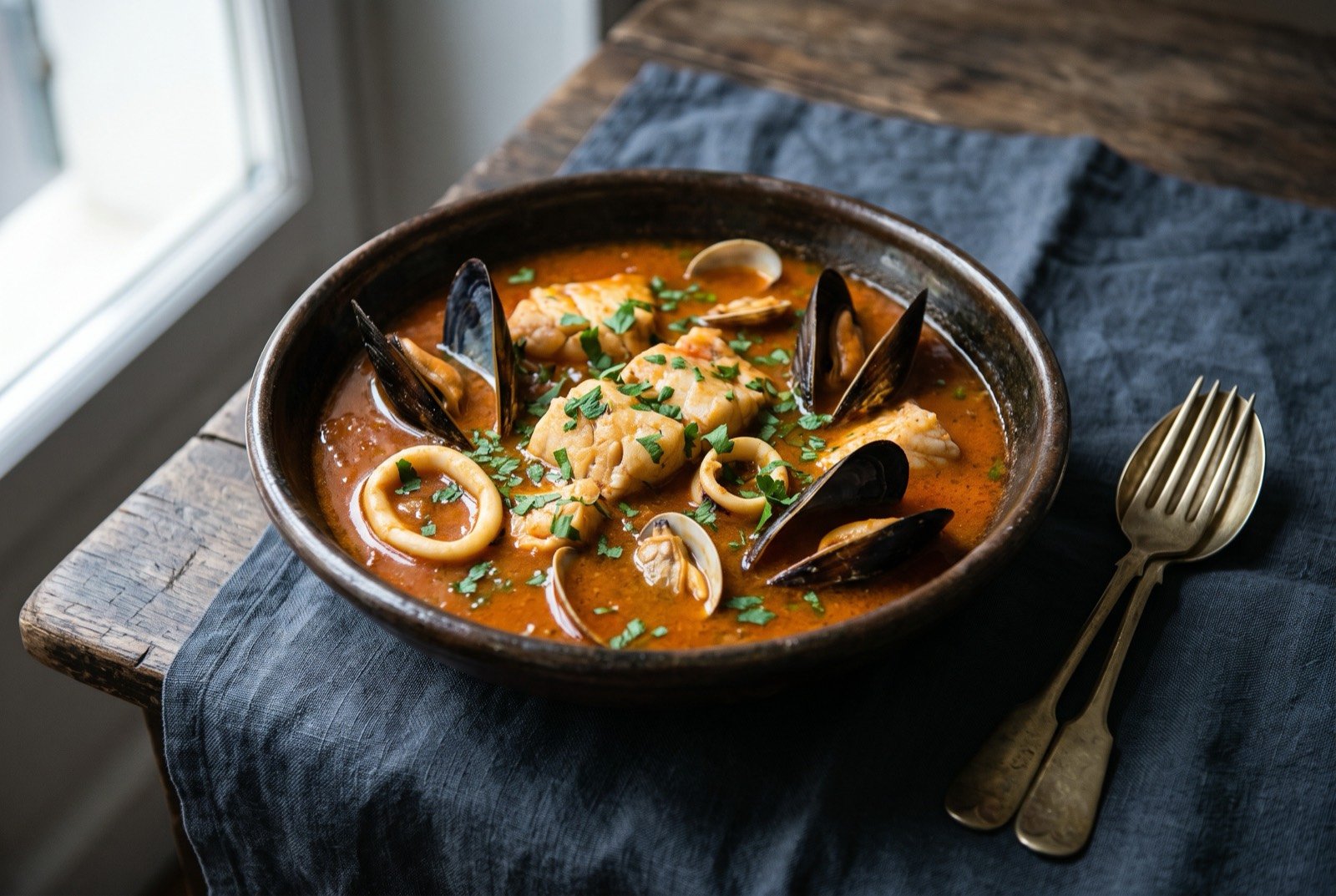
Illustration
- Time
- 1 hour 15
- Researched
- 20 sources cited
A fishermen's stew made from whole pieces of unsold fish rather than fish ground into a purée, that wholeness the dish's defining technical difference from an ordinary fish soup. This chapter presents ttoro as a parallel tradition to marmitako and marmita cántabra, both fully treated in EU-04, not as their ancestor or their descendant, since no source consulted makes that genealogical claim.
As tradition built it
Serves 6. About 1 hour 15 minutes.
Ingredients
- 300 g mussels
- 500 g conger eel
- 500 g monkfish
- 500 g hake
- 300 g squid
- 500 ml dry white wine
- 3 onions
- 3 cloves garlic
- 500 g potatoes
- 1 tomato
- 6 sweet green peppers
- 2 good pinches Espelette pepper, 2 bouquets garnis
- 200 ml olive oil
Method
- Make a fish-head and trimmings stock, simmered about 45 minutes with a bouquet garni and 250ml of the dry white wine, strained.
- Build a sauce base: sauté onion and diced potato in olive oil with peeled tomato, sliced sweet green peppers, a bouquet garni and the remaining wine, reduced fully.
- Combine with the strained stock and Espelette pepper.
- Add the fish in sequence by cooking time: conger eel first, 30 minutes, then mussels and squid, then monkfish, 20 minutes, then hake last, 5 minutes.
- Finish with a chopped garlic and parsley hachis.
What a modern chef changes
The fish added in sequence with more precision than "by feel."
Not tied to a single rung; this dish's elevation is mainly a matter of timing discipline rather than one of this chapter's chemistry-driven techniques
Method
- Time each fish addition from a kitchen timer rather than by eye, since the sequence above is already precise and the traditional method's main vulnerability is a cook losing track mid-service.
- Reserve the Espelette pepper for a final adjustment, per Rung 6, rather than adding it during the base's build.
- Serve the stock and the fish plated separately, poured together at the table, a presentation choice rather than a change to the cooking, so a guest sees the dish's actual components before the broth softens them further.