Europe · Volume 16
The Alps and French-speaking Switzerland
Altitude, Cheese and a Border the Kitchen Never Drew
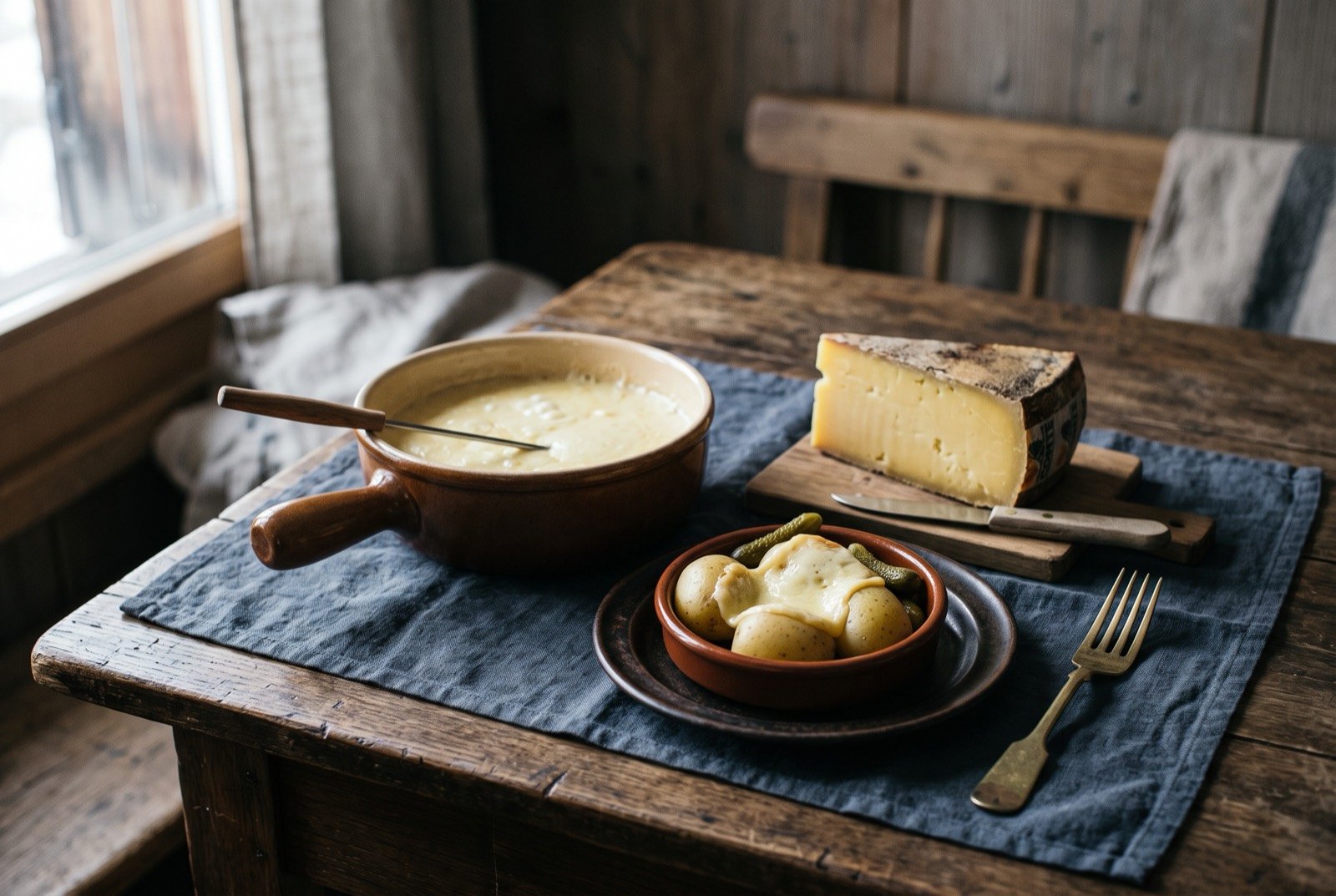
Savoie, the Dauphiné and French-speaking Switzerland, taken as the one continuous Alpine dairy world they actually are, not two national cuisines sharing a mountain range. A poor mountain grammar of milk fat, buckwheat and pork predates the ski resort by centuries, worked alongside the two famous dishes that do not. Every dish as tradition built it, then what a modern chef would change.
Sources and review · What this chapter does not assert · How we research · Spotted something wrong?
A Sense of Place
This volume's food logic is written by altitude before it is written by anything else, and it is shared across a national border the food itself does not respect. Savoie, Haute-Savoie, the Dauphiné on the French side; Vaud, Geneva and Fribourg's Gruyère country on the Swiss, running from lakeside valley floor at Lac Léman, Lac du Bourget and Annecy, through mid-altitude vineyard terraces at Lavaux, Chignin and Apremont, to the alpage proper: high summer pasture above roughly 1,000 to 1,500 metres where cattle graze from June to October and, in the strictest cases, cheese is still made on the spot, in a copper vat, before the milk has even had time to cool.
The grammar this produces is consistent on both sides of the frontier. Fat comes from milk, not from olive oil or lard: butter, cream and above all cheese are the dominant fat source, because dairy cattle, not olives or wheat, are what these slopes will support. Starch is a poor mountain's compromise between what will grow at altitude and what will keep through a winter that can run to six months: the potato, which displaced kohlrabi as the Alpine staple only from around 1730, and buckwheat, hardy enough for thin soil and a short season, milled and cut into crozets. Protein is pork above all, a pig fed on scraps and dairy whey and slaughtered once a year for a winter's worth of charcuterie, with beef a secondary, more prestige-inflected protein tied to the same cattle that give the milk. Aromatics are minimal and mountain-appropriate: garlic, onion, thyme, bay, nutmeg, fennel seed on the Genevan side, and the region's own dry white wines used as a cooking liquid as often as a drink.
Three mountain cattle breeds carry almost the entire dairy economy on the French side. Abondance, from Haute-Savoie's Val d'Abondance, has a distinctive mahogany-red-and-white coat and milk whose fat and protein ratio suits it particularly to cheesemaking. Tarine, or Tarentaise, uniformly fawn with black hooves, is bred specifically for hardiness on steep, temperature-swinging terrain. Montbéliarde is permitted alongside both in the Reblochon and Abondance specifications. This is worth stating plainly because it changes how a reader should think about what separates one cheese from another: the difference in character between Reblochon, Beaufort and Abondance is not a matter of chef technique. It is these three breeds' milk, at defined altitudes, under defined grazing rules, worked by methods each cheese's own legal specification has fixed as a minimum, not a marketing description.
None of this belongs to one nation more than the other, and the political history underneath it is genuinely more complicated than "French Alps" and "Swiss Alps" as two settled categories. Savoie and Haute-Savoie were part of an independent European state, the Duchy of Savoy, until 1860. The Dauphiné was a wholly separate historic territory, sold outright to the French crown in 1349, nearly five centuries earlier. Geneva was a semi-independent Calvinist city-republic for centuries before it joined the Swiss Confederation only in 1815. Vaud spent 1536 to 1798 as conquered Bernese territory before declaring its own independence and joining the Confederation in its own right. Fribourg, genuinely bilingual long before its 1991 formal recognition as such, only annexed the county of Gruyère itself in 1555. A British reader arriving with "French Alps, cook fondue" and "Switzerland, cook more fondue" as the working model will miss almost everything that actually shaped this food, including the fact, covered in full below, that neither dish is anything like as old as either national tourism industry would like it to be.
The History in Layers
Transhumance, the fact underneath everything else
"L'estive," the seasonal movement of herds up to high summer pasture and back, structures this cuisine on both sides of the border more than any single recipe does. From roughly June, cattle move up to alpage pasture for around five months, grazing fresh high-altitude grass that gives the milk, and the cheese made from it, its floral, aromatic character; the autumn "descente des alpages," cattle decorated with flowers and bells in a two-and-a-half-hour procession, remains a marked public festival around Annecy today. This is not folklore laid over a modern industry. Cheese made at altitude on the alpage itself, as both Beaufort Chalet d'Alpage and Vaud's L'Etivaz still require by law, is the direct continuation of the practice, not a marketing recreation of it.
Four political histories, none reducible to the others
What is now Savoie and Haute-Savoie was, for most of its documented history, not France. The territory became a county, then a duchy in 1416, its rulers going on to become Kings of Sicily in 1713 and then Kings of Sardinia in 1720, ruling the Kingdom of Sardinia-Piedmont from Turin with Savoy itself one province among several, alongside Piedmont and Nice. The House of Savoy became the royal house of unified Italy in 1861, one year after Savoy itself was ceded away. This gave Savoyard identity a genuinely Italian-facing political axis for centuries, which is also the honest explanation for why polenta, of obvious northern-Italian ancestry, is a genuine Savoyard staple: "polenta-diots" is an institution at every village fête across both Savoies, not a borrowed novelty. The independence ended at the Treaty of Turin, signed 24 March 1860: Sardinia-Piedmont, negotiating with Napoleon III after the 1858 Plombières agreement, ceded Savoy and Nice to France in exchange for military support against Austria, ratified by a lopsided plebiscite that some Savoyard liberals themselves would have preferred to see resolve toward independence or Switzerland instead.
The Dauphiné's story is genuinely separate and should not be folded into Savoy's. Its last independent ruler, Humbert II de la Tour-du-Pin, childless, in debt and under pressure from the neighbouring Count of Savoy, sold his domain to the House of Valois in a formal act signed 30 March 1349, ceding the Dauphiné to the future Charles V for 200,000 florins plus an annual rent. From this sale, "Dauphin" became the title of the heir to the French throne. The structural point worth carrying into how this volume is read: the Dauphiné had already been French for over five hundred years by the time Savoy joined it in 1860. Dauphinois food identity, walnuts, ravioles, Saint-Marcellin, gratin dauphinois itself, developed inside the French state for centuries, while Savoyard identity developed largely outside it.
Across the border, Bernese Vaud tells a similarly corrective story. Bern conquered the Pays de Vaud outright in 1536 and administered it as subject territory, not a partner canton, for 262 years. What matters directly for the food: a specialist source on Vaudois cuisine states plainly that the Vaudoise table "has been much more influenced over the centuries by that of the good cousins of Savoie and Franche-Comté than by representatives of the Bernese Bear," and that "apart from sauerkraut and rösti, the Bernese legacy in Vaudoise cuisine is insignificant." Vaud declared its own independence on 24 January 1798 and joined the Confederation in its own right in 1803.
Geneva's Reformation, adopted the same year Bern took Vaud, is more often credited with shaping the city's food than the documentary trail actually supports. Sumptuary ordinances regulating dress and food did exist, but Geneva's own state archives place the first substantial legal push in September 1558, four years before Calvin's death, and the term "ordonnances somptuaires" itself is only attested from 1668, over a century later; the ordinances in fact intensified after Calvin's death, across the following two centuries. This chapter does not assert a tight, single-author line from Calvin to any specific Genevan dish. What is real is a documented, genuinely Reformed civic austerity, of which the plain tarte aux pruneaux served on the Jeûne genevois, Geneva's own cantonal fast day, is the surviving symbolic descendant, not a direct instruction from the reformer himself.
Two separate monastic threads, and a cheese older than either
The Abbaye d'Abondance, founded just before 1108, became the head of a network of five daughter abbeys before its 1761 dissolution; the Chablais region around it is documented as reputed for cheese from at least the 14th century because of the monks' own production. The Grande Chartreuse, founded 1084, ran dairy activity through a network of around twenty haberts, barn and lodging combined, in the mountains around the monastery. Separately, and more famously, the Chartreuse liqueur has a documented origin in a 1605 manuscript recipe of roughly 130 botanicals, fixed by Frère Jérôme Maubec between 1737 and 1764, with the green variant following in 1840. These are two distinct legacies, a documented cheesemaking economy and a documented liqueur formula, and this chapter keeps them apart rather than folding both into one generic "the monks made it" story.
Gruyère's own documented history, on the Swiss side, is both older and more precisely dated than either French monastic thread. A 1115 charter guaranteed the priory of Rougemont an annual delivery of "fatty cheeses" from the Gruérien mountains, and a 1312 document describes alpine-chalet cheese production explicitly intended for export; the name itself is first attested in 1655. This documents cheese production in the region from 1115, not the specific modern recipe or wheel format, and should be read with that precision rather than as an unbroken twelfth-century recipe. Vacherin Fribourgeois, by contrast, has a documented 14th-century origin as a use for milk surplus to Gruyère production, and its own consortium supplies a genuinely useful piece of intellectual honesty: its official history document separates a documented fact, a 1448 service of the cheese to the Duchess Eleanor of Austria at an official Fribourg reception, from a "Vaccarinus" monk-inventor-of-fondue legend it flags, in its own text, as folklore. It is rare for a producer body to be this transparent about its own mythology, and this chapter takes the cue.
The cheeses this volume is built around are unusually thoroughly codified on both sides of the border: Beaufort AOC from 1968, Reblochon's producers recording methods from 1958, Abondance AOC 1990 and AOP 1996, Tomme de Savoie IGP 1996, Gruyère AOP 2001, Vacherin Fribourgeois AOP 2005, Longeole IGP 2009, saucisse aux choux vaudoise IGP 2004. What this codification actually changes is worth stating plainly: it fixes breed, altitude, grazing days, curd temperature, ageing time and geographic zone as legal minimums, not merely traditional habits, so "authentic" here has an enforceable, checkable specification behind it, which is rarer than it sounds even within this atlas.
The single most important corrective in this whole volume: fondue and raclette are not ancient, on either side of the border
A British reader arriving at this chapter almost certainly assumes fondue and raclette are ancient Alpine peasant food. They are not, and the sourcing on this point is unusually strong from both directions, which is worth reading as one converging argument rather than two separate findings.
From the French side: the technique of melted cheese and wine is old and first documented in a 1699 Zurich manual, refined in French print during the 18th century, but this is Swiss and French-court history, not Savoyard peasant history. The named Savoyard food historian Marie-Thérèse Hermann, author of La Cuisine paysante de Savoie, states the case directly: "Avant la guerre, on ne faisait pas de fondue en Savoie. C'est un plat de luxe que nous ont fait connaître les Genevois. La Savoie ne revendique pas la paternité de la fondue." Before the war, fondue was not made in Savoie. It is a luxury dish the Genevans introduced us to. Savoy does not claim fondue's paternity. Its actual arrival in Savoyard practice dates to after the Second World War, and initially only in the part of Haute-Savoie bordering Switzerland.
From the Swiss side, the correction is even more precisely documented. The Swiss National Museum's own history blog and the Swiss Federal Archives are explicit that fondue moitié-moitié is a real, older Fribourg regional dish, but that "fondue as Switzerland's national dish" is a deliberate mid-20th-century marketing construction. The vector was the Union suisse du commerce du fromage, a cheese-trade cartel founded in 1914, which pivoted from wartime supply management to postwar consumption marketing. Its slogan, "Fondue isch guet und git e gueti Luune," fondue is good and puts you in a good mood, is credited by the National Museum's own historians with manufacturing "a rediscovered culinary tradition" after 1945, with the Swiss Army's communal messing culture amplifying it further. Even German-speaking Switzerland only adopted fondue genuinely after 1945.
Read together, a real, regional Fribourg dish was marketed nationally within Switzerland from the 1930s to the 1950s by a cheese cartel, and separately carried across the border into Savoie after the war by Genevan example, where it was then further amplified by the ski-tourism boom of the 1960s and 1970s. Fondue's status as the defining dish of this whole volume is a twentieth-century phenomenon layered onto much older, more genuinely local food: Reblochon, Beaufort, diots, longeole, boutefas, all of which have real pre-tourism pastoral and monastic lineages that fondue and raclette simply do not.
Raclette is Swiss in origin, specifically Valaisan, not French: shepherds placed a large piece of cheese near a fire and scraped, "racler," the melted portion onto bread or potatoes, a practice originally called "fromage rôti" that only took the name raclette from the 19th century onward. Raclette de Savoie IGP is a genuinely French adaptation of a borrowed Swiss practice, using a softer, milder cheese than its Valaisan cousin. The tourism-economy mechanism that domesticated it for a French table is concretely dateable rather than vague: the modern individual-tray electric raclette appliance was developed through a partnership between Rippoz and Tefal in 1975, in Savoie itself.
Tartiflette: resolved honestly, not either way
The word "tartiflette" is a late-20th-century coinage. The most repeated account, attributed via the French food writer Christian Millau, holds that the Syndicat Interprofessionnel du Reblochon invented the dish in the 1980s specifically to move surplus Reblochon during an overproduction crisis, deliberately choosing a name built on the older Savoyard dialect word "tartifla," potato, because it sounded old and traditional when the standardised recipe itself was not. What complicates this, and should stay a genuine complication rather than a footnote: the syndicate's own director, Lucile Marton, directly disputed sole authorship in 2014, stating "Nous ne sommes pas à l'initiative de la création de cette recette, même si on ne peut pas nier que la filière en a profité," we did not initiate the creation of this recipe, even if we cannot deny the industry benefited from it. A separate, unverified account credits a restaurateur in La Clusaz with renaming an older dish, péla, potato, onion and cheese cooked in a long-handled pan, without wine. Both accounts agree péla itself is genuinely older. The honest position: tartiflette as a named, standardised, Reblochon-forward gratin is a real late-20th-century commercial invention, almost certainly connected to the Reblochon syndicate's promotional interests even if not solely authored by them, built on top of a genuinely older, less codified peasant dish. It received Label Rouge certification only on 9 October 2014, three decades after its supposed invention, a telling detail in itself.
The Malakoff, and a border echo worth naming directly
The Malakoff carries its own contested-origin story, structurally similar to tartiflette's. Popular legend places its invention during the 1853 to 1855 Crimean War siege of the Malakoff redoubt, Swiss soldiers supposedly frying cheese slices near the entrenchments. The French Wikipedia article on the dish states directly that "no written source, in any case, confirms this legend." The better-documented layer sits a generation later: around 1880 to 1891, Ida Larpin, a cook in the household of Prince Napoléon at his villa in Prangins, is credited with the modern batter-fried Gruyère recipe, for a reception honouring Crimean War veterans; her recipe passed to cousins Alfred and Rose Larpin, innkeepers at the Écusson Vaudois in Eysins, credited with refining the frying medium from butter to oil. The dish remains specifically associated with five villages on the Vaudois Côte: Eysins, Begnins, Bursins, Luins and Vinzel.
The Röstigraben, and Savoy's own Turin-facing history: a genuine parallel
The term Röstigraben dates only to the 1930s, marking a linguistic and cultural, not gastronomic, fault line between French- and German-speaking Switzerland, running close to the Sarine river through bilingual Fribourg. This is a real structural echo of Savoy's own centuries under Turin rather than Paris: both halves of this volume carry an identity shaped by a border that does not match the modern national map a British reader would assume. The clearest concrete case: Gruyère AOP's production zone legally extends into the French-speaking part of German-majority Bern canton, a precise instance of a Romandy product's economic geography crossing the Röstigraben westward. What belongs firmly to this volume: papet vaudois, malakoff, fondue moitié-moitié, longeole, boutefas, saucisse aux choux vaudoise, taillé aux greubons, Lavaux's Chasselas, Lake Geneva's féra and perche. What does not, and belongs instead to a future Central Europe volume: rösti itself, Zürcher Geschnetzeltes, Älplermagronen, viande des Grisons. Croziflette, the crozets-and-tartiflette hybrid sometimes assumed Swiss, belongs to neither Romandy nor even a strong Savoyard claim: every source found treats it as a recent Savoyard invention with no documented presence in either country's own culinary heritage inventories, and this chapter has not given it a full entry for that reason.
The Flavour Arsenal
Cheeses
| Cheese | Zone | What matters |
|---|---|---|
| Reblochon de Savoie AOP | Haute-Savoie mountains, Val d'Arly | Raw, whole milk, no standardisation; rennet at 30 to 35°C. Name from the patois "reblocher," to milk a second time: 13th-century farmers around Thônes were taxed on their alpage by the milk yield an inspector observed, so practised a deliberately incomplete first milking in front of him, then a second, hidden milking after dark, whose richer, creamier "rebloche" milk became the cheese. Tax evasion turned into a superior product, not vague peasant tradition. |
| Beaufort AOP | Beaufortain, Tarentaise, Maurienne, part of Val d'Arly | "Le prince des gruyères," Brillat-Savarin, 1825. Always made in a copper cauldron; curd cut small and heated to 53 to 54°C with constant stirring, pressed roughly 20 hours in wooden forms giving the distinctive concave heel. Minimum affinage 5 months, optimal 7 to 12. Beaufort Chalet d'Alpage, above 1,500 metres, twice daily, single herd, entirely by hand, is a separate, rarer tier from standard Beaufort and the two should not be treated as interchangeable when buying. |
| Abondance AOP | Chablais, Val d'Abondance | Pressed, semi-cooked paste, evening and following morning's milkings mixed in a copper vat, aged on spruce boards 3 to 6 months. Nearly disappeared commercially in the 1970s before AOC protection revived it. |
| Tomme de Savoie IGP | Savoie, Haute-Savoie | Historically the farmhouse's use of what was left: a comparatively lean cheese made from the skimmed milk after cream had already gone to butter, and after richer whole-milk cheeses like Beaufort had first claim on the best milk. A distinct economic logic, not an accidental lesser cheese. Minimum affinage 30 days. |
| Gruyère AOP | Fribourg, Vaud, Neuchâtel, Jura, French-speaking Bern | First documented 1115, name attested 1655. Raw milk from within a 20 kilometre radius, no silage, copper vats up to 6,600 litres, ageing 5 to 18 months at 12 to 18°C and roughly 92% humidity. Its production zone crosses the Röstigraben into French-speaking Bern, the clearest concrete instance of this volume's whole cross-border argument. |
| Vacherin Fribourgeois AOP | Fribourg canton only | Documented 14th-century origin as a use for Gruyère's own milk surplus. The consortium's own history document distinguishes a documented 1448 service to the Duchess of Austria from a self-flagged "Vaccarinus" monk-inventor legend, an unusually honest producer body. |
Cured meats and sausages
Diots are a coarsely chopped pork sausage, salt, pepper, sometimes nutmeg or garlic, in natural casing, framed by sources as medieval-rooted pastoral preservation, tied to the necessity of keeping meat through a long winter, though not pinned to a specific date. Longeole is genuinely different and should never be presented as a diot's Genevan cousin without qualification: pork meat, neck fat and raw, never pre-cooked, rind ground coarsely at 5 to 8 millimetres, mixed with fennel seed, salt and white pepper as the only mandatory seasonings, tied in Geneva's own yellow-and-red string, hung a minimum of 12 hours, then poached, never smoked, at a bare simmer for 2.5 to 3 hours so the raw rind's gelatine has time to soften into the meat. Its plausible origin sits in the post-1685 Second Refuge, the wave of French Protestant migration into Geneva; an oral legend crediting a monk called "Père Longeot" is flagged as tradition, not fact, by its own producer guide.
Boutefas, made jointly across Vaud and Fribourg, is pork stuffed into the animal's own caecum, giving it its shape, the largest sausage in Romandy at 600 grams up to 3 kilograms, first documented in 1634, simmered roughly an hour and a half. Saucisse aux choux vaudoise and saucisson vaudois, the essential companion to papet vaudois, are lean pork, lard, cooked rind and blanched cabbage, minced coarser than a typical British sausage. Taillé aux greubons, a laminated pastry studded with rendered pork-fat cracklings, is attested in Swiss-Romande writing from the early 19th century, a genuinely tri-cantonal tradition across Vaud, Fribourg and Neuchâtel. Atriaux, minced pork and liver wrapped in caul fat, is a genuinely cross-language-border dish, attested in a 1602 Genevan poem and again in German under the name "Adrio" in a 1749 Bernese cookbook, now associated with St Martin's Day in November.
Starches, lake fish and named products
Crozets are small, roughly one centimetre, dried buckwheat pasta squares, originating in the Tarentaise valley, dried slowly, close to 48 hours, at a temperature that must not exceed 70°C, since too hot a dry case-hardens the outside while the centre stays underdried. Potatoes displaced kohlrabi as the Alpine starch staple from around 1730.
Féra, a whitefish, and perche are Lake Geneva's two defining commercial fish, together the bulk of the professional catch, roughly 170 tonnes féra and 438 tonnes perche taken commercially in 2022, classically served meunière or with an old-fashioned mustard cream. Cardon épineux genevois, Geneva's own protected spined thistle, is documented at a 1566 ducal banquet, also carrying a Huguenot-refugee popularisation legend that both threads are worth keeping rather than collapsing into one; it is the centrepiece, gratinéed, of the Genevan Christmas table.
Chasselas, Lavaux's defining grape and one of the oldest cultivated varieties in Europe, occupies roughly three-quarters of Lavaux's planted area; the terraces themselves, over 10,000 of them held up by more than 400 kilometres of dry-stone wall, were first built by Cistercian monks from the 11th century and inscribed as UNESCO World Heritage in 2007. On the French side, AOC Vin de Savoie was recognised in 1973; Jacquère is the dominant white grape, and Apremont and Abymes, its two largest crus, are planted specifically on the debris field of the 1248 Mont Granier landslide, the broken limestone rubble the direct source of the wines' pronounced minerality. Roussette, also called Altesse, stands alone under its own appellation for single-varietal cuvées; Chignin-Bergeron uses Roussanne. These wines are cooking liquid throughout this chapter's recipes, not only a drink.
Chartreuse, covered in full above, is worth one further note here: the exact 130-botanical formula is genuinely and permanently secret, known only to two or three monks at any time, which means any modern elevation of Chartreuse-adjacent flavour has to work from documented tasting notes and the finished liqueur itself, not from a recoverable recipe.
The Technique Ladder
The argument, from inside
This volume's serious kitchens make a genuinely useful test case for the whole atlas's argument, because the two most famous dishes associated with this cuisine are exactly the ones a chef working from real technique tends to treat carefully rather than reach for by default. Emmanuel Renaut at Flocons de Sel in Megève, three stars, a former sous-chef to Marc Veyrat, is probably the clearest living example of a chef organising a kitchen around the mountain itself rather than French technique laid over it, building his cooking from hunting, fishing, foraged alpine plants and what the season, increasingly reshaped by a changing climate, actually produces. Julien Machet at Le Farçon in La Tania built his restaurant's identity specifically around the history of the "colporteurs savoyards," the nomadic pedlars who once carried goods across the old Duchy of Savoy, drawing on regional history as the organising idea, not only regional ingredients. On the Swiss side, the 2026 Gault&Millau Vaud list shows the same instinct in a younger generation: Jérémie Cordier at the Hôtel Bon Rivage on Lake Geneva's shore is described as working a "cuisine végétale, lacustre et montagnarde," plant-led, lake-fish-led and mountain-led, that sublimates the local terroir rather than importing a foreign one. Michaël Arnoult's new three-star kitchen at Les Morainières, deliberately sited in Savoie's wine country rather than a fashionable resort town, is a useful correction to the idea that serious Alpine cooking only happens at altitude.
Worth naming as a deliberate contrast rather than a model: Yannick Alléno's three-star Le 1947 in Courchevel is frequently framed by French travel press as elevated Savoyard cuisine, but Alléno himself describes his own cooking there as "purement parisienne," purely Parisian, built around his signature long extraction and fermentation-based sauce work wherever he cooks, worked down to its simplest expression rather than built up from Savoyard raw material. Both framings are kept here rather than letting the more marketable one stand as settled fact.
The strongest single piece of chemistry behind this whole technique ladder is genuinely peer-reviewed rather than received wisdom: researchers at ETH Zurich used a rheometer, a device that measures a fluid's resistance by tracking a ball moving through it, on real fondue samples, and found that roughly 3% starch by weight produces a fondue that stays creamy without becoming stringy or splitting, at a working temperature of 70°C. Every rung below either draws directly on that kind of documented mechanism or on a legally specified traditional method, not on assumption.
Rung 1. Hold fondue at 70°C and understand what "splitting" actually is
Fondue's smoothness depends on cheese proteins staying broken down into an even suspension in the wine and fat. If the mixture gets too hot, those proteins coagulate and clump back together, seizing into a tight, elastic mass, which is what "tranche," splits or tears, means in practice. Wine's role in preventing this is not just flavour: its tartaric acid actively helps the cheese proteins disperse in the first place, which is why a genuinely acidic, dry white wine, Chasselas on the Swiss side, a Jacquère-based Savoie wine on the French, is doing real chemical work. The ETH Zurich figure, roughly 3% starch by weight, is the functional minimum for a stable emulsion at 70°C; more wine or acid thins the mixture, more starch thickens it. A kitchen thermometer held at or near 70°C, stopping well short of a boil, is the single highest-leverage change a home cook can make, and matters equally for Fribourg's fondue moitié-moitié, held to exactly this same discipline in its own consortium recipe.
Rung 2. Know why cheddar cannot be rescued by better technique
Cheddar and generic "fondue cheese" blends are not simply a less prestigious substitute for Gruyère, Comté or Beaufort. They are a structurally different category of cheese, uncooked curd, higher pH, and their fat separates from casein protein more readily on melting, producing a greasy, split or rubbery result regardless of how carefully the heat is managed. The Alpine cooked-curd cheeses this volume runs on are structurally suited to melting precisely because the curd itself is heated during cheesemaking, leaving the fat and protein network able to re-melt into a stable suspension. This is a genuine, checkable reason a UK fondue kit built around the wrong base cheese cannot be fixed by temperature control alone; the ingredient is wrong before any heat is applied.
Rung 3. Treat a washed rind as an active surface, not a garnish
Raclette du Valais's own production specification requires a minimum three months' ageing in a humid cellar, the wheels regularly turned and rubbed, the washing itself what actively builds the rind's flavour and surface bacterial culture responsible for the cheese's characteristic pungency. Tartiflette's own official recipe runs on exactly the same logic in reverse: the Reblochon is halved and placed rind-side up on top of the gratin, and the rind is never removed, because it is what browns, blisters and carries the most complex aromatic compounds under the oven's heat. Removing it, a common UK shortcut for cooks unsure whether a cheese rind is meant to be eaten, throws away the dish's actual finishing technique, not just a garnish. A real, actively rubbed rind, not a uniform waxed or shrink-wrapped surface, is also the single most useful visible signal a British buyer has that a raclette cheese is the genuine article rather than the industrial product discussed below.
Rung 4. Match the poach to the sausage, not the other way round
Diots and longeole are frequently treated in British kitchens as interchangeable Continental sausages, and their traditional methods actively refuse that treatment. Diots are pierced to stop the casing bursting, browned five minutes for even colour without drying the meat, then simmered gently in dry white Savoie wine for 40 to 50 minutes, the wine's acidity credited with balancing the sausage's richness. Longeole, coarser-ground and packed with raw, uncooked rind, needs a longer, gentler treatment for that rind's gelatine to soften properly: 2.5 to 3 hours at a bare simmer, never smoked, never fried. Treating one as a faster version of the other produces a diot cooked too long or a longeole that never properly renders.
Rung 5. Dry buckwheat pasta patiently, not fast
Crozets were originally cut small specifically so mountain travellers could pack and carry them, and are dried slowly, close to 48 hours, at a temperature that must not exceed 70°C. Too hot, and the pasta case-hardens on the outside while the centre stays underdried, affecting both shelf life and how the pasta rehydrates on cooking. A dehydrator held at a genuinely controlled sub-70°C setting for an extended, patient dry is one of the more directly transferable pieces of equipment-to-technique matching in this whole volume.
Rung 6. Build the malakoff batter as engineering, not decoration
The malakoff's fried cheese stick depends on a specific, checkable sequence: Gruyère cut into roughly one centimetre sticks, marinated in white wine, dredged in flour, then coated in a batter of flour, milk and egg yolks lightened by folding in whipped egg whites, fried until golden. The whipped whites are doing real structural work, giving the batter a lighter, more aerated coating than a plain egg-and-flour dip would, which is what stops the finished dish reading as a dense fritter rather than a crisp shell around a molten centre.
The Ferment and Preserve Bench
Copper-vat alpine cheese ageing: Beaufort, Gruyère and L'Etivaz
The clearest indigenous ancestor-technique in this whole cuisine for anything a modern kitchen would call single-source, minimal-intervention processing. Beaufort and Gruyère are both made in copper vats, curdled and cut, then aged for months in cool, humid caves at controlled temperature, regularly turned and rubbed by a cave master to develop the rind. L'Etivaz AOP, made in the Pays-d'Enhaut above Vaud, takes this further: it is legally required to be made exclusively in a copper cauldron heated by an open wood fire, at the alpage itself, during the summer season from 10 May to 10 October, from a single herd's milk, by around 70 families who still work this way. The wood fire and the copper are both specified for their genuine technical effect, even heat distribution and a real, checkable mild smokiness, not for aesthetics; this is the clearest single example in this whole volume of a "traditional" method that is a legally written technical constraint, not folklore dressed up as necessity.
Diots and longeole curing
A pig slaughtered once a year, its meat needing to keep through a mountain winter, is the same preservation logic that runs through this whole atlas's argument that every restaurant technique has an indigenous ancestor. Diots, coarsely chopped pork in natural casing, and longeole, pork meat, neck fat and raw rind bound with fennel seed and tied in Geneva's own colours, are worked and rested for a defined period, a minimum 12 hours at room temperature for longeole specifically, before cooking, allowing the coarse grind's fat and connective tissue to bind properly.
Crozets, dried for winter storage
Buckwheat dough rolled, cut to strips, diced to small squares, dried slowly close to 48 hours at a temperature never exceeding 70°C. A shape and drying discipline chosen historically so the pasta would travel in a mountain worker's pack and keep through a season with no fresh produce; see rung 5 above for the direct modern equipment application.
Chartreuse, the monastic liqueur
A 1605 manuscript recipe of roughly 130 botanicals, passed to the Grande Chartreuse monastery and fixed as a definitive formula by Frère Jérôme Maubec between 1737 and 1764, with the green variant following in 1840. The current production run is deliberately capped by the Carthusian monks themselves, formalised in a January 2023 letter to distributors, on the stated grounds that the order does not want commercial demand to reshape monastic life. The exact plant list remains genuinely secret.
Sourcing in Britain
Verified August 2026. Where a supplier could not be fully confirmed, or where a live import restriction affects a specific product, that is said rather than smoothed over.
The live regulatory fact that shapes almost everything below
Since 1 July 2025, Defra has suspended imports of unpasteurised and thermised cow's-milk cheeses, raw milk and related products from France and Italy, following confirmed lumpy skin disease outbreaks in cattle in both countries, including one near Chambéry, inside this volume's own Savoie territory. Cheese matured before 23 May 2025 was allowed to continue entering under existing stock; nothing produced after that date currently can. Switzerland sits outside this suspension. As of August 2026 a UK reader chasing this volume's core French cheeses genuinely cannot buy fresh raw-milk Reblochon, and is buying down dwindling pre-ban stock, a pasteurised swap, or a British stand-in for Beaufort, Abondance, Tomme de Savoie and Comté too. State this plainly rather than trust a retailer's listing to still be selling what it says on the label.
The ranked list: what decides great from grim
- Reblochon. Matters enormously, and currently has no real UK substitute. The Mousetrap Cheese Shop sells a pasteurised stand-in, Fleur des Alpes, made specifically because of the import restriction. Fine Cheese Co. and Paxton & Whitfield both point customers instead to Yarlington and Rollright, two genuinely excellent British washed-rind cheeses from David Jowett of Kingstone Dairy in the Cotswolds, built specifically to answer this gap. Present them as their own cheeses, not disguised Reblochon.
- Vacherin Fribourgeois, in a genuine moitié-moitié fondue. Not import-restricted, since it is Swiss, but frequently out of stock at UK specialists when checked. The Cheese Lady lists it directly; if unobtainable, an honest all-Gruyère fondue is a different, single-cheese dish, not a faithful moitié-moitié, and should be presented as such.
- Gruyère AOP. Also unrestricted, and the single most reliable Swiss cheese find in this research: Cheese Etc. in Pangbourne stocks raw-milk Gruyère aged a minimum of 10 months in the Kaltbach caves, with a working price ladder and a full counter at time of research.
- Beaufort, Abondance, Tomme de Savoie, and Comté as a substitute for all three. All raw-milk and French, so subject to the same suspension for anything matured after 23 May 2025; treat any current UK stock, from George Mewes Cheese, Fine & Wild or similar specialists, as very likely the tail end of pre-ban wheels rather than a resumed supply line, and check with the retailer directly. Tesco Finest's Abondance line is explicitly pasteurised and the one unrestricted supermarket route to something in that style. Gruyère and Comté are frequently treated as interchangeable in UK kitchens but come from different breeds, affinage traditions and regulatory bodies; neither is a "fake" of the other, but a recipe built around one will not taste identical made with the other.
- Diots. French Click lists a genuine imported smoked diot, though live stock could not be confirmed at time of research. A good Toulouse-style coarse pork sausage, hand-cut or coarsely minced with no rusk filler, from Swaledale or Thomas Joseph Butchery, is a genuinely close stand-in, since the cooking method, poached or braised low and slow, does most of the remaining work.
- Longeole. No credible UK stockist was found by two independent research passes. Treat this as a dish to describe rather than claim is sourceable; a coarse, fennel-added Toulouse-style sausage, built at home if necessary, is the honest homage, not a claimed equivalent.
- Crozets. Genuinely and easily available, no substitute needed: Alpina Savoie's buckwheat crozets are stocked via Amazon UK and Epicerie Corner. As a shelf-stable dry pasta with no dairy or fresh-meat exposure, it sits entirely outside the current import restrictions.
- Wine. Alpine Wines is the clearest UK specialist for both Savoie (Apremont, Chignin, Abymes) and Vaud/Lavaux wines, unusually carrying dedicated pages for both sides of this volume's border. Vinatis and Hedonism Wines carry named-producer Savoie bottles at the serious end. A crisp, mineral, unoaked white such as Muscadet or Albariño is an honest substitute for Chasselas at the table, food wines both built to disappear behind the dish, though neither carries Lavaux's own lakeside specificity.
- Chartreuse. The shortage is deliberate, not a supply-chain failure, the result of the monks' own 2021 decision to cap production. Master of Malt still lists both colours at a premium. Dolin's Génépy le Chamois, from a house founded in 1821 in Chambéry, this volume's own territory, is the most honest substitute, a genuinely regional product rather than a generic stand-in.
- Kit. Le Creuset UK runs a dedicated fondue category with properly weighted cast-iron caquelons. For raclette, The Courtyard Dairy sells genuine Swiss-made half-wheel raclette machines manufactured by TTM in Sierre, in the Valais itself, the real traditional machine rather than a compact imitation.
General importers and delis
The French Comté, a UK-facing specialist focused on Comté and related mountain cheeses, restaurants, hotels and delis. Jumi Cheese, the Swiss specialist stall at Borough Market and Newington Green, sourcing from four family dairies working with around sixty local farmers in the Emmental region. Treat this as a starting list, not an exhaustive one: UK Continental cheese retail is fragmented, and the raw-milk import situation described above has been moving fast enough, retailer by retailer, that any specific listing should be checked live before ordering rather than assumed current.
Voices and Sources
From inside the tradition
- Michaël Arnoult, Les Morainières, Jongieux, three Michelin stars from 2026, the only new three-star restaurant that year, sited deliberately in Savoie's wine country rather than a resort.
- Emmanuel Renaut, Flocons de Sel, Megève, three stars, Meilleur Ouvrier de France 2004. A former sous-chef to Marc Veyrat, his cooking is built from the mountain itself, hunting, fishing, foraged alpine plants, shifting with season and climate.
- Marc Veyrat, self-taught, born in Annecy, the formative figure behind Renaut and Sulpice both. Forages mountain herbs and roots himself, credited with using them to replace meat, flour, oil and cream where a classically French kitchen would default to those.
- Jean Sulpice, Auberge du Père Bise, Talloires, two stars, Gault&Millau chef of the year 2018. Trained under Veyrat; for a period ran Europe's highest-altitude starred restaurant at L'Oxalys, Val Thorens, 2,300 metres.
- Julien Machet, Le Farçon, La Tania, one star since 2006, built his restaurant's identity around the history of the colporteurs savoyards, the nomadic pedlars of the old Duchy of Savoy.
- Franck Giovannini, Restaurant de l'Hôtel de Ville, Crissier, three Michelin stars continuously since 1975 across four chefs. Unambiguously classical grande cuisine française rather than a regional Vaudois project, and named here as such, not as evidence of a distinct Romande culinary school.
- Denis Martin, Vevey, retired March 2024, the acknowledged pioneer of molecular gastronomy in French-speaking Switzerland after roughly fifty years cooking.
- Helena Collaud and Jeoffrey Fraiche, Le Pont de Brent, near Montreux, building a seasonal, wine-paired cuisine, part of the current wave of younger Vaud chefs working avowedly terroir-led rather than imported French technique.
- Jérémie Cordier, Hôtel Bon Rivage on Lake Geneva's shore, described as working a plant-led, lake-fish-led and mountain-led cuisine that sublimates the local terroir.
The UK diaspora
- St Moritz, Soho. London's oldest Swiss restaurant, serving Fondue Neuchâteloise and rösti. Customer reviews describe it consistently as the real thing; this chapter found no independent Swiss-Romande or specialist food press verification of its cheese sourcing or technique beyond those reviews, and states that limit plainly rather than presenting "authentic" as a settled fact.
- Jimmy Garcia's "The Lodge," a recurring winter pop-up whose Swiss fondue cheese was reported as imported directly from Verbier rather than a generic UK wholesaler, a genuinely different supply chain from most UK fondue-night catering. Whether that sourcing claim still holds for any current iteration of the concept could not be verified.
The gap, named
No Geneva restaurant at a serious level was found built specifically around Genevan-rural cuisine, longeole, cardons de Genève and the rest; the two most Michelin-visible Geneva kitchens found in this research are both explicitly non-Genevan projects, French and Italian respectively. This is stated as a real gap rather than filled with a restaurant that does not fit the description. No UK stockist of genuine diots or longeole beyond one fragile imported diot listing was found, despite two independent research passes looking for one. No deposited, gram-quantified official recipe exists for papet vaudois, farçon savoyard in any of its three regional variants, malakoff or boutefas; the quantities and methods given in this chapter for those dishes are drawn from consistent household and consortium description, not a single authenticated standard, and this chapter has not invented figures to fill that gap.
Things this chapter has deliberately not asserted
- That fondue or raclette, in any form, are ancient or even pre-20th-century peasant dishes on either side of this volume's border. The sourcing on both sides points the other way: a genuine older Fribourg regional dish, fondue moitié-moitié, was marketed nationally within Switzerland from the 1930s to the 1950s by a cheese-trade cartel, and separately carried into Savoie only after the Second World War by Genevan example, per named food historian Marie-Thérèse Hermann's own direct testimony. Raclette is a 19th-century-named Valaisan shepherd practice, domesticated for a French table only in 1975. Both became this volume's defining dishes chiefly through the 1950s to 1970s ski-tourism boom.
- That tartiflette was invented purely and solely by the Reblochon syndicate in the 1980s as a cynical marketing exercise, full stop. The syndicate's own director has directly disputed sole authorship; a competing, also unverified, restaurateur account exists; the dish sits on top of a genuinely older, less codified dish, péla.
- That the Malakoff's Crimean War siege origin is documented history. Its own best source states directly that no written source confirms the legend; the better-evidenced layer is the Larpin family's recipe roughly a generation later.
- That Calvin personally dictated dietary austerity to Geneva's kitchens. The documented sumptuary-law apparatus is real but dates mostly to after his death and intensified across the following two centuries, not as a single Calvin-authored programme.
- That Vacherin Fribourgeois's "Vaccarinus" monk-inventor legend is history. The cheese's own consortium presents it explicitly as folklore, in its own official history document.
- That the reblochon "rebloche" tax-evasion etymology is documented against a primary medieval source. It is consistently and plausibly repeated across multiple sources but was not traced to a specific primary document in the research behind this chapter.
- That the exact 130-plant Chartreuse formula, or any specific ingredient in it, is knowable. It is deliberately and permanently secret, known only to two or three monks at any time.
- That Berthoud is definitively the first French dish to receive EU Traditional Speciality Guaranteed status. This rests on a single food-journalism source and has not been checked against the EU's own eAmbrosia register.
- That croziflette is a Swiss or Romandy dish. Every source found treats it as a modern Savoyard invention with no documented presence in Vaud, Geneva or Fribourg's own culinary heritage inventories, and it has not been given a full entry in this chapter for that reason.
- That gratin dauphinois's correct traditional form belongs definitively to this volume rather than a future Lyon and Burgundy volume. This overlap is named, not resolved. What this chapter does assert, with reasonably strong sourcing: the dish's first documented mention dates to 12 July 1788, and the traditional recipe contains no cheese at all, only potato, butter and milk, a correction worth carrying even where the dish itself is not covered here.
- That the specific Gruyère ageing-grade retail terminology, doux, mi-salé, salé, surchoix, is fixed at the exact month thresholds sometimes quoted. This is corroborated at retail tier only, not against the AOP's own technical specification text, which could not be accessed directly during this chapter's research.
- That any UK retailer currently selling Beaufort, Abondance, Tomme de Savoie or Comté is doing so from freshly imported, post-ban stock rather than pre-23-May-2025 aged wheels. No retailer page made this distinction explicit, and this chapter has flagged the ambiguity rather than resolved it.
The first volume of France and the Alps. Research briefs: EU-16-tradition.md and EU-16-modernist-sourcing.md. Sourcing verified August 2026.
Hold fondue at 70°C and understand what "splitting" actually is
Fondue's smoothness depends on cheese proteins staying broken down into an even suspension in the wine and fat.
Know why cheddar cannot be rescued by better technique
Cheddar and generic "fondue cheese" blends are not simply a less prestigious substitute for Gruyère, Comté or Beaufort.
Treat a washed rind as an active surface, not a garnish
Raclette du Valais's own production specification requires a minimum three months' ageing in a humid cellar, the wheels regularly turned and rubbed, the...
Match the poach to the sausage, not the other way round
Diots and longeole are frequently treated in British kitchens as interchangeable Continental sausages, and their traditional methods actively refuse that...
Dry buckwheat pasta patiently, not fast
Crozets were originally cut small specifically so mountain travellers could pack and carry them, and are dried slowly, close to 48 hours, at a temperature that...
Build the malakoff batter as engineering, not decoration
The malakoff's fried cheese stick depends on a specific, checkable sequence: Gruyère cut into roughly one centimetre sticks, marinated in white wine, dredged...
The dishes
- Tartiflette Savoie and Haute-Savoie
- Fondue moitié-moitié Fribourg
- Raclette Vaud and Fribourg by origin claim, though the practice is properly Valaisan
- Diots au vin blanc de Savoie, with polenta Savoie
- Gratin de crozets au Beaufort Savoie, specifically the Tarentaise valley
- Berthoud Savoie, the Val d'Abondance
- Papet vaudois Vaud
- Malakoff Vaud, the Côte, specifically the five villages of Eysins, Begnins, Bursins, Luins and Vinzel
- Longeole, with cardon gratin Geneva canton only
Sources and review
- Researched
- 22 sources cited
- Reviewed
- Not yet reviewed from inside the tradition
- Cooked
- Not yet cooked and reported
Where this volume comes from
3 research briefs on file for this volume, researched to the rules on How we research. Published 28 August 2026. Last changed 8 September 2026.
The brief's own account of its sources
Roughly 55 to 60 distinct sources across two independent research passes (approximately 20 French-language searches on the Savoie/Dauphiné side, roughly 25 French-language searches on the Romandy side), all genuine French-language search rather than English search with a French word inserted, per the house style's explicit instruction. Official/institutional tier (highest confidence, anchors most dated facts): the INAO Reblochon cahier des charges PDF, agriculture.gouv.fr's Abondance AOP page, the AOP-IGP Swiss federal consortium (aop-igp.ch) and its product-specific sites (gruyere.