Europe · Volume 11
Normandy, Brittany and the Atlantic Coast
Butter, Cider and the Buckwheat Line
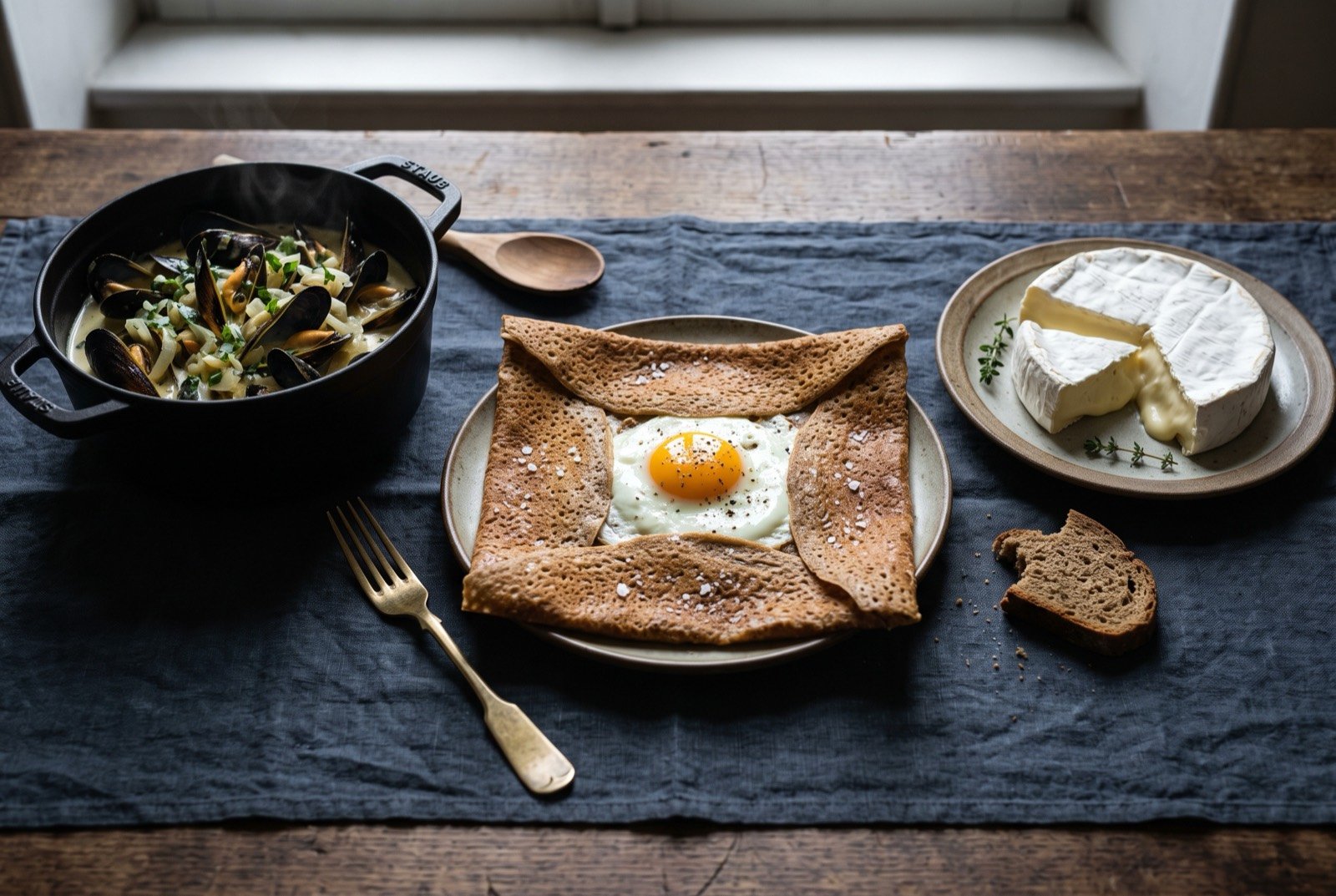
The Atlantic seaboard of France, deliberately not the whole of France: a bocage of dairy cattle and cider apples in Normandy, a Celtic peninsula of buckwheat and salt in Brittany, joined less by a shared cuisine than by a shared refusal of wine, oil and wheat as the default. Two food worlds, one cold sea, and every dish as tradition built it, then what a modern chef would change.
Sources and review · What this chapter does not assert · How we research · Know this better? Tell us
A Sense of Place
Normandy and Brittany sit next to each other on the map and cook from almost opposite premises. Normandy is a dairy country that happens to have a coastline: its logic is grass, cattle, cream, butter, and an orchard economy that turns surplus apples into cider and then, by distillation, into Calvados. Brittany is a granite peninsula that happens to have some good grazing: its logic is poor, acid soil that would not carry wheat, a fishing fleet worked hard enough to have its own strict modern regulation, and a linguistic and cultural identity that sets it apart from the rest of France in a way no other volume in this atlas, so far, has had to account for. The two halves are joined at exactly one point on the map, the Bay of Mont-Saint-Michel, where a single AOP mussel bed and a single AOP salt-marsh lamb straddle a border that, ecologically, barely exists there at all.
Normandy: the bocage, the cow, and what she makes
The bocage normand, a hedgerow-and-meadow landscape of small enclosed pastures, gives near year-round grazing in a mild, wet, oceanic climate. The three-coloured Norman cow, black-striped, blond-fawn and white, with a distinctive "spectacles" marking round each eye, was formalised as a breed in the second half of the 19th century from three older local populations, the Cotentin, the Cauchoise and the Augeronne, officially recognised in the Norman Herd-Book in 1883. Her milk, unusually rich in both fat and protein, is the actual raw material behind the region's whole reputation: the four AOP cheeses, Isigny's AOP butter and cream, and, at one remove, the veal, beef and duck that come off dairy land turned periodically to grazing.
The apple side of the ledger runs in parallel rather than beneath it. Cider apple varieties expanded into the region from the Basque Country from the start of the 16th century, and cider distillation is recorded from the same century; Calvados only became a fully protected AOC in 1984, with its own Domfrontais appellation, pear-inflected and column-distilled, following in 1997. Salt-marsh lamb, agneau de pré-salé, grazes the tidal herbu of the Mont-Saint-Michel bay, a tradition traced to monastic grazing rights from the 11th century, though its AOC only dates to 2009 and full European AOP status to 2013, a pattern worth noticing early: much of what reads as ancient in this chapter is actually old practice given modern legal form quite recently.
Brittany: poor soil, a hard sea, and a language that survives it
Brittany's ecology starts from a harder fact: granite, acid, light soils that struggle with wheat but suit buckwheat, a pseudo-cereal, not a grain, that asks nothing of the ground and matures in about three months. Its coastline is worked by a genuinely rigorous fishing economy, scallop dredging in the Baie de Saint-Brieuc restricted to two days a week and forty-five minutes a tide, langoustine landed at Loctudy and Le Guilvinec under rival "demoiselle" trademarks, oyster farming at Cancale running continuously since the 19th century. And it carries something no other volume in this atlas has needed to address directly: a genuine, still-spoken Brythonic language, brought across the Channel by migrants fleeing Britain between the late 4th and 7th centuries, layered under a 19th and 20th century identity movement that is, as the section below sets out, considerably more recent than it likes to present itself.
Reading the two kitchens side by side
| Element | Normandy | Brittany |
|---|---|---|
| Fat | Butter and thick cream from Norman-breed cattle, Isigny AOP | Salted butter, beurre demi-sel, churned from cultured cream |
| Starch | Wheat, orchard fruit | Buckwheat (blé noir) on poor soil, wheat reserved for sweet crêpes |
| Aromatic base | Cider and Calvados, reduced into cream sauces | Fleur de sel de Guérande; shallot and butter (the lipig sauce); seaweed, a modern rather than ancestral addition |
| Everyday protein, land | Pork, salt-marsh lamb, farmyard duck | Pork (andouille de Guémené), lamb sharing the same Mont-Saint-Michel bay flock as Normandy |
| Everyday protein, sea | Bouchot mussels, four named oyster basins, sole, Channel shellfish | Cancale oysters, Baie de Saint-Brieuc scallops, Loctudy and Le Guilvinec langoustine, cotriade's mixed catch |
| Sweet | Teurgoule, caramel au beurre salé (Isigny) | Kouign-amann, far breton |
The History in Layers
The Brythonic migration into Armorica, real, and what got built on top of it
From the late 4th to the 7th century, Brittonic-speaking Britons crossed the Channel to Armorica, fleeing Anglo-Saxon and Irish pressure on Britain, principally from what is now Cornwall, Wales and the extreme south of Scotland, in numbers estimated at "at least several tens of thousands," bringing with them the Brittonic language that became modern Breton. Monks were prominent among the migrants and founded many of Brittany's abbeys. This part of the story is solidly attested. What is not solidly attested, and what this chapter treats with real care, is the self-conscious "Celtic" identity built on top of it centuries later. A 1997 doctoral thesis by Joseph Rio at Université Rennes 2 traces how Breton self-mythology moved through two successive legendary frameworks between the 9th and 19th centuries, first "Trojanism," then "Celtomania," each serving the political needs of its own moment rather than recording an unbroken memory. Napoleon founded the Académie celtique in Paris in 1804, and European Romanticism's invention of a "Celtic golden age," druids and bards included, fed directly into Breton letters, peaking in 1839 with Théodore Hersart de La Villemarqué's Barzaz Breiz, a collection of songs presented as ancient and contested for its own embellishments ever since. The Breton flag, the Gwenn ha Du, was designed only in 1923 to 1925 and adopted by an explicitly autonomist party in 1927; it only became common at festivals and food events from the 2010s. None of this is invented from nothing: the language is real, the migration is real, and fest-noz, Brittany's collective dance gathering, is real and living enough to have been inscribed by UNESCO on the Representative List of the Intangible Cultural Heritage of Humanity in December 2012. But the packaging around it, the sense that Breton identity is one continuous thread from the 5th century to the last fest-noz, is substantially a 19th and 20th century construction, and Breton scholarship says so about itself.
Attached to France, and what that actually changed at the table
Brittany's formal attachment to the Kingdom of France runs through the 1499 marriage of Louis XII and Anne of Brittany and the 1532 Union Pact, which preserved the duchy's existing privileges rather than dissolving them outright. One of those privileges genuinely mattered for the kitchen: Brittany was exempted from the gabelle, the royal salt tax, one of a handful of "pays exempts" set apart from the heavily taxed Paris basin. Cheap, legal salt is the explanation usually given for Brittany's strong tradition of generously salted butter and salted preservation more widely, and the geography checks out; what does not check out quite so cleanly is a single rigorous study tying the two together, so this chapter states the connection as the plausible, widely repeated explanation it is, not as settled fact.
The Norman duchy, a Viking cession with no traceable food legacy
Normandy's own name records the same kind of layered history: the duchy grew from territory ceded to the Viking leader Rollo, developing what regional history calls a double heritage, Norse and Franco-Roman-Christian. Viking place names survive strongly in the Manche, and the Vikings mostly took over existing towns, Rouen, Bayeux, rather than founding new ones. What this chapter did not find, despite looking, is any credible source tying that Norse settlement to a specific culinary practice, a dish, a dairying method, a way of pressing cider. The dairy economy and the orchard trade read, from everything gathered here, as medieval and early modern developments in their own right, not Viking imports, and the chapter does not claim otherwise.
The AOP and AOC system: old practice, recent protection
A pattern worth naming plainly, because it recurs across almost everything in this chapter's flavour arsenal: the legal protections that now define Norman and Breton products are mostly very recent, even where the practice behind them is centuries old. Camembert de Normandie, Livarot, Pont-l'Évêque and Neufchâtel are each governed by their own INAO cahier des charges, with the requirement that at least half, and in Livarot's case all, of the milking herd be Norman breed only dating to 2017. Calvados reached full AOC status in 1984, Calvados Domfrontais in 1997. The Mont-Saint-Michel bay's bouchot mussels became AOP only in 2011, its salt-marsh lamb AOC in 2009 and full AOP in 2013. Farine de blé noir de Bretagne, Brittany's own buckwheat flour, was homologated as IGP in France in 2008 and recognised at EU level in 2010. None of this means the products themselves are new. It means the paperwork is new, generally a response to industrial-era pressure to protect a genuine regional practice from dilution, and the chapter treats the protections as evidence of that pressure rather than as evidence of the product's age.
Two legends worth naming and setting aside
Two stories recur constantly in writing about this coast, and neither survives real checking. The first is Marie Harel's 1791 invention of Camembert, supposedly handed the recipe by a refractory Brie priest during the Revolution: the priest's own writings place him in the village of Camembert only from 1796 to 1797, and Marie Harel's own birth and death dates do not match the ones carved on her gravestone, a discrepancy one French historical review reads as probable confusion between mother and daughter, both cheesemakers, concluding the whole story is "a romantic tale rather than a precise historical account." The second is that Duchess Anne of Brittany personally introduced buckwheat to the region in the 16th century, debunked directly by Brittany's own cultural heritage body, Bécédia, on the simple grounds that a sovereign could not "order" an agricultural crop into being, and on the harder evidence that buckwheat pollen predates her by millennia, with written mentions in Brittany from 1497, before her reign as duchess had even properly established the political conditions the legend imagines. Both stories persist because they are good stories. Neither is history, and this chapter does not repeat them as if they were.
The crêperie itself is a 19th and 20th century institution
This is, in the researched judgement behind this chapter, the single most important corrective the volume has to offer, because it inverts what most readers will assume walking in. The buckwheat galette is genuinely old: the grain reached Brittany by the 10th century archaeologically and by 1497 in writing, and griddles resembling the modern galettière turn up in medieval excavation at Landévennec Abbey. But the sit-down crêperie, the format almost everyone pictures when they picture Breton food, is not old at all. Bécédia dates the first recognisable crêperie restaurant to 19th century Rennes, a stall on the rue Beaurepaire known as "Poganne," selling a galette, an egg and butter for a sou each; a 1923 guidebook still describes only "crêpes with butter" served with cider or milk, well short of today's format; and the crêperie as an international institution spread mainly through Breton emigrants, notably to 1950s Paris, adapting the dish with diverse fillings much as Italian immigrants adapted pizza in America. Bécédia's own framing is worth quoting in substance rather than smoothing over: Breton food identity today reflects both real cultural roots and a fairly recent, deliberate reinvention, a double movement of disappearance and conservation running at the same time. That is exactly the kind of honest, unflattering history this chapter would rather state than paper over.
The Flavour Arsenal
The four Norman AOP cheeses
Camembert de Normandie, Pont-l'Évêque, Livarot and Neufchâtel are each governed by an Organisation de Défense et de Gestion under INAO oversight, sovereign over its own specification. Livarot, nicknamed "le Colonel" for the five bands of sedge (laîches) traditionally wrapped round its rind, evoking a colonel's stripes, has required exclusively Norman-breed milk since 2017. Neufchâtel, one of the oldest, probably produced from the 6th century in the Pays de Bray, is shaped into a heart, a form popularly explained by a Hundred Years' War legend of young women gifting cheeses to English soldiers, a story worth telling as legend, since no source repeating it treats it as documented fact. The through-line across all four: raw milk, a specified minimum proportion of Norman-breed cattle, and maturation inside the region, the actual content behind the AOP mark, rather than the shape or the packaging.
Isigny butter and cream, AOP since 1986
Isigny has been a centre of the butter trade for centuries, its terroir formally named a "cru herbager prestigieux" as early as 1874. The technical detail that separates Isigny cream from an ordinary commercial one is maturation: the cream is left to mature slowly for 16 to 18 hours before churning, no additives, no extraction agents permitted, a step that builds an aromatic depth a same-day commercial cream simply does not have time to develop.
Cider, and the real difference between fermier and industrial
Fermier cider is made on the farm from the producer's own orchard fruit, fermented slowly with the yeasts already present on the fruit and in the cellar. Industrial cider is mechanised and additive-standardised, pasteurised for shelf stability, and tastes, by French producers' own description, cuit, cooked, of stewed fruit, rather than of fresh apple. Three cider AOCs matter here: Pays d'Auge, whose cahier des charges explicitly forbids pressing by auger screw press, a rule written specifically to stop a 1987 relaxation elsewhere in Normandy that allowed concentrated must to be added back to fresh juice; Cotentin, which tolerates no added water at all and specifies traditional local varieties, Belle Fille de la Manche, Peau de Chien, Petit Amer, Sans Pareille among them; and, in Brittany, Cornouaille, protecting 38 communes of south Finistère since 1996, built from acidic varieties, Judor and Kermerrien, giving a drier, more mineral, "iodised" character than Normandy's rounder, sweeter styles.
Calvados, three appellations, not one
Calvados AOC covers the widest area and either still. Calvados Pays d'Auge requires double distillation in a pot still (alambic charentais) and is the more prestigious of the three. Calvados Domfrontais, the youngest appellation, granted in 1997, requires a minimum 30% perry pears alongside the cider apples and single distillation in a column still. The three are genuinely different spirits, not marketing tiers of the same one, and a chapter or a cellar that treats them interchangeably is missing the actual argument of the appellation system.
Buckwheat, blé noir, IGP since 2008
Not a cereal but a pseudo-cereal, native to Asia, thriving specifically where wheat cannot: poor, light, acid soils, no chemical inputs needed, a three-month growing cycle. Regionally uneven even within Brittany, nearly absent around the Gulf of Morbihan, up to 40% of arable land in Ille-et-Vilaine by 1866. The protected IGP specifies the grain must be grown, stored and milled within historic Brittany, and covers what is genuinely the region's founding staple starch, the wheat crêpe being the later, sweeter exception rather than the rule.
Fleur de sel and sel de Guérande, IGP since 2010
Two different products from the same salt pan, not one product marketed two ways. Sel de Guérande, grey, harvested from the bottom of the pan in contact with the clay, is the everyday cooking and seasoning salt. Fleur de sel, white, hand-skimmed off the surface with a wooden tool called a lousse, forming only on the hottest, driest, most wind-favourable days, is a finishing salt, fine and friable, never a cooking one. Confusing the two is a real, avoidable technical mistake, not a matter of preference.
Andouille de Vire and andouille de Guémené, two different products often run together
Andouille de Vire is Norman, made in Vire, Calvados, from the pig's chaudins, cleaned, rolled, stuffed into a natural casing and cold-smoked, traditionally over beechwood, for more than a month; it received Indication Géographique Protégée status in 2019. Andouille de Guémené is Breton, made at Guémené-sur-Scorff in the Morbihan, with its own distinct method and reputation. One French source puts the confusion bluntly: Vire's andouille, star of the genre, is "sadly, not Breton." This chapter keeps the two separate deliberately, since the mix-up is genuinely common in English-language writing about the region.
Beurre demi-sel, Bordier and Le Gall
Genuine Breton salted butter is churned from cultured, lightly fermented cream in a wooden churn, giving a tang and a supple texture ordinary sweet-cream butter lacks, salted at 0.5 to 3% with visible, crunchy salt crystals rather than dissolved salt. Bordier, of Saint-Malo, is hand-worked in a wooden malaxeur for 15 to 25 minutes after churning to aerate it, a labour-intensive process that shows directly in the finished texture. Whether Breton demi-sel holds any AOC or AOP protection of its own, unlike Isigny's butter, could not be confirmed in this chapter's research and should not be assumed.
Bouchot mussels, one AOP spanning both halves of this volume
The only mussel with a European quality label in France, grown on wooden stakes across eight communes of the Mont-Saint-Michel bay, Breton and Norman shoreline both, since the AOP's grant in 2011, though bouchot farming at scale in this specific bay only began in 1954. Mussel larvae are caught on fibre ropes in April and May, then wound round the bouchots for a minimum of 11 months before harvest, exposed to air twice daily by the tide, unlike a permanently submerged rope-grown mussel.
Langoustine, two rival names for the same fishery logic
Loctudy, in the Pays bigouden of south Finistère, France's fifth-largest fishing port, markets its catch as "Demoiselles de Loctudy," a registered trademark; neighbouring Le Guilvinec defends its own "demoiselle" name for langoustine from the same Grande Vasière fishing zone, a real and ongoing rivalry rather than one settled name. Normandy has its own, older and separate demoiselle tradition, Demoiselles de Cherbourg, small lobsters or langoustines in court-bouillon, attested from at least 1908 in the Cotentin. The two "demoiselle" traditions are not the same thing wearing two names; they are genuinely separate regional claims, and this chapter keeps them apart.
The Technique Ladder
Six techniques, each explained by why it works, not only what it does.
Rung 1. The buckwheat batter's rest
The buckwheat batter's rest. Buckwheat flour has no gluten to develop, so what a long rest, professional crêperies favour something close to a full day, actually does is hydrate the flour completely and let its starches and any residual enzymatic activity settle, producing a batter that spreads thin without tearing and cooks with a clean, nutty flavour rather than a raw, grainy one. Skipping the rest, or using flour that has sat open and stale for months, is the most commonly cited reason a galette comes out gluey rather than lace-thin.
Rung 2. Cream-and-cider reduction, Normandy's own finishing method
Cream-and-cider reduction, Normandy's own finishing method. Cider's acidity, reduced hard alongside aromatics, cuts and lifts the fat of cream and butter rather than simply adding to it, the reason poulet vallée d'Auge and moules à la crème normande both read as rich without reading as heavy. The technique fails when a thin, sweet, industrial cider is substituted for a properly tannic fermier one: there is not enough acid structure left after reduction to do the actual work.
Rung 3. Shellfish timing, cut short, not simmered long
Shellfish timing, cut short, not simmered long. Mussels are done the instant roughly 80% of the shells have opened, because residual heat keeps cooking them for several minutes after the pan comes off the heat; scallops want no more than a minute a side in a genuinely hot pan, pulled while the centre is still faintly translucent; langoustine wants as little as sixty seconds in well-salted boiling water before an immediate plunge into ice. In every case the failure mode is the same, cooking to a fixed time rather than to a visual cue, and it is the single most repeated cause of rubbery, disappointing Atlantic seafood in both amateur and tourist-trade kitchens.
Rung 4. Lamination under strict temperature discipline, kouign-amann's actual secret
Lamination under strict temperature discipline, kouign-amann's actual secret. The butter, folded into the dough in the same repeated-turn method as a croissant, must stay cold and firm at every stage; if it melts during a fold it incorporates into the dough rather than staying as a distinct layer, and the lamination is, in the words of one French source, irreparably ruined, the difference between a pastry that shatters into caramelised layers and one that collapses into a dense, greasy cake.
Rung 5. Restraint on salt-marsh lamb
Restraint on salt-marsh lamb. Because the animal's own diet of tide-exposed, salt-tolerant marsh plants has already seasoned the meat from the inside, the AOC's own cooking guidance is explicit that simple technique, a hot sear, a slow roast, a basting of the animal's own fat, a little thyme, is what the product actually calls for. Heavy seasoning or an elaborate sauce does not elevate pré-salé lamb, it defeats the entire point of the designation.
Rung 6. The sealed, low, long braise, tripes à la mode de Caen's method
The sealed, low, long braise, tripes à la mode de Caen's method. Cooking the four parts of tripe with a beef foot inside a stoneware tripière, its lid sealed shut with a flour-and-water paste so no liquid or aroma escapes, for many hours at a low, steady heat, is doing exactly what modern sous vide does by different means: holding a sealed, humid, low-temperature environment long enough for tough collagen to convert fully into gelatine without the meat drying out, a genuinely old technology for the same physics a water bath now automates.
The Ferment and Preserve Bench
Three preparations, each a genuine preservation technology rather than a modern flourish.
1. Cider, into Calvados
Cider, into Calvados. Fermentation is itself the first preservation step, turning perishable apple juice into something that keeps; distillation is the second, concentrating that preserved liquid into a spirit that keeps for decades and improves with age in oak. The Pays d'Auge and Domfrontais AOCs protect two genuinely different versions of this same chain, pot-distilled apple-only Calvados against column-distilled, pear-inflected Domfrontais, both built on the same underlying logic of turning a fragile harvest into something durable.
2. Andouille, smoked and dried
Andouille, smoked and dried. Both andouille de Vire and andouille de Guémené preserve the pig's less noble cuts, the chaudins, by cleaning, salting, stuffing and a long, slow cold smoke, traditionally over beechwood for more than a month. This is a genuinely old rural technology, using a whole animal rather than wasting a part of it, not a rustic affectation revived for its texture alone.
3. Salted butter, and the exemption that let it happen
Salted butter, and the exemption that let it happen. Brittany's freedom from the gabelle gave it comparatively cheap, legal salt at a time when much of France did not have it, the widely repeated, plausible though not rigorously proven explanation for a butter tradition that salts generously rather than sparingly. Salt at 0.5 to 3% by weight, worked through a cultured, already slightly fermented cream, extends the butter's keeping life while building the tang that defines it, preservation and flavour arriving from the same technique rather than two separate decisions.
Sourcing in Britain
The butter, before anything else
The butter, before anything else. Genuine cultured, hand-churned Breton demi-sel changes more dishes in this chapter than any other single substitution: Bordier (Saint-Malo), stocked in the UK by La Fromagerie, hand-worked in a wooden malaxeur for 15 to 25 minutes after churning; or Le Gall, an AOP Breton butter certified since 1986 and, genuinely usefully, stocked by ordinary UK supermarkets including Tesco, making it the realistic weekly-shop choice rather than a special-order one. If neither is to hand, a good cultured, hand-finished English or Welsh salted butter with visible salt crystals from a specialist creamery is the honest fallback, though it will lack Breton butter's specific cultured tang; no UK butter should be presented as a true substitute for Bordier's flavour, only its function.
The cheeses, and reading the label properly
The cheeses, and reading the label properly. Camembert de Normandie AOP, Livarot AOP, Pont-l'Évêque AOP and Neufchâtel AOP are all findable in the UK, from Fine & Wild, Pong Cheese, Jones the Grocer and The Artisan Food Company among others, though stock rotates and small-batch soft cheeses go in and out. The single most important check is on the label itself: raw milk (lait cru) and the AOP roundel both stated explicitly, since retailer copy is not always reliable on this point, one UK stockist found selling a "Camembert au lait cru" whose own specification sheet stated pasteurised milk. "Fabriqué en Normandie," made in Normandy but pasteurised, is a legally distinct, lesser product from the AOP cheese itself, whatever the packaging implies.
Calvados
Calvados. Christian Drouin, widely stocked at Master of Malt, is the strongest single house to buy from for this chapter's purposes, since it separately bottles both Pays d'Auge and Domfrontais expressions, letting a cellar hold the genuine difference between the two rather than one generic "Calvados." Boulard and Père Magloire are both also confirmed UK-stocked, at The Whisky Exchange and Master of Malt respectively. Read the label for the AOC name itself, Pays d'Auge or Domfrontais or plain Calvados, and treat anything sold only as "apple brandy" as a different, unregulated product.
Cider for cooking
Cider for cooking. This is genuinely the hardest category in the whole sourcing dossier. Fournier and Cinq Autels, both real, bittersweet Norman ciders, are stocked by Beers of Europe and Vintage Roots respectively; the benchmark producer, Domaine Dupont, could not be confirmed as UK-available at all in this research and should not be assumed sourceable. Where a true bittersweet French cider cannot be found, the honest substitute is a traditional-method English farmhouse cider genuinely made from bittersweet cider apples, Dabinett, Yarlington Mill or Kingston Black, from a Somerset or Herefordshire producer, not a mainstream dessert-apple cider like Aspall or Thatchers, which is markedly less tannic and will reduce to something thinner and sweeter than the dish needs.
Buckwheat flour
Buckwheat flour. Treblec, milled in Brittany specifically for galette-making, is stocked by several UK French grocers including French Click and BonneBouffe, and is the first choice for a genuinely Breton result. Doves Farm's organic stoneground wholemeal buckwheat flour, UK-milled from imported grain and widely available at ordinary supermarkets, is an entirely respectable, always-available fallback, the difference between the two closer to good versus best than wrong versus right.
Fleur de sel de Guérande
Fleur de sel de Guérande. Sous Chef UK stocks Terre Exotique's, correctly marked IGP. Genuine fleur de sel is pale grey-white, slightly damp and irregular in crystal size, never bone-dry or bright white; a generic "French sea salt" without Guérande named on the label is not the same product, whatever the name on the tin implies.
Seafood
Seafood. Bouchot mussels have no true UK equivalent, but Shetland and Scottish rope-grown mussels, MSC-certified since 2012, are the right technique if not the same product, suspension-grown rather than dredged, giving the same clean, thin-shelled result. For scallops, look specifically for "hand-dived" or "diver-caught" rather than "hand cut," which usually only describes hand-shucking of a dredged scallop, a genuine and easily missed distinction; Tom's Hand Dived Scallops and King Crab both confirmed genuinely diver-harvested stock. Langoustine is the least compromised substitution in this whole chapter: Scottish langoustine, available through The Fish Society among others, is what much French-served langoustine actually is to begin with.
Salt-marsh lamb
Salt-marsh lamb. Romney Marsh lamb, from Kent, is recognised by Slow Food UK's Ark of Taste and available from several named butchers; strikingly, roughly 90% of UK salt-marsh lamb is exported to France, where it is prized by French chefs, meaning the "substitute" is very often literally the same product the French market itself buys. Gower salt marsh lamb, from Wales, holds UK Protected Designation of Origin status, the first new food recognised under Britain's post-Brexit geographical indication scheme in August 2021, and is available direct from Gower Salt Marsh Lamb Ltd. Both work for the same reason the French original does: sheep grazing directly on salt-tolerant coastal plants, pre-seasoning the meat from the inside.
Kit
Kit. A dedicated billig, Krampouz's own reference model, is genuine but expensive catering equipment, £300 to £600 and up, sold in the UK mainly through catering suppliers. A more proportionate home alternative is Netherton Foundry's British-made spun iron crêpe pan, pre-seasoned, oak-handled, stocked by Sous Chef UK and Borough Kitchen, giving the flat, responsive iron surface the technique actually needs without the catering-scale spend. A wooden rozell, or T-stick spreader, correctly named as such, is sold cheaply by CFW.
The single decision that matters most
The single decision that matters most. A real, bittersweet, tannic cider over a sweet, thin one, for anything reduced. It is the ingredient most likely to be casually substituted wrong, because "cider is cider" to most UK shoppers, and the one where getting it right costs almost nothing extra: the difference in the finished poulet vallée d'Auge or moules à la crème normande between a properly structured reduction and a thin, sweet one traces back to this single choice more than to any other.
Voices and Sources
Official and regulatory sources
Official and regulatory sources: INAO's own product pages and cahiers des charges for Camembert de Normandie, Livarot, the Norman and Breton cider and Calvados AOCs, the Mont-Saint-Michel bay's bouchot mussels and salt-marsh lamb, and the buckwheat flour and Guérande salt IGPs; Légifrance for the buckwheat flour's homologating decree; the UK's own Defra for Gower salt marsh lamb's Protected Designation of Origin.
French national and regional press
French national and regional press: France Info, a national broadcaster, for the Isigny caramel history and Cotriade's fishermen's-food origin; France 3 Régions, French public regional broadcaster, for the andouille de Vire and Livarot clarifications and for current chef-status reporting in Caen and Rouen; regional and departmental tourism boards, Ille-et-Vilaine, the Côtes-d'Armor prefecture and the Côtes-d'Armor fishermen's committee CDPMEM22, for the Baie de Saint-Brieuc scallop fishery's regulation in direct detail.
Breton heritage scholarship
Breton heritage scholarship: Bécédia (bcd.bzh), Bretagne Culture Diversité's own cultural encyclopaedia, used repeatedly and directly as the strongest single source in this chapter for the honest, invented-tradition argument about the crêperie and for the buckwheat myth-busting; Joseph Rio's 1997 doctoral thesis at Université Rennes 2 on the origins of Breton celtomania; UNESCO's own inscription record for fest-noz.
Named chefs and restaurants, contemporary reference points for the elevation half of this chapter
Named chefs and restaurants, contemporary reference points for the elevation half of this chapter: Olivier Bellin of L'Auberge des Glazicks, Plomodiern; Nicolas and Solenn Conraux of La Table de la Butte, Plouider, whose fermentation programme, koji, shio koji, miso, is treated here as the clearest working model of a genuinely indigenous-adjacent elevation technique; Olivier Roellinger, for the Cancale spice trade history behind his still-active spice house; Julien Lemarié of Ima, Rennes, for seaweed sourced directly from a named grower; Alexandre Bourdas of SaQuaNa, Honfleur; Pierre Caillet of Maison Caillet, Valmont; Arnaud Viel of La Renaissance, Argentan, whose published langoustine trilogy is a direct source for this chapter's technique ladder. Julie Andrieu, French food broadcaster and writer, for the poulet vallée d'Auge recipe this chapter draws its quantities from.
On UK diaspora cooking
On UK diaspora cooking: genuinely little was found, and this chapter treats that absence as a finding rather than a gap in the search. No credible, seriously regarded UK restaurant specifically cooking elevated Norman or Breton food, beyond galette-and-crêpe level, turned up in the research behind this chapter.
Things this chapter has deliberately not asserted
- That Marie Harel invented Camembert in 1791 after receiving the recipe from a refractory priest. The documentary record contradicts the story's own dates, and it is presented here as legend.
- That Duchess Anne of Brittany personally introduced buckwheat to the region. Brittany's own heritage scholarship debunks this directly; buckwheat predates her by centuries.
- That Breton "Celtic" identity is one unbroken thread from the 5th century migration to the present. The migration, the language and fest-noz are real; the self-conscious Celtic revival apparatus, the flag, the bardic imagery, is substantially a 19th and 20th century construction, argued by Breton scholarship about itself.
- That the sit-down crêperie is an ancient Breton institution. It is a 19th and 20th century format, and this chapter treats that as the single most important corrective it has to offer.
- That beurre blanc belongs to this volume as a Norman technique. It is a late 19th century Nantes and Loire sauce, and is excluded here rather than claimed.
- That homard à l'armoricaine, under either spelling, is a genuinely Norman or Breton dish. Its most credibly documented origin is a Paris restaurant run by a chef from the Languedoc coast in 1854; the "armoricaine" spelling is a 1938 rebranding, not a recovered regional truth, and it is not given a home-dish treatment here.
- That andouille de Vire or Demoiselles de Cherbourg are Breton. Both are confirmed Norman, and are kept apart in this chapter from their genuinely separate Breton equivalents, andouille de Guémené and the Demoiselles de Loctudy or Guilvinec.
- That Brittany has a rich, ancient seaweed cuisine. The harvesting economy is old and real, mostly agricultural in purpose; the food tradition beyond famine food and one minor flan use is thin, and its current culinary prominence in Breton fine dining is a modern development, not an inherited one.
- That Vikings shaped Norman dairying, cider-making or any specific dish. No credible source connecting Norse settlement to Norman culinary practice was found.
- That Brittany's gabelle exemption is proven to be the direct cause of its salted-butter tradition. The connection is plausible and widely repeated, not traced to a single rigorous study.
- Whether Breton demi-sel butter holds any AOC or AOP protection of its own. Not confirmed.
- A single fixed ratio for kouign-amann. Named Douarnenez bakers themselves disagree by a wide margin, and a range is given instead.
- Fixed historical quantities for far breton or caramel au beurre salé. No specific traditional recipe with real quantities survives in the sourcing behind this chapter for either dish; the method is given honestly instead of an invented precision.
- Cotriade's precise regional origin. Sources conflict between two different centuries and areas, and the dispute is stated rather than resolved.
- Any named, currently operating UK restaurant seriously cooking elevated Norman or Breton food. None was found in the research behind this chapter.
- That American ration exchanges for Norman produce during the 1944 landings are documented history. The claim is plausible and widely repeated but was not traced to a credible primary or academic source, and is not asserted here.
The buckwheat batter's rest
The buckwheat batter's rest. Buckwheat flour has no gluten to develop, so what a long rest, professional crêperies favour something close to a full day...
Cream-and-cider reduction, Normandy's own finishing method
Cream-and-cider reduction, Normandy's own finishing method.
Shellfish timing, cut short, not simmered long
Shellfish timing, cut short, not simmered long.
Lamination under strict temperature discipline, kouign-amann's actual secret
Lamination under strict temperature discipline, kouign-amann's actual secret.
Restraint on salt-marsh lamb
Restraint on salt-marsh lamb. Because the animal's own diet of tide-exposed, salt-tolerant marsh plants has already seasoned the meat from the inside, the...
The sealed, low, long braise, tripes à la mode de Caen's method
The sealed, low, long braise, tripes à la mode de Caen's method.
The dishes
- Poulet vallée d'Auge Pays d'Auge, Normandy
- Tripes à la mode de Caen Caen, Normandy
- Moules à la crème normande Normandy
- Teurgoule Normandy
- Caramel au beurre salé, Isigny Isigny, Normandy
- Galette de blé noir Brittany
- Kig ha farz Léon, north Finistère, Brittany
- Kouign-amann Douarnenez, Brittany
- Far breton Brittany
- Cotriade Brittany
- Coquilles Saint-Jacques à la bretonne Baie de Saint-Brieuc, Brittany
Sources and review
- Researched
- Researched from 72 sources in the brief
Where this volume comes from
4 research briefs on file for this volume, researched to the rules on How we research. Published 28 August 2026. Last changed 20 September 2026.
The brief's own account of its sources
Normandy half: of roughly 20 to 25 distinct sources drawn on, an estimated 8 to 9 are strong, in-tradition or official (INAO cahiers des charges and product pages, France Info, the Calvados interprofession as far as accessible, the official Norman cattle breed body, Wikimanche, Julie Andrieu as a named French food broadcaster), covering the AOP and AOC framework, the Norman cattle breed, Isigny butter and caramel history, the pré-salé lamb AOP, oyster basin history and the poulet vallée d'Auge recipe.
One time here is our estimate, from comparable dishes in this atlas.