France and the Alps · Volume 11, Butter, Cider and the Buckwheat Line
Kouign-amann
Douarnenez, Brittany
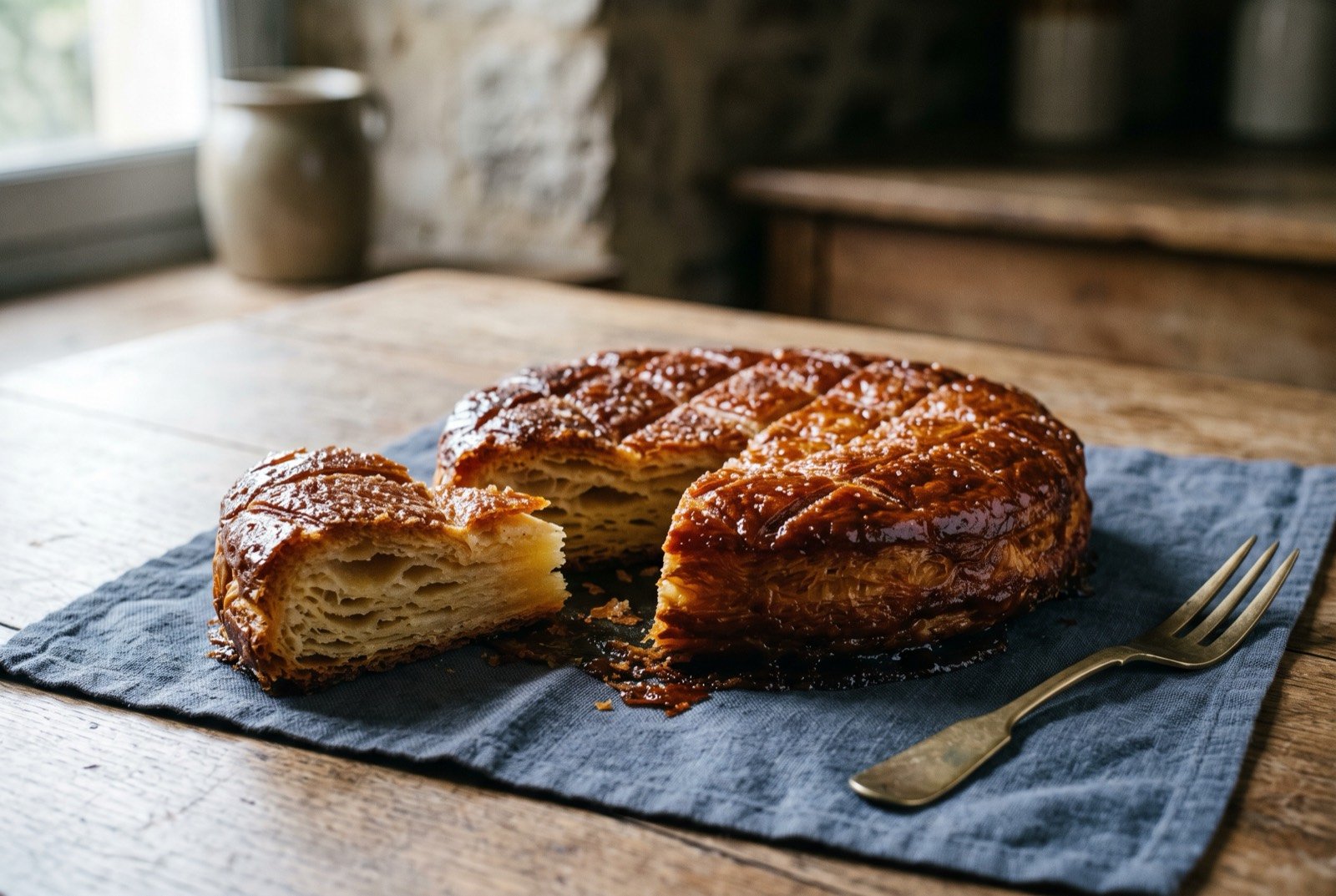
An illustration of the dish, not a photograph of it cooked.
- Time
- About 1 hour to 1 hour 45No source states a time. Comparable dishes in this atlas take this long.
- Reviewed
- Not yet reviewed from inside the tradition
- Cooked
- Not yet cooked and reported
Legend credits its invention around 1860 to Yves-René Scordia, a Douarnenez baker who, the story goes, improvised a new recipe from bread dough, butter and sugar on a day when flour ran short but butter did not, rather than turn a customer away.
As tradition built it
Proof 1½ to 2 hours in a mild, humid environment, no hotter than about 27°C, then bake about 20 minutes at 190°C.
Ingredients
One cited ratio
- 400 g flour
- 300 g butter
- 300 g sugar
Association-defined standard, per 200 g flour
- 200 g flour
- 150 g butter
- 150 g sugar
Method
- Fold the butter and sugar into the flour-based bread dough through repeated turns, on the same principle as a croissant's lamination.
- Score the top in a diamond pattern.
- Proof in a mild, humid environment, no hotter than around 27°C, so the butter never threatens to melt out of the dough before baking.
- Bake so the butter-sugar mixture weeps through the layers and caramelises on the surface.
Notes
Ratios genuinely vary, even among named Douarnenez bakers; no single source resolves the spread, so a range is given rather than one false authority.
What a modern chef changes
Cold lamination held to the letter, cultured demi-sel, and a Big Green Egg bake
Rung 4
Method
- Hold the fridge and the work surface properly cold throughout every fold, following the lamination rung to the letter, since this dish's whole character depends on the butter staying a distinct layer rather than incorporating into the dough.
- Use a genuinely cultured, hand-worked salted butter, Breton demi-sel where it can be found, rather than a plain unsalted butter with salt added separately, for the tang that a straightforward butter-and-sugar lamination is actually built to carry.
- Bake in a Big Green Egg run as a very hot, steady oven with a pizza stone, closer to a wood-fired bakery's radiant heat than a domestic electric oven manages, watching the surface rather than the clock, since no reliably sourced baking time survives in the tradition this chapter could confirm.