Central Europe · Volume 18, Lye, the Purity Myth and the Alp Next Door
Allgäuer Kässpatzen
The Allgäu
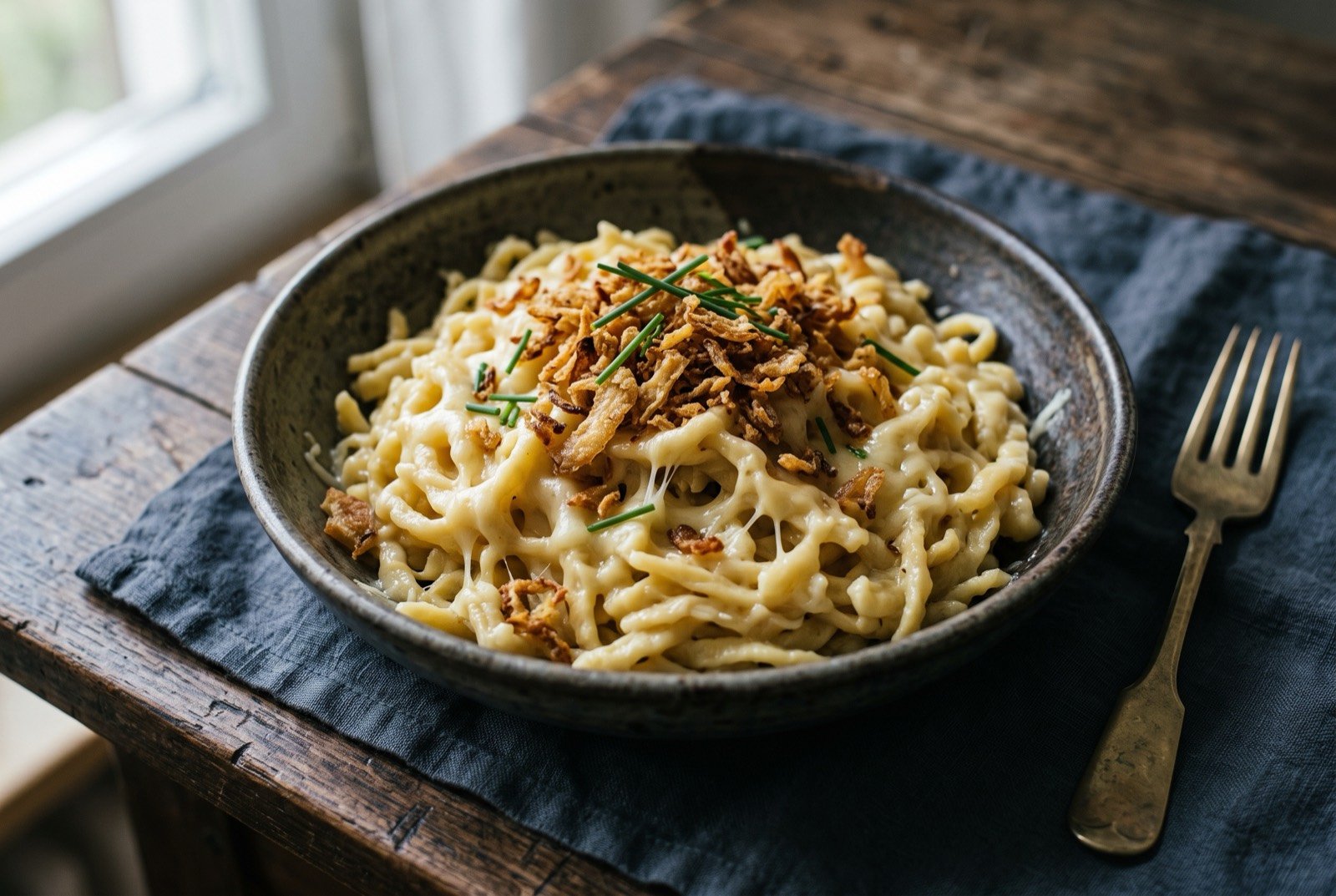
An illustration of the dish, not a photograph of it cooked.
- Time
- 1 hour
- Researched
- 11 sources cited
- Reviewed
- Not yet reviewed from inside the tradition
- Cooked
- Not yet cooked and reported
A 19th-century farmer and herder's dish, now the region's acknowledged national plate.
As tradition built it
Serves 4 to 6. About 1 hour.
Ingredients
- 600 g Spätzle or spelt flour
- 6 eggs
- as needed water, as needed
- 1 tsp salt
- 250 g aged Bergkäse, grated
- 200 g young Bergkäse, grated
- 50 g Weisslacker cheese, grated
- 100 g butter
- 3 onions, thinly sliced
- to finish chives, to finish
Method
- Whisk the flour, eggs, salt and enough water to form a thick, sticky batter that falls reluctantly from a spoon. Beat vigorously, at least 100 strokes, to develop the gluten, then rest, covered, 20 minutes.
- Bring a large pan of salted water to a full rolling boil.
- Scrape the batter from a wet board, or push through a Spätzlehobel, directly into the water in batches small enough that the water never drops off the boil. Lift out with a slotted spoon once the noodles float, roughly 2 to 3 minutes.
- Meanwhile, fry the onions slowly in half the butter until deep golden.
- Layer the drained Spätzle with the three cheeses, aged Bergkäse, young Bergkäse and Weisslacker, in a warm pan or gratin dish, tossing over gentle heat, or under a hot grill, until the cheese fully melts through every layer.
- Top with the fried onions, a final knob of butter and chives.
What a modern chef changes
Hand-scraped batter for the rough, sauce-clinging surface a pressed noodle cannot give
Rung 4
Method
- Scrape every portion by hand from a wet board rather than pressing through a Hobel, accepting the slower pace for the irregular shapes, thin edges and thicker core that genuinely hold more melted cheese, exactly the trade-off Vincent Klink names when he calls the hand-scraped version a luxury-kitchen technique now.
- Confit the sliced onions in butter at a low, held 90°C rather than frying them over direct heat, for a fully even, no-catch caramelisation before a final, brief blast in a hot pan just to crisp the edges.
- Finish the gratin under a Big Green Egg run indirect at a high, controlled heat rather than a domestic grill, for a more even melt and a properly blistered top without scorching one edge before the centre catches up.