Central Europe · Volume 18, Lye, the Purity Myth and the Alp Next Door
Laugenbrezel
Bavaria and Swabia both
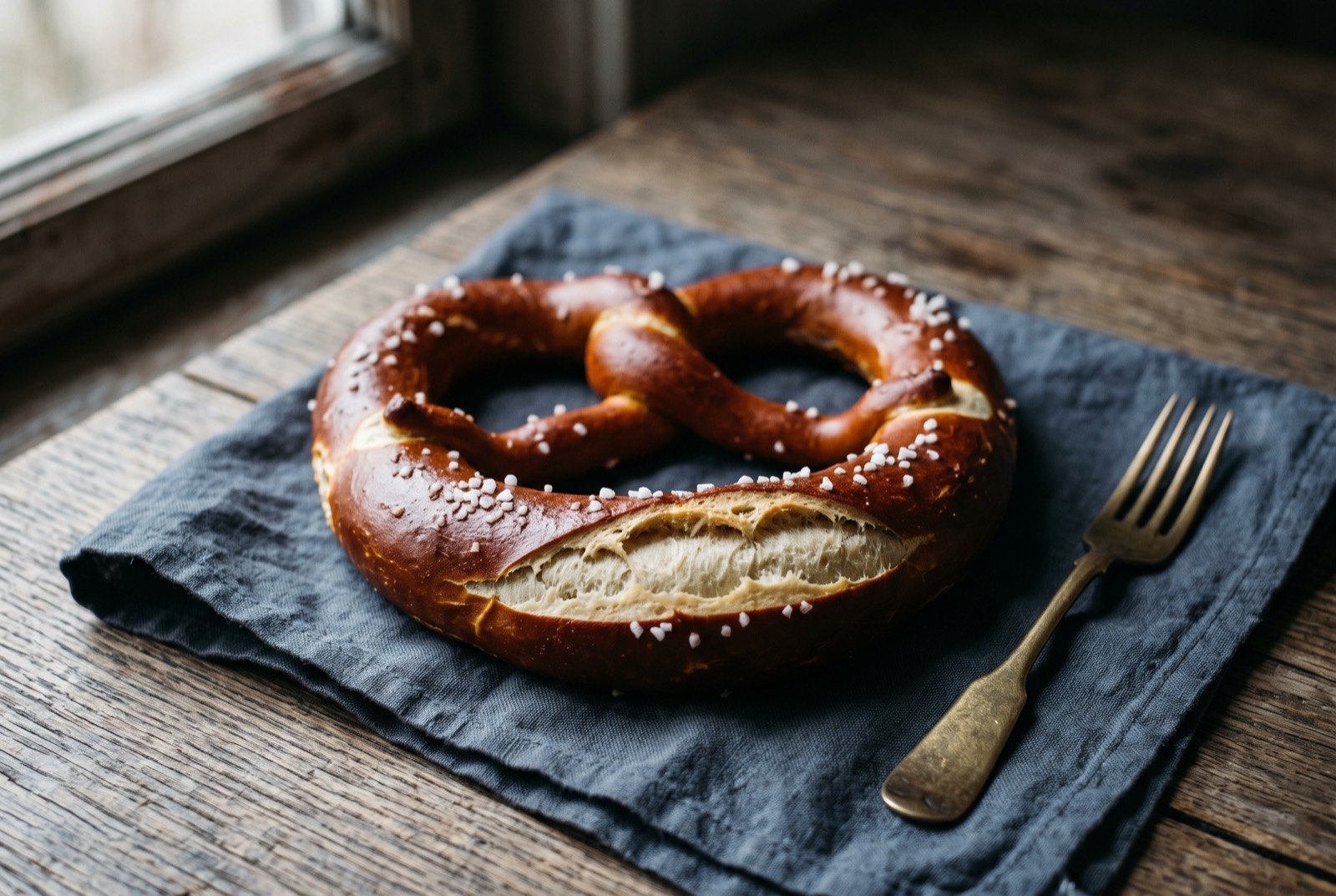
An illustration of the dish, not a photograph of it cooked.
- Time
- 3 hours
- Researched
- 11 sources cited
- Reviewed
- Not yet reviewed from inside the tradition
- Cooked
- Not yet cooked and reported
Though the crust chemistry belongs to neither exclusively. The origin legends are all explicitly folklore; see the history above.
As tradition built it
Makes 8 pretzels. About 3 hours including proving.
Ingredients
- 500 g strong white bread flour
- 300 ml water, lukewarm
- 7 g fast-action yeast
- 10 g malt syrup or brown sugar
- 40 g unsalted butter, softened
- 10 g fine salt
- 1 litre water
- 30 g food-grade sodium hydroxide (or 60 g bicarbonate of soda, see below)
- to finish coarse pretzel or sea salt, to finish
Method
- Combine the flour, water, yeast and malt in a stand mixer and knead 8 minutes, then work in the butter and salt and knead a further 5 minutes until smooth and elastic.
- Prove, covered, 1 hour, until doubled.
- Divide into 8 pieces, roll each into a long rope roughly 60 cm, and shape into the classic pretzel twist.
- Rest the shaped pretzels uncovered in the fridge for at least 1 hour, or ideally overnight; a dried surface is what lets the lye grip properly rather than sliding off.
- Wearing gloves and eye protection, dissolve the sodium hydroxide in the litre of water in a non-aluminium pan, taking care never to add water to the pellets rather than the reverse. Dip each pretzel in the solution for 15 seconds, then lift out onto a lined tray.
- Score each pretzel's thick belly with a sharp blade, scatter with coarse salt, and bake at 220°C for 12 to 15 minutes, until deep chestnut brown.
- If lye is unobtainable or unwanted, dip instead in a solution of 60g bicarbonate of soda per litre of water, boiled briefly first to increase its alkalinity; the crust will be a shade paler and less glossy but the pretzel is otherwise the same.
What a modern chef changes
A long cold ferment for real crumb development, and a properly measured lye bath rather than a guessed dip
Rung 1
Method
- Replace the same-day dough with a pre-ferment made a day ahead, a small portion of the flour, water and yeast left to bubble for 12 to 18 hours before the main dough is built around it, then an overnight cold prove for the shaped pretzels rather than the one-hour room-temperature rest above. This is the documented reason bakery pretzels vary so much: fast industrial dough-handling is a genuine, named cause of underdeveloped aroma, and the extra time is doing real work, not tradition for its own sake.
- Weigh the lye solution to an exact percentage by weight rather than a rough dissolve, using a kitchen scale rather than volume measures, since the whole safety argument for lye baking rests on staying at or below 4% concentration, not on caution alone.
- Dehydrate a portion of the finished, cooled pretzels at a low, controlled heat and grind them to a coarse crumb in a spice grinder, folding the crumb through soft butter as a pretzel-crust butter to serve alongside a fresh batch, a way of using the crust's own Maillard flavour twice rather than once.