Europe · Volume 18
Bavaria, the Alps and German Switzerland
Lye, the Purity Myth and the Alp Next Door
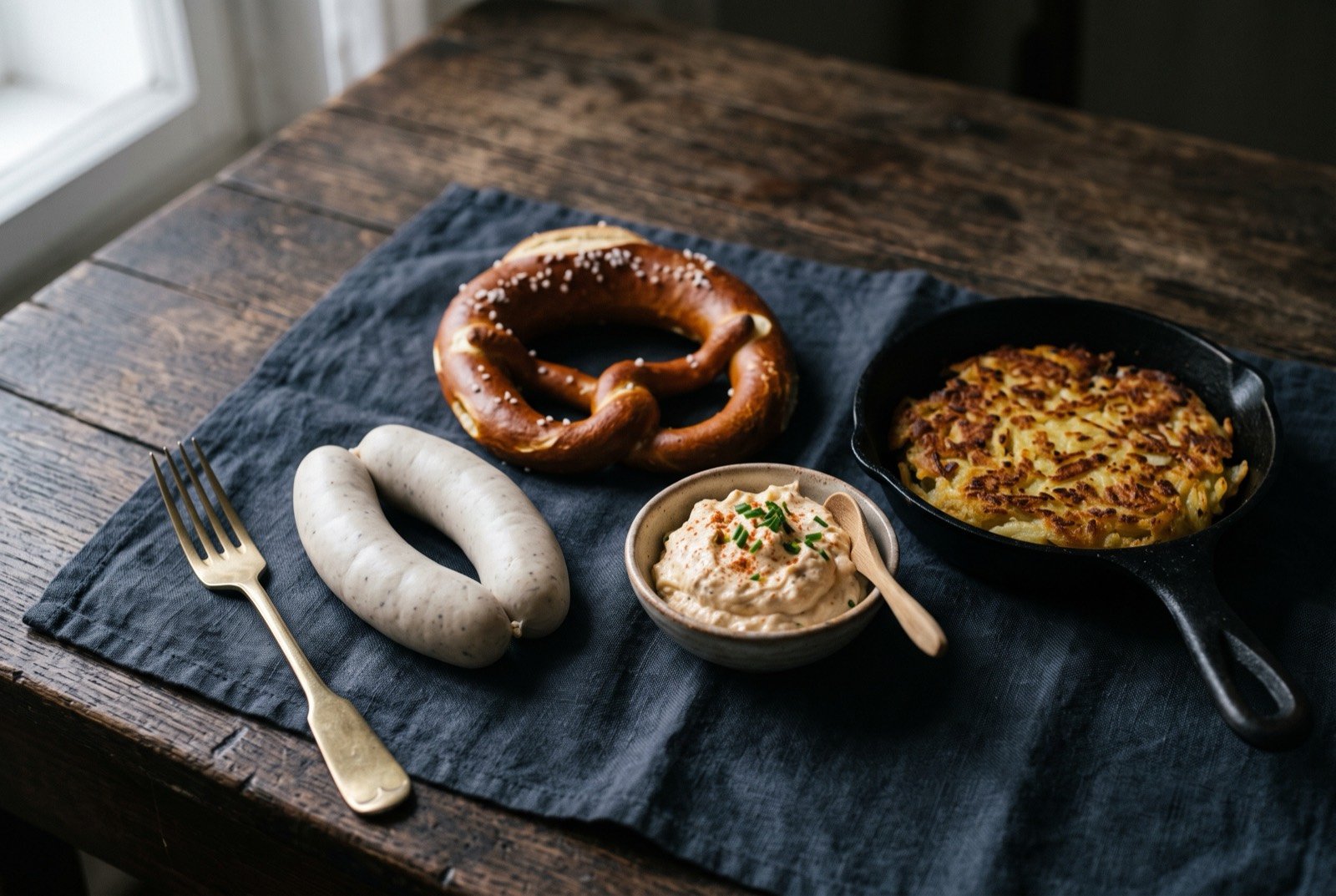
Bavaria and Swabia taken on their own terms, a beer, pork and dumpling world stranger than its tourist board tells it. Not lederhosen and a stein, but a purity law that is not what it claims to be, a sausage that must never hear noon, and a caustic bath that turns a bread roll into something else entirely. Every dish as tradition built it, then what a modern chef would change.
Sources and review · What this chapter does not assert · How we research · Spotted something wrong?
A Sense of Place
This volume covers two things deliberately held at different depths, and that imbalance is a decision, not an oversight. Bavaria and Swabia, the beer, pork, dumpling and lye-baking world of southern Germany, get the full treatment: a sense of place, a history in layers, a flavour arsenal, a technique ladder, dishes given twice. German-speaking Switzerland gets a light touch, because its Alpine dairy world, the copper vats, the transhumance, the washed rinds, was already written in full in this atlas's Volume EU-16, which covers Savoie and French-speaking Switzerland as one continuous mountain grammar that does not respect its own national border. EU-16's own text hands four dishes across that border in the other direction, naming them explicitly as belonging to "a future Central Europe volume": Rösti, Zürcher Geschnetzeltes, Älplermagronen and Bündnerfleisch. This is that volume. Fondue and raclette are not covered here at all: they belong to EU-16, and a reader wanting them should go there.
The grammar underneath Bavaria and Swabia is a lowland-to-Alpine dairy and pork economy, structurally related to but distinct from Savoie's. Fat is pork lard and butter before it is anything else, with the Allgäu's alpine dairy standing as Bavaria's own cheese country, built not by ancient custom but by a dated 19th-century reform: the agronomist Carl Hirnbein, recognising the Allgäu's poor soils could not sustain flax, studied cheesemaking in Belgium and Switzerland and introduced Emmentaler-style round-cheese production around 1830, the direct origin of Allgäuer Emmentaler. Starch is wheat, worked two ways that between them define this cuisine's whole character: as a soft egg noodle, Spätzle, scraped or pressed into boiling water, and as a lye-dipped bread, Brezel, whose crust depends on a genuinely caustic chemical bath. Protein is pork above all, veal for ceremony and Sunday tables, with beef a secondary meat. Aromatics are marjoram, caraway and a sweet, coarse mustard invented by name in 1854, not folk tradition beyond memory. Beer is not a beverage alongside the food so much as a cooking liquid, a basting agent and a civic institution in its own right, one this chapter spends real time getting right rather than repeating uncritically.
Two peoples, not one, sit inside "Bavaria" as a British reader is likely to imagine it. Altbayern, Old Bavaria proper, is Wittelsbach court territory, Catholic, beer-and-pork, its rural cooking gradually refined for ducal and royal use from the medieval period and then filtering back down into 19th-century bourgeois kitchens. Swabia is a different cultural region entirely, historically Württemberg, Bayerisch-Schwaben and the Allgäu, a region that does not map onto today's state borders, its cuisine drawn by more than one source as "rather simple and down to earth" against Bavaria's "culinary self-confidence: regional, rustic, and hearty." Confessional geography sharpens this further: the Pietist parts of Old Württemberg produced a plainer, more austere table than the Catholic regions under Habsburg influence, Upper Swabia among them, though this specific contrast rests on generalist cultural summaries rather than food-history scholarship and should be read as suggestive, not settled.
A popular shorthand exists for the north-south version of this same divide, the Weisswurstäquator, the "white sausage equator." It is worth naming here precisely so this chapter does not repeat it uncritically: it is not old folklore. Its earliest documented use is a 1971 Bavarian documentary film, and it only gained real currency in the 1980s amid heightened West German regionalism. It has no fixed geographic definition. Treat it as a modern joke dressed up as ancient regional truth, which is exactly what it is.
| Peoples | Defining logic | Dishes that carry it |
|---|---|---|
| Altbayern (Old Bavaria) | Wittelsbach court cuisine, refined from rural roots; beer and pork as civic institutions | Weisswurst, Schweinshaxe, Obatzda, Nürnberger Bratwurst |
| Swabia | Pietist thrift and Catholic Habsburg influence both present; wheat pasta, and meat hidden under a Lenten cover | Spätzle in all its forms, Maultaschen, Filderkraut |
| The Allgäu | A 19th-century reform economy, not ancient alpine custom; Germany's premier dairy region | Allgäuer Kässpatzen, Bergkäse |
| German-speaking Switzerland (Alemannic) | Alpwirtschaft, not transhumance in the strict sense; a Zurich-Bern potato-and-veal axis | Rösti, Zürcher Geschnetzeltes |
| Graubünden (Romansh-German) | Föhn-wind air-drying and alpine cheese, under its own legal protection since 2000 | Bündnerfleisch, Bündner Alpkäse, Älplermagronen |
Catholic feast and fasting shaped this table as much as ecology did. Medieval fasting rules were severe, one meal a day, meat and dairy forbidden, the strictest days limited to a few bites of bread and sips of beer or water, though the specific detail rests on a hobbyist medieval-history source and deserves an academic cross-check before it is repeated as settled fact. What is better documented is the loophole the Council of Constance opened in 1414 to 1418, ruling that "everything that lives in water counts as fish," which is how beaver and otter ended up on Lenten tables alongside actual fish, and, on one source's account, the same logic of hiding meat inside dough that Swabia's own Maultaschen depends on directly, treated fully below. The beer garden, Bavaria's most exported institution, has an origin that is entirely technical rather than romantic: 19th-century Munich brewers used bottom-fermenting yeast needing 4 to 8°C, brewable only in the cold months, so brewers dug deep cellars into the Isar's banks and packed them with winter ice to keep beer cool through summer. The gravel-covered, chestnut-shaded gardens that grew up over these cellars became the beer garden proper, and the custom that visitors may bring their own food traces to a real royal arbitration: a dispute between breweries and innkeepers serious enough for King Maximilian I to intervene, resolved by an 1812 ordinance that let breweries keep serving beer on site but barred them from selling food.
The History in Layers
The Reinheitsgebot: documented reality against a manufactured myth
The actual 1516 text survives, in Bavarian dialect Early New High German: only barley, hops and water are to go into beer, "kainem Pier merer Stuckh dann allain Gersten, Hopffen und Wasser genomen." It was issued in Ingolstadt that spring by the two Bavarian dukes Wilhelm IV and Ludwig X, jointly ruling after Bavaria's reunification. It was not the first such law. Documented predecessor beer ordinances exist for Nuremberg from 1302 to 1305, Weimar in 1348, Landshut in 1409 and 1486, and a 1487 three-ingredient law for the County of Munich under Duke Albrecht IV, identified by Bavaria's own state historical encyclopedia as "the most influential predecessor law," with an ingredient list identical to 1516's. Real motives behind the 1516 law were quality control against adulterated beer, price regulation, capping winter beer at one penny per measure, territorial consolidation after the Bavaria-Munich and Bavaria-Landshut merger, tax revenue, and the competitive suppression of rural noble brewers.
The name itself is a 20th-century invention. "Reinheitsgebot" as a term was first used officially only in 1909, in Reichstag debates; neither the medieval nor the early-modern sources used this word at all. Any claim that the Reinheitsgebot is the world's oldest unbroken food law, proof of some essential Bavarian purity, is contradicted by the primary historical record, and this chapter does not repeat it.
Monastic brewing genuinely mattered, though the scale claims attached to it, up to 500 monastery breweries across German lands at the medieval peak, rest on a consumer beer-culture site rather than academic monastic history and should be read as indicative rather than exact. The wheat beer story is better documented: wheat brewing was technically banned under purity-law logic, "wheat for bread, barley for beer, oats for the horses," but in 1548 Freiherr von Degenberg was granted the exclusive right to brew wheat beer north of the Danube. When the Degenberg line died out in 1602 the privilege passed to Duke Maximilian IV, whose Hofbräuhaus, built in 1589, held exclusive Weissbier rights for over two centuries, a genuinely aristocratic monopoly, until Elector Karl Theodor opened wheat beer brewing to all Bavarian brewers in 1798. The 1803 Secularisation then transferred church property to secular hands, closing some 200 monastery breweries in Bavaria alone.
Court cuisine, industrialised sausage, and a myth-making festival
The Bavarian dukes and kings refined Altbayerische Küche for court use, and this refined court cuisine filtered down into bourgeois urban households from the 19th century onward, closely related to Bohemian and Austrian cooking through Wittelsbach-Habsburg dynastic ties. Leberkäse's own origin story is dated and named, if not fully verified beyond its own repetition: allegedly invented in the late 18th century when Elector Karl Theodor brought his own butcher from the Palatinate to Bavaria, who baked finely chopped pork and beef in bread-tin moulds. "Leber" once referred to the liver meat originally in the recipe, later dropped though the name stuck; "Käse" comes from Old High German for a compact mass, not actual cheese. Mechanisation of the meat trade and the arrival of refrigeration and cutter technology spread it across the German-speaking world through the 19th century as a cheap, filling meal for tradesmen and travellers.
Nürnberger Bratwurst carries the best-documented medieval food-regulation story in this whole volume, though one detail needs a caveat. A 1313 Nuremberg city council ordinance reportedly restricted bratwurst production to pork loin cuts, reserved to specialist pork butchers who had to present their sausages daily to sworn inspectors for compliance checking, with substandard sausages said to be thrown in a high arc into the river Pegnitz. This specific detail, including the inspector's title "Würstlein," recurs near-verbatim across several sources descending from the same trade-association narrative, so it is one source repeated rather than independently triangulated. What is independently corroborated is the sausage's EU Protected Geographical Indication status from 2003, the first bratwurst in Europe to hold it, and the tradition of grilling specifically over beech wood, which the trade association still treats as non-negotiable.
Oktoberfest, Bavaria's most globally exported festival, began as a royal wedding, not a beer festival: the 1810 marriage of Crown Prince Ludwig of Bavaria to Princess Therese of Sachsen-Hildburghausen, closing with a horse race on a meadow named Theresienwiese in the bride's honour. Its transformation into a global mega-event is dated specifically to the 1980s and 1990s; the "Oide Wiesn," with historic fairground rides, was created for the festival's 200th anniversary in 2010 explicitly as a counterweight to that commercialisation, which is itself worth knowing before treating Oktoberfest kitsch as ancient custom.
Maultaschen and the theology of hidden meat
Maultaschen's origin is genuinely monastic, though a common misattribution needs correcting here: the monastery in question is Kloster Maulbronn, a Cistercian house, not a Carthusian one. An official regional heritage body names a probably legendary figure, a lay monk called Jakob Fleisch, who wanted to eat meat during Lent and hid it in dough. It cannot be definitively proven whether Maultaschen were actually invented at Maulbronn or merely spread from there, though the dish's own name probably originates with the monastery. The nickname "Herrgottsbscheisserle," roughly "little God-cheater," reflects the straightforward belief that hiding meat inside dough made it symbolically invisible to God during the fasting period. Maultaschen appear regularly on Easter tables today, marking the fasting season's end, served either in broth or pan-fried with onion and egg.
Rösti, Zürcher Geschnetzeltes and Älplermagronen: three dishes younger, or more contested, than their fame suggests
This chapter treats German-speaking Switzerland lightly by scope, but not carelessly, and the strongest single finding across all three dishes handed here from EU-16 is that none of them is as old, or as settled, as its own popularity implies.
Rösti's own origin is a genuine, unresolved dispute, not settled fact. Canton Bern's official heritage page states the dish began as "prötleten Herdöpfel," fried potatoes, in Zurich, spreading across Bern, the Alpine regions and into French-speaking Switzerland, where it was called "pommes de terre rôties," the actual source of the modern name Rösti, not the reverse. A separate, weaker, Western-secondary account from a German potato-industry trade body claims a Bernese origin instead, landworkers frying the previous night's leftovers. These two accounts conflict and are not resolved here. The Bernese dialect dictionary at least confirms the dish's local weight beyond doubt: it records the idiom "D Finger ab der Röschti," hands off, using the dish itself as a metaphor for something not to be touched.
Zürcher Geschnetzeltes is younger than its fame, and was still changing after its first documentation. A Swiss public broadcaster's own history podcast makes the corrective explicit: "a dish's popularity is not automatically evidence that it is a traditional creation." The first documented modern version appears in a 1947 cookbook, as "Geschnitzeltes Kalbfleisch," a veal dish in white wine and cream, but crucially without mushrooms or calf kidney, both now treated as near-essential, meaning the recipe kept evolving for years after this first documented appearance. A weaker, conflicting source claims an earlier 1903 documentation; both dates are given here rather than one silently dropped, though the 1947 source is the stronger of the two.
Älplermagronen's most repeated origin story could not be traced to any primary source. The widely told account attributes the dish to the Gotthard Tunnel's construction between 1872 and 1882, Italian labourers bringing pasta which Swiss workers then stretched with potatoes. Every instance of this story found in this research was a lifestyle site restating the same claim with no citation behind it. It belongs in this chapter's "deliberately not asserted" list, not in its history.
Bündnerfleisch's own name is a correction of an older one. The standard historical dictionary of Swiss German, the Schweizerisches Idiotikon, records the older name as Bindenfleisch, referring to the cloths the meat was wrapped in while drying, a plain description of method rather than a reference to the Graubünden demonym; a rival theory is explicitly flagged by the same source as unlikely. It has held protected geographical indication status since September 2000, a designation that fixes where the meat must be cured and dried, in Graubünden's own air, but not where the raw beef itself must come from, a real tension in the modern supply chain worth stating plainly rather than smoothing over.
The Alpine dairy grammar this volume shares with EU-16, without repeating it
The same Alpine dairy-and-altitude logic EU-16 establishes for Savoie and Romandy, milk fat as the dominant fat, cheese made seasonally at altitude, a legally codified geographic-indication system, runs through German-speaking Switzerland too, expressed through different named cheeses and a different legal apparatus, not a separate phenomenon. The Swiss Alpine Club's own culture pages, citing University of Zurich research, draw a technical distinction worth keeping precise: Alpwirtschaft is not, strictly, transhumance. Genuine transhumance combines settled agriculture with a seasonal move of livestock between two regions that both retain winter pasture; Swiss Alpwirtschaft operates under snow constraints that eliminate winter alpine grazing altogether, forcing cattle into valley barns each winter, so valley and mountain operations form one inseparable whole rather than two functionally distinct ones. The Alpine pasture season itself was inscribed on UNESCO's Representative List of the Intangible Cultural Heritage of Humanity in December 2023. Bündner Alpkäse is produced across roughly 130 alpine dairies in Graubünden during a 70 to 120 day season, some 600 tonnes a year, an economy that was actually marginal in the canton until 19th-century cooperative modernisation, not an unbroken ancient practice.
The Flavour Arsenal
| Ingredient | What it does | What matters |
|---|---|---|
| Sweet mustard (Weisswurstsenf) | Cuts Weisswurst's richness with vinegar and sugar rather than heat | A dated commercial invention, not folk tradition: Johann Conrad Develey founded his Munich mustard factory in 1845 and devised the sweet blend, vinegar, spices, brown sugar, in 1854. Händlmaier's Hausmacher Senf followed in 1914, Regensburg. Coarsely ground brown and mostly yellow seed, loosened with sugar, sweetener or apple sauce, honey in the better versions. |
| Marjoram (Majoran) | The defining herb of Bavarian and Swabian sausage and fatty roasts | Nicknamed "Wurstkraut," sausage herb; credited traditionally with aiding digestion of rich food; pairs with caraway in heavy meat dishes and features in Swabian Schneckensüpple. |
| Caraway (Kümmel) | Cuts fat and is the named crackling agent for pork | Used across Brotzeit, rye bread and the Swabian Seele roll, in cabbage and legume dishes, and specifically named as helping crisp the crust on Schweinebraten and Schweinshaxe. |
| Bergkäse and Weisslacker | The melting cheese for Käsespätzle and Kässpatzen | Aged and young Bergkäse together, with a smaller proportion of pungent Weisslacker, is the real Allgäu ratio, not a single supermarket block. |
| Alpine cheese for Älplermagronen | Gruyère, Emmentaler or Appenzeller, or whatever Alpkäse the herd's own season produced | In the herding context this was never a shop-bought named cheese but whatever the alp itself made that season; a modern kitchen substitutes a named alpine cheese for that seasonal variability. |
| Bündnerfleisch | Air-dried beef, Graubünden's own cured meat | Cured 5 to 35 days at 2 to 6°C, then matured 3 to 6 months at 12 to 18°C, losing 45 to 55% of its weight to moisture; protected by name since 2000. |
| Filderkraut | The Swabian sauerkraut cultivar | A fine pointed cabbage grown on the Filder plain south of Stuttgart, cultivation documented from 1501, the specific Spitzkraut variety named in 1772; a listed Slow Food "Arche des Geschmacks" passenger with EU-recognised protected status. |
| Kirschwasser | Cherry brandy, Black Forest and Baden-adjacent, not core Bavarian or Swabian | Distilled from fermented sweet or black cherries including a small proportion of crushed pits, aged at least two years by connoisseurs; genuinely originates as a spirit category in Switzerland and France, not Germany. |
| Lye (Natronlauge) | The chemical that makes a pretzel a pretzel | A food-grade solution of at most 4% sodium hydroxide, converted during baking into harmless sodium bicarbonate; treated in full in the technique ladder below. |
The Technique Ladder
The argument, from inside
This volume's strongest working chefs treat the same instinct the rest of this atlas keeps finding: elevate the tradition's own logic, don't lay French structure over it. Sebastian Frank at Horváth in Berlin, two Michelin stars, Austria's own "Koch des Jahres" and Gault Millau's "Bester Koch Europas" 2018, strips traditional Austrian dishes to a handful of components and rebuilds them so the origin stays legible, the clearest working model in German-language fine dining for exactly this atlas's animating idea, even though his kitchen sits just outside this volume's own borders. Vincent Klink at the Michelin-starred Wielandshöhe in Stuttgart makes the domestic version of the same point from inside Swabian cooking specifically: "Handgeschabte Spätzle gehören inzwischen in den Luxusbereich," hand-scraped Spätzle now belong in the luxury category, meaning the traditional hand technique has been priced out of everyday cooking and survives mainly at the top end. Andreas Caminada runs Casa Caminada in Graubünden specifically for Bündner food culture, alongside his three-starred Schloss Schauenstein next door, treating Älplermagronen faithfully rather than radically, 280g potatoes, 250g pasta, onion, 75g diced bacon, mountain cheese, cream, butter, gratinéed and served with apple compote, chives and fried onion, a refinement of scale and precision rather than a rebuild.
One honest finding worth naming plainly: no verifiable serious diaspora chef doing modernist Bavarian or Alpine-German food was found anywhere outside German-speaking Europe, beyond a single London brasserie. This is a real gap in the research, not a modesty, and it belongs in this chapter's own account of itself rather than being papered over with a weak example.
Rung 1. Lye-dipping is chemistry, and the chemistry is what makes safety and flavour the same fact
Pretzel lye is a food-grade solution of at most 4% sodium hydroxide in water. Dipping the shaped dough before baking breaks down surface starch and protein into sugars and amino acids and dramatically accelerates the Maillard reaction, which is where the deep chestnut crust and glossy sheen actually come from, not from egg wash or colouring. During baking, carbon dioxide released from the dough converts the surface sodium hydroxide into sodium bicarbonate, neutralising the causticity entirely, which is why a fully baked pretzel is completely safe to eat despite starting in a genuinely corrosive bath. Sodium hydroxide causes real skin and eye burns before that neutralisation happens, so gloves and eye protection during dipping are not optional theatre, and it must never touch aluminium, which it corrodes. A genuine safe substitute exists: baking soda gives a similar flavour with a less glossy, less deeply coloured crust.
Rung 2. Match the heat method to what the protein actually needs, not to habit
Weisswurst is deliberately poached, never fried, grilled or smoked, at roughly 70°C, because its pale colour and delicate texture depend on that gentle, uncovered water bath; putting the lid on risks the skin bursting on contact with trapped steam. Nürnberger Bratwurst is the structural opposite within the same regional sausage culture, always grilled over beech wood specifically for smoke and browning. Treating either as a faster version of the other, boiling a Bratwurst or grilling a Weisswurst, produces the wrong sausage, not a shortcut to the same one.
Rung 3. Separate tenderising from crisping into two distinct stages
A traditional oven-roasted Schweinshaxe asks one heat to do two incompatible jobs at once, render the connective tissue tender and crisp the rind, and compromises on both. The better logic, confirmed by German home-cook consensus for a sous vide approach: cook the whole knuckle at roughly 70°C for around 14 hours, or 73°C for 8.5 hours, to fully soften the connective tissue while keeping the meat moist, then finish separately at 220 to 300°C for 30 to 45 minutes purely to blister and crisp the rind, which scores far more easily once softened than it would raw. Rösti runs on exactly the same separation, differently applied: the clearest documented professional method, from Thomas Huber at Krone Sihlbrugg, precooks floury potatoes then deliberately cools and dries them in the fridge at 3°C for two days or more before grating, because raw or same-day-cooked potatoes give a worse result. Huber also monitors a genuine core temperature during frying, targeting roughly 75°C, grates in one consistent direction for even browning, and fries in butter, not oil.
Rung 4. A hand-scraped batter is a rougher, more sauce-clinging surface than a pressed one, by design
Spätzle batter must be "zäh," thick and sticky, reluctant to fall from a spoon; too thin and the noodles disintegrate in the water, too thick and they turn hard. The roughly 100g flour to 1 egg per person ratio is a starting point, not a fixed law, and vigorous beating, at least 100 strokes, develops the gluten structure that gives the noodle its bite, followed by a 20-minute rest. The technique distinction that actually matters for the finished dish: hand-scraping from a wet board, drawing the dough off the edge in quick motions directly into boiling water, gives irregular shapes, thin edges and a thicker core, and that rough, uneven surface is what maximises sauce and melted cheese adhesion. A Spätzlehobel, an elongated press, is faster and more uniform, but the surface it produces holds less. This same logic, dough deliberately left imperfect rather than machined smooth, is worth carrying into Maultaschen's own hand-folded parcels.
Rung 5. Build the pan sauce as a mechanical emulsion, off the heat
The clearest single piece of professional technique found for Zürcher Geschnetzeltes, from a Gault Millau comparison of Zurich's own hotel kitchens: cut veal across the grain into 5mm to 1cm strips, since thicker pieces toughen, dust lightly with cornstarch before a very hot, small-batch sear that seals the juice in, then build the sauce, mushrooms, a little more starch, wine, stock, cream, separately, returning the meat only briefly at the end. Stefan Jäckel at Zurich's Hotel Storchen finishes his own version by emulsifying the sauce in a high-shear mixer for a dense yet light result, a professional-kitchen tool directly analogous to a home high-power blender, used off the direct heat rather than in the pan itself.
Rung 6. Buy for ripeness, not for brand
Obatzda's entire character depends on a properly ripe, almost-runny soft cheese, traditionally camembert, beaten with butter, quark, onion, paprika, caraway and a splash of wheat beer. A firm or under-ripe camembert straight from the shelf, common outside Bavaria, gives a paste rather than the intended spreadable, faintly funky cream, and no amount of seasoning technique afterwards corrects for buying the cheese too soon. This is the same principle Rösti and Bergkäse both depend on in their own ways, that the raw material's own condition, not the cook's skill, is very often the variable actually deciding the result.
The Ferment and Preserve Bench
1. Sauerkraut, and Filderkraut specifically
Lactic-acid fermentation of white or pointed cabbage, traditionally in wooden barrels or stoneware crocks, fermenting roughly 10 to 12 days at room temperature as the bacteria convert the vegetable's own carbohydrates into lactic acid, acetic acid and carbon dioxide under exclusion of air. Filderkraut, the named Swabian cultivar grown on the Filder plain south of Stuttgart, is documented from 1501, with the specific pointed Spitzkraut variety named in 1772; it carries EU-recognised protected status and a place on Slow Food Germany's own "Arche des Geschmacks," a genuinely well-sourced cluster in a cuisine where much else rests on weaker ground.
2. Bündnerfleisch, air-dried in two stages
Lean cuts from the hind leg are rubbed with salt and spices, pepper, garlic, ginger, juniper, bay and allspice, and cure in vats for 5 to 35 days at 2 to 6°C. Drying follows in two further stages, hung first at 1 to 10°C, then matured at 12 to 18°C for 3 to 6 months, losing 45 to 55% of its original weight to moisture as it goes, with periodic pressing giving the meat its characteristic rectangular block. A white noble mould develops during ageing, protecting the meat and signalling proper maturity, brushed off before sale. Protected by name since 2000, though the raw beef itself need not originate in Graubünden, only the curing and drying.
3. Bündner Alpkäse, made on the mountain itself
Produced across roughly 130 alpine dairies in Graubünden during a 70 to 120 day summer season, evening milk cooled and mixed with the following morning's for full fat content, rennet added at 32°C, curdling within 30 minutes, the curd cut to coffee-bean size and heated to 45 to 47°C, pressed 24 hours, salt-bathed a further 1 to 2 days to build the rind, then aged 2 to 3 months in cool cellars with regular brine-washing to develop the characteristic Schmiereflora, the washed-rind bacterial culture, a mild, semi-firm cheese by the end of it, and the same underlying grammar EU-16 already documents for Beaufort and Gruyère on the French-Swiss side.
Sourcing in Britain
Verified August 2026. Where a UK stockist could not be confirmed, or a legal restriction affects a specific ingredient, that is said plainly rather than smoothed over.
The live regulatory fact that shapes the pretzel section above
Sodium hydroxide above 12% w/w concentration is a regulated substance under the Poisons Act 1972, as amended by the Control of Poisons and Explosives Precursors Regulations 2015 and 2023, and cannot be sold to a member of the public without an Explosives Precursors and Poisons licence. This means the "buy pure food-grade lye pellets and dilute your own solution" approach that American recipes recommend without a second thought is not straightforwardly legal for a UK home cook to buy retail. Sous Chef sells Mee Chun Lye Water, a ready-diluted sodium hydroxide solution imported for noodles, mooncakes and pretzels, at a concentration low enough to sell without a licence, and is the honest route to a genuine lye crust rather than attempting to source and dilute pure pellets. The baked-soda alternative given in the recipe above needs no special sourcing at all.
The ranked list: what decides great from grim
- Camembert ripeness for Obatzda. Decides the dish outright; a chalky-centred supermarket camembert eaten too soon gives a bland paste no seasoning fixes. Président and Isigny Sainte-Mère are the two most consistently available proper soft-ripened brands; buy several days ahead and ripen at room temperature.
- Genuine alpine cheese over generic block Emmental, for Kässpatzen and Älplermagronen. KäseSwiss, a Swiss specialist trading since 2005, now a warehouse shop in London SE16 plus an online shop, stocks Gruyère Alpine Alpage AOP, Gruyère Vieux AOP, Aged Emmentaler AOP and Chällerhocker, a genuinely better source than a supermarket cheese aisle. London Cheesemongers stocks Bergkäse from Appenzell Innerrhoden directly.
- Genuine Bündnerfleisch versus Bresaola. Culinaris UK in Cambridge stocks authentic Swiss Bündnerfleisch, the best-verified genuine product found in this research. Waitrose's Bresaola della Valtellina PGI is a reliable, honest substitute, but a genuinely different product, different curing spice, different region, different cure length, and should be named as a substitution, not an equivalent.
- Lye versus baked soda for a Brezel crust. A real, checkable difference in colour, chew and flavour, but UK law makes Sous Chef's ready-diluted lye water, or the baked-soda method above, the honest defaults rather than the pure-pellet approach.
- Fresh weisswurst and Schweinshaxe. German Deli and The Sausage Man both stock genuine Munich-style Weisswurst; ask a UK butcher specifically for the hind pork knuckle with skin left on and well scored for Schweinshaxe, since supermarkets rarely carry it and the foreleg cut sold for stock is not the same joint.
- Rose veal, cut to the request, not to the label. Hampstead Butcher & Providore, Althams Butchers and The Dorset Meat Company all stock British rose veal, the standard, welfare-sound choice now; ask specifically for loin or leg cut into thin escalopes then sliced into strips for Geschnetzeltes, a different request from a schnitzel escalope.
- Fresh versus frozen Maultaschen. German Deli stocks the Bürger brand, filled with pork, bacon, spinach, onion and marjoram; a legitimate, correctly-reciped frozen import, not a corner cut, if making the dish from scratch is not wanted.
- Waxy potatoes for Rösti. Charlotte or Wilja, not Maris Piper or King Edward, which are floury and give a stickier, less textbook result.
- Kirschwasser for anyone attempting a Schwarzwälder Kirschtorte. Spiritly UK stocks genuine Kirschwasser; note this dish sits at this volume's edge, Baden rather than Bavaria or Swabia proper, and is treated here only in passing for that reason.
- German and Swiss beer, for cooking and the table. Any Reinheitsgebot-compliant lager or Weissbier works for cooking, Erdinger and Paulaner both mainstream UK supermarket stock. German Beer UK carries Weihenstephaner, the world's oldest working brewery, worth the extra effort for the table.
What could not be sourced
No UK butcher was found producing fresh weisswurst to order, only pre-made importers. No UK retailer stocking tinned Leberkäse was found, and no ready-made Obatzda at all; both must be made at home from the recipes above, or in Leberkäse's case, bought fresh and chilled from a specialist German deli rather than expected in tinned form. No dedicated UK retailer for a German spätzle press or Hobel was found, beyond unverified marketplace listings; the colander-and-scraper method needs no specialist kit and is the sensible default in any case, given rung 4's own argument for the rougher, hand-scraped result.
Voices and Sources
From inside the tradition
- Alexander Huber, Huberwirt, Pleiskirchen, 11th generation of the same family running the inn across 400-plus years, the first to complete a formal chef's apprenticeship. His stated principle, "the product stays the product and must not be falsified," runs directly counter to importing French technique over Bavarian ingredients.
- Vincent Klink, Wielandshöhe, Stuttgart, Michelin-starred since 1991, the most prominent public voice on Swabian food identity and the source of this chapter's clearest quote on hand-scraped Spätzle's decline into a luxury technique.
- Sebastian Frank, Horváth, Berlin, two Michelin stars, Austrian cuisine specifically. Not inside this volume's own borders, but the clearest German-language model for stripping a tradition to its components and rebuilding it so the origin stays legible.
- Andreas Caminada, Schloss Schauenstein and Casa Caminada, Fürstenau, Graubünden, three Michelin stars, running a dedicated second kitchen specifically for Bündner food culture alongside his international fine-dining register.
- Thomas Huber, Krone Sihlbrugg, whose published Rösti method, cold-rested potato and a monitored 75°C core temperature, is the clearest professional technique documented in this whole chapter.
- Stefan Jäckel, Rôtisserie at Hotel Storchen, Zurich, whose high-shear-emulsified Zürcher Geschnetzeltes sauce judges rated the best of a direct city-wide comparison.
The UK diaspora
German Gymnasium, King's Cross, London, Executive Head Chef Alex Thiel, the clearest UK example found of elevated German and Austrian-inflected dining, including occasional Bavarian tasting-menu evenings. This is a large brasserie operation, not Michelin-tier, and should be read as the best UK approximation found, not evidence of a genuine UK fine-dining Bavarian scene.
The gap, named
No verifiable serious diaspora chef doing modernist Bavarian or Alpine-German cuisine was found anywhere outside German-speaking Europe, beyond the one London example above. This was searched for specifically and not found, not merely unresearched, and this chapter states that plainly rather than reaching for a weak substitute. No UK Geneva-style deep dive was attempted for this volume's own Swiss dishes, since German-speaking Switzerland is deliberately light touch here; a reader wanting the fuller Swiss-Romande research programme should read EU-16, which underwent it in full.
Things this chapter has deliberately not asserted
- That the Reinheitsgebot is the world's oldest unbroken food law, or evidence of some essential, ancient Bavarian purity. The primary 1516 text survives and says only barley, hops and water, but it was neither the first such law, several Bavarian towns had earlier versions, nor was it called "Reinheitsgebot" until a 1909 Reichstag debate coined the term. The marketing myth and the documented history are two different things, and this chapter has kept them apart.
- That the Weisswurstäquator is an old or ethnographically real regional boundary. Its earliest documented use is a 1971 documentary film, and it gained currency only in the 1980s. Treat it as a modern joke dressed as ancient truth.
- That Weisswurst was invented by "Moser Sepp" on 22 February 1857 through a specific kitchen accident. Munich's own city archivist has found an 1814 engraving of people eating the sausage decades earlier; Moser deserves credit at most for a juicier reformulation, not the invention itself.
- That the 1313 Nuremberg bratwurst ordinance's specific details, the "Würstlein" inspector's title, sausages thrown into the Pegnitz, are independently verified history. These details recur near-verbatim across several sources descending from one trade-association narrative and have not been checked against a primary municipal document.
- That Katharina Eisenreich definitely invented Obatzda at the Weihenstephaner Bräustüberl in the 1920s. This specific attribution is repeated across food blogs and has not been traced to a primary or institutional source.
- That any of the pretzel origin legends, the crossed-arms symbolism, the 610 monk, Frieder of Bad Urach's 1477 pardon, are documented history rather than folklore. The sources themselves present these as legend, and this chapter has kept them that way.
- That Rösti definitively originated in either Zurich or Bern. Canton Bern's own heritage page and a separate potato-industry account conflict directly on this point, and this chapter has not picked a side.
- That Zürcher Geschnetzeltes was first documented in 1947 rather than 1903. Both dates appear in the sources found; 1947, from a Swiss public broadcaster's own history programme, is the stronger of the two, but the earlier claim is not silently dropped.
- That Älplermagronen originated with the Gotthard Tunnel's Italian labourers. This is the single most repeated origin story found in this research and the single least sourced: every version traces back to an uncredited lifestyle-site claim, not a primary historical record.
- That Schwarzwälder Kirschtorte is properly a Bavarian or Swabian dish. It is Baden and Black Forest in origin, adjacent to this volume rather than inside it, and is treated here only in passing, as a sourcing note, for that reason.
- That fondue or raclette belong to this volume in any form. They belong to EU-16, which treats their own genuinely 20th-century marketing origins in full; this chapter has not re-derived or duplicated that argument.
- That a modernist Bavarian or Alpine-German diaspora restaurant exists anywhere outside German-speaking Europe beyond one London brasserie. This was searched for directly and not found. Stated as an absence, not filled with a weak example.
Lye-dipping is chemistry, and the chemistry is what makes safety and flavour the same fact
Pretzel lye is a food-grade solution of at most 4% sodium hydroxide in water.
Match the heat method to what the protein actually needs, not to habit
Weisswurst is deliberately poached, never fried, grilled or smoked, at roughly 70°C, because its pale colour and delicate texture depend on that gentle...
Separate tenderising from crisping into two distinct stages
A traditional oven-roasted Schweinshaxe asks one heat to do two incompatible jobs at once, render the connective tissue tender and crisp the rind, and...
A hand-scraped batter is a rougher, more sauce-clinging surface than a pressed one, by design
Spätzle batter must be "zäh," thick and sticky, reluctant to fall from a spoon; too thin and the noodles disintegrate in the water, too thick and they turn...
Build the pan sauce as a mechanical emulsion, off the heat
The clearest single piece of professional technique found for Zürcher Geschnetzeltes, from a Gault Millau comparison of Zurich's own hotel kitchens: cut veal...
Buy for ripeness, not for brand
Obatzda's entire character depends on a properly ripe, almost-runny soft cheese, traditionally camembert, beaten with butter, quark, onion, paprika, caraway...
The dishes
- Weisswurst Munich
- Laugenbrezel Bavaria and Swabia both
- Obatzda Freising, near Munich
- Allgäuer Kässpatzen The Allgäu
- Maultaschen Kloster Maulbronn and the Swabian Lenten table
- Schweinshaxe Bavaria
- Rösti Zurich and Bern
- Zürcher Geschnetzeltes Zurich
- Älplermagronen Graubünden's alpine pastures
Sources and review
- Researched
- 11 sources cited
- Reviewed
- Not yet reviewed from inside the tradition
- Cooked
- Not yet cooked and reported
Where this volume comes from
3 research briefs on file for this volume, researched to the rules on How we research. Published 28 August 2026. Last changed 8 September 2026.
The brief's own account of its sources
Bavaria and Swabia pass. Approximately 45 distinct URLs across roughly 35 searches, nearly all in German. Roughly 15% are strong local or institutional sources (Historisches Lexikon Bayerns, the Bavarian LGL food-safety authority, Genusserbe Bayern, Staatliche Schlösser und Gärten Baden-Württemberg, Filderstadt's municipal site, Slow Food Deutschland, the EU's EUR-Lex register, the EU PGI registrar for Nürnberger Bratwurst).