Europe · Volume 17
North Germany and the Baltic Coast
The Herring Fleet and the Sausage Stand
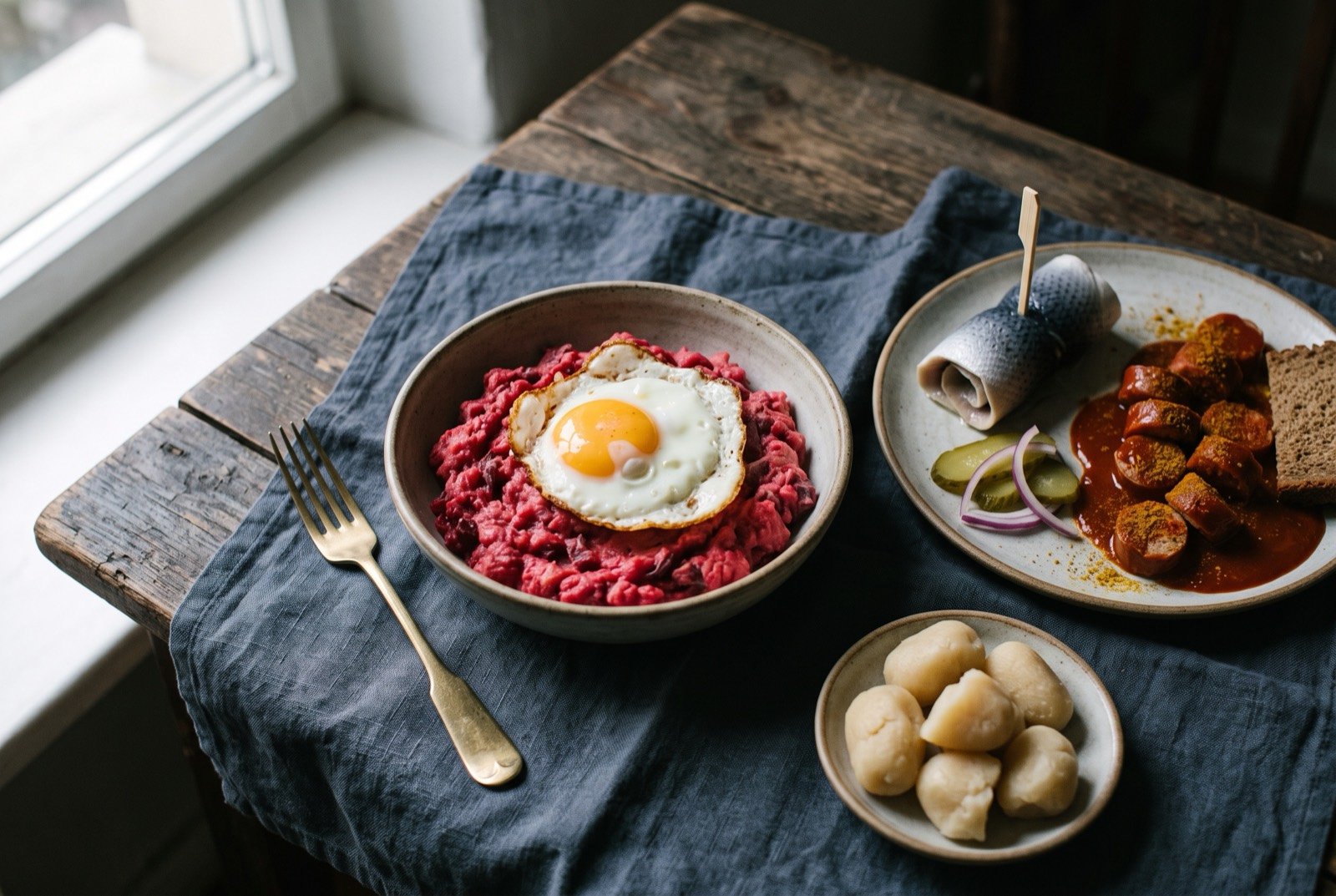
Hamburg, Bremen, Lübeck and Kiel on one hand, Berlin and Brandenburg on the other: two food worlds sharing a flag and little else. One built by ports, herring and the Hanseatic trading network; the other by sandy, glacially poor soil, a garrison capital and the street-food culture that gave the world currywurst. Every dish as tradition built it, then what a modern chef would change.
Sources and review · What this chapter does not assert · How we research · Spotted something wrong?
A Sense of Place
This volume covers two structurally different food worlds that the atlas's own culinary-region logic groups together for a reason worth stating plainly before either is described. The Hanseatic coast, Hamburg, Bremen, Lübeck and Kiel, is a maritime, trading, Protestant north, built by the herring fleet and by the Hanseatic League's own trading network. Berlin and Brandenburg, inland and landlocked, is a poor-soil garrison capital's cuisine, built by Prussian statecraft and a 19th century industrial working class. Both are unmistakably North German. Neither looks anything like the Catholic, Alpine, dairy-and-pork south this atlas has already written in the Alps and French-speaking Switzerland.
The coast's ecology is written by the Marschland: fertile, flat land built from tidal sediment and made permanently farmable only through centuries of dike-building and drainage, a process running from the medieval period onward that shifted the region's economy from extensive pasture toward intensive arable and cattle farming once the land was protected. On top of this sits the Hanseatic trading network, roughly the 13th to 17th centuries, which linked North Sea and Baltic catch, herring above all, with Lüneburg salt, Baltic and Russian grain and furs, and Flemish and English cloth. Lübeck's merchants dominated European trade for four centuries on the strength of herring, salt, furs, grain and cod. The grammar this produces is consistent across Hamburg, Bremen, Lübeck and Kiel: fat from butter and pork lard rather than olive oil, starch from potato, arriving only from the 17th century, and rye, protein from herring, cod, pork and salted or pickled beef, and a preserving logic of salting, vinegar-pickling and cold-smoking, forced by the absence of refrigeration and the need to carry a seasonal herring glut and a winter's slaughtered livestock through the rest of the year.
Berlin and Brandenburg's ecology could hardly be more different. Brandenburg's soil is sandy and glacially scoured, earning it the old, still dictionary-attested nickname "des Heiligen Römischen Reiches Streusandbüchse", the Holy Roman Empire's sand-shaker box. Berlin's own cuisine, by its own standard reference's account, was before the late 19th century a cuisine of hearty flavour and satiation rather than refinement, shaped by Brandenburg's tradition plus successive waves of Silesian, Bohemian, East Prussian, Pomeranian, Mecklenburg and Huguenot immigrants arriving in a city whose poor soil had previously supported little beyond cabbage and turnips. Protein here is pork, goose, poultry and freshwater fish, pike, zander, eel, trout, and the carp of Brandenburg's own lakes, rather than the coast's herring; starch is potato from around 1750 and rye or wheat bread; preserving is salting and curing and the lacto-fermentation of vegetables rather than the coast's smoking and pickling of fish. A Prussian salt tax, with a mandatory minimum purchase obligation attached to it, is credited with driving Brandenburg's pickling culture generally, cucumbers and rollmops both, tying vegetable preservation directly to fiscal policy rather than only to what the garden produced.
No source found for this volume directly contrasts Berlin and Hamburg's food cultures in one place, which is itself worth noting: the contrast below is this chapter's own synthesis of two separately researched traditions, not a claim lifted from either. Hamburg's food was shaped well into the 20th century by an extensive fish supply from the Elbe and the nearby North Sea, herring in every form, Matjes, Bismarckhering, Brathering, and Pannfisch as centrepieces. Berlin and Brandenburg's food, by contrast, is a landlocked garrison-and-capital cuisine built on pork, freshwater fish, potato and pickle. This volume's spine runs from Labskaus and Matjes on the coast to currywurst and Buletten in the capital: genuinely two cuisines sharing a flag, a coastline four hundred miles from a plate of chips-and-curry-sauce, not one cuisine wearing two hats.
The History in Layers
The Hanseatic League: no fixed founding date, and a real decline
There is no single agreed founding date for the Hanseatic League. 1282 is when German merchants active in England first called their association a "Hanse"; 1356, the first Hansetag, or Hanseatic Diet, held in Lübeck, is the conventional symbolic founding point, though it marks a diet, not a birth. The League peaked in the 14th century at roughly two hundred port and inland member cities, running from London and Bruges in the west to Bergen in the north and Novgorod in the east; the 1370 Peace of Stralsund, ending a war with Denmark, cemented a period of Hanseatic dominance over the Baltic. Decline set in from around 1400, as the League's loosely federated structure, strong on trade privilege but without a standing army or a central treasury, lost ground to the more centrally organised nation states then emerging in England, France and the Netherlands. Herring itself contributed directly to the Hanse's Baltic decline in a way worth stating precisely rather than left as background colour: Baltic herring stocks fell steadily from around 1500 and had nearly vanished by the mid-16th century, exactly as North Sea herring, fished and cured by the rising Dutch, grew in importance. A trading empire built substantially on one fish's migratory habits lost its footing when that fish moved.
Lübeck itself, refounded in 1143 as the first Western city built on the Baltic coast, hosted that first Hansetag in 1356 and held what sources describe as an informally leading position among Hanseatic cities, mediator and opinion-maker rather than ruler, hence "Königin der Hanse", Queen of the Hanse. This is worth reading correctly: Lübeck led by consensus and reputation within a federation of equals, not by command, which is itself a distinctly northern, mercantile model of power, closer to a modern trade association than to a royal court.
Herring, cured two different ways, and what that difference actually is
The Dutch curing method, "kaken", removes the gills and most of the gut but deliberately leaves the pancreas in; its enzymes lightly ferment the flesh, which is the herring's ripening, before the fish goes into a barrel with salt. The popular story that a single Dutch fisherman, Willem Beukelszoon, personally invented this method is very likely folklore rather than history. A 16th century chronicler credits him with a "new way of treating herring", but a near-identical preservation method traces to Scandinavia well before 1300, predating him by generations, which makes him at best a populariser and quite possibly a legend attached retrospectively to a technique nobody remembers actually inventing. German curing of the same fish, the tradition behind Loggermatjes, uses a markedly higher salt concentration than Dutch Hollandse Nieuwe, producing a saltier, less delicate result. The Netherlands also legally requires the fish to be frozen to at least minus 45°C before or after salting, a food-safety measure against the anisakis parasite that older German tradition did not frame the same way. What this volume's research could not establish, despite dedicated search, is a clean account of how German-cured and Dutch-cured herring actually moved to different markets along different routes; what is well documented is that Lübeck fought its Baltic rival Stralsund directly over the herring trade, which tells you the fish mattered enough to fight over, without telling you exactly how the two curing traditions' supply chains diverged.
Marzipan: two rival famine legends, and the true story underneath both
Lübeck tells a famous story: in 1407, facing empty grain stores, the city's senate supposedly commissioned its bakers to make bread from ground almonds instead, "Marci-panis". Königsberg, four hundred miles east, tells an almost identical story about itself, dated 1409. Other marzipan cities tell versions of the same tale again. This chapter will not adjudicate between them, because the honest answer is that neither is likely true. Almonds and sugar were far more expensive than grain throughout the medieval period, so a genuine grain famine would not plausibly have been solved by baking with the costlier ingredient instead of the cheaper one; the economics of the legend fall apart on inspection. What the evidence does support is a Near Eastern origin for marzipan itself, reaching Lübeck's confectioners through trade routes that Crusade-era contact with the eastern Mediterranean had opened, arriving as an established sweet from elsewhere rather than being invented from desperation in either German city. What is solidly documented, and much more useful than either legend, is Niederegger's actual founding: Johann Georg Niederegger, born in Ulm in 1777, took over an existing Lübeck confectionery in 1806 and put his own name to it. Production has stayed exclusively in Lübeck ever since, and "Lübecker Marzipan" has held EU-protected geographical indication status since 1996, restricting the name to production within Lübeck's own city limits and the adjoining towns of Stockelsdorf and Bad Schwartau.
A Protestant coast, and a gap this chapter will not paper over
Hamburg and Lübeck converted fully to Protestantism during the 16th century, driven in the cities specifically by the lower classes and burghers rather than imposed from above, spread partly through Lutheran hymnody, while southern Germany remained predominantly Catholic. This is worth stating because it is the coast's own answer to the Alps volume's Calvinist Geneva: a genuinely Reformed civic identity with real consequences for how these cities saw themselves against a Catholic south. What this chapter will not do is invent a specific culinary consequence for it. Other parts of Protestant Germany have a well documented history of fasting-rule disputes over butter, the "Butterbrief" phenomenon recorded for the Rhineland. Despite dedicated German-language search, no source was found connecting the Reformation specifically to a change in fasting practice or butter consumption on this Hanseatic coast. The Reformation happened here, decisively; a specific culinary consequence of it here has not been found, and this chapter says so rather than assuming one must exist because it exists elsewhere in Germany.
Erbswurst: the clearest line from the Prussian army to a civilian kitchen
If any single dish demonstrates a direct, dated, unambiguous line from Prussian military logistics into German food, it is Erbswurst, and it belongs to Berlin's half of this volume rather than the coast's. Erbswurst, a dehydrated pea flour, bacon, salt, onion and spice mixture, was Germany's first instant soup: packed into parchment or gut casing, reconstituted with hot water in the field. It was invented in 1867 by Johann Heinrich Grüneberg, a Berlin preserves manufacturer, and the Prussian state bought the invention outright for 35,000 Taler. It was first issued as field rations during the Franco-Prussian War of 1870 to 1871; the Königlich Preußische Fabrik für Heeres-Conserven in Berlin, the Royal Prussian Factory for Army Preserves, was built within weeks in July 1870 and at its peak employed 1,700 workers producing up to 65 tonnes of Erbswurst a day. The patent passed to Knorr in 1889, which is the honest reason a British reader has plausibly eaten a descendant of this dish, in the form of a Knorr packet soup, without ever knowing its origin was a Prussian war contract.
Huguenots, real and overstated in roughly equal measure
French Protestant refugees settling in Brandenburg from the late 17th century genuinely introduced cauliflower, asparagus, peas, beans, cucumbers and leaf salad to a cuisine that had previously relied on cabbage and turnips, a real and well attested culinary contribution. What is overstated, and repeated as received wisdom across Berlin food writing without a documented source behind it, is the claim that Huguenot cooks specifically invented the Bulette, Berlin's meat patty, with the word itself popularly, but only popularly, traced to French "boulette", little ball. This chapter treats the vegetable introductions as fact and the Bulette's invention story as folk etymology: a plausible-sounding claim that nobody has actually traced to a document.
The Kneipe, and what Berlin's working class actually ate at the bar
Berlin's Arbeiterkneipe, the worker's pub, developed through the 19th century as what one dedicated Berlin history society calls the proletarian living room, an escape from cramped tenement housing after a shift at a factory, mine or dock. Until roughly 1875 Berlin drank mainly top-fermented Weißbier in simple Weißbierkneipen; only after 1880 did proper Biergaststätten emerge, serving beer and spirits alongside a small Imbiss, a snack, of Buletten, Bockwurst or Rollmops. This is the direct social and economic ancestor of the currywurst stand that would appear seven decades later: cheap, hot, hand-held protein sold where working people already gathered to drink.
Currywurst: the honest version, which is not a single story
No dish in this volume has a more contested, more thoroughly mythologised origin story than currywurst, and this chapter treats that contest as the point rather than smoothing it into a tidy legend. The best documented account: on 4 September 1949, Herta Heuwer, born in Königsberg in 1913, died in Berlin in 1999, at her sausage stand at Kantstraße 101 in Charlottenburg, mixed tomato paste, Worcestershire sauce, curry powder and other spices and poured the result over a fried, sliced Brühwurst. She later moved to larger premises nearby, ran it day and night with nineteen staff at its peak, and reportedly sold up to ten thousand portions a week. She never patented the recipe and took her exact formula to her grave in 1999. What she did register, in 1958, was the fantasy trademark "Chillup" for a "special sauce", a trademark for a name, not a patent on a recipe, and this is documented at Germany's own patent office, the Deutsches Patent- und Markenamt, which is about as authoritative a source as this claim could have.
That trademark filing is also the only piece of hard paper evidence anywhere in this story, and it postdates two other, less documented but genuinely competing claims. Hamburg counter-claims through gastronome Oskar Kriwitz, said to have served a curry-sauced sausage in the city's harbour district as early as 1947, and through the writer Uwe Timm, who has stated he ate currywurst at Hamburg's Großneumarkt that same year, a claim underlying his 1993 novella Die Entdeckung der Currywurst and strong enough that Hamburg erected its own commemorative plaque in 2003. The Ruhr region claims precedence too: Duisburg's "Peter Pomm's Puszta-Stube" is said to have served a curry-sauced sausage from 1936, with separate research citing invoices allegedly showing a Duisburg butcher buying English curry powder from a Hamburg spice mill as early as 1935. German food writing states the position plainly: there is simply no unambiguous answer to who invented currywurst. This chapter's own position is that Heuwer's claim is the best documented of several, precisely because a real, dated trademark sits behind it, not because it is proven, and it presents the dish that way.
East and West Berlin, one dish, one Wall between them
This is the volume's single best documented piece of Cold War food history, and it deserves to be told with its dates intact. Konnopke's Imbiss, still trading under the Schönhauser Allee U-Bahn viaduct in Prenzlauer Berg, was founded on 4 October 1930 by Max and Charlotte Konnopke. It is credited as the first stand to introduce currywurst into East Berlin, in 1960, brought over by their son Günter after he encountered the dish while working at a butchery in Wedding, on the western side of the city. Because East Berlin and the GDR more broadly struggled to obtain natural sausage casings, the Konnopkes and their butcher devised a skinless sausage, "ohne Darm", specifically to work around the shortage, developing the accompanying sauce recipe at home; it remains a closely guarded family secret to this day. West Berlin, with access to Western goods, kept the traditional cased sausage, "mit Darm", as its norm. The divide outlived the Wall itself: "Berliner Currywurst ohne Darm" received formal German geographical-indication protection on 6 March 2020, restricted to sausages made within Berlin's own city limits, with an EU-level application filed in August 2023. A single dish, split by a political border into two genuinely different products, each now legally defined against the other, is as clean an illustration of this atlas's own argument about trade, empire and politics shaping food as anything found in this whole volume.
The Spreewald's Sorbian and Wendish inheritance
The Spreewald, Brandenburg's network of Spree tributaries and channels south of Berlin, is Sorbian and Wendish settlement territory. The Sorbs identify as descendants of Slavic settlers arriving during the migration period, and have preserved their own West Slavic language and a distinct culture, marked by festivals including the January Vogelhochzeit, the bird wedding, and the Zapust carnival. One claim repeated in regional food writing, that Slavic tribes in the Spreewald laid the groundwork for quark, soured-milk products and Plinsen pancakes as early as the 7th or 8th century, could not be independently corroborated in this research and rests on a single commercial source; this chapter treats it as unverified rather than repeating it as fact. Much better attested is the Sorbische Hochzeitssuppe, a clear chicken broth with egg custard, peas, small-diced carrot and sometimes asparagus, traditionally served from one communal tureen as the first course of a Sorbian wedding, a genuinely distinct culinary inheritance inside a region a British reader would otherwise assume was culturally uniform.
The Flavour Arsenal
Herring, cured three different ways
| Preparation | What it is | What matters |
|---|---|---|
| Matjes | Young herring, caught early May to late June, before the breeding season, when fat content exceeds 15 percent but roe and milt are undeveloped, the "maiden" fish the name itself describes. Cured whole with the pancreas deliberately left in, salted mildly at roughly 2 to 3 percent, five days in an oak barrel. | The pancreas's own enzymes ripen the flesh, which is the entire point of the dish. Industrial "nordische Art" fillets, boned and skinned, have no pancreas to ferment with, so they are compensated with heavier salt, sugar, acid and technological "ripening agents" instead: a fundamentally different product wearing the same name. |
| Rollmops (Bismarckhering base) | Paired herring fillets, joined at the back, cured raw in a vinegar-salt brine for at least 35 days, then rolled by hand around a piece of pickle and fixed with a wooden skewer. | Genuinely and correctly sharply acidic, roughly 7 percent acetic acid and at least 14 percent salt, strong enough to dissolve the fish's own small bones. Do not judge this the way Matjes should be judged; a clean, assertive vinegar cure is the dish working as intended, not a fault. |
| Bratmatjes / Brathering | Herring, floured and fried, then set to cool in a vinegar marinade with onion. | The frying step adds a layer neither of the above preparations has, and the dish is deliberately served cold, the marinade continuing to work on the fish after cooking. |
Rye, kale, groats and the almond trade
Schwarzbrot, dark rye bread, is the coast's daily bread, traditionally leavened with a natural sourdough rather than commercial yeast, made from whole-grain rye including the husk and germ. Grünkohl, curly kale, is a genuinely hardy winter crop that improves after a first frost, which is why Bremen's Grünkohlfahrt season runs November to March; a merchant club's 1871 winter walk that stopped for kale supposedly tasted so good the outing became an annual tradition, and Bremen still claims the longest continuous public version of it today. Pinkel, the sausage that accompanies it, is bacon or fatback, beef suet, onions and oat groats, hot-smoked over beechwood after stuffing, then finished by simmering together with the kale rather than eaten as a standalone smoked sausage: it is built to dissolve its fat into the braise, not to be sliced and served whole. Marzipan almond paste is the coast's other defining flavour, and its quality marker is genuinely counter-intuitive: standard Lübecker Marzipan runs 70 parts almond paste to 30 parts sugar, but the top grade, Lübecker Edelmarzipan, runs 90 parts almond paste to only 10 parts sugar, so the less sweet version is the finer one, exactly the opposite of what a British reader used to marzipan as a cake covering would assume.
Berlin and Brandenburg's own arsenal
Curry powder itself is a British colonial-era invention, a simplification of Indian spice combinations for a European palate, reaching Germany via England roughly 250 years ago; curry ketchup, the sauce built on top of it, is a distinctly German 1950s invention, born on the street stalls that combined bottled ketchup with curry powder before Heuwer's own more considered version overtook them. Kartoffelsalat Berliner Art, potato salad in the Berlin style, is built on mayonnaise, gherkin and hard-boiled egg, explicitly distinct from the vinegar-and-stock-based potato salad of southern Germany, a real regional fault line inside one national dish. Spreewald gherkins are dill-forward and traditionally salt-brined in stoneware crocks with no vinegar at all, relying on the cucumbers' own natural lactic-acid bacteria, with grape leaves traditionally lining the crock and removed after a few days to slow the white kahm yeast film that forms on the brine's surface. Quark stirred with linseed oil, onion and a pinch of salt, eaten with boiled potatoes, is the clearest surviving poor person's dish of the Lausitz and Spreewald tradition, still genuinely eaten today rather than preserved only as folklore.
The Technique Ladder
Six rungs, each one a preserving or building technique this coast and this capital actually developed to survive a climate and an economy, not a French kitchen's method imported and relabelled.
Rung 1. Enzymatic ripening
Matjes is not simply salted fish. Leaving the herring's own pancreas inside the fish during curing allows its digestive enzymes to work on the flesh itself over several days, breaking down protein in a way plain salting alone cannot, which is what gives correctly made Matjes its buttery texture and mild, almost sweet flavour rather than the flat saltiness of a fillet cured without it.
Rung 2. Vinegar-brine pickling to the point of dissolving bone
Rollmops and Bismarckhering are cured in a brine strong enough, roughly 7 percent acetic acid and 14 percent salt, to soften and effectively dissolve the herring's small bones over several weeks, turning a bony fish into something eaten whole without a second thought. This is a genuinely different chemical process from Matjes's enzymatic ripening, and treating the two herrings as interchangeable, as many bad versions do, misunderstands what each is actually for.
Rung 3. Cold-smoking below the point of cooking
Traditional Kieler Sprotten and smoked eel are cured under 25°C, a temperature that flavours and lightly preserves the fish without cooking it at all, a slow process historically reserved for master smokehouses because humidity, wood and temperature control at that range are unforgiving. Hot-smoking, by contrast, runs 80 to 120°C and fully cooks the fish in a fraction of the time; the two methods produce genuinely different foods from the same starting point, and a cheap product tasting of liquid smoke rather than real wood has almost certainly skipped the slow, cold version for the fast, hot one.
Rung 4. The milk-soaked panade
Berlin's Bulette is built by soaking stale bread rolls in milk, squeezing them out, and working the resulting paste into minced meat with egg, onion, salt and pepper before pan-frying. This is the one point every source consulted agrees defines the dish structurally: the starch and milk protein bind moisture into the patty that would otherwise cook out of it, the same principle behind a French quenelle's panade, arrived at independently by a Berlin kitchen with no need of the comparison.
Rung 5. Rendering smoked fat into a braise
Grünkohl mit Pinkel and Eisbein mit Sauerkraut both work the same way: a smoked, fatty meat, Pinkel sausage or a cured pork knuckle, is cooked slowly alongside a vegetable that would otherwise be plain, kale or cabbage, until the meat's rendered fat and smoke flavour have worked their way through the whole dish. The vegetable is not a side to the meat here; it is the meat's flavour carried somewhere else.
Rung 6. Controlling crystallisation through sugar ratio
Lübeck marzipan's quality is set almost entirely by how little sugar it contains relative to almond paste, since sugar left uncontrolled crystallises and turns the paste grainy. Commercial production uses invert sugar or sorbitol specifically to prevent this, keeping the paste workable and smooth even at the lower sugar ratios that define the finest grades; a home cook working by hand needs to understand this is a crystallisation problem being solved, not simply a matter of taste.
The Ferment and Preserve Bench
1. Home-cured quick Matjes
A true enzymatic Matjes cure needs the herring's own pancreas and its natural enzymes, genuinely difficult to control outside commercial curing, which is precisely why industrial substitutes exist at all. This is honestly a quick-cure referencing Matjes's flavour, not a reproduction of the real process, and should be understood as that rather than oversold. Freeze whole, gutted herring fillets at the coldest domestic freezer setting for a minimum of 7 days, the standard UK Food Standards Agency guidance for home-curing raw fish safely, then thaw and dry-cure in a mix of roughly 12 to 15 percent salt to fish weight, plus a little sugar, for 24 to 48 hours refrigerated. If the result tastes too salty, a brief 5 percent brine soak for 4 to 8 hours afterwards softens it. The texture will never quite match a true five-day enzymatic cure, but the flavour is close enough to be genuinely useful, and far better than a bought industrial fillet.
2. Rollmops brine
A 7 percent acetic acid, 14 percent salt vinegar brine (roughly one part white wine vinegar to three parts water by volume, salted heavily and sweetened lightly with sugar to taste), simmered with bay, peppercorns and a little mustard seed, then cooled completely before the fish goes in. Thirty-five days minimum for a proper cure that has genuinely softened the small bones; shorter cures will taste fine but will not have done the same structural work on the fish.
3. Spreewald-style gherkin ferment
Small cucumbers, layered in a stoneware crock or large kilner jar with dill fronds and, if available, a few grape leaves or vine leaves, covered completely with a cooled brine of roughly 4 percent salt to water, weighted under a plate or a water-filled bag to keep everything submerged, and left at a cool room temperature for a minimum of 7 days. A white kahm film on the surface signals active fermentation and can simply be skimmed off; the grape leaves, where used, are traditionally removed after the first few days, since their own tannins are thought to slow the film's formation.
4. Home-made Pinkel
No UK stockist exists for this sausage, so making it is not a modernist flourish, it is simply the only honest route to the dish. Pinhead oatmeal or coarse groats, softened briefly in a little stock; beef suet or back fat, diced small; smoked bacon, diced; a finely diced onion, softened; salt, white pepper, allspice and a touch of marjoram. Mix everything together while the groats are still slightly warm, stuff into ox or beef casing from a UK sausage-making supplier, and hot-smoke over beechwood, or on a Big Green Egg with beechwood chips, at a controlled 90 to 100°C, for around an hour, until firm and lightly coloured. It is not eaten at this stage; it goes into the kale pot to finish, exactly as tradition intends.
Sourcing in Britain
Verified August 2026. The single most important sourcing fact in this chapter, worth stating before any brand names: commercial UK retail sourcing of German meat, dairy and fish products is currently unrestricted. A foot-and-mouth outbreak confirmed in Brandenburg on 10 January 2025 briefly triggered a UK ban on imports of susceptible animal products from the affected containment zone, but the UK lifted the restriction entirely on 14 May 2025, recognising the whole of Germany as foot-and-mouth-free once again. What remains live and worth knowing is a separate, blanket UK ban on personal meat and dairy imports from all EU countries, which affects a traveller trying to hand-carry Mettwurst, quark or fresh Kieler Sprotten home from Hamburg or Berlin in their own luggage, not the shop-bought sourcing below.
Ingredients that decide great from grim, ranked. Worth the effort every time: Niederegger marzipan for any of this chapter's confectionery work, since its almond ratio, roughly 65 to 70 percent depending on the line, is structurally different from a generic UK cake-covering marzipan closer to 25 percent almond, changing how the paste behaves when worked, not merely how sweet it tastes; it is stocked by Lakeland, John Lewis & Partners and Jarrolds of Norwich, so there is no excuse to reach for a cheaper substitute. Hela curry ketchup, the genuine German market leader in Delikat, mild, or Pikant, medium, strengths, confirmed stocked on Amazon UK and via german-food.co.uk, is a real, distinct product built for this dish, not a British chip-shop curry sauce, which is a different category entirely, a roux-thickened gravy rather than a spiced ketchup. Spreewaldrabe's PGI-protected Spreewald gherkins, available via germandeli.co.uk, are dill and mustard-seed brined in a way a standard sweeter British gherkin is not, and the difference genuinely changes Labskaus and any open sandwich built with them.
Worth getting, but a good substitute closes most of the gap: rye bread, where Mestemacher (widely distributed, and stocked by germandeli.co.uk) or a proper bakery loaf from a specialist such as Barbakan Delicatessen in Chorlton, Manchester, both work well, against a noticeably lighter, sweeter supermarket own-label rye that is an adequate stopgap rather than a match. Rügenfisch smoked Kieler Sprotten, the genuine article from the Baltic port itself, stocked by British Food Shop, is worth seeking out, though any Baltic brisling smoked in oil is close enough not to lose sleep over.
Barely matters, and not worth the anxiety: quark, which is a non-issue in the UK, since most supermarket quark, Aldi, Waitrose, Tesco, Sainsbury's, Morrisons and Ocado all stock it, is itself imported from Germany. Curly kale is a non-issue too, and UK-grown kale's own autumn-to-late-winter season if anything suits Grünkohl mit Pinkel better than most German supply, since it is traditionally a first-frost dish. Corned beef for Labskaus is an honest, low-cost, historically defensible choice rather than a compromise: British tinned corned beef such as Fray Bentos is genuinely the same category of product, brined, cooked, pressed beef, that Hamburg's own dockside larder used, and arguably closer to the dish's own history than seeking out an imported German tin.
A genuine gap, stated rather than papered over: Pinkel has no UK stockist at all, so the ferment bench's home-made version above is not an elevation, it is the only honest route to the dish. Two names sometimes circulated for German ingredients in Britain, "Titania Foodstore" and a curry ketchup brand called "Werner's", could not be verified as existing UK retailers or products in this research and are not repeated here as sourcing advice.
Kit. A ProQ Cold Smoke Generator, widely stocked across UK retailers at £35 to £50, burns wood dust for up to ten hours unattended and attaches to a Big Green Egg for genuine cold-smoking of sprats or eel below the 25°C threshold this chapter's technique ladder describes. Weschenfelder of Grimsby is the UK's main home-curing supplier, for natural hog, sheep and beef casings and curing salts, essential for the home-made Pinkel above; a dedicated vertical sausage stuffer is a better investment than a stand-mixer attachment, which grinds well but stuffs only adequately. Severn & Wye Smokery, Gloucestershire, a genuinely well regarded UK eel smokery supplying Fortnum & Mason and Harrods, is a legitimate source for smoked eel rather than a compromise, since European eel is CITES-listed and heavily regulated continent-wide, meaning authentically German smoked eel is now hard to find even in Germany itself.
Voices and Sources
This chapter draws on the Deutsches Patent- und Markenamt's own documented history of the Chillup trademark and the currywurst origin dispute; the Europäisches Hansemuseum Lübeck's permanent exhibition on the Hanseatic League; Niederegger's own account of its 1806 founding and unchanged production method; official Landkreis Dahme-Spreewald and Sorbian cultural sources on the Spreewald's Slavic inheritance; named regional press including the Weser-Kurier and Berliner Zeitung; and named contemporary chefs whose own kitchens engage this tradition directly, Kevin Fehling at The Table in Hamburg, Marco Müller at Rutz in Berlin, and Johannes King, formerly of Söl'ring Hof on Sylt, whose own writing on elevating Matjes, Grünkohl and Brathering without importing foreign technique sits closest to this book's own argument. Full research, with every source URL and confidence flag, is kept in the accompanying briefs, EU-17-tradition.md and EU-17-modernist-sourcing.md.
Things this chapter has deliberately not asserted
- That Labskaus originated in Hamburg. Multiple sources state directly that it did not, and no original recipe for it survives anywhere; whether the herring belongs mixed into the mash or served alongside remains a genuinely live regional argument, not a settled question this chapter has picked a side on.
- That Herta Heuwer's 1949 account is the true or sole origin of currywurst. It is the best documented of at least three competing claims, Berlin, Hamburg and the Ruhr, evidenced only by a 1958 trademark filing for a sauce name, not for the dish itself.
- That either Lübeck's or Königsberg's famine-bread legend for the invention of marzipan is true. Both are almost certainly folklore; the real transmission route runs through Near Eastern trade opened partly by the Crusades.
- That Willem Beukelszoon personally invented Dutch herring curing. The method very likely predates him by generations, and the attribution to him is probably a later legend attached to an already established technique.
- That the Huguenots literally invented Berlin's Bulette. This is popular folk etymology built on the French word "boulette", not a documented culinary transmission; their genuine, well attested contribution was a set of vegetables, not this dish.
- That any fine-dining kitchen currently offers a signature, sourced reworking of the Bulette, or a serious modernist treatment of Grünkohl mit Pinkel. Neither was found in this research, and this chapter has not invented one to fill the gap.
- That a specific Reformation-era change in fasting practice or butter consumption shaped this coast's cuisine, the way such a link is documented for the Rhineland. No source connecting the two for Hamburg, Bremen, Lübeck or Kiel specifically was found, despite dedicated search, and the chapter has not assumed one must exist simply because it exists elsewhere in Protestant Germany.
- That the exact recipe given here for Grünkohl mit Pinkel, Eisbein's traditional cooking time, or Heuwer's original currywurst sauce reproduces a documented historical original. None of the three has a surviving original recipe; each is presented honestly as a considered reconstruction from well attested technique and ingredients, not a recovered artefact.
- That any named UK diaspora restaurant or cook has specifically reworked Labskaus, Matjes, Rollmops or Lübeck marzipan technique. The UK's German food diaspora, where it exists at all, is built almost entirely around Berlin's currywurst and Bratwurst culture; the Hanseatic coast's own dishes have essentially no footprint in British diaspora cooking, and this chapter states that gap rather than inventing a UK connection to close it.
Enzymatic ripening
Matjes is not simply salted fish. Leaving the herring's own pancreas inside the fish during curing allows its digestive enzymes to work on the flesh itself...
Vinegar-brine pickling to the point of dissolving bone
Rollmops and Bismarckhering are cured in a brine strong enough, roughly 7 percent acetic acid and 14 percent salt, to soften and effectively dissolve the...
Cold-smoking below the point of cooking
Traditional Kieler Sprotten and smoked eel are cured under 25°C, a temperature that flavours and lightly preserves the fish without cooking it at all, a slow...
The milk-soaked panade
Berlin's Bulette is built by soaking stale bread rolls in milk, squeezing them out, and working the resulting paste into minced meat with egg, onion, salt and...
Rendering smoked fat into a braise
Grünkohl mit Pinkel and Eisbein mit Sauerkraut both work the same way: a smoked, fatty meat, Pinkel sausage or a cured pork knuckle, is cooked slowly alongside...
Controlling crystallisation through sugar ratio
Lübeck marzipan's quality is set almost entirely by how little sugar it contains relative to almond paste, since sugar left uncontrolled crystallises and turns...
The dishes
- Labskaus Hamburg and Kiel
- Fischbrötchen mit Matjes
- Rollmops Reported Berlin origin, now a pan-German coastal tradition
- Grünkohl mit Pinkel Bremen
- Aalsuppe Hamburg
- Currywurst Berlin (contested; also claimed by Hamburg and the Ruhr)
- Buletten Berlin
- Eisbein mit Sauerkraut Berlin and Brandenburg
- Rote Grütze North Germany, specifically Schleswig-Holstein (contested with Scandinavia)
- Lübecker Marzipan Lübeck
Sources and review
- Reviewed
- Not yet reviewed from inside the tradition
- Cooked
- Not yet cooked and reported
Where this volume comes from
3 research briefs on file for this volume, researched to the rules on How we research. Published 28 August 2026. Last changed 8 September 2026.
The brief's own account of its sources
Roughly 55 to 60 web searches, all German-language, were run across the two research passes synthesised into this brief (roughly 27 for the Hanseatic-coast pass, roughly 27 for the Berlin and Brandenburg pass), plus a number of direct page fetches to museum, producer, patent-office and regional-press sites. Balance of sources.