Europe · Volume 19
Austria and the Habsburg Table
The Court, the Coffeehouse and the Alps Underneath It
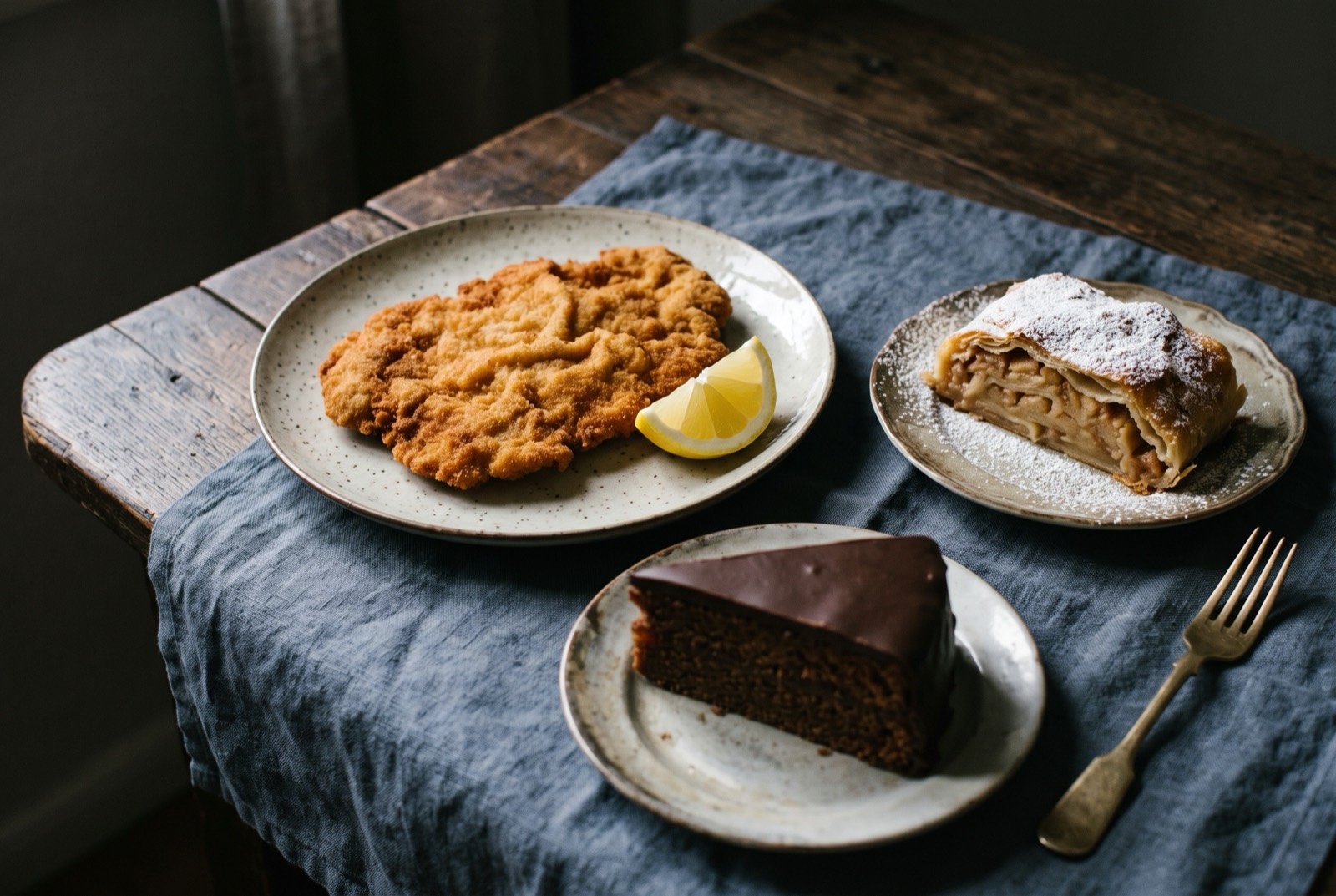
Vienna's imperial kitchen and coffeehouse tradition, and the four Alpine provinces, Salzburg, Tyrol, Styria and Carinthia, that fed it and stand apart from it. Not a Wiener Schnitzel and Sachertorte postcard, but a capital's genuine multi-ethnic synthesis beside a mountain republic's own dairy, cure and dumpling logic, owing almost nothing to the court and everything to altitude. Every dish as tradition built it, then what a modern chef would change.
Sources and review · What this chapter does not assert · How we research · Spotted something wrong?
A Sense of Place
Two different forces built this volume, and they built it in the opposite order to almost everywhere else in this atlas. Everywhere else, ecology comes first and empire comes later, laid on top. In Vienna it runs the other way. The city sits on the Danube at the eastern edge of the German-speaking world, the head of a multi-ethnic empire that at its height in 1910 covered 52 million people speaking sixteen languages, Bohemia, Hungary, Galicia, the Balkans, parts of Italy, all answering to one court. Vienna's food is not a regional cuisine that later absorbed some foreign dishes. It is a capital's synthesis first, and only secondarily a place with its own ecology, and it says so plainly in its own history: the term "Wiener Küche" only enters cookbooks at the very end of the eighteenth century, and the tradition as eaten today consolidated mainly in the nineteenth, confirmed as a reputation at the Congress of Vienna in 1814 and 1815, when the assembled diplomats of Europe ate their way through the city's restaurants and went home talking about it.
Away from Vienna, in Salzburg, Tyrol, Styria and Carinthia, the logic reverses completely, and it is the ordinary logic of this atlas: altitude, dairy cattle, a short growing season and a long winter, in that order, with the Habsburg court a distant administrative fact rather than a kitchen influence. These four provinces are joined to Vienna by a flag and a set of borders that shifted repeatedly under Habsburg rule, but their food answers to the Alm, the summer mountain pasture, not to the Hofburg. A reader arriving with "Wiener Schnitzel, cook that everywhere" as the working model of Austrian food will miss almost everything that actually shaped this country's table, including the fact that the empire's most famous dish and its Alpine cheese dumplings come from two structurally unrelated food worlds that happen to share a passport.
Vienna's own synthesis is worth being precise about, because it is usually described as a vague, admirable multiculturalism and it is actually something much more specific and traceable: a documented nineteenth-century labour migration. From around 1840, when the first railway lines reached Vienna, a continuous stream of migrants from the Kingdom of Bohemia arrived in the city, working construction, service and above all domestic households, and Bohemian-born cooks, often from Moravia specifically, had an outsized effect on Vienna's kitchens and especially its pastry tradition. These cooks generally spoke German with a recognisable Bohemian accent and frequently carried Magdalena Dobromila Rettigová's cookbook Domácí kuchařka, first printed in 1842 and running to thirty-six Czech and nearly twenty German editions, which functioned as an entry ticket to K.u.K. household standards. Buchteln, Powidltatscherl, Liwanzen, Topfengolatschen, Mohnnudeln: pastries eaten today as unambiguously Viennese are, on the documentary record, Bohemian classics, carried into the city's kitchens by the women who staffed its households, not invented there. Layer on top of that a genuine Italian trade influence dating from around 1600, still visible in loanwords, Risibisi, Melanzani, Maroni; a Hungarian influence that gave Vienna its Gulasch, reworked completely on Viennese terms rather than imported unchanged, covered fully below; French court terminology from the eighteenth century; and the Ottoman-Eastern Mediterranean technical ancestor of strudel's hand-pulled dough, which arrived via Hungary. Then add the New World arrivals that reached every European kitchen after the Columbian Exchange, potato, tomato, paprika, cocoa, and the picture is complete: Vienna did not have a cuisine that later met the world. Vienna's cuisine is what happens when an empire's kitchens all report to one capital.
The four provinces answer to a completely different set of facts. Alpine dual-purpose cattle breeds, the ancestors of today's Simmental Fleckvieh and Tiroler Grauvieh, were already noted for their milk yield by Roman writers, Pliny and Strabo among them, and the transhumance pattern that moves them between valley winter quarters and high summer pasture has roots reaching into the Neolithic in Tyrol specifically, among the oldest continuous forms of Alpine agriculture anywhere. This pattern still runs on a fixed annual rhythm with fixed names, worth using precisely: the Almauftrieb, the drive up to summer pasture, typically around Pentecost, and the Almabtrieb, the descent each September, now also a genuine folk festival. UNESCO recognised Alpine transhumance as intangible cultural heritage in 2011, and Tyrol's Ötztal is cited as an exemplary living case, with roughly 5,000 sheep and goats still driven annually over the passes from South Tyrol.
What this altitude economy produces is consistent across all four provinces even where their politics and dialects diverge sharply. Fat comes overwhelmingly from milk and pork, not from an imported oil, with one striking regional exception: Styria's pumpkin seed oil, drizzled rather than cooked with, which is discussed at length below and is a far more recent arrival to the national table than its now-iconic status suggests. Starch is the mountain farmer's compromise between what will grow at altitude and what will keep through a winter that can still run to five or six months at height: potatoes, and above all stale bread, worked back into dumplings, Kaspressknödel, Speckknödel, Kärntner Kasnudeln's dough casing, so that nothing edible in the larder goes to waste. Protein is pork, cured against the winter as Speck and Verhackert, with named, EU-protected cheeses, Tiroler Bergkäse, Tiroler Almkäse, Gailtaler Almkäse, carrying the dairy economy the rest of the year. And the whole system runs on genuine cross-border kinship rather than clean national lines: Tyrol's Tiroler Speck and South Tyrol's Südtiroler Speck are, by the frank admission of Austrian policy commentary, the same Alpine curing tradition divided by a 1919 border and a trademark regime, not by anything a cook would recognise as a real difference, and Carinthia's Kärntner Kasnudeln and Tyrol's Schlutzkrapfen share a single documented ancestor, a 1485 travel account describing filled pasta made by Pustertal women, that later diverged by valley into several different local names for what was once one dish.
Read together, Vienna and the provinces are not one cuisine wearing two hats. They are a capital's synthesis and a mountain republic's ecology, genuinely different food logics that happen to share a flag, and the honest way to write this volume is to let that difference stay visible rather than smoothing it into one national story it was never trying to tell.
The History in Layers
The indigenous core: an Alpine dairy and cure economy older than any empire
Before there was a Habsburg court to cook for, there was Alpine transhumance, and it is worth stating plainly that this is the oldest layer in the whole volume, older than Vienna's imperial identity by millennia rather than centuries. The evidence is not literary but agricultural and archaeological: Roman writers already recorded Alpine cattle's milk yield, and the seasonal movement of herds between valley and summit pasture in Tyrol has roots reaching into the Neolithic. Everything downstream of this, the cured Speck, the pressed Alm cheeses, the bread-and-cheese dumpling family, is a direct technical answer to one fact: a short growing season, a long winter, and a herd that must be fed and milked somewhere in between. This is the layer the Habsburg court never touched and did not need to.
The Bohemian layer, underappreciated and specifically documented
The single most important corrective in this whole volume concerns what "Viennese" actually means, and it is not a vague point about empire in general but a specific, traceable nineteenth-century migration. From around 1840 a continuous stream of Bohemian, often Moravian, migrants arrived in Vienna to work in domestic service, and these cooks brought a documented cookbook tradition, Rettigová's Domácí kuchařka, with them. Buchteln, Powidltatscherl, Liwanzen, Topfengolatschen, Mohnnudeln, Topfenknödel in its warm Lenten form: this is not marginal seasoning on an otherwise settled Viennese repertoire, it is a large share of what most people would now unhesitatingly call Austrian pastry, arriving through household service rather than through the court kitchen at all. Say this plainly rather than gesturing at it: many pastries now considered typically Austrian are Bohemian classics.
The imperial court, and what it actually was
The Hofküche fed over 2,000 court employees daily, not merely the imperial family; breakfast alone meant more than 500 portions from five in the morning, and staff meals came in three subscription tiers differentiated by quantity rather than quality, the top tier literally named the Kaisermenü, what the emperor himself ate at lunch. This is worth stating because it changes how a reader should picture "court food": less a small, rarefied table for the Habsburgs alone and more an enormous, disciplined catering operation with the emperor's own table sitting, unusually, at the accessible end of it rather than sealed off from it. Franz Joseph's own documented breakfast routine, a Melange with Kipferl or a milk coffee with Gugelhupf taken at his desk between five and six in the morning, and his habit of sending an aide out for Würstel with mustard, horseradish and a Seidl of beer, reads as genuinely modest by the standards of European royal dining. What does not survive scrutiny is the popular idea that Tafelspitz was invented at the Hotel Sacher for impatient officers unable to finish their food under court etiquette before the emperor, who ate quickly, rose from the table. That story is sourced only to English-facing tourism writing, contradicts the dish's own much older, well-documented lineage as ordinary Viennese boiled beef that moved from court habit down into the aspirational bourgeoisie via household servants imitating what they saw the emperor eat, and Hotel Sacher itself only opened in 1876, decades into Franz Joseph's reign. Even the source that reports Tafelspitz as his favourite dish flags the claim itself as "legendär", reputation rather than verified fact. Treat it as widely repeated tradition, not settled history, which is exactly what this chapter does below.
The coffeehouse, and the myth that does not survive checking
Nearly every visitor to Vienna is told that Georg Franz Kolschitzky, having helped break the second Ottoman siege of the city in 1683, was rewarded with captured coffee sacks and opened Vienna's first coffeehouse. It is a good story and it is not true. The Austrian historian Karl Teply has scientifically refuted it: the documented record shows an Armenian, Johannes Deodat, received the first official privilege to serve coffee publicly on 17 January 1685, operating from what is now Rotenturmstraße 14, with Kolschitzky and two other former siege scouts receiving their own privilege only a year later. Kolschitzky's wartime heroism is not in question. His status as the coffeehouse tradition's founder is a later invention, and a website run by his own admirers is candid enough to title its debunking page "die Legende", the legend. What is real and well documented is the institution that grew from Deodat's privilege: newspapers provided at table from 1720, at the Kramersches Kaffeehaus on the Graben, the origin of the tradition of reading a paper on a wooden holding-stick; women admitted from 1856; and, much later, formal recognition as living intangible cultural heritage by UNESCO's Austrian commission in 2011, a status its own custodians are explicit is meant to protect an ongoing social practice, not freeze a museum piece. Vienna's own coffeehouse guild reports the culture is not dying in any simple sense, closures now running close to openings, though the number of establishments that would meet a strict historic definition, perhaps fifty, is genuinely small against the roughly 958 cafés of all kinds the city held in 2021.
The Hungarian thread, named and set aside
Gulasch arrived in Vienna with Hungarian soldiers in the mid-nineteenth century, a herdsman's paprika-and-beef dish, gulyás hús, that Puszta cattle herders had cooked over open fire since the medieval period, its defining spice, paprika, itself arriving in Hungary via Ottoman and Balkan trade in the sixteenth century. Vienna did not import this dish unchanged. Viennese cooks use paprika powder rather than whole pods and rebuilt the dish's whole consistency on Viennese terms, producing Wiener Saftgulasch as a genuinely distinct thing from its Hungarian ancestor rather than a borrowed name on the same stew. This chapter treats Gulasch as part of Vienna's own repertoire below for exactly that reason, while being honest that its deeper origin, and the full weight of Hungary's paprika kitchen, belongs to a future Balkans volume of this atlas, not yet written, and this chapter deliberately does not attempt to re-derive that material here. The connection is real and worth naming plainly; it is not this volume's story to finish telling.
The provinces' own layered history, running on a different clock
Where Vienna's history is a story of arrival and synthesis, the four provinces' history is a story of continuity punctuated by a small number of genuinely dateable legal moments. The Buschenschank tradition, the seasonal wine tavern a winemaker runs directly on their own property, has an exact legal birth: 1784, when Emperor Joseph II's Zirkularverordnung permitted farmers and winegrowers to sell and serve their own produce without the licensing burden of a full inn, the same decree that underlies the Heuriger elsewhere in Austria and South Tyrol's own Törggelen season, three regional names for one imperial administrative act. Styria's Kürbiskernöl, treated by outsiders as an ancient Alpine staple, is nothing of the sort: first documented in 1735, its defining hull-less pumpkin variety spread across Styria only between 1870 and 1880, and the oil remained essentially unknown outside South Styria, even within Austria, until the 1970s, gaining EU protected status only in 1996. Its "iconic Austrian" reputation is a development of the last forty to fifty years, not a deep-time inheritance, and the honest thing to do with that fact is state it, not quietly let the oil borrow more antiquity than it has earned. Meanwhile Tiroler Speck's own protected status, granted in 1997 under the same EU regulation as Tiroler Bergkäse, sits alongside a candid Austrian policy admission that the Tyrolean and South Tyrolean versions of this same cure are one continuous Alpine tradition, split by the 1919 border into two separately trademarked products that differ mainly in where the bacon is legally sliced. And Kärntner Kasnudeln and Tyrol's Schlutzkrapfen share what may be the single strongest piece of continuity evidence in the whole volume: Paolo Santonino, an Italian church secretary travelling through the Pustertal in 1485, recorded local women making filled pasta with flavourful contents, a single documented root from which two provincial dishes, and two different national identities either side of a much later border, eventually grew apart.
The Flavour Arsenal
Fats
| Fat | Notes |
|---|---|
| Butterschmalz | Clarified butter, the standard frying medium for Wiener Schnitzel and Backhendl; tolerates the 170 to 175°C needed without burning while keeping genuine dairy aroma, sometimes cut roughly half and half with a neutral oil to raise its smoke tolerance further |
| Pork and beef lard (Schmalz) | The older, plainer fat behind Backhendl before Butterschmalz became the default, and still the base for much Alpine farmhouse frying |
| Steirisches Kürbiskernöl | Styrian pumpkin seed oil, roasted seed pressed cold once ground, never itself used as a cooking medium, drizzled on finished dishes only; a comparatively recent national arrival, see History above |
| Duck and goose fat | Used in the provinces for confit-adjacent preservation and in modernist adaptations of Alpine potato dishes |
Dairy
| Ingredient | Notes |
|---|---|
| Topfen | Fresh curd cheese, the base of Topfenknödel and Kärntner Kasnudeln filling and of much Austrian baking; UK quark is functionally the same product, see Sourcing below |
| Tiroler Bergkäse (g.U.) | Raw-milk hard cheese from Heumilch, hay milk, matured a minimum of three months, mild-nutty young and increasingly piquant with age |
| Tiroler Almkäse / Alpkäse (g.U.) | Made only from milk produced during the ninety to 120 day Alm grazing season, not valley milk |
| Graukäse | Sour-milk, low-fat, sharp grey cheese, the defining filling cheese for Tyrolean Kaspressknödel; Salzburg and Pinzgau use Bierkäse in its place |
| Gailtaler Almkäse (g.U.) | Carinthia's own protected Alm cheese, evidence this is a provincial phenomenon, not a Tyrol-only one |
Starches and staples
| Ingredient | Notes |
|---|---|
| Semmeln (bread rolls) | The base of Semmelbrösel, fine dry breadcrumbs, and of the whole stale-bread dumpling family, Speckknödel, Kaspressknödel |
| Erdäpfel (potatoes) | The everyday Alpine and Viennese starch, boiled, mashed or grated for Gröstl and Rösti-adjacent dishes |
| Wheat flour, high protein | The base of hand-stretched strudel dough, needing real gluten development to stretch to translucency without tearing |
| Semmelbrösel | Fine dried breadcrumb, distinct in texture and function from panko, see Sourcing and the Technique Ladder below |
Aromatics and named products
| Ingredient | Notes |
|---|---|
| Kren (horseradish) | Central to Tafelspitz's Apfelkren and to Steirisches Wurzelfleisch's finishing note; fresh, not the jarred creamed version |
| Kümmel (caraway) | Cabbage and roast seasoning across the provinces |
| Mohn (poppy seed) | Central to Austrian baking, Mohnnudeln, Buchteln fillings, strudel; must be fresh-ground, see Sourcing below |
| Wacholder (juniper) | Part of Tiroler Speck's dry-cure spice mixture alongside sea salt, pepper and garlic |
| Kerbel (chervil) and mint | The signature herb pairing in Kärntner Kasnudeln filling, though the exact ratio genuinely varies by valley |
Cured meats and preserved products
| Product | Notes |
|---|---|
| Tiroler Speck (g.g.A.) | Dry-salted with sea salt, juniper, pepper and garlic, cold-smoked at roughly 20°C over a minimum 50% beech or ash wood, air-matured months in Tyrolean mountain air |
| Verhackert | Hand-chopped cured pork fat spread, salted and smoked two to three weeks, worked with onion, garlic and sometimes marjoram and caraway, historically potted under a cap of beef tallow; Carinthia's equivalent is Sasaka |
| Wiener Würstel | The plain boiled sausage of Franz Joseph's own documented mid-morning snack, mustard and horseradish alongside |
The Technique Ladder
Six rungs, three from Vienna's kitchen and three from the Alpine provinces, and each explained by what it is actually doing to the food, not just named.
Rung 1. Soufflieren: let the crumb separate from the meat, don't press it on
A correct Wiener Schnitzel crumb puffs slightly away from the meat in a blistered, wavy shell rather than clinging tight to the surface. This happens because the beaten veal is lightly sprayed or brushed with water before flouring, egging and crumbing, and the crumb itself is applied loosely rather than pressed on firmly. In the hot fat, that surface moisture flashes to steam and physically lifts the crumb layer away from the meat, the same mechanism that makes a soufflé rise, applied to a coating rather than a batter. Press the crumb on hard, or skip the water, and the crumb bonds tightly to the meat instead, turning soggy rather than blistered once fried.
Rung 2. Hold a gentle simmer, never a rolling boil, for a gelatine-rich working cut
Tafelspitz is a working muscle, the pointed rump, genuinely tough raw and reliant on long, gentle heat to convert its connective tissue to gelatine without seizing the muscle fibre into dryness. The traditional method already gets this right by instinct and habit: bones brought to a boil first and skimmed clean, the beef added and simmered gently, not boiled hard, for around ninety minutes, more vegetables added for a final half hour. A rolling boil agitates and toughens the fibre faster than the connective tissue can break down; a bare simmer gives the collagen time to do its work while the muscle itself stays tender rather than stringy.
Rung 3. Stretch strudel dough by gravity, not by pulling
A well-made strudel dough, strong flour, water, egg, a little oil and salt, worked hard to develop full gluten strength and then rested so that gluten relaxes, will stretch to paper thinness under its own weight if both hands go in flat beneath it and draw gently outward from the centre. Pulled or pinched at the fingertips instead, the same dough tears, because the tension concentrates at a point rather than distributing across the whole sheet. The standard Austrian test for doneness, being able to read a newspaper through the stretched dough, is really a test of whether the gluten network has been worked and rested correctly, not a party trick.
Rung 4. Fold whipped egg white in, don't stir it in
Kaiserschmarrn's batter and Salzburger Nockerl both depend on the same physical fact: egg white whipped to a stiff, glossy foam traps air in a protein structure that collapses the moment it is stirred rather than folded. Beaten yolks and sugar form the flavour base; the whipped whites are folded through gently at the very end, preserving as much trapped air as the fold allows, and any further stirring after that point actively works against the dish, developing gluten in the flour already present and squeezing air back out of the foam. This is the single most commonly named domestic failure in Austrian cookery writing for exactly that reason: overmixing is not a minor fault, it is the dish's one real point of no return.
Rung 5. Cure and cold-smoke, don't hot-smoke, for Alpine preservation
Tiroler Speck's specification is precise for a reason: dry salt with juniper, pepper and garlic first, drawing moisture out and beginning preservation chemically, then cold-smoke at roughly 20°C rather than hot-smoke, so the smoke's flavour compounds penetrate slowly without cooking the meat, followed by months of air-drying in genuinely cold mountain air. Each stage does a different job, salt for preservation and flavour, cold smoke for flavour and a further barrier against spoilage, air-drying for moisture loss and concentration, and none of the three stages can substitute for another.
Rung 6. Brown the butter properly before it meets the dumpling
Kärntner Kasnudeln's traditional finish, foaming browned butter, Nussbutter, poured hot over the boiled dumplings, depends on carrying the butter's milk solids past their simple melting point into genuine Maillard browning, a nutty, faintly toasted aroma that plain melted butter never develops. Carried too far the solids burn and turn bitter instead; the window between properly browned and burnt is narrow and is judged by smell and colour, not by a fixed time.
The Ferment and Preserve Bench
1. Verhackert (and Carinthia's Sasaka)
Pork bacon salted and smoked two to three weeks, then hand-chopped, "hacken" gives the product its name, with onion, garlic and sometimes marjoram and caraway, historically packed into fat-lined clay pots and capped with beef tallow to keep through summer without refrigeration. Documented as an established part of the Styrian Brettljause since at least 1916, and shared, under the local name Sasaka, across the border into Carinthia's own Alpine-Adriatic cooking.
2. Tiroler Speck
Dry-salted with sea salt, juniper, pepper and garlic, cold-smoked at roughly 20°C over a minimum of half beech or ash wood, then air-matured for months in genuinely cold Tyrolean mountain air. Every stage does a distinct job, see Rung 5 above, and none can be skipped or rushed without losing the finished product's character.
3. Alm cheese ageing
Tiroler Bergkäse and Tiroler Almkäse, along with Carinthia's Gailtaler Almkäse, are matured for a minimum of three months and often considerably longer, red-culture rind treatment developing their character as they age from mild and nutty toward genuinely piquant. Almkäse specifically is made only from milk produced during the ninety to 120 day Alm grazing season, tying the cheese's very existence to the transhumance calendar described in the History above.
4. Steirisches Kürbiskernöl
Not a ferment but a genuine preserve in its own right: seeds ground, mixed with water and salt into a paste, gently roasted with constant stirring, then mechanically pressed without chemical aids, roughly 2.5 to 3kg of seed yielding one litre of oil. The fresh oil rests a minimum of seven days for sediment to settle before bottling, and correctly stored it keeps its aromatic character for a genuinely long shelf life, provided it never meets heat in use.
5. Marillenschnaps
Apricot brandy from the Wachau valley, a genuine fruit distillate rather than a flavoured neutral spirit when made by a named, reputable producer. A cheap "apricot schnapps" without a Wachau or Austrian designation is very likely the latter, worth flagging to the reader directly rather than assuming the two are interchangeable.
Sourcing in Britain
The live fact that shapes almost everything below
There is no confirmed UK retailer of genuine Austrian PDO Alpine mountain cheese, Tiroler Bergkäse or its relatives, at the time of writing. A UK product called "Bergkase" does exist, from Mons Cheesemongers, but it is explicitly Swiss on the retailer's own listing, not the Austrian original, and the two must not be conflated. A reader wanting the genuine article is, for now, looking at direct import or a considered substitute, Comté or Gruyère, with an honest note that neither is the same thing.
The ranked list: what decides great from grim
- Fine dried breadcrumbs, not panko, for Semmelbrösel. Panko's coarse, hollow structure produces a lighter, craggier crust, not the classic Viennese blistered shell. Buy plain dried breadcrumbs, or dry stale bread rolls in a dehydrator or low oven and grind them fine in a spice grinder or high-power blender.
- UK rose veal, bought deliberately, not apologised for. British rose veal exists as a direct, welfare-forward response to the old bob-calf controversy: pasture- and straw-reared, Red Tractor assured in the best cases, pink rather than white because the calves are not iron-restricted. It is a genuinely better animal-welfare outcome than the Continental milk-fed white veal classic Austrian recipes were written around, at the cost of a slightly different colour and a marginally more developed flavour, and should be sourced and used with that framed as a positive, not a compromise.
- The PGI mark on Kürbiskernöl. A pale, generic pumpkin seed oil sold as a health food near flax and hemp oils is a different, milder product entirely, not what this cuisine calls for. Look for the g.g.A./PGI mark and Styrian stamp-pressing.
- Fresh-ground poppy seed, never pre-ground. Milled poppy seed turns rancid quickly; whole seed keeps far better. Buy whole in bulk and grind fresh in a dedicated spice grinder each time.
- A named Wachau producer for Marillenschnaps. Bailoni and Rochelt are both genuine Wachau distillers; an undesignated "apricot schnapps" is very likely a flavoured neutral spirit instead.
Named UK stockists
- Kipferl (Camden Passage, Islington, and online), a genuine Austrian restaurant, patisserie and wine importer trading since 2003. Stocks Sachertorte, Linzertorte, Apfelstrudel, Steirisches Kürbiskernöl (Hamlitsch brand), and a real Austrian wine range, Grüner Veltliner, Blaufränkisch, natural and orange wines. Delivers UK-wide.
- Austrian Food UK (online), a dedicated Austrian grocery retailer stocking Almdudler, Mautner Markhof mustards, Julius Meinl coffee, Prinz schnapps, and Pelzmann Steirisches Kürbiskernöl.
- Waitrose, for a genuinely Austrian Grüner Veltliner: their own-label bottling is made for them by Markus Huber at his family winery in the Traisental valley, Lower Austria.
- Westons Rose Veal, R. J. Trevarthen and The Dorset Meat Company, three named UK veal producers working to real welfare standards, straw-bedded, pasture-reared calves, worth seeking out by name rather than buying whatever a supermarket happens to label "veal."
- Nuts in Bulk, for whole poppy seed by weight rather than a small, stale supermarket jar.
- Quark, genuinely and widely available at Tesco, Sainsbury's, Morrisons, Ocado and Aldi, usually shelved with hard cheese rather than yoghurt, easy to walk past. Full-fat, well drained through a chinois or muslin, is the right choice for Topfenknödel and Kasnudeln filling; the common own-label fat-free version is too wet without that extra draining step.
Kit already in the reader's kitchen, genuinely well matched
A chinois earns its keep twice in this volume: clarifying a proper Tafelspitz consommé, and draining quark to the right consistency for Topfenknödel and Kasnudeln filling. A dehydrator has a real, if secondary, use drying wild mushrooms for Gulasch or drying a portion of apple for strudel filling's textural contrast. A spice grinder is the correct tool for fresh-milling poppy seed and for making genuinely fine Semmelbrösel from dried bread. The one piece of kit worth actually buying is a flat-faced cutlet bat for schnitzel, not something the reader's existing equipment substitutes for; a Gugelhupf tin is a similarly worthwhile, inexpensive addition if Reindling or Kaiserschmarrn's cousin dishes become a regular thing. No dedicated strudel cloth or Kaiserschmarrn pan exists as a real UK retail product, and none is needed: a large, well-floured cotton cloth and a good ovenproof frying pan do both jobs completely.
Voices and Sources
From inside the tradition
- Ingrid Haslinger, the named Austrian food historian behind most of the serious documented material on the Hofküche, worked at Vienna's former Imperial Silver and Table Chamber from 1987 to 2014 and has published Küche und Tafelkultur am kaiserlichen Hofe zu Wien, Tafeln wie ein Kaiser, Tafeln mit Sisi, and an edited memoir of an actual imperial court chef, Otto Desbalmes.
- Katharina Prato (1818 to 1897), whose Süddeutsche Küche, first published 1858, became the best-selling cookbook of the entire Austro-Hungarian monarchy, roughly a million copies across 79 editions between 1858 and 1960, and is itself primary evidence for the multi-ethnic synthesis this chapter describes: Prato placed Viennese, Hungarian, South Slavic, Polish, Italian, Jewish and Bohemian dishes in one volume, decades before anyone wrote a scholarly account of why.
- Marie von Rokitansky, Die österreichische Küche (1897), and Magdalena Dobromila Rettigová, whose 1842 Domácí kuchařka travelled into Vienna's kitchens with the Bohemian cooks who staffed its households.
- Heinz Reitbauer of Steirereck, Vienna's only restaurant doing serious, technically ambitious work built from specifically Austrian produce and preservation practice rather than an imported French idiom; and Lukas Mraz of Mraz & Sohn, running Austrian offal and preservation traditions through contemporary technique while keeping the frame recognisably Austrian.
The UK diaspora
Kipferl (Islington), the one substantive, ingredient-serious Austrian restaurant and importer in Britain, trading since 2003.
Museums and archives
Wien Museum, for its Kaffeehaus photographic collection and dedicated exhibition; the Silberkammer, part of the Hofburg and Schönbrunn museum complex, holding actual court kitchen cookware; and Wien Geschichte Wiki, the City of Vienna's own reference, an unusually reliable, well-maintained municipal source used throughout this chapter's research.
The gap, named
No genuinely sceptical local voice arguing that Vienna's coffeehouse scene has become tourist theatre in parts of the first district was found in this chapter's research. The reading given above, that the culture is renewing rather than merely surviving, rests on cultural-body and tourism-adjacent sourcing and should be read as well evidenced rather than beyond all local dissent.
Things this chapter has deliberately not asserted
- That Anna Sacher invented Tafelspitz for impatient officers at court. This story appears only in English-facing tourism writing and directly contradicts the dish's own better-documented lineage as ordinary Viennese boiled beef predating Hotel Sacher's 1876 opening.
- That Franz Joseph ate Tafelspitz almost exclusively, or that it was verifiably his favourite dish. The strongest available source calls this claim itself "legendär." It is presented here as widely repeated tradition, not settled fact.
- Any of the three competing Kaiserschmarrn origin stories as history. None is attached to a primary document. The linguistic counter-evidence, that "Kaiser" plausibly derives from "Kaser" or "casa" rather than the emperor's title, is treated as the stronger claim.
- Empress Elisabeth's specific diet or eating habits. Nothing here could be independently verified from an accessible source; Ingrid Haslinger's Tafeln mit Sisi almost certainly holds the real material, and this chapter has chosen not to repeat the extensive, largely unreliable English-language popular claims about her diet instead.
- That Salzburger Nockerl was invented by Salome Alt for Wolf Dietrich von Raitenau. Austria's own federal ministry states the dish's real origin cannot be established and offers a specific technical objection to this story: the technology it requires postdates Wolf Dietrich's death by roughly two centuries.
- That Steirisches Kürbiskernöl is an ancient Austrian staple. It is first documented in 1735, remained essentially unknown outside South Styria until the 1970s, and gained its now-iconic national status only in the last forty to fifty years.
- A single canonical recipe for Kärntner Kasnudeln. Austria's own traditional-foods registry states plainly that none exists; filling ratios and herb mixes genuinely vary by valley, and this chapter has represented that as real diversity rather than picking one version to call authentic.
- That Vienna's coffeehouse culture is uniformly a living, thriving tradition rather than partly tourist performance in its most visited addresses. The sourcing found leans toward the "still living" reading; no critical local counter-voice was located to test it against, and that gap is named rather than papered over.
- That the Reindling/Pogača/Gubana cross-border lineage, or the Carinthian-Slovenian linguistic crossover more broadly, is settled beyond the Austrian side of the border. Both rest on Austrian-language sourcing only; the Slovenian and Friulian side of these claims was not independently reached.
- The precise, singular recipe difference between Hotel Sacher's and Demel's Sachertorte. The two-jam-layer distinction is the best-supported version across the sources found, but no single primary document from the 1965 court ruling itself was located stating the technical difference with full precision.
Soufflieren: let the crumb separate from the meat, don't press it on
A correct Wiener Schnitzel crumb puffs slightly away from the meat in a blistered, wavy shell rather than clinging tight to the surface.
Hold a gentle simmer, never a rolling boil, for a gelatine-rich working cut
Tafelspitz is a working muscle, the pointed rump, genuinely tough raw and reliant on long, gentle heat to convert its connective tissue to gelatine without...
Stretch strudel dough by gravity, not by pulling
A well-made strudel dough, strong flour, water, egg, a little oil and salt, worked hard to develop full gluten strength and then rested so that gluten relaxes...
Fold whipped egg white in, don't stir it in
Kaiserschmarrn's batter and Salzburger Nockerl both depend on the same physical fact: egg white whipped to a stiff, glossy foam traps air in a protein...
Cure and cold-smoke, don't hot-smoke, for Alpine preservation
Tiroler Speck's specification is precise for a reason: dry salt with juniper, pepper and garlic first, drawing moisture out and beginning preservation...
Brown the butter properly before it meets the dumpling
Kärntner Kasnudeln's traditional finish, foaming browned butter, Nussbutter, poured hot over the boiled dumplings, depends on carrying the butter's milk solids...
The dishes
- Wiener Schnitzel Vienna
- Tafelspitz Vienna
- Beuschel Vienna
- Backhendl Vienna
- Apfelstrudel Vienna
- Kaiserschmarrn Vienna
- Sachertorte Vienna
- Salzburger Nockerl Salzburg
- Tiroler Kaspressknödel Tyrol
- Steirisches Backhendlsalat Styria
- Kärntner Kasnudeln Carinthia
Sources and review
- Reviewed
- Not yet reviewed from inside the tradition
- Cooked
- Not yet cooked and reported
Where this volume comes from
3 research briefs on file for this volume, researched to the rules on How we research. Published 28 August 2026. Last changed 8 September 2026.