Europe · Volume 20
The Czech Republic and Slovakia
Lard, Bryndza and a Court Cuisine That Passed Overhead
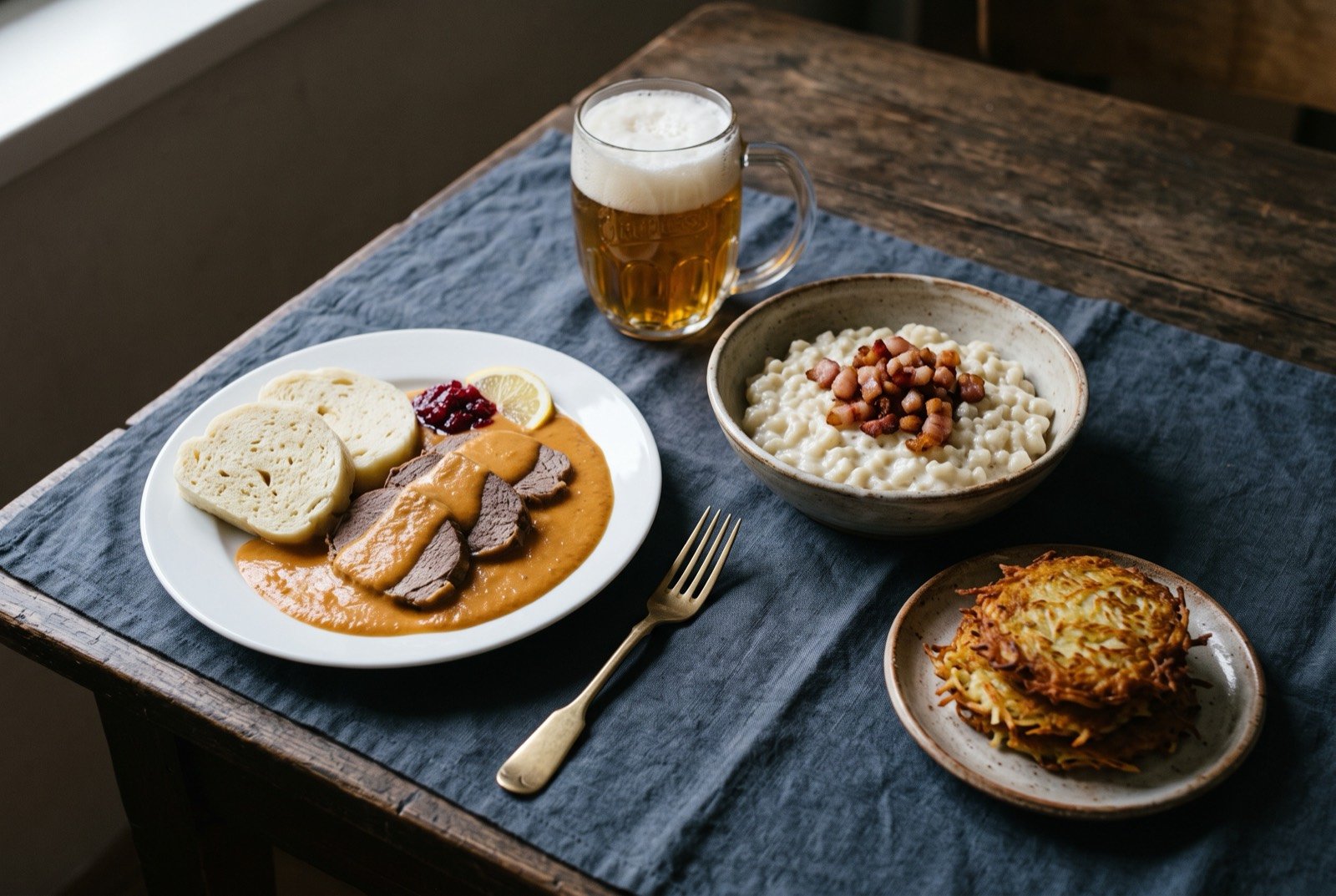
Two adjoining food worlds sharing a twentieth-century state and very little else. Bohemia and Moravia run on lard and dumplings; Slovakia's highland Carpathian arc runs on a shepherd economy imported in the fourteenth century and sheep's-milk cheese fermented into a spreadable paste. Both sat inside empires that gave almost nothing back. Every dish as tradition built it, then what a modern chef would change.
Sources and review · What this chapter does not assert · How we research · Spotted something wrong?
A Sense of Place
This volume's food logic is written by two different ecologies wearing one shared political history. Bohemia and Moravia are lowland and mid-altitude arable country: grain, root vegetables, pig, hop and cattle land, drained by the Elbe and the Morava, with beer as much a structural fact of the cuisine as any ingredient. Slovakia is two countries in one, and the volume treats them honestly as such rather than flattening them into a single "Slovak" identity: the Tatra highlands and the Carpathian arc, running through Orava, Liptov, Spiš, Gemer, Zvolen, Turiec and Šariš, are sheep-pastoral upland country unsuited to arable farming but excellent for grazing; the Danube lowland south around Bratislava is a mixed-farming, market-garden, orchard and river-fishing world carrying a heavy Hungarian and Austrian imprint, poultry, paprika and river fish where the highlands have potato, caraway and sheep. This chapter's spine sits in the highland half of that pair, because that is where a genuinely distinct cooking culture, not a provincial variant of a Danubian one, actually lives.
The grammar, stated plainly. Fat runs on two registers in Bohemia and Moravia, and which register a dish belongs to is a class-historical marker worth keeping visible rather than smoothing over. Lard, rendered pork fat, is the base fat of the village and workers' kitchen: roasting, frying, greasing dumplings. Butter belongs structurally to the aristocratic and burgher register, and its presence in a recipe, svíčková's earliest versions among them, is itself evidence of where that recipe sat in the social order it came from. In Slovakia's highlands, fat is sheep and pig lard and the fat of sheep's-milk cheese itself; in the Danube lowland it shifts toward the poultry fat and paprika-forward oil of a Hungarian-facing kitchen. The starch across the whole volume is the potato and, in Bohemia and Moravia specifically, the dumpling built from it or from bread, standing in for rice or noodles at almost every main course, and leavened by two genuinely different mechanisms that should never be treated as interchangeable: yeast, for the bread dumpling; raw grated potato starch and egg, for the potato one. Aromatics are caraway, treated by Czech spice suppliers and food writers as close to symbolic of the cuisine's own identity; marjoram, load-bearing rather than decorative in soups, sauces and minced-meat dishes; dill, defining the classic sour sauces; and poppy seed in the sweet register. Slovakia's highlands share caraway and dill but not paprika, which belongs to the southern lowland kitchen and should not be assumed to belong to the highland one.
The peoples, and the political histories that actually shaped the food. Czechs and Moravians are not interchangeable. Moravia holds roughly ninety six per cent of Czech vineyard area and has its own dumpling, moravský knedlík, made without the diced bread roll that gives its Bohemian cousin its mosaic cross-section. Slovácko, in south-east Moravia hard against the Slovak border, carries a living folk culture with its own dialect food names, and a genuinely distinct pastoral thread: a Wallachian shepherd population, ethnically Romanian-descended transhumant herders who migrated along the Carpathian arc from the thirteenth century, lost their own language over the following centuries but kept sheep-dairy words, brynza among them, and much of the practice itself. The historic German-speaking population, present across the entire Bohemian, Moravian and Silesian borderland until its forced expulsion in 1945 and 1946, was the bearer of a distinct culinary tradition in its own right, not a footnote to a Czech one; the standard modern academic reference on this cuisine treats that expulsion as the second great rupture in Czech-lands food history, after the mid-nineteenth-century formation of a self-consciously Czech national cuisine. In Slovakia, the load-bearing historical fact is the Wallachian colonisation itself, covered in full below: a fourteenth to seventeenth century pastoral migration that brought an entire legal and economic system, and the vocabulary that still names the trade today, bača for the head shepherd, salaš for the mountain dairy farm, koliba for the shepherd's hut, košiar for the sheep pen, into terrain the existing lowland economy had never used.
| People or region | Defining logic | Dishes that carry it |
|---|---|---|
| Bohemia | Lowland grain, pig and hop country; the aristocratic-roast-to-svíčková lineage; the reformist urban cookbook tradition | Svíčková na smetaně, houskový knedlík, kulajda |
| Moravia | Wine country; its own dumpling without the bread mosaic; Slovácko's Wallachian-descended shepherd margin | Moravský knedlík, kapustové strapačky-adjacent dishes at the Slovak border |
| Historic German-speaking Bohemia, Moravia and Silesia | A distinct culinary tradition, largely lost after the 1945 to 1946 expulsion | Starý sýr's German-named variants (Hauskäse, Kümmelkäsl), the Prügelkrapfen ancestor of trdelník |
| The Tatra highlands and Carpathian arc | Wallachian-descended sheep pastoralism, imported wholesale, not a local development | Bryndzové halušky, kapustnica, oštiepok |
| The Danube lowland south | Hungarian- and Austrian-facing mixed farming, paprika, poultry, river fish | Outside this chapter's spine, named as a genuine internal contrast rather than covered in full |
The History in Layers
The indigenous core, and the aristocratic roast that becomes svíčková
Grains, legumes, root vegetables, mushrooms and dairy dominated the medieval Bohemian and Moravian diet; meat was rare outside feast days. Aristocratic kitchens ran on spit-roasted "great roasts" of beef or venison, carved at table and dipped in old-style sauces called šalše. This is the direct, documented ancestor of svíčková, not a folk dish later refined upward for a smarter table: the sauce technique moved down the social order over centuries, not up.
Habsburg rule, checked rather than assumed
A British reader arrives at this volume expecting "centuries of Austrian rule" to explain most of what is on the plate. The sourcing does not support that as a blanket claim, and this chapter treats it dish by dish rather than as received wisdom. The historian Martin Franc, of the Masaryk Institute at the Czech Academy of Sciences, makes the sharpest correction: late-nineteenth-century bourgeois Prague dining, in his own words, was "more similar to that in Linz than somewhere in Moravian countryside," because middle-class urban dining was broadly uniform across the whole Austrian monarchy, Prague included, and the real regional distinctiveness of Czech food sat in the countryside, not the capital. Prague's actual net original contribution to European gastronomy in this period is narrower than the city's own tourist mythology suggests, largely reducible to Prague ham's international reputation. Franc goes further and directly disputes vepřo knedlo zelo's usual billing as the Czech national dish, calling it "essentially a recipe common to the entire Central European region," coded as specifically Czech mainly because Czech-lands restaurants were built around heavy beer consumption and pork paired with beer better than his own preferred candidate for the more genuinely singular Czech dish: plum dumplings, first documented in Moravian Wallachia.
The dish-by-dish record backs up a more textured picture than either "purely Czech" or "purely Austrian" allows. Guláš demonstrably arrived via Vienna, not directly from Hungary: the earliest published Czech-lands recipe, from 1805, is explicitly Viennese in form, seasoned with lemon zest rather than paprika, with the paprika-forward "uherský," Hungarian, version tracked separately and both fully assimilated into Czech-language cookbooks by 1820. Svíčková, by contrast, is a case where a broadly similar Viennese dish existed in the same period but never permanently took hold there, while the Czech version did become native and endure. Kuře na paprice, chicken in paprika cream, was imported wholesale, taken directly from the leading Danubian-cuisine cookbook author Katharina Prato and reportedly a favourite dish of Franz Josef I himself. Three dishes, three different relationships to the same empire: one borrowed and localised, one borrowed and rejected by its own source while thriving elsewhere, one simply imported whole. No single sentence about "Austrian influence" covers all three, and this chapter has tried not to write one.
On the Slovak side, the record supports treating highland shepherd cuisine and the Viennese and Budapest court table as genuinely separate worlds, connected by extraction rather than fusion. Salašníctvo, mountain sheep pastoralism, operated under its own legal and economic system, imported wholesale from the Wallachian colonisation below, entirely distinct from manorial or urban food economies. From the mid-eighteenth century, under sheep-farming modernisation pushed by Maria Theresa and Joseph II, Liptov bryndza was rafted down the Váh river to the Habsburg court in Vienna and to Budapest, adopted by the nobility as an exotic delicacy from the mountains. This is a commodity flowing one way into a court that consumed it as a curiosity, not a court technique flowing down into the highlands: the product crossed the border, the cuisine did not. The point holds even more sharply once the economics underneath it are stated plainly: bryndza remained expensive and largely inaccessible to the very shepherds and bačas who made it, since they were typically servants of the flock's owner rather than owners of it themselves. A luxury export made by people who could rarely afford to eat it is not a court cuisine reaching down; it is an extraction, dressed as one.
The Wallachian colonisation
This is the single most load-bearing historical fact in the Slovak half of this volume, and it is real, dated and well documented, not a repeated one-line claim. Wallachian colonisation resettled parts of Slovakia under a distinct Wallachian legal code across the fourteenth to seventeenth centuries, beginning with pastoral populations of Romanian and Ruthenian origin entering the eastern counties in the 1300s and spreading progressively west into Gemer, upper Pohronie, Liptov, Orava and Trenčín, with Slovak, Polish and Ruthenian settlers increasingly dominant as the migration moved west. Settlers operated under "adapted German law, customised to the needs of new settlers," paid the landowner a twentieth of their sheep and livestock plus deliveries of cheese, bryndza, game and homespun cloth, and were led by hereditary richters, šoltýsi or vajdas. By the seventeenth century these communities had fully merged into the broader Slovak rural population, but the ecological point they made permanent had not disappeared: the Wallachians exploited previously unused high-elevation pasture, forest clearings and open ridgelines, that lowland sheep-keeping had never touched, bringing a hardier sheep breed and the vocabulary that still runs the trade today. A royal charter is credibly, though not certainly, part of this story: King Matthias Corvinus is credited in aggregated Slovak sources with granting Wallachian settlers rights and freedoms in 1474, formalising a colonisation already under way. This specific claim could not be traced to a primary charter text in the research behind this chapter, and is stated here as plausible tradition rather than settled fact. The scholarly authority behind the whole picture is the ethnographer Ján Podolák, whose 1982 monograph is treated by later Slovak ethnologists as the foundational work on Carpathian sheep pastoralism.
The twentieth century: socialism's genuinely under-told effect on both halves of the volume
This deserves real space rather than a passing clause, because specific, now-assumed-ancient dishes turn out to be recent standardisations under a planned economy, and that fact changes how a reader should hold the word "traditional" through the rest of this chapter.
In Bohemia and Moravia, the state confiscated farms after 1948, imports dried up, dining for pleasure was treated as bourgeois excess, and restaurants operated under a state-dictated recipe book. Public catering pursued a deliberately austere, nutritious rather than pleasurable cooking, aimed at feeding the workforce under a bureaucratic recipe-approval system that constrained creativity by design. Agricultural investment in the 1970s and 1980s secured a reliable pork supply specifically, cementing pork's dominance on the table, while home cooking saw a genuine boom in processed convenience food, marketed explicitly as freeing housewives to contribute more labour to building the socialist state. Martin Franc, again, argues Czechoslovak restaurant gastronomy was conservative throughout this period, with real high points in the late 1950s and 1960s followed by a marked falling behind, for want of any institutional pressure to keep pace internationally.
The dating is specific enough to name. Smažený sýr, fried cheese, moved from a 1930s haute-restaurant novelty into a standardised, cheap public-catering staple by the 1953 official restaurant norms, and had become, by the late 1970s, a fast short-order dish made in double breading from block Emmental or Gorgonzola in batter. Kulajda's spread nationwide from its small original South Bohemian home region is dated specifically to the second half of the twentieth century, entering official standardised public-catering recipes only in the 1970s. Cranberries with svíčková, widely assumed traditional today, were rejected outright by an influential 1897 Prague housekeeping-school cookbook and forgotten for decades, revived only through widely used postwar cookbooks. None of this makes these dishes fake. It means the word "traditional" in a Czech kitchen frequently means "fixed under socialism," not "unbroken since the Middle Ages," and a chapter that pretends otherwise is not being honest with its reader.
In Slovakia, bryndza's own industrial history predates socialism by more than a century: the first manufactory opened in Detva in 1787, founded by a butter merchant named Ján Vagač who discovered customers loved the bryndza he gave away as a gift with orders. From 1892, Teodor Vallo mechanised bryndza into the familiar spreadable paste using rollers and brine, and from 1903 campaigned against counterfeit and inferior product, eventually securing formal certification requirements as a senator after 1945. Nationalisation followed, sources giving slightly different years, one account placing it in 1948 with incorporation into state dairy combines by 1955, a producer family's own history giving 1951 specifically; documented quality decline followed either way. After 1989 some bryndziarne were returned to their original owners through restitution, but most bryndza today is made in large industrial dairies rather than small artisan operations. This chapter did not find a named, detailed post-1989 quality-revival story with a specific producer and a documented before-and-after, and says so plainly rather than inventing one to round off the narrative neatly.
Trdelník: what actually happened, precisely, and why neither popular version is quite right
A British reader who has visited Prague has almost certainly eaten, or at least seen, a trdelník: a hollow, spiral pastry wound on a spit, rolled in sugar, cinnamon and nuts, sold everywhere from Old Town Square, sometimes filled with soft ice cream. It is marketed as "staročeský," Old Czech. This chapter treats that claim as settled and settles it the other way, but the honest answer is more interesting than a simple debunking, and both extremes on offer online are wrong.
The Slovak legal fact is precise and unambiguous. Skalický trdelník received European Union Protected Geographical Indication status on 22 October 2007, the first Slovak product ever so registered, legally restricted to production within the district of Skalica, bounded by the Morava, Teplica and Myjava rivers and the Czech border. Local Skalica tradition dates production to the start of the eighteenth century and credits the recipe to a Transylvanian chef working in Skalica between 1783 and 1801, brought there by a retired general.
But there is a genuinely older, narrower Czech-lands ancestor that the popular "it's not Czech at all, it's Hungarian" line completely misses, and it deserves to be named rather than erased in the debunking. Nineteenth-century dialect dictionaries and modern ethnographic fieldwork document a real, living, regional South Moravian tradition of spit-roasted pastries genuinely distinct from the modern Prague item: on Brněnsko and Podhorácko, baked from dough strips wound on a wooden shaft locally called "dřevko" or "kozička"; in Slovácko, at least three locally documented variants, including a large festive version baked "as long as an arm," greased and rolled in chopped nuts and sugar, sliced into strips after baking rather than eaten whole, never filled. These were genuinely ritual foods, tied to Shrovetide, to weddings, and traditionally carried to women who had just given birth, not an everyday street snack. Most strikingly, there was a specifically German-Moravian branch, called Prügelkrapfen in German, baked as a ceremonial item in the German-speaking villages around Znojmo as late as the interwar period. The standard modern academic reference on this cuisine states the fact of its loss without softening it: "after the expulsion of the German inhabitants, they were forgotten here." That is a direct, dated instance of Sudeten German culinary loss following the 1945 to 1946 expulsion, one of a small number this chapter can point to with real precision.
The modern Prague item is dated precisely, and even the Czech state's own tourism authority concedes the timeline: trdelník "started to become famous in Czechia after the Easter markets in 2002," and no Czech cookbook published before 2000 contains a trdelník recipe at all. Ice-cream-filled versions, now reportedly outselling the plain roll at many Prague stands, are a further, more recent layer again, dated to roughly 2016.
So: it is false that trdelník has no genuine Bohemian or Moravian roots whatsoever. A documented, ritually significant, spit-roasted pastry tradition existed in specific parts of South Moravia, and specifically among the region's German-speaking population, from at least the early nineteenth century. It is equally false, and actively misleading, that today's Prague tourist product has real continuity with that tradition. The historical item was regional, not national; sliced and eaten plain, never filled; tied to specific rural rites of passage rather than sold as street food; and its most literal ancestor was a German-Bohemian dish, demonstrably forgotten after 1945, that only resurfaced, transformed almost beyond recognition, as a deliberately marketed tourism product from the 1990s onward, borrowing its name and very likely its technique from the separately surviving Transylvanian tradition and its Skalica-PGI Slovak cousin. Both strands are true at once. This chapter gives trdelník no full recipe of its own, for exactly this reason: there is no single dish here to give a real quantity and timing to, only a genuinely tangled provenance worth understanding properly rather than either romanticising or dismissing.
The Flavour Arsenal
Fats, dairy and cheese
| Ingredient | Zone | What matters |
|---|---|---|
| Sádlo (lard) | Bohemia and Moravia | The base fat of the village and workers' kitchen: roasting, frying, greasing dumplings. Its presence or absence in a historical recipe is a genuine class marker, not an incidental choice. |
| Máslo (butter) | Bohemia, urban and aristocratic register | The fat of the burgher and noble kitchen; the earliest svíčková recipes are butter-based, tracing the dish's aristocratic-roast ancestry directly. |
| Bryndza | Slovak highlands, EU PGI since 16 July 2008 | Ripened sheep curd cheese, minimum fifty per cent sheep's milk under the Slovak protected specification, salted and kneaded to a spreadable paste. Proteolysis, enzymes breaking the protein matrix into shorter peptides, is the mechanism behind its texture; traditionally made bryndza carries a markedly more diverse lactic acid bacterial population than commercial yoghurt, which both flavours it and actively suppresses spoilage organisms. |
| Oštiepok | Slovak highlands | Pressed, moulded sheep's-milk cheese, shaped in carved wooden moulds that stamp a decorative pattern into the rind, salted in brine up to twenty four hours, then smoked around six days. Firmer and more travel-hardy than bryndza. |
| Tvaroh | Both, Bohemia and Moravia especially | Fresh acid-set curd cheese, the base of both starý sýr (below) and much sweet baking; the direct cousin of German quark and Polish twaróg. |
| Starý sýr, Hauskäse, Kümmelkäsl | Historic German-Moravian and Silesian borderland | Crumbled tvaroh, salted and topped with caraway, matured a week or so in a cool place; genuinely a minority German-Bohemian ferment, not a generic Czech one, and named as such below. |
Aromatics and starches
| Ingredient | Zone | What matters |
|---|---|---|
| Kmín (caraway) | Both | Treated by Czech spice suppliers as close to symbolic of the cuisine's own identity; the protected Czech variety carries a minimum 2.8 per cent essential oil content. Bread, potatoes, roasts, sauerkraut, cheese-curing. |
| Majoránka (marjoram) | Bohemia and Moravia | Load-bearing, not decorative: soups, sauces, minced-meat dishes, blood sausage, potato pancakes. British kitchens tend to own one stale jar; this cuisine uses it in real quantity. |
| Kopr (dill) | Both | Defines the classic sour sauces, koprová omáčka above all, and kulajda. |
| Mák (poppy seed) | Bohemia and Moravia | Generous in the sweet register: škubánky, koláče, medovník-adjacent baking. |
| Paprika | Slovak Danube lowland, not the highlands | A genuine internal boundary worth respecting rather than assuming: paprika belongs structurally to the southern, Hungarian-facing kitchen, and its absence from highland cooking is itself informative. |
| Brambory (potato) | Both | The dumpling and pancake starch of the whole volume, arriving in Slovak agriculture in the eighteenth century and becoming the highland staple once it did. |
| Hrubá mouka (coarse-milled flour) | Bohemia and Moravia | Specifically coarse, not fine flour, recurs as load-bearing for dumpling texture across every independent Czech source found for this chapter; standard UK plain flour is a genuine mismatch, addressed in the sourcing section below. |
Cured and smoked meats, and mushrooms
Pork cuts carry a real division of labour worth respecting: kýta, leg, and panenka, tenderloin, go to schnitzels, hams and quick cooking; plec, shoulder, and krkovice, neck, go to slow braising, pulled meat and guláš; bůček, belly, goes to mincing, stuffing and the fattier styles of guláš. Smoking, uzení, is a defining preservation technique on both sides of the border: meat was originally smoked hanging in the chimney above the domestic hearth, and full salt penetration to the centre of the meat before smoking is treated as essential, checkable by an evenly reddish cross-section throughout the cut, taking two to three weeks for smaller belly cuts and three to six weeks for a larger cut such as pork neck.
Mushroom foraging is close to a national institution on the Czech side: around three quarters of Czechs report personal foraging experience, ranking in Czech press alongside beer and cottage culture as a defining national pastime, with documented culinary use since at least the fifteenth century, when mushrooms were, in a direct reversal of ancient Rome's elite-luxury framing, "the meat of the poor" in rural areas. Anyone may forage in any forest, state or private, for personal use free of charge with no legal quantity cap, though damaging the forest itself can draw a substantial fine. In Slovakia, the same near-ritual framing applies to the forests around Čadca, Oščadnica, Terchová and Malá Fatra, and dried wild mushrooms are standard in highland soups including kapustnica.
Part Two
The Technique Ladder
The argument, from inside
Both nations' serious kitchens are still young by the standards of this atlas. Czechia received its first standalone Michelin Guide only in December 2025, seventy nine restaurants, a single two-star kitchen and eight one-star; Slovakia has no Michelin coverage at all as of 2026, running instead on the Falstaff Slovakia guide. That youth is exactly why the technique ladder below is worth taking seriously: this is a cuisine where the gap between the tourist-trap version and the properly cooked version is unusually wide, and closing it is entirely a matter of mechanism, not secret ingredients.
The clearest single example of doing this properly is Oldřich Sahajdák at La Degustation Bohême Bourgeoise in Prague, one Michelin star since 2012, whose explicit method is to research nineteenth-century Czech cookbooks directly and work with fish from Czech rivers, rather than reach for imported French technique. Two doors down the same lineage, Eska in Karlín built its entire identity around reviving old technique, fermentation, drying, wood-fired heat, before its own tasting restaurant, Štangl, opened upstairs and picked up a Michelin star in the very first guide. On the Slovak side, ECK Devín in Bratislava, the highest-scoring restaurant in the country's own serious guide, builds an eight-course tasting menu explicitly around bryndza, mutton, river fish and fermented cabbage: the highland larder taken seriously at the top of the country's fine dining, not diluted into a generically Central European menu.
Rung 1. Stop kneading the moment the dumpling dough is smooth
Both Czech dumpling families fail the same way for the same reason: too much flour, or too much kneading, over-develops gluten, and the dough turns from tender to rubbery. The guidance repeated across independent Czech sources is that yeasted bread-dumpling dough should stay soft and pliable, even slightly sticky, with flour added gradually and kneading stopped the instant the dough turns smooth, not worked further for the sake of looking tidy. This is precisely the mechanism that makes a good loaf of bread: strong, well-developed gluten. A knedlík wants the opposite discipline, and knowing when to stop is the entire skill.
Rung 2. Sear before you braise, because the vegetables in a straight braise never get direct heat
Svíčková's root-vegetable cream sauce is built on a sequencing choice that is easy to skip and ruinous when skipped: the beef and vegetables are seared hard first, then braised, because vegetables cooking submerged in liquid from the start never reach the higher, drier heat that builds real flavour through browning. Skip the sear and the finished purée tastes boiled rather than roasted, however long the braise runs afterward.
Rung 3. Bloom paprika for thirty seconds, then loosen it immediately
This is the single most diagnostic mechanism in the whole chapter for why a bad guláš tastes bitter rather than sweetly deep. Paprika's natural sugars scorch fast in hot fat; the professional guidance, collated from named Czech chefs, is to add paprika to the pan and stir for roughly thirty seconds only, then immediately loosen it with liquid so it never sits in dry heat a moment longer than that. A rushed home cook or a corner-cutting tourist kitchen routinely leaves the paprika in the pan while attending to something else, and that thirty-second window is exactly where a good guláš turns into a bitter, grey one.
Rung 4. Double-coat, then rest, before frying
Smažený sýr's whole structural integrity, staying intact rather than leaking molten cheese into the fryer, depends on a double application of flour, egg and breadcrumbs, the trojobal, followed by a genuine ten to fifteen minute rest so the coating dries and firms before it meets hot oil. Skip the rest and the coating cracks under the cheese's expansion; skip the second coat and it simply is not sealed.
Rung 5. Treat fermentation as controllable technique, not folk mystery
Bryndza's tang and safety both come from the same mechanism: a genuinely diverse population of lactic acid bacteria doing real, checkable work during ripening, both producing the cheese's characteristic sourness and actively suppressing the organisms that would otherwise make unpasteurised dairy risky. Czech sauerkraut runs on the identical principle at industrial scale: the Slovácká Fruta plant in Kunovice has made sauerkraut since 1925 by treading shredded cabbage directly in vats with no starter added at all, spontaneous lactic fermentation doing the entire job over six to eight weeks. Both are worth stating to a home cook plainly: this is not a leap of faith, it is a controllable, understood process, and a UK kitchen with a stable cool room or a temperature-controlled fermentation setup can run it properly.
Rung 6. Full salt penetration before smoke, checkable by the cut
Cold-smoked meat and cheese on both sides of the border share one non-negotiable prerequisite: the salt must fully penetrate to the centre before smoking begins, checkable by an evenly reddish cross-section right through the cut, not a pale, unseasoned core. Smaller cuts such as belly need two to three weeks of curing; a larger cut such as pork neck needs three to six. Smoking before that penetration is complete produces meat that is smoky on the outside and under-seasoned within, the single most common fault in amateur home-smoking of these traditions.
Part Three
The Ferment and Preserve Bench
1. Sauerkraut, two living traditions
The clearest indigenous-ancestor case in this whole volume, still practised commercially exactly as it was a century ago. At the Slovácká Fruta plant in Kunovice, Moravia, sauerkraut has been made since 1925 by treading shredded cabbage directly in vats, salted and caraway-seeded, with no fermentation starter added at all, six to eight weeks of spontaneous lactic fermentation doing the entire job. The domestic Czech method runs on the same principle at smaller scale: cabbage shredded, salted at roughly two per cent of its own weight, sometimes with caraway, horseradish or onion, pounded to release juice and eliminate air pockets, packed tightly, weighted under its own brine, and left one to three weeks depending on temperature. The Slovak method adds a specific salt ratio, fifteen to twenty grams per kilogram of cabbage, and a longer fermentation, twenty to twenty five degrees for around four weeks. One named regional Slovak variant, Stupavské zelé, made by a traditional cabbage-and-salt-only method with natural outdoor lactic fermentation, received full European Union Protected Designation of Origin status on 11 May 2017, only the second Slovak food after Žitava paprika to hold that top tier of designation.
2. Starý sýr and its German-Bohemian descendants
A genuinely minority ferment worth naming honestly as such rather than folded into a generic "Czech cheese" category. Once made across the historically German-speaking Hřebečsko, Kravařsko, western Silesia and the Krkonoše, and also documented in Slovácko and Brněnsko: crumbled tvaroh, salted, mixed and topped with caraway, matured a week or so in a cool place. Called Hauskäse or, with caraway, Kümmelkäsl in German; in the Rumburk area sometimes matured with beer and called Bierhundel, beer dog. Kvargle, the related smaller-format regional speciality, are the direct documented ancestor of Olomoucké tvarůžky, the Czech Republic's most famous strong cheese, itself documented back to the fifteenth century with real industrial-scale production only from 1876.
3. Bryndza
Covered in full above. Ripened sheep curd cheese, salted and kneaded to a spreadable paste, its texture built by proteolysis and its safety by a genuinely diverse population of lactic acid bacteria doing real, checkable antimicrobial work during ripening.
4. Bottom-fermentation lager brewing
Bottom fermentation uses yeast that sinks to the vessel floor during a slower, two-phase fermentation at cooler temperatures, roughly ten degrees, replacing the older top-fermentation method across the Czech lands broadly between 1840 and 1870. Pilsner-type pale lager was first brewed on 5 October 1842 by the Bavarian-trained brewer Josef Groll at the newly founded Bürgerliches Brauhaus in Plzeň: the town's burghers had wanted an ordinary Bavarian-style lager and instead, by an accident of technique rather than design, got an entirely new style, pale and hop-forward rather than the cloudy dark beers standard elsewhere at the time. It reached thirty five Prague pubs by 1853, Vienna by 1856, Paris by 1862, and is credibly the direct ancestor of more than two thirds of the beer produced anywhere in the world today. Žatecký chmel, Saaz hops, the aromatic variety underpinning the style, has held European Union protected designation of origin status since 2007, associated with over seven hundred years of documented cultivation in the Žatec region.
5. Slivovica
Home plum brandy, its cultural rooting tied to Maria Theresa's 1752 Gardening Ordinance, which encouraged orchard planting and fruit processing including distilling. Ripe plums are crushed and left to ferment naturally, sugars converting to alcohol, before distillation; a commonly cited distillation temperature around eighty eight degrees should be treated as indicative rather than a verified technical standard, since this chapter did not find a primary distiller's source giving a precise protocol. Its cultural role extended beyond drinking: a folk remedy for sore throat, earache and toothache.
Sourcing in Britain
Verified August 2026. Where a supplier could not be fully confirmed, or where a claim rests on a single source, that is said rather than smoothed over.
The retail picture, stated plainly
There is a real, if small, dedicated retail ecosystem for this cuisine in the UK, concentrated in north west London, East Sheen, Golders Green and West Hampstead specifically, with online shops reaching the rest of the country. A UK cook without access to a physical shop can build a genuinely proper Czech and Slovak store cupboard entirely by post from two or three of the retailers below.
The ranked list: what decides great from grim
- Fresh bryndza, not a supermarket feta substitute. This is the single biggest gap between an authentic bryndzové halušky and a passable imitation: feta's firmness and one-note salt completely misrepresent the dish's yoghurt-like tang. Halusky, Slovakia-Foods and u Janosika all stock it, distinguishing fresh (roughly a week's shelf life, closer to the real thing) from termizovaná, thermised, long-life bryndza. Both are pasteurised products from the Czech Republic or Slovakia rather than unpasteurised, PGI-protected Slovak bryndza, which is not realistically importable fresh in retail quantity. If none can be reached, a soft, salty, tangy sheep's milk cheese such as a young Bulgarian or Balkan sirene, or a soft French Ossau-Iraty loosened with its own whey, is the honest substitute, never feta.
- A floury potato, Maris Piper or King Edward, never a waxy salad variety, for both dumplings and halušky dough. Free, entirely a matter of which bag to pick up, and routinely ignored by cooks reaching for new potatoes out of habit.
- Oštiepok, genuinely easier to source than bryndza since it is a firmer, smoked cheese that travels well. Confirmed at Halusky, Knedliky and Slovakia-Foods.
- Real smoked pork and klobása from a specialist, not a generic "Polish sausage" from a supermarket world-foods aisle, which is usually a different, more garlicky, differently spiced product. Slovakia-Foods is the confirmed strongest source, describing itself as one of the biggest Czech and Slovak meat wholesalers in the UK. No general UK butcher carries an equivalent; a good UK smokehouse's all-pork, unsweetened cold- or hot-smoked sausage is the closest domestic substitute.
- Fresh, properly stocked marjoram and caraway, bought in real quantity from a spice specialist rather than a tired supermarket jar. Both are used far more heavily here than in British cooking. Nuts in Bulk and Seasoned Pioneers for marjoram; Nuts in Bulk and BuyWholefoodsOnline for caraway.
- Tvaroh, or quark as an entirely reasonable stand-in. Halusky stocks genuine tvaroh; failing that, a firmer, less watery UK supermarket quark is functionally the same acid-set curd cheese under a different regional name and is one of the few substitutions in this chapter that is not really a compromise.
- Poppy seed in real, bakeable quantity. Nuts in Bulk sells from 500g to 50kg; a small supermarket jar is the wrong purchase entirely for a proper medovník or koláč.
- Bread for dumplings, made honestly rather than sourced pre-made. No dedicated Czech dumpling-mix product exists in the UK. Halusky sells rohlíky, the correct roll, fresh or frozen; failing that, a plain, dense white roll with a thin crust, a day or two stale, is the right substitute, not a British roll with a thick crackly crust or added seeds, which will not shred and bind the same way.
- A spätzle press, honestly presented as a substitute, not the real tool. No dedicated Slovak halušky board or press was found for sale in the UK. A spätzle press with an 8mm hole size, widely available on Amazon UK and from specialists such as GAMMO, produces a close approximation. Do not buy an Italian-style gnocchi board as a substitute; it ridges pasta rather than extruding dumplings and does a different job entirely.
- Slivovica, genuinely and widely available, more so than most ingredients here. Look specifically for R. Jelínek (Czech, from Vizovice, the best known and most exported) or Spišská (Slovak), stocked at Tastebrandy.co.uk and Kosher Wine UK. Balkan Serbian slivovitz, also widely sold in the UK, is a related but genuinely distinct tradition and should not be presented as the same thing.
Beer, and the gap between what the UK buys and what a Czech pub pours
Pasteurised Pilsner Urquell is easy to find, confirmed at Tesco and Morrisons. What the UK bottle does not replicate is tankové pivo, tank beer: in the Czech Republic itself, around 180 high-volume pubs serve the beer unpasteurised, delivered in sealed tanks with a shelf life of about three weeks, the beer's own natural carbonation intact and its Žatec hop character noticeably more aromatic than the pasteurised export version. One London pub, the White Horse in Parsons Green, has installed genuine Tankovna and is the only verified UK outlet for it. Worth telling the reader plainly: what they buy in a supermarket, however good, is a different beer from what is drunk in a Prague pub, not a lesser bottling of the same thing.
Budweiser Budvar, the genuine Czech beer from České Budějovice, is a separate and interesting case worth a line in the chapter itself: a real, well documented trademark dispute with the American Anheuser-Busch dates back to 1907 and has been fought through more than a hundred court cases worldwide. In the UK specifically, a Court of Appeal ruling in 2000 found "honest concurrent use" and both companies were entered onto the UK Trade Marks Register that May; a further Anheuser-Busch InBev challenge in 2005 ultimately failed at the UK Supreme Court. Both a Czech Budweiser Budvar and an American Budweiser sit lawfully on UK shelves under the same name, for genuine historical reasons that have nothing to do with either being a knock-off of the other. Confirmed at Morrisons and Tesco.
General shops
Halusky, East Sheen, trading online since roughly 2001 and describing itself as the longest-running Czech and Slovak online delicatessen in the UK, physical shop attached. Dukla, Golders Green, a physical grocer whose website returned an access error during this research and should be phoned to confirm before ordering (020 8458 1175). Slovakia-Foods.co.uk, pitched at bulk buyers with pack sizes suited to stocking up rather than a single purchase. Knedliky and u Janosika, both online-only and UK-wide. Treat this as a starting list rather than an exhaustive one; a Warrington shop (Včielka Maja) and a Manchester Cheetham Hill listing were both found but could not be independently re-verified as currently trading, and should be checked by phone rather than relied on from a stale online listing.
Voices and Sources
From inside the tradition, historical
- Magdalena Dobromila Rettigová (1785 to 1845), author of Domácí kuchařka, 1826, over seven hundred recipes, conventionally credited as founder of modern Czech middle-class cuisine, though her own technique for elegant roasts, svíčková's direct ancestor, was itself shaped by aristocratic exposure in youth.
- Marie Janků-Sandtnerová, hugely influential interwar and postwar cookbook author, whose recipes for svíčková, guláš, smažený sýr and škubánky are repeatedly cited as the point where the modern standard versions of these dishes were fixed.
- Ján Babilon (1818 to 1877), Slovak master chef, author of the first cookbook written in the Slovak language, published in Pest in 1870, reportedly up to fifteen hundred recipes and twenty years in the making.
- Ján Vagač, who opened the first bryndza manufactory in Detva in 1787, and Teodor Vallo, who mechanised the cheese into its familiar spreadable form from 1892 and later secured formal quality certification as a senator.
- Ján Podolák, ethnographer, author of Tradičné ovčiarstvo na Slovensku, 1982, the standard scholarly reference on Carpathian sheep pastoralism and the Wallachian colonisation's ethnic and economic character.
Contemporary academic voice
- Irena Korbelářová and the Silesian University research team at Opava, authors of Kulinární dědictví Čech, Moravy a Slezska, 2022, a 388-page peer-reviewed encyclopedia built on 2018 to 2022 field research and dialect and ethnographic sources back to the early nineteenth century. This is the single most valuable source behind this chapter, and the authority for its precise dating of svíčková, guláš, kulajda, smažený sýr, škubánky, starý sýr, trdelník and beer history.
- Martin Franc, historian at the Masaryk Institute and Archive of the Czech Academy of Sciences, author of Retrojídlo: Jak jsme jedli za socialismu, whose direct interviews anchor this chapter's careful, dish-by-dish handling of Habsburg influence and its account of socialist-era catering.
Contemporary chefs and restaurants
- Oldřich Sahajdák, La Degustation Bohême Bourgeoise, Prague, one Michelin star since 2012, who researches nineteenth-century Czech cookbooks directly and works with fish from Czech rivers, the clearest example in this volume of elevating the indigenous rather than importing French method.
- Jan Knedla, Papilio, Vysoký Újezd, Czechia's first two-star restaurant, awarded December 2025, trained internationally including under Joël Robuchon, applying that training to Czech childhood food.
- Radek Kašpárek, Field, Prague, one Michelin star since 2016.
- Martin Štangl, Eska and its upstairs tasting restaurant Štangl, Prague, both built on a deliberate revival of fermentation, drying and wood-fired heat.
- Daniel Tilinger and, per a second, not fully reconciled source, Lukáš Hesko, ECK and ECK Devín, Bratislava, the highest-scoring restaurant in Falstaff Slovakia's own 2026 guide, an eight-course tasting menu built explicitly around bryndza, mutton, river fish and fermented cabbage. This chapter could not resolve the naming conflict between these two sources during its research and names both rather than guessing.
The UK diaspora
- Bohemia House, West Hampstead, London, the former Czechoslovak National House, bought after the Second World War by Czechoslovak legionaries who had fought with the British army and serving the community continuously since 1946. Effectively the only dedicated Czech and Slovak restaurant in London, and a genuine community anchor rather than a themed restaurant for outsiders: twenty to thirty per cent of a given day's customers are reported to be Czech or Slovak themselves.
The gap, named
No second, independently verifiable, currently trading Czech or Slovak restaurant was found anywhere else in the UK. This is a genuinely thin diaspora dining scene compared with, for instance, Polish or Ukrainian diaspora dining in Britain, and this chapter has not padded it with generic "Eastern European" restaurants that happen to serve a pierogi. No UK stockist was found for a genuine, unpasteurised, PGI-protected Slovak bryndza sold fresh at retail; everything available is pasteurised or thermised. No dedicated Slovak halušky board or press was found for sale in Britain at all; the spätzle-press substitute above is a considered judgement, not a claimed equivalent.
Things this chapter has deliberately not asserted
- That Habsburg rule shaped Czech and Slovak food in one uniform way. The dish-by-dish record shows guláš imported via Vienna and localised, svíčková's Viennese cousin fading while the Czech version endured, kuře na paprice imported wholesale, and highland Slovak shepherd cuisine running as an economically separate world from the Vienna and Budapest court tables it occasionally exported a luxury product to. No single blanket sentence about "Austrian influence" is safe, and this chapter has not written one.
- That vepřo knedlo zelo is uncontroversially the Czech national dish. Historian Martin Franc directly disputes this, arguing it is a recipe common to the whole Central European region, coded Czech mainly for commercial reasons tied to beer, and preferring plum dumplings as the more genuinely singular candidate. Both positions are named; neither is adjudicated as settled.
- That trdelník has no genuine roots in Bohemia or Moravia at all, or, at the other extreme, that it is an authentic ancient Bohemian tradition. Both are wrong. A real, narrow, ritually specific spit-roasted pastry tradition existed in South Moravia, with a documented German-Bohemian branch lost after the 1945 expulsion; the modern Prague tourist item is a precisely dated post-2002 invention with no real continuity to it. See the history section above for the full argument. No full recipe is given for this reason: there is no single dish here that a real quantity and timing can honestly attach to.
- That the exact scale of Sudeten German culinary loss after 1945 can be generalised beyond the specific documented cases named in this chapter (starý sýr's German-named variants, trdelník's Prügelkrapfen ancestor). No source found attempts a broader aggregate estimate of how much of this cuisine as a whole carries an unacknowledged German-Bohemian origin, and this chapter has not speculated one into existence.
- That Wallachian colonisation was set in motion specifically by King Matthias Corvinus's 1474 charter. This appears repeatedly in aggregated Slovak sources but could not be traced to a primary charter text in the research behind this chapter.
- A single, clean "bryndza nearly disappeared under socialism, then had a quality revival after 1989" narrative with a named producer and a documented before and after. The nationalisation and quality decline are clearly documented; a specific, detailed post-1989 revival story was not found, and this chapter has not invented one to round off the history neatly. The EU PGI registration in 2008 is the clearest documented post-1989 quality-protection story available, and stands in for a revival narrative rather than being presented as one.
- The exact identity of the chef or chefs behind ECK and ECK Devín in Bratislava. Two source types name Daniel Tilinger and Lukáš Hesko respectively for what may be the same restaurant or two related sites; this was not resolved during research and both names are given rather than one asserted with false confidence.
- Named regional bryndza micro-variants, such as Klenovecká or Zázrivská, as documented traditions with a distinct, sourced character. These exist as commercial place-branded products, but no source found in this chapter's research substantiates what specifically distinguishes each one.
- The precise "world's worst cuisine, 2006" reviewer attribution, which is widely repeated in both Czech and English coverage of Czech food's reputation abroad but could not be traced to a named reviewer or an original primary source during this chapter's research, despite being treated as real and consequential by the Czech food press itself.
- Specific health claims for fermented cabbage and bryndza, such as exact vitamin K2 content or bacterial colony counts, which rest on specialist food blogs rather than peer-reviewed nutrition science in the sourcing behind this chapter. The underlying mechanism, lactic fermentation and proteolysis, is safe to state as fact; the precise numbers attached to it in some sources are not independently verified here.
- That UK-sold Pilsner Urquell is delivered weekly from Plzeň in temperature-controlled trucks, a specific supply-chain claim reported via a secondary summary of the brand owner's own marketing language rather than independently confirmed against a primary source in this chapter's research.
Stop kneading the moment the dumpling dough is smooth
Both Czech dumpling families fail the same way for the same reason: too much flour, or too much kneading, over-develops gluten, and the dough turns from tender...
Sear before you braise, because the vegetables in a straight braise never get direct heat
Svíčková's root-vegetable cream sauce is built on a sequencing choice that is easy to skip and ruinous when skipped: the beef and vegetables are seared hard...
Bloom paprika for thirty seconds, then loosen it immediately
This is the single most diagnostic mechanism in the whole chapter for why a bad guláš tastes bitter rather than sweetly deep.
Double-coat, then rest, before frying
Smažený sýr's whole structural integrity, staying intact rather than leaking molten cheese into the fryer, depends on a double application of flour, egg and...
Treat fermentation as controllable technique, not folk mystery
Bryndza's tang and safety both come from the same mechanism: a genuinely diverse population of lactic acid bacteria doing real, checkable work during ripening...
Full salt penetration before smoke, checkable by the cut
Cold-smoked meat and cheese on both sides of the border share one non-negotiable prerequisite: the salt must fully penetrate to the centre before smoking...
The dishes
- Svíčková na smetaně Bohemia
- Guláš Bohemia and Moravia, by way of Vienna
- Houskový knedlík Bohemia and Moravia
- Bramborový knedlík Bohemia and Moravia
- Vepřo knedlo zelo Bohemia
- Smažený sýr Bohemia
- Kulajda South Bohemia
- Medovník Bohemia and Moravia
- Bryndzové halušky Slovakia's Tatra highlands
- Kapustnica Slovakia
- Zemiakové placky Slovakia
Sources and review
- Researched
- 27 sources cited
- Reviewed
- Not yet reviewed from inside the tradition
- Cooked
- Not yet cooked and reported
Where this volume comes from
4 research briefs on file for this volume, researched to the rules on How we research. Published 28 August 2026. Last changed 8 September 2026.
The brief's own account of its sources
Roughly 45 Czech-language search queries and direct fetches (Bohemia and Moravia pass) plus roughly 30 Slovak-language search queries and direct fetches (Slovakia pass), a combined total of around 75 searches for this brief specifically, out of the roughly 155 across all four research passes for this volume.