Europe · Volume 21
Poland
Rye, Smoke and the Kitchen Beside It
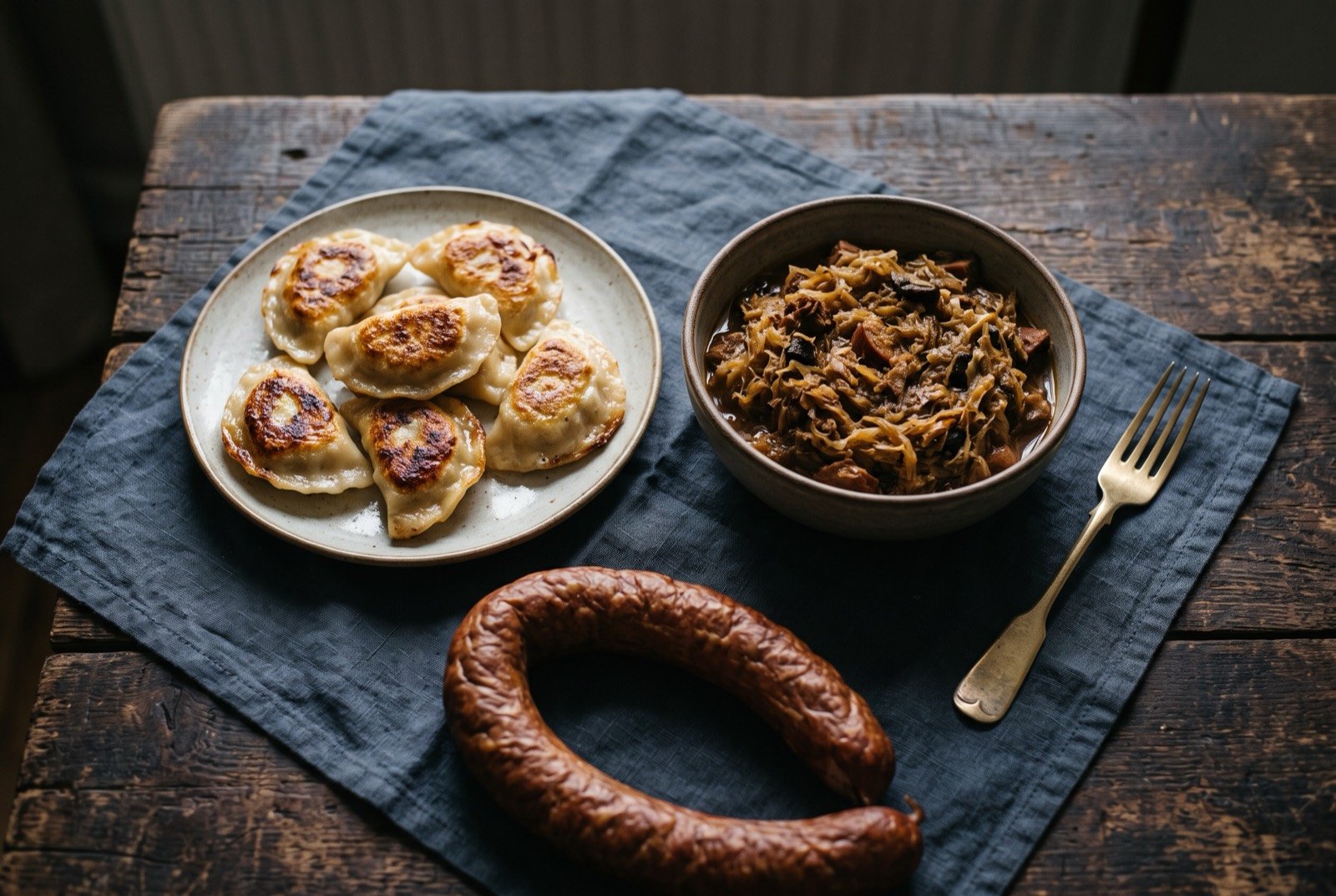
Poland's everyday Catholic Slavic table, rye, pork, cabbage, fermentation and smoke, given in full, and beside it, named outright rather than folded silently into "Polish food," the pre-1939 Ashkenazi Jewish culinary inheritance that grew up on the same soil. Two tables, not one flattened into the other, and every dish as tradition built it, then what a modern chef would change.
Sources and review · What this chapter does not assert · How we research · Spotted something wrong?
A Sense of Place
Poland sits on the North European Plain, cold and wet enough that wheat has historically been the secondary grain. Rye has been the dominant bread grain for most of documented Polish history, and this single ecological fact runs underneath more of this chapter than any other: it is why the everyday fermented rye sour, zakwas, sits at the structural centre of the cuisine rather than at its edge, the base of żurek, the sour soup that this volume's own modern chefs still call the most archetypally Polish dish there is, more so than anything grander. Buckwheat filled the ground rye and wheat could not: hardy enough for poor soil and a short season, historically peasant food that only reached burgher tables in the nineteenth century, with its stronghold in the Lublin region and the eastern borderlands. Poland retains unusually large forest cover for so densely settled a country, and mushroom foraging, grzybobranie, is described in the country's own press as close to a national pastime rather than a rural specialism; Poland is a major global exporter of dried porcini, sold onward into Italy, Germany and France under someone else's label. Carp farming has genuine medieval depth, introduced by Cistercian monks, likely in the twelfth century, specifically to provide food permitted on fasting days, with the oldest pond complexes around Milicz in the Barycz valley dating from the twelfth and thirteenth centuries. The pig is the central protein, obvious from every other thread in this chapter even where no single source states it as thesis: kiełbasa's real regional variety, kotlet schabowy, krupniok, smoked meats, lard as the standard cooking and pastry fat even for a doughnut. Fermentation, smoking and drying are the three preservation technologies that recur across every regional kitchen below, the expected answer to a short growing season and a long, hard winter.
That is one table. Before 1939, in the same towns, on some of the same streets, ran a second: Poland held the largest Jewish population in the world, roughly 3.3 million people, close to ten per cent of the whole country. Warsaw alone held over 350,000 Jews on the eve of the war, about thirty per cent of the city, and this was not one undifferentiated Jewish world any more than Poland itself was one undifferentiated Catholic one. The historian Israel Gutman drew the distinction sharply: Warsaw's Jewish community, in his account, "lacked tradition and character, which were important features of communities in such cities as Cracow, Lublin or Lviv, where the Jews had lived for generations." Kraków's Kazimierz district, Lublin and Lwów held older, more textured communities; a small shtetl such as Tykocin held a different structure again, a single dominant synagogue and a marketplace economy lived in far closer daily contact with Polish and Lithuanian peasant neighbours than a capital city allowed. Vilna, Wilno to interwar Poland, which held it as its own territory from 1922 to 1939 while Lithuania claimed it throughout, was called "di yerusholayem delite," the Jerusalem of Lithuania, a major centre of Litvak religious and intellectual life since the mid-fifteenth century. This chapter holds that contested ground rather than resolving it, and does not claim Vilna's food unambiguously as Polish.
What shaped this second table was not ecology first, as it was for the Catholic Slavic table, but religious law. Kashrut governed the kitchen at every level: meat and dairy could not be cooked or eaten together, which forced separate cookware, and forced Ashkenazi cooks away from butter as a cooking fat for meat dishes entirely. Pork fat was forbidden outright, and olive oil, the obvious Mediterranean answer, was expensive and often simply unobtainable this far north. The substitute, rendered poultry fat, schmaltz, became the defining cooking fat of the whole tradition, and it is worth stating plainly here because it changes how a reader should understand almost every dish in the second half of this chapter: this is not a taste preference. It is kosher law, working on the same poor, cold, grain-and-root-vegetable economy the Catholic Slavic table was built from, and arriving at a genuinely different flavour logic as a direct result. The Sabbath's own prohibition on lighting or maintaining fire from Friday sundown to Saturday night did the same structural work for a single dish, cholent, assembled and set to a low, steady heat before sundown and left twelve hours or more, unattended, because no flame could be adjusted while it cooked. Two tables, built from broadly the same landscape and the same poverty, shaped by two different sets of rules, standing beside each other for the better part of seven centuries. This chapter treats them as what they were.
The regional map, Catholic Slavic Poland
| Region | Defining logic | Dishes and products that carry it |
|---|---|---|
| Kashubia and the Baltic coast | Sea and freshwater fish culture, potato and cabbage the vegetable base | Kaszubian fish soup; czernina, duck or goose blood soup, at feasts and weddings |
| Tatra highlands, Podhale | Transhumant sheep pastoralism, a Wallachian cheesemaking heritage from the fourteenth century | Oscypek, an EU Protected Designation of Origin since 2008; bundz; bryndza; moskole, a griddled potato flatbread |
| Silesia (Śląsk) | Centuries of Czech, German and Austrian rule over an industrial mining region; potatoes and dumplings as fuel | Kluski śląskie; rolada; krupniok, groats, blood and organ meat with marjoram; a distinctly rye-and-juniper Silesian żur |
| Mazovia, around Warsaw | Claimed continuation of Old Polish court cuisine, French, German and Russian overlay from proximity to the capital | Flaki warszawskie, zrazy mazowieckie, though this table entry rests on weaker, consumer-level sourcing than the others |
| The eastern borderlands (kresy) | A genuinely multi-ethnic exchange zone, Polish, Lithuanian, Belarusian, Ukrainian, Tatar and Jewish overlap under the old Commonwealth | Kindziuk, a Lithuanian-style dried sausage; buckwheat-dough pierogi biłgorajski |
| Wielkopolska, Poznań | A guild-city tradition tied to one specific saint's day | Rogal świętomarciński, an EU Protected Geographical Indication since 2008, tied to 11 November and dated in its modern form to 1891 |
The History in Layers
An indigenous Slavic core, and a court cuisine most Poles no longer recognise as their own
Rye, buckwheat, cabbage and forest foraging pre-date Christianisation. What Poles today call "kuchnia staropolska," Old Polish cuisine, is a real historiographical category, but it is worth introducing with the same caution its own leading academic historian applies to it. Jarosław Dumanowski, of Nicolaus Copernicus University in Toruń, who leads the Monumenta Poloniae Culinaria project republishing the oldest Polish cookbooks with the Wilanów Palace Museum, calls "kuchnia staropolska" itself partly a retrospectively constructed myth rather than one continuous, stable tradition. The founding text of that tradition is real and dateable regardless: Compendium Ferculorum albo Zebranie potraw, 1682, by Stanisław Czerniecki, chef to the Lubomirski court at Wiśnicz, a book so significant that no further Polish cookbook was published for over a century after it. The court table it describes was heavily spiced, saffron, ginger, pepper, cinnamon, cloves, cardamom and mace, Poland's proximity to Ottoman and Hungarian trade routes giving it earlier access to this pantry than Western Europe had. The peasant table beneath it was built on salt and native herb, and some of its dishes were adopted upward onto gentry tables over the following centuries, not the other way round, a detail worth carrying into every dish in this chapter that a British reader might otherwise assume trickled down. Dumanowski's second, quieter point matters just as much: Old Polish fasting cuisine, built around a liturgical calendar that made roughly a third of the year meat-free, genuinely resembles modern veganism in its structure, a fact that complicates any assumption that this is a cuisine built purely around the pig.
A borderland argument, and a myth this chapter will not repeat
The eastern kresy, the old Commonwealth's multi-ethnic frontier, is where Polish, Lithuanian, Belarusian, Ukrainian, Tatar and Jewish food genuinely overlapped for centuries, and pierogi are the clearest single case of what that overlap actually means. Poland's own national linguistic authority, PWN Poradnia Językowa, confirms plainly that "ruskie," in pierogi ruskie, derives from Ruś Czerwona, Red Ruthenia, the historic region around eastern Galicia, not from Russia; most Polish speakers today have lost the distinction and hear "Russian" where none is meant. What this chapter will not repeat is the popular story that pierogi themselves reached Europe via Marco Polo from China. It does not survive checking. A Roman-era cookbook, De Re Coquinaria, already records a stuffed-dough recipe in the fifth century CE, centuries before Marco Polo's journey, and food historians increasingly treat stuffed dumplings as an independent invention across several culinary traditions rather than a single point of origin travelling outward. A separate, thirteenth-century legend crediting Saint Jacek Odrowąż with carrying the idea back from a mission to Kievan Rus is flagged, by the very sources that repeat it, as legend rather than history. This chapter treats both the same way: named, and set aside.
Kashrut reshapes a shared poverty into a second cuisine
The legal foundation of Polish Jewish settlement is unusually precisely dated. The Statute of Kalisz, issued 8 September 1264 by Bolesław the Pious, Duke of Greater Poland, granted Jewish communities settlement rights, legal protection, freedom of religious practice and trade, and jurisdiction over their own internal legal matters under their own courts, confirmed and extended in the fourteenth century by Casimir the Great. Settlement itself pre-dates the statute: Jews are evidenced in Kalisz from the twelfth century, arriving as refugees from the Rhineland Crusader massacres. What that settlement built, over the following six and a half centuries, was a cuisine shaped first by kashrut and only second by ecology, the inversion of the Catholic Slavic table's own priority. Schmaltz, rendered chicken or goose fat, became the central cooking fat precisely because butter could not touch meat and pork fat could not be eaten at all; one source dates German Jewish geese being raised specifically for fat as early as the eleventh century, a claim this chapter treats as plausible rather than confirmed, resting on a single outlet. Gribenes, the cracklings and softened onion left from rendering it, is worth naming as its own ingredient rather than a footnote, the thing that makes chopped liver what it is.
A real and recurring regional split runs through this tradition that a British reader is unlikely to know to look for: Polish and Galitzianer Jewish cooking trends sweet, sugar in gefilte fish, a sweet noodle kugel, while Litvak cooking, Lithuania and Belarus, trends savoury and heavily peppered. The best explanation on offer is economic rather than cultural: Poland built a major sugar beet refining industry from the early nineteenth century, one Jewish communities were commercially involved in, making sugar genuinely cheap in Polish Jewish kitchens in a way it never became across the Lithuanian border. The linguist Marvin Herzog is credited with mapping what food writers now call the Gefilte Line in the 1960s, a Yiddish dialect boundary that tracks with striking closeness onto this same sweet-savoury culinary divide, language and cooking shaped by the same trade geography.
What partition did, and what the Vienna schnitzel became
The partitions of 1795 to 1918 split Poland between Prussia, Austria and Russia for well over a century, and regional Polish cooking still carries the mark unevenly: Prussian rule is credited, in moderate-confidence sources, with bringing new technique and salads into Pomerania and Wielkopolska; Austrian rule, Kraków especially, with the most refined pastry tradition, still visible in Małopolska's confectionery today; Russian rule with the least emphasis on culinary refinement, rural populations holding to groats and potato. One dish tells this story unusually precisely. Kotlet schabowy, breaded, fried pork cutlet, so associated with Poland today that it reads as a national dish, is a documented Viennese import: the first printed Polish recipe appears in 1860, in Lucyna Ćwierczakiewiczowa's cookbook, adapting Wiener Schnitzel, originally veal, an imperial court luxury fried in clarified butter, by substituting the cheaper, more available pork. It only became a genuine everyday dish under the communist PRL, not before. Robert Makłowicz, Poland's best-known culinary broadcaster, has made a public habit of pointing this out directly: kotlet schabowy descends from Milanese cotoletta by way of Vienna, not from anywhere Polish at all, and his own repeated public position is that there is no such thing as a pure, patriotic Polish cuisine untouched by outside influence. This chapter agrees with him, and asks the reader to hold that same scepticism through every dish that follows.
What the Holocaust actually destroyed
Roughly ninety per cent of Polish Jewry was murdered. The most useful framing this research found for what that meant, specifically, for food, comes from the Holocaust historian Kelsey Maurine Brickl: the Holocaust destroyed not a collection of recipes but an entire culinary geography. "A regional cuisine is not merely a collection of dishes," she writes. "When that population disappears, the cuisine changes even if many of its recipes survive." What was actually lost includes the bakeries, the butchers, the dairies, the markets, the whole multi-generational transmission network that lets a living cuisine keep evolving, not only the paper record of it, and this chapter takes that argument seriously rather than pretending the record it draws from is more complete than it is. One case makes the loss and the honest partial recovery concrete. Fania Lewando, a kosher vegetarian chef and restaurateur in Vilna, published The Vilna Vegetarian Cookbook in Yiddish in 1938, roughly four hundred recipes. She and her husband were killed by the Nazis in 1941; the exact circumstances are not fully agreed between sources, and this chapter does not resolve them. A surviving copy of her book turned up decades later at a London antiquarian book fair, was donated to the YIVO Institute in New York, and was translated and republished in 2015 by Eve Jochnowitz, with an introduction by Joan Nathan. In Vilna itself, roughly ninety five per cent of Lithuania's Jews, somewhere between 160,000 and 210,000 people, were murdered, a large share at Ponary outside the city in the summer of 1941, before the major death camps were even fully operational.
What America made afterwards, named honestly
A large share of what the world now calls Jewish deli food is specifically an American reinvention, one or two steps removed from anything traceable to Poland, and the distinction is worth making explicit rather than glossed over, because this chapter is specifically about the Polish original, not the American afterlife. Rugelach's rolled-pastry technique genuinely originates in Poland, Hungary and Galicia, but the cream-cheese-dough cookie sold under that name today is dated to Newark's Third Ward Jewish bakeries by 1939, made possible by industrial American cream cheese production that did not exist in the old country. Babka genuinely originates in Poland and Ukraine in the early 1800s, rolled with cinnamon or fruit alongside challah dough, but remained essentially unknown outside Eastern Europe until the 1950s, when Israeli and American bakeries began producing it at scale. Bagels are genuinely Polish in first documented reference, covered in full below, but the boiled-then-baked commercial bagel that now dominates the world is itself a later American development. None of this makes the American versions fake. It does mean this chapter should not, and will not, present them as unbroken continuations of the pre-1939 original.
The Flavour Arsenal
The Catholic Slavic pantry
Rye is the bread grain and the base of żurek's zakwas starter, and its regional variants are worth knowing rather than flattening: Silesia insists on rye flour specifically for its own sour; Lubelszczyzna uses buckwheat flour instead, called locally kwasza or kisielica; Podlasie uses oat flour. Buckwheat pre-dates the potato in the Polish diet by centuries, historically peasant food that only reached burgher tables in the nineteenth century, its stronghold the Lublin region and the kresy. Sour cream, śmietana, is the universal enrichment, from the simplest cucumber salad, mizeria, through to nearly every soup and sauce in this chapter, well attested by the sheer breadth of consistent mention across Polish sources rather than by any one scholarly treatment. Dill and marjoram are the defining herbs, dill paired above all with fish, potato and soup, marjoram aromatising soups and meat marinades and standing as the single defining seasoning in krupniok specifically. Dried forest mushrooms, borowik, the porcini of the September and October foraging season, are treated as indispensable to the Wigilia table, one source stating plainly that the meal is unimaginable without them. Kiełbasa is not one sausage but a real regional family: wiejska, boiled, mild, larger-cut pork and veal; myśliwska, hunter's kiełbasa, dry, cured, cold-smoked, blending pork with game; krakowska, dry and intensely flavoured, tied to eighteenth-century Kraków butcher tradition; śląska, thin and all-purpose; and kindziuk, the kresy's own long-matured, intensely aromatic dried sausage. Poppy seed, mak, has archaeological evidence stretching back to the Bronze Age and written recipes for poppy pastry from the fifteenth century, traditionally hand-ground in a wooden bowl, a makutra, to preserve its aroma.
The Ashkenazi pantry
Schmaltz, rendered chicken or, historically, goose fat, is the central cooking fat, and everything else in this list sits downstream of the fact that kashrut put it there. Gribenes, the cracklings and onion left from rendering it, is its named byproduct, used above all to enrich chopped liver. Onion is the dominant aromatic across nearly every dish here. Carp and pike are the freshwater fish tradition underlying gefilte fish. Egg noodles, lokshen, and egg-enriched dough carry kugel and challah both; lokshen's own etymology has real depth, Eastern Yiddish "lokshen" argued to derive, via Persian, from noodles that reached Slavic Eastern Europe through Central Asian Tatar contact in the sixteenth century, a genuinely separate route from Western Yiddish "frimsel," borrowed from Italian vermicelli through German-speaking Ashkenazi communities two centuries earlier. Rye and dark bread, pumpernickel specifically, is named as a staple of German and Polish Jewish life, eaten far more often day to day than challah, which was kept for Shabbat. Honey carries the specific symbolism of Rosh Hashanah, the apple dipped in honey. Poppy seed reappears here as a genuine crossover point: the same paste fills both the Polish makowiec and the Yiddish mohn roll, essentially one technique claimed by both tables, and no source found in this research says with any confidence which direction the borrowing ran, or whether it simply developed in parallel on the same soil, which is itself the more honest answer.
Part Two
The Technique Ladder
The argument, from inside
Poland's own Michelin history is genuinely recent, and worth stating plainly rather than softened for effect: the country's first star of any kind was awarded only in 2013, to Wojciech Modest Amaro's Atelier Amaro in Warsaw, the third starred restaurant in the whole of Central Europe, in a building that had previously been a public toilet. Atelier Amaro closed in 2020, a direct casualty of the pandemic. What has grown since is a genuinely serious, decade-long shift some Polish food writers call nowa polska kuchnia, new Polish cuisine, chefs rebuilding technique from Polish peasant and noble-table roots rather than importing French method wholesale, in exactly the spirit this atlas argues for everywhere. Przemysław Klima at Bottiglieria 1881 in Kraków holds Poland's only two Michelin stars, a fusion of Polish and Scandinavian technique built exclusively on local product. Beata Śniechowska at BABA in Wrocław, a former MasterChef Polska winner with a doctorate in thermodynamics, became the first woman in Poland to hold a Michelin star as a chef-owner in the 2026 guide, and Michelin's own citation praises her "assured reinterpretations of traditional Polish dishes," cooking built from childhood memory and season rather than imported grammar, which is probably the single clearest embodiment in the whole Polish scene of this atlas's founding argument. Aleksander Baron, chef-owner of Solec 44 in Warsaw and author of Kiszonki i fermentacje, runs, by his own restaurant's account, hundreds of jars of live ferment at any one time, and is repeatedly named across Polish food press as the country's foremost living authority on fermentation as a serious kitchen discipline, not a garnish.
Every rung below draws on that kind of documented mechanism, on Old Polish or Ashkenazi practice already fixed by centuries of repetition, or, honestly, on the strongest convergent household-level evidence this research could find where nothing more precise exists.
Rung 1. Judge zakwas by nose, not by the clock
Żurek's sour rye starter is built from rye flour and water alone, with garlic, bay leaf and allspice berries commonly fermented in alongside it, at room temperature, roughly 20 to 22°C, stirred daily, in a container covered loosely enough to let gas escape rather than sealed. The chef Jasiek Kuroń's own published method gives a working ratio of one cup of rye flour to a litre of water, and states readiness at three to five days, but the more important instruction, repeated across every source this research found, is that readiness is a live-culture judgement, not a fixed clock: a strong, clean sour smell and light surface bubbling, not a stopwatch. A UK kitchen running noticeably cooler or warmer than a Polish one should trust its nose over any printed day count.
Rung 2. Give sauerkraut and cucumbers the full two weeks
Polish sources disagree by roughly double on the exact salt ratio for sauerkraut, somewhere between 10 and 25 grams of non-iodised salt per kilogram of shredded cabbage, and this chapter presents that as a genuine range rather than pretending to a false precision. What is consistent, and what matters more than the salt figure, is time: a fully soured, properly live product needs a minimum of two weeks, the vigorous initial fermentation visible as foaming across the first two to three days, with a full home ferment running one to four weeks depending on temperature and taste. This is the direct, checkable reason a jarred supermarket sauerkraut, fermented for a fraction of that window and very often pasteurised afterward, tastes thin and one-note next to a properly made one: it has been stopped before the culture finished its work, and pasteurisation then kills what culture remained. Fermented cucumbers, ogórki kiszone, follow the same logic at a brine ratio of roughly one part salt to ten parts water for the classic, fully soured style, weighted under their own liquid in a stoneware crock, garlic, dill flower head and horseradish the traditional flavourings.
Rung 3. Dry the casing before you smoke the kiełbasa
Genuine Polish kiełbasa is smoked, not merely seasoned, and the two smoking traditions are genuinely different techniques, not two speeds of the same one. Hot smoking runs roughly 50 to 65°C for four to six hours, to an internal meat temperature around 68 to 72°C. Cold smoking runs below 30°C, tighter sources specifying 12 to 25°C, a far slower, multi-day process that trades speed for a sausage that keeps for months rather than days, and is unambiguously the more advanced of the two, and the more interesting one for a reader whose Big Green Egg can hold a genuinely controlled low temperature over many hours. Alder is the dominant traditional wood, often blended with beech for a stronger, more assertive smoke, roughly seventy parts alder to thirty parts beech in one detailed commercial-style formula, with cherry added only in the final hour for colour and a faint sweetness. The single most important practical step, and the one most likely to be skipped by a home cook working from a recipe rather than a tradition, is drying the casing before smoke ever touches it: a wet casing repels smoke and ruins the colour, and the target is a dry, faintly tacky surface, a pellicle, achieved by air-drying two to four hours in a cool, ventilated spot first. Smoke too hot, above roughly 80°C, and the casing splits and the sausage dries out regardless of how carefully everything before it was done.
Rung 4. Treat schmaltz as the whole flavour logic, not a substitute for butter
A British reader is likely to reach for butter or a neutral oil in any of this chapter's second half without thinking twice, and that instinct should be resisted, because schmaltz is not standing in for butter here, it is the point. Chicken or goose fat, rendered slowly, carries a specific savoury depth that neither butter nor a neutral oil replicates, and it is the ingredient that makes chopped liver, cholent and kugel taste like themselves rather than like a kosher-adjacent approximation of a French or English dish. Gribenes, the crisp cracklings and softened onion left behind by the render, is not a byproduct to discard but the finishing garnish that chopped liver in particular is built around. Rendering it at home is straightforward and needs no special sourcing: chicken skin and fat from any butcher or supermarket bird, rendered low and slow until clear.
Rung 5. Read cholent as engineering, not folklore
Cholent's twelve-plus hour, unattended, low-heat overnight cook looks, to a modern kitchen, like an eccentric piece of folk cookery. It is closer to an engineering constraint solved with the tools available at the time: the Sabbath prohibition on lighting or adjusting fire from Friday sundown to Saturday night meant the pot had to be assembled, sealed and set to a heat source, historically a banked hearth or a communal bakery oven left burning after the day's baking, before sundown, and left entirely alone until it was eaten the following day. A modern approximation runs roughly 12 to 16 hours at 95 to 105°C. What is worth naming directly is how close this sits, mechanically, to a sous vide bath or a Big Green Egg held at a steady low dome temperature for the same length of time: the same low-and-slow logic, arrived at seven centuries earlier by religious constraint rather than by technique, and just as effective for it.
Rung 6. Fry kotlet schabowy hot and briefly, not low and long
The single most common way this dish goes wrong, in Poland and far more often in its diaspora versions, is frying it too gently and for too long, on the mistaken assumption that a thicker cutlet needs a gentler pan. Polish culinary advice converges on the opposite: a working oil temperature of roughly 160 to 175°C, and a thin, evenly pounded cutlet needing as little as 90 to 120 seconds per side, not the three to five minutes a cautious cook might default to. Push much past that and the muscle fibres tighten and force their moisture out, the exact mechanism that produces the tough, dry, grey cutlet a bad diaspora restaurant serves. A cutlet taken straight from the fridge into hot fat suffers the same violent contraction; letting it come closer to room temperature first, and giving it a milk or kefir marinade before crumbing, both work against the same failure.
Part Three
The Ferment and Preserve Bench
1. Zakwas, the fermented rye sour
Rye flour and water alone, fermented at 20 to 22°C for three to five days, judged by smell and light effervescence rather than a fixed clock (see rung 1). This is the single most structurally important ferment in the whole Catholic Slavic table, the base of żurek and, by extension, of the whole sour-soup family this cuisine builds its winter cooking around.
2. Kapusta kiszona and ogórki kiszone
Sauerkraut needs a genuine two weeks minimum to fully sour, salted at roughly 10 to 25 grams per kilogram of cabbage, weighted under its own brine in a stoneware crock (see rung 2). Fermented cucumbers follow a roughly one-to-ten salt-to-water brine, garlic, dill flower head and horseradish the traditional additions. Both are the clearest, most checkable evidence in this whole volume for why a shortcut jarred product cannot substitute for the real, patient process: the culture simply has not had time to do its work.
3. Kiełbasa smoking
Cold smoke below 30°C over several days for a long-keeping product, or hot smoke at 50 to 65°C for four to six hours for something to eat sooner, alder and beech the traditional woods, the casing dried to a tacky pellicle before smoke ever touches it (see rung 3). The clearest single case in this chapter of a "traditional" method that is, on inspection, a checkable, transferable piece of food science, curing salt's nitrite doing real, named work against botulism, not decoration.
4. Dried forest mushrooms
Slow-soaked in lukewarm water three to four hours before use, the soaking liquid itself the more valuable product, carrying an umami depth Polish sources describe as difficult to achieve from fresh ingredients alone. Central to barszcz z uszkami and to bigos both, and to the Wigilia table generally.
5. Schmaltz and gribenes
Chicken or, historically, goose skin and fat, rendered slowly to a clear liquid, the crisp cracklings and softened onion left behind reserved separately (see rung 4). This is the Ashkenazi table's own preserve-bench entry, and its own indigenous ancestor to a technique a modern kitchen would otherwise reach for duck fat or clarified butter to achieve: not a substitute forced by scarcity, but the flavour logic the whole second half of this chapter is built from.
Sourcing in Britain
Verified August 2026. This chapter needs two genuinely separate sourcing threads, Polish ingredients and kosher or Jewish deli ingredients, because a Polish deli and a kosher deli are different shops selling different products, even in a country with a large, long-established community for each. Where a retailer could not be independently confirmed as current, that is said plainly rather than repeated from an old listicle.
Polish ingredients
- Real, wood-smoked kiełbasa, not generic "Polish sausage." Krakus, a UK distributor with over seventy years of production history, names its varieties directly on its own site with real smoking detail: Podwawelska (beechwood and alderwood), Żywiecka, krakowska and myśliwska. Sokołów is stocked across mainstream UK retailers via price-comparison listing. What to look for on a label to avoid a UK-made imitation: a named smoking wood, not "smoke flavouring," a short ingredient list dominated by meat and named spices, and a Polish manufacturer's address. British supermarket own-label "Polish style" sausages, Morrisons specifically flagged in this research, are highly unlikely to use Polish-sourced meat at all.
- Fermented, unpasteurised sauerkraut. Most jarred sauerkraut in UK Eastern European shops and supermarkets, including common Dawtona and Edmal brands, is pasteurised. For a genuinely live product, Tesco itself stocks Vadasz Raw Garlic and Dill Sauerkraut; The Cultured Food Company's Organic Sauerkraut is a second option. Look for "raw," "unpasteurised" or a refrigeration requirement on the label; a shelf-stable jar has almost certainly been pasteurised.
- Rye flour, dried mushrooms and general Polish groceries. Piknik Express and London Grocery are both confirmed UK-facing online Polish delis, the former stocking Podlaskie Młyny's graded rye flour and several oscypek products, the latter over 300 Polish products across eight categories. No UK stockist of dried Polish borowiki with confirmed UK delivery was found in this research; a general Polish grocer, not a specialist mushroom retailer, is the safer route.
- Physical shops. Barbakan Delicatessen, Chorlton, Manchester, established 1964, the best-documented Polish retailer in Britain, a working bakery that has won national trade awards. Mleczko Delikatesy, five branches across west London, Slough and Reading. Polish Specialities, King Street, Hammersmith, by the Polish Social and Cultural Centre, the historic heart of Polish London. Beyond these three, most city-by-city listings for Birmingham, Balham and Southampton rest only on business directories and Facebook pages rather than independent corroboration, and should be checked live before relying on them.
- Twaróg. Not confirmed at a specific named UK retailer in this research. Quark, widely available across every major UK supermarket, is the standard substitute, but a genuine compromise, tangier and lower in fat than true twaróg, not a seamless swap.
- Oscypek. Genuinely PDO-protected and seasonal, producible only in the Tatra Podhale region, May to October, only intermittently available even from Piknik Express, the one confirmed UK stockist. Slovak oštiepok, sold by halusky.co.uk, is a related but genuinely different tradition worth naming honestly as a substitute rather than the same cheese.
- Kit. A pierogi crimper is ordinary kitchenware, available from Amazon UK or Etsy UK for under £10. The Big Green Egg's own community forum has genuine, tested guidance for hot-smoking kiełbasa at home; cold smoking sausage safely requires the meat to be cured or pre-cooked first, a real food-safety point, not a traditional-purist's preference.
Kosher and Jewish deli ingredients
- The London Beth Din's own certification. KLBD, the Kashrut Division of the London Beth Din, certifies roughly 40,000 ingredients and over 3,500 UK retail products and publishes its own current list of certified delis and shops, the single most authoritative source in this whole sourcing section. Its own directory names Kosher Deli (five branches, Borehamwood, Edgware, Golders Green, Hendon, Temple Fortune), Manna Deli in Hendon, The Kelman Deli in Bushey, and Menachem's in Golders Green. Two further UK kosher authorities, the Federation of Synagogues Kashrus Board and Machzikei Hadass, are worth knowing, since Stamford Hill's shops in particular may carry a Machzikei Hadass mark rather than KLBD.
- Named delis and bakeries. Panzer's, St John's Wood, opened 1944 by an Austrian and a Czech refugee, the best-verified retailer in this section, known for its own-bakery bagels and hand-sliced smoked salmon. Reich's and Platters Deli, Temple Fortune, and Kosher Kingdom, Golders Green, Europe's largest kosher supermarket by its own description. Deli 98 in Stamford Hill, serving that specifically Charedi community. Oren Deli, London Fields, one of the few Jewish delis found entirely outside north west London. For challah, Carmelli Bakery and Grodzinski Bakery, Golders Green, both now under common ownership, a real piece of trade consolidation worth naming rather than presenting the two as independent rivals. In Manchester, Kosher Deli and Shefa Mehadrin in Prestwich, both independently confirmed.
- Matzo meal. Rakusen's, founded 1900 in Leeds by a Lithuanian-born émigré, still operating in Leeds, London Beth Din certified, and genuinely mainstream, stocked at Waitrose, Ocado, Morrisons, Sainsbury's and Amazon UK. A good, quietly satisfying detail: this is a British-manufactured piece of exactly the Eastern European Jewish inheritance this chapter is about.
- Gefilte fish. B Kosher, a verified UK kosher retailer with branches in Hendon and Borehamwood, stocks Kedem's jarred gefilte fish. The distinction between a jarred product, often carp or mullet with matzo meal filler, and a fresh, homemade version using salmon or trout with minimal filler is real and consistently drawn across Jewish food writing, though most of that writing is American rather than specifically Polish in its framing, worth noting given this chapter's own Polish focus.
- Schmaltz, the hardest single sourcing gap in this whole chapter. No UK retailer with a confirmed, currently in-stock jarred schmaltz product was found with any real confidence. Home rendering, from any butcher's or supermarket's chicken skin and fat, is very likely the more reliable route for a UK reader, and this chapter presents it as the primary method rather than implying a shop-bought jar can be relied on.
The ranked list: what decides great from grim
- Fermented, unpasteurised sauerkraut over a vinegar-brined or pasteurised jar. The single biggest quality lever on the whole Slavic side of this volume.
- Named, wood-smoked kiełbasa over generic supermarket "Polish sausage." Krakus is the best-verified route.
- Home-rendered schmaltz over a shop substitute. Probably the single most important decision on the Ashkenazi side, and the sourcing gap this research least managed to fill.
- Homemade gefilte fish over jarred, where the time and cold-storage exist to make it.
- Quark as an honestly-named compromise for twaróg, not a claimed equivalent.
- Real oscypek, or an honestly-named Slovak oštiepok, over skipping the ingredient entirely.
Voices and Sources
The Catholic Slavic table
- Jarosław Dumanowski, historian, Nicolaus Copernicus University, Toruń, leads the Monumenta Poloniae Culinaria republication project with the Wilanów Palace Museum, and is the clearest, most self-critical academic voice in this whole chapter.
- Przemysław Klima, Bottiglieria 1881, Kraków, Poland's only two Michelin stars, Polish and Scandinavian technique built on local product.
- Beata Śniechowska, BABA, Wrocław, the first woman in Poland to hold a Michelin star as chef-owner, a former MasterChef Polska winner with a doctorate in thermodynamics.
- Witek Iwański, hub.praga, Warsaw, and Bartosz Szymczak, Rozbrat 20, Warsaw, both Michelin-starred, both working explicitly from Polish roots.
- Andrea Camastra, NUTA, Warsaw, formerly of Senses, which is no longer operating; Polish cuisine worked with Italian accent and a subtle Asian layer.
- Aleksander Baron, Solec 44, Warsaw, author of Kiszonki i fermentacje, repeatedly named as Poland's foremost living fermentation authority.
- Robert Makłowicz, culinary critic and broadcaster, the most public voice arguing against the idea of a pure, unmixed Polish cuisine.
- Wojciech Modest Amaro, formerly of Atelier Amaro, Poland's first Michelin star, 2013, since closed.
The UK diaspora
- Ognisko Polskie, South Kensington, founded as a wartime émigré hub in 1939 or 1940, run commercially since 2013, holds a Michelin Plate; reviewed for its room and specific dishes more than for cutting-edge technique.
- Daquise, South Kensington, opened 1947, London's oldest Polish restaurant, genuinely historically significant, though critical consensus, stated plainly by more than one reviewer, is that people go for the atmosphere and the history, not the cooking.
- Baltic, Southwark, closed permanently in April 2021. While open, a detailed, technically literate review credited it with succeeding through lighter technique and better ingredients than the "kitsch" diaspora standard, gołąbki pan-fried with thin cabbage rather than boiled soft, in particular. This restaurant is closed and is named here for its documented technique, not as a current recommendation.
- No evidence was found of a London restaurant working in the ambitious "new Polish cuisine" register of Bottiglieria 1881 or BABA. This is stated as a real gap rather than filled with a plausible-sounding name.
The pre-1939 Ashkenazi Jewish table
- POLIN Museum of the History of Polish Jews, Warsaw, its permanent exhibition chief-curated by Barbara Kirshenblatt-Gimblett, and its 2022 temporary exhibition on Jewish culinary culture, over forty recipes selected by Sabina Francuz.
- Eve Jochnowitz, described as the premier scholar of Ashkenazi food history, translator, with Joan Nathan, of Fania Lewando's rediscovered Vilna Vegetarian Cookbook.
- Gil Marks, Encyclopedia of Jewish Food; Claudia Roden, The Book of Jewish Food; Michael Wex, Born to Kvetch; Maggie Glezer, A Blessing of Bread; Maria Balinska, The Bagel: The Surprising History of a Modest Bread, a BBC journalist of Polish Jewish and gentile ancestry who did her own archival research at Jagiellonian University in Kraków.
- Laurel Kratochvila, Fine Bagels, Berlin, author of Dobre Dobre: Baking from Poland and Beyond (2025), a New York Times Best Cookbook of 2025 and 2026 James Beard Award nominee.
- Maryla Musidłowska and Jakub Chojęcki, running Boker Tov kosher vegetarian breakfasts at the Warsaw Jewish Community Center.
- Kazimierz, Kraków's Jewish revival restaurants, Cheder Cafe, Klezmer Hois and Ariel, genuine and now decades old, though this chapter notes honestly that some criticism exists of a degree of performed rather than lived authenticity in that revival scene, a criticism this research could not read in full and does not adjudicate.
- Josef Herman, a Warsaw-born painter who lived in Wales from 1944 to 1955, recorded fondly remembering his mother's Warsaw carp cooking, the one genuinely Polish-specific thread this research found in the UK Jewish diaspora, distinct from the generically East European Ashkenazi names, Rinkoff's, Kossoff's, Beigel Bake, Bloom's, that otherwise dominate that record.
Things this chapter has deliberately not asserted
- That pierogi reached Poland via Marco Polo from China. A Roman-era cookbook already records stuffed dough in the fifth century CE, centuries before Marco Polo's journey, and the popular legend does not survive checking.
- That carp's place as the obligatory Wigilia fish is ancient. Multiple sources converge that it only became near-universal after the Second World War, tied to a 1947 promotional campaign and to postwar mass-farming economics; before that, other fish held regional primacy.
- That Wigilia's fixed twelve-dish count is an old tradition. It appears to be a relatively late standardisation, turn of the nineteenth into the twentieth century; dish count previously varied by household wealth and region.
- That "kuchnia staropolska," Old Polish cuisine, is one continuous, unbroken tradition. Its own leading academic historian, Jarosław Dumanowski, calls it partly a retrospectively constructed category, real as a historiographical object, not as an unchanging lived practice.
- That the story of Saint Jacek Odrowąż bringing pierogi back from Kievan Rus, or of Jan III Sobieski bringing sernik back from Vienna, is documented history. Both are flagged as legend by the sources that repeat them.
- That juniper is a standard traditional wood for smoking kiełbasa specifically. It appears reliably in game-seasoning contexts in this research, not confirmed for kiełbasa smoking, though plausible.
- That any single, precise salt ratio for sauerkraut is settled. Polish home-cooking sources themselves disagree by roughly double, 10 to 25 grams per kilogram, and this chapter presents that as a genuine range.
- That Senses, in Warsaw, is currently open. It does not appear on the 2026 Michelin starred list and appears to have closed around 2020; its former chef now runs NUTA instead.
- That any current London restaurant works Polish food in the ambitious, technique-forward register of Poland's own new-wave chefs. This research found none, and states that as a gap rather than filling it with a plausible name.
- That schmaltz's eleventh-century German origin, as sometimes dated for geese specifically raised for fat, is confirmed beyond a single source. It is treated here as plausible, not established.
- That rugelach and babka, as commercially sold today, are direct, unbroken continuations of anything eaten in pre-1939 Poland. Their rolled-pastry and layered-dough techniques are genuinely Polish and Galician in root, but the specific products now sold under those names are twentieth-century American reinventions, and this chapter treats that as a meaningful distinction, not pedantry.
- That the precise circumstances of Fania Lewando's death in 1941 are settled. Sources disagree on the detail, and this chapter has not chosen between them.
- That this chapter's own record of pre-1939 Polish Jewish food is complete. It is not, and could not be from this research alone. The scholar Kelsey Maurine Brickl's argument is the honest frame this chapter has adopted throughout: the Holocaust destroyed a living culinary geography, not only a set of recipes, and where this chapter is thinner than its Catholic Slavic half, that thinness is very often the honest finding itself, not a research failure to be quietly smoothed over.
Judge zakwas by nose, not by the clock
Żurek's sour rye starter is built from rye flour and water alone, with garlic, bay leaf and allspice berries commonly fermented in alongside it, at room...
Give sauerkraut and cucumbers the full two weeks
Polish sources disagree by roughly double on the exact salt ratio for sauerkraut, somewhere between 10 and 25 grams of non-iodised salt per kilogram of...
Dry the casing before you smoke the kiełbasa
Genuine Polish kiełbasa is smoked, not merely seasoned, and the two smoking traditions are genuinely different techniques, not two speeds of the same one.
Treat schmaltz as the whole flavour logic, not a substitute for butter
A British reader is likely to reach for butter or a neutral oil in any of this chapter's second half without thinking twice, and that instinct should be...
Read cholent as engineering, not folklore
Cholent's twelve-plus hour, unattended, low-heat overnight cook looks, to a modern kitchen, like an eccentric piece of folk cookery.
Fry kotlet schabowy hot and briefly, not low and long
The single most common way this dish goes wrong, in Poland and far more often in its diaspora versions, is frying it too gently and for too long, on the...
The dishes
- Pierogi ruskie Poland-wide, most identified with the eastern kresy
- Bigos Poland-wide
- Żurek Poland-wide, with real regional variation
- Barszcz czerwony z uszkami Poland-wide, the fixed centrepiece of the Wigilia table
- Kiełbasa myśliwska, home-smoked Poland-wide
- Kotlet schabowy Poland-wide, though genuinely Viennese in origin, first printed in Poland in 1860
- Cholent Ashkenazi, pre-1939 Poland
- Gefilte fish Ashkenazi, pre-1939 Poland
- Chopped liver Ashkenazi, pre-1939 Poland
- Kugel (sweet noodle) Ashkenazi, pre-1939 Poland
- Challah Ashkenazi, pre-1939 Poland
Sources and review
- Researched
- 10 sources cited
- Reviewed
- Not yet reviewed from inside the tradition
- Cooked
- Not yet cooked and reported
Where this volume comes from
3 research briefs on file for this volume, researched to the rules on How we research. Published 28 August 2026. Last changed 8 September 2026.
The brief's own account of its sources
Pass A (Catholic Slavic table), rough breakdown of roughly 34 searches. A small core of genuinely strong, in-tradition or academic sources anchors the most load-bearing claims: Jarosław Dumanowski (academic historian, multiple interviews plus his Wilanów Palace Museum affiliation); the Museum of Polish History in Warsaw (an official institution); Polish Wikipedia articles citing named sources; PWN Poradnia Językowa (Poland's national linguistic authority, used for the "ruskie" etymology, safe to assert plainly); official EU protected-designation registrations and their certifying bodies; and