Europe · Volume 22
The Low Countries
Herring, Beer and a Coastline Three Nations Share
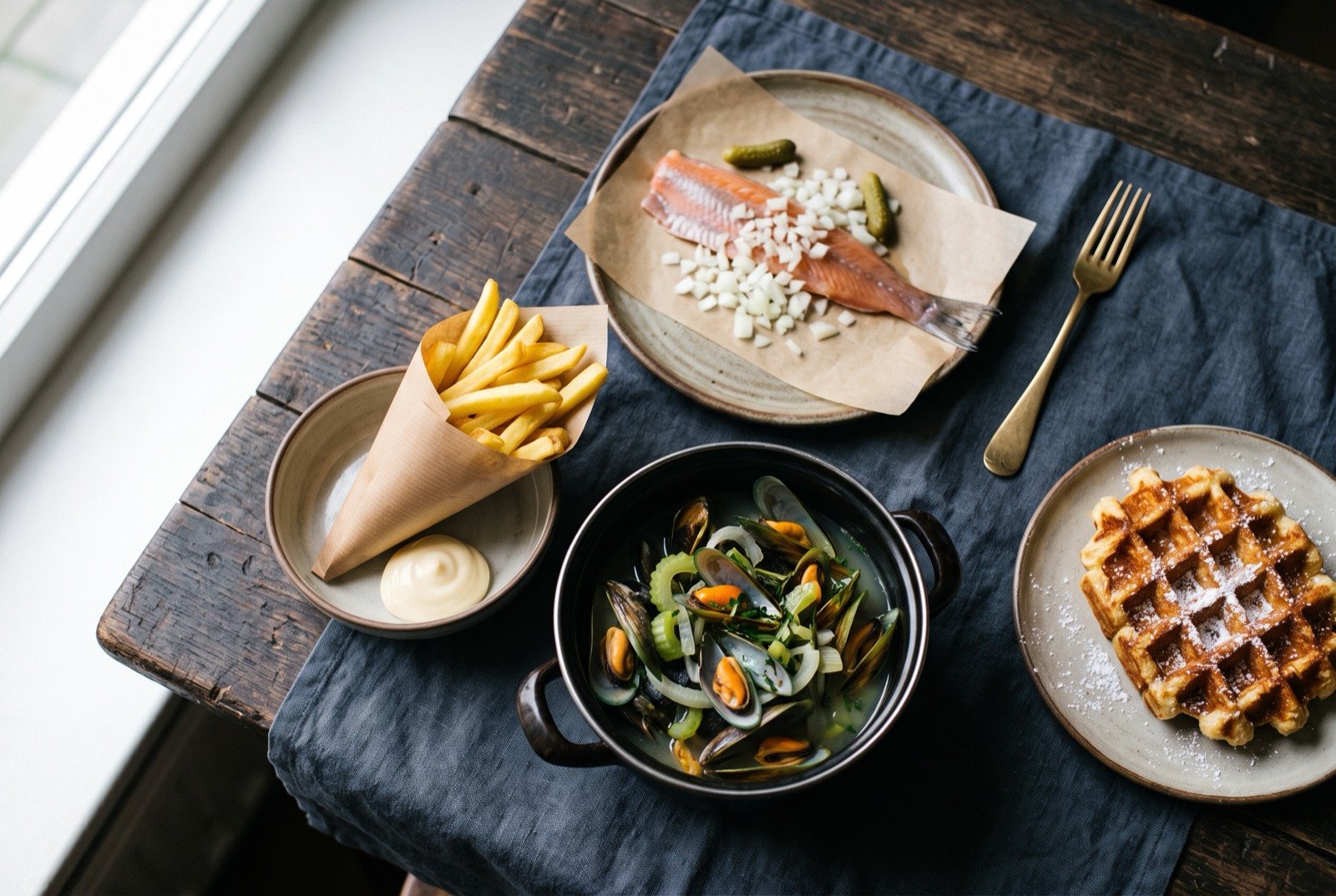
Three small nations sharing one river delta and one stretch of North Sea: the Netherlands, a Protestant merchant republic built on a herring fleet that briefly ran the world's trade; Belgium, Dutch-speaking Flanders and French-speaking Wallonia sharing a beer-and-chocolate craft neither half owns alone; and Luxembourg, touched lightly. Every dish as tradition built it, then what a modern chef would change.
Sources and review · What this chapter does not assert · How we research · Spotted something wrong?
A Sense of Place
The Netherlands: polder, herring cart, and a nation that argued with the sea and won
Roughly a quarter of the Netherlands sits below sea level, land wrested from the water by dikes, windmills and, later, steam and diesel pumps, and it is not an exaggeration to say Dutch cooking's whole logic follows from that fact. The staple starch is the potato, grown on reclaimed polder soil; the fat is butter, from cattle grazed on the same low, wet pasture; the aromatic is nutmeg, arriving centuries ago through the Dutch East India Company's Indonesian spice monopoly and never leaving the cupboard since; the thickener, where there is one, is bread or a warmed cream-and-egg liaison rather than a built roux. The sea itself supplies the other half of the story: herring, mussels, eel and North Sea whitefish, eaten with a bluntness (raw, by the tail, with nothing but chopped onion) that a French or Italian fish tradition would find almost aggressively plain, and is exactly the point. Protestant frugality, not a lack of ambition, shaped this cuisine: considered, competent home cooking within real constraint, not the showy court cuisine that grew up around Catholic Europe's monarchies and prince-bishops.
Flanders and Wallonia: one small country, two kitchens sharing a beer
Belgium did not exist as a state until 1830, and its food did not merge into one cuisine when the state appeared. Flanders, Dutch-speaking, shares the Netherlands' maritime ecology directly, the same North Sea mussel and herring trade, the same potato-and-butter starch logic, but layers on a genuinely distinct fine-dining and craft tradition: chocolate, praline, the double-fried frite, and a beer culture running from everyday commercial lager to six ATP-certified Trappist monasteries. Wallonia, French-speaking, sits closer to the food logic of northern France, but the two halves of the country are bound by exactly the things this volume treats as home dishes: moules-frites eaten the same way from Ostend to Liège, waffles that differ mechanically (a yeasted dough in Liège, a whipped batter in Brussels) rather than by any linguistic border, and a beer-and-monastery tradition, Trappist houses at Westmalle and Achel in Flanders, at Chimay, Orval, Rochefort and Westvleteren in Wallonia, that treats the language line as simply irrelevant to where a good abbey brewery might sit.
Luxembourg, named honestly and lightly
Luxembourg gets one dish and a paragraph here, not a full chapter's treatment: its national dish, judd mat gaardebounen, smoked pork collar with broad beans, sits genuinely at the crossing point of French, German and Belgian influence, and deserves its own volume once this atlas's Europe map extends that far rather than a diluted half-chapter now. It is named here because it belongs to this region's ecology and history, not because this chapter can do it justice.
The structural logic, at a glance
| Netherlands | Flanders | Wallonia | |
|---|---|---|---|
| Fat | Butter | Butter, beef fat for frites | Butter, duck and pork fat at the French border |
| Starch | Potato | Potato | Potato, bread |
| Thickener | Bread, egg-and-cream liaison | Egg-and-cream liaison, bread-and-mustard | Roux, in the French manner |
| Aromatic | Nutmeg, clove | Nutmeg, bay, thyme | Bay, thyme, clove |
| The sea's contribution | Herring, mussels, eel | Mussels, North Sea whitefish | Freshwater fish, inland from the coast |
| The fourth fat | Not used | Beer, in a braise | Beer, in a braise |
The History in Layers
A silver herring economy
Between roughly 1550 and 1700, Dutch salt herring fishing was so dominant across Europe that rival nations actively tried to legislate and blockade it out of existence, and failed. The technique that made this possible, kaken, gutting the herring but deliberately leaving its pancreas in place so the fish's own enzymes ripen the flesh during a short salt cure, is popularly credited to a fourteenth-century Zeeland fisherman, Willem Beukelszoon of Biervliet. This is very likely a myth: a 2006 archaeozoological paper by Lauwerier and Laarman, and separate Danish excavation evidence from a twelfth-century fishing village, show gutted, cured herring predates him by two centuries, and a Biervliet archive record shows a Willem Beukelsz. as an alderman in 1312, hard to square with the humble-fisherman legend. What genuinely happened in the fourteenth century was curing aboard ship, in Flanders and Zeeland, which let boats stay at sea longer and catch and process far more fish, and this shipboard innovation, not any single inventor, is what built the fishery into an economic power. More capital was invested in the herring fishery at its height than in the Dutch overseas trading companies, and the Dutch East India Company's own founding capital drew directly on profits and shareholding accumulated in the herring trade. Herring did not simply feed the Golden Age; it financed the ships that built it.
The spice monopoly, named plainly
The Dutch East India Company, the VOC, needed a second fortune to match the first, and found it in the Banda Islands, at the time the world's only source of nutmeg and mace. When the Bandanese would not submit to the monopoly the VOC tried to force on them after building an unauthorised fortress in 1609, Governor-General Jan Pieterszoon Coen organised a punitive expedition in 1621. The result, remembered in Dutch as the Bloedbad van Banda, depopulated the island of Lontor: of an estimated ten to fifteen thousand inhabitants, the majority died from violence, starvation or disease, forty-four local leaders were executed by quartering and beheading with their heads displayed on bamboo poles, and roughly eight hundred surviving Bandanese were enslaved and shipped to Java. Coen secured his monopoly and has carried the epithet Slachter van Banda, Butcher of Banda, since the nineteenth century; the Dutch national archive's own educational material now describes the episode as genocide. This is not a fringe reading of a distant colonial footnote. It is the specific mechanism by which nutmeg, mace, clove and cinnamon became cheap enough to sit in every Dutch kitchen cupboard, seasoning a Sunday stamppot or a Sinterklaas biscuit without a second thought about where the spice came from or what it cost to make it common. Naming that mechanism, rather than gesturing vaguely at "the spice trade," is what this chapter owes the dish.
Burgundy, a border that used to run through no one's kitchen
Medieval Flanders became a hereditary county from 863, nominally vassal to the French crown, before passing to the Valois Dukes of Burgundy in 1384 and then to the Habsburgs in 1482. This medieval and Burgundian layer, already treated in this atlas's account of the French Nord in EU-12, is genuinely shared property: the County of Flanders' food culture, its beer, its cabbage-and-pork economy, its trading towns, belongs as much to modern Belgium as to the corner of France that was administratively cut away from it by the Treaty of the Pyrenees in 1659. The split that actually mattered for food came later and for a different reason: the Eighty Years' War (1568 to 1648) divided the Low Countries into a Protestant, republican north, the future Netherlands, and a Catholic south that remained under Habsburg and then Austrian rule until Napoleon and, later, briefly reunited with the Netherlands, broke away for good in 1830. That religious and political split is the real hinge between "Dutch" and "Belgian" food far more than any older ethnic or linguistic line, and it is worth being precise about that rather than reading the modern national border backward into the medieval period.
1830, and an accidental vegetable
Belgium's own founding moment produced, almost by accident, one of its most distinctive vegetables. The popular story credits a Schaarbeek farmer, Jan Lammers, who during the unrest of the 1830 Belgian Revolution stored chicory roots in his dark cellar for safety and returned weeks later to find pale, blanched leaves growing from them. Current historians no longer accept this account. Credit is now generally given instead to Frans Bréziers, head gardener of the Brussels Botanical Garden at the Schaarbeekse Poort, for a discovery most likely made in the winter of 1834 to 1835, a few years after the revolution rather than during it, and the garden itself sits in what is now Saint-Josse-ten-Noode rather than the modern municipality of Schaerbeek proper. Witloof, Belgian endive, chicon, whichever name is used, did not reach the Brussels market under its blanched-leaf identity until 1867. The story is worth telling with its correction attached rather than repeating the tidier, wrong version, since the correction is itself a small lesson in how national food myths get made and kept.
Empire's other ledger
This region's colonial history is not only the VOC's spice monopoly. Belgium's own colonial record, King Leopold II's personal rule over the Congo Free State from 1885 to 1908 and the brutal forced-labour rubber economy that underpinned it, is a matter of settled historical record and belongs in any honest account of how Brussels became the wealthy capital whose grand arcades house Neuhaus's original chocolate shop. This chapter does not claim a direct, documented line from Congolese extraction to any specific dish or ingredient treated here, unlike the VOC's clearly traceable nutmeg pipeline into the Dutch kitchen, and it would be dishonest to invent one. What can be said plainly is that the wealth financing Belgium's Belle Époque food and drink culture, its grand cafés, its chocolate houses, its exhibition architecture, did not appear from nowhere, and naming that is part of telling this region's history in full rather than only the parts that flatter it.
Language, federal Belgium, and a beer map that ignores both
Modern Belgium is a federal state built around its language communities, but its beer geography refuses to sort neatly along that line: Trappist breweries sit in both Flanders (Westmalle, and Achel until its 2021 decertification) and Wallonia (Chimay, Orval, Rochefort, Westvleteren), and lambic's wild fermentation belongs to one specific micro-region, the Zenne valley and Pajottenland southwest of Brussels, that straddles the internal border without caring about it. If this region's food history teaches one thing that generalises across the whole atlas, it is this: ecology and monastic tradition drew this map centuries before the modern language communities did, and the map they drew is still the one that matters at the table.
The Flavour Arsenal
Herring, and the cured-fish family it heads
Hollandse Nieuwe, new-season herring, is legally defined, not just a marketing phrase: at least sixteen per cent fat, gutted and salted by the traditional Dutch method, kaken, that leaves the pancreas in place so its enzymes lightly ripen the flesh over one to three days in barrel or brine. In 2015 the European Commission recognised Hollandse Nieuwe as a Guaranteed Traditional Speciality, protecting the process rather than a fishing ground, which matters because of an honest complication worth stating up front rather than burying in the sourcing section: since a 1977 to 1983 North Sea fishing ban disrupted the Dutch fleet's own at-sea gutting, most Hollandse Nieuwe sold today, roughly two-thirds, is Norwegian-caught herring, gutted onshore and shipped to the Netherlands to be cured the Dutch way. The tradition survives in method more than in the fish's own passport. Kibbeling, battered fried whitefish, and smoked eel round out the cured and fried-fish family that sits alongside it at any Dutch fish stall.
The spice pantry the VOC built
Nutmeg, mace, clove and cinnamon arrived through the VOC's Banda monopoly and never left Dutch home cooking: nutmeg finishing a stamppot, a cauliflower or a cheese sauce is near-automatic rather than an occasional flourish. Speculaaskruiden, the speculaas spice blend, cinnamon, nutmeg, clove, ginger and cardamom, is the same pantry pressed into a carved wooden mould and baked at Sinterklaas. Belgium's own version of the biscuit, speculoos, tells the same colonial-trade story from the other side of the border: those spices were comparatively expensive in Belgium, so Flemish bakers who settled in Brussels in the early twentieth century built a caramel-and-candi-sugar version instead of a fully spiced one, producing a genuinely different, less overtly spiced biscuit under a name that looks like a simple spelling variant and is not.
Dairy: butter, cream, and an aged cheese worth waiting for
Butter is the base fat of Dutch and Flemish cooking in a way olive oil never will be here. Gouda and Edam have been traded from their namesake towns since the fourteenth century, and four traditional cheese markets, at Alkmaar, Edam, Gouda and Woerden, survive as living theatre, farmers and traders still settling price by handjeklap, a ritualised hand-clap negotiation. What matters for a serious cook is age: a young Gouda sold in most supermarkets is a mild, rubbery, unfinished product, while a properly aged farmhouse Gouda, boerenkaas, twelve months and beyond, is a completely different food, crystalline, caramelised, worth seeking out specifically rather than assuming any block labelled Gouda will do.
Beer as a fourth ingredient, not a drink alongside the meal
Beer functions as an actual cooking medium in this cuisine, a braising liquid as much as a beverage. The distinction that matters, and that almost no casual account gets right, is between genuine Trappist beer, brewed within or immediately alongside a monastery under the monks' own supervision and carrying the Authentic Trappist Product mark from the International Trappist Association, and commercial abbey beer, brewed by an ordinary brewery under licence to use an abbey's name, with no requirement that a monk ever touch it. Leffe and Grimbergen are the most widely sold examples of the second, licensed category. Six Belgian monasteries currently hold genuine ATP status: Westmalle and, until 2021, Achel in Flanders; Chimay, Orval, Rochefort and Westvleteren in Wallonia. Westvleteren deliberately caps its own production at a level that covers the monks' living costs rather than maximising sale, and will not sell through a shop or restaurant at all. Lambic and gueuze sit in a different category again, genuinely spontaneous fermentation, wild yeasts specific to the air of the Zenne valley and Pajottenland infecting the cooled wort overnight with no cultured yeast pitched at all, a beer that cannot be replicated by recipe alone outside that one stretch of Belgian countryside.
The potato and the vegetable staples
Potato reached the Netherlands and Belgium relatively late, not in wide use until the eighteenth century, and now underpins the whole starch logic of the region: mashed for stamppot and stoemp, fried twice for frites, boiled plain alongside a waterzooi. Witloof, Belgian endive, is the one genuinely nineteenth-century vegetable invention in this arsenal, forced in darkness from a chicory root to produce its pale, faintly bitter leaf, and broad beans, gardenbounen, carry Luxembourg's own national dish.
Chocolate, cocoa and sugar
Belgian chocolate's real reputation rests on two technical facts rather than a marketing phrase: a legal requirement for genuinely higher cocoa content and the systematic use of pure cocoa butter rather than cheaper vegetable fat, and conching, sometimes run for more than forty-eight hours by serious makers, which develops the silky texture and aromatic roundness that separates a proper maison from an industrial bar sold on the word "Belgian" alone. Pearl sugar, coarse, heat-resistant crystals folded through a yeasted dough rather than sprinkled on top, is what turns a plain waffle into a Liège waffle, its caramelised nubs the single ingredient responsible for the whole dish's identity.
The Technique Ladder
The argument, from inside
Every technique in this chapter is a version of the same discipline this atlas keeps finding wherever it looks properly: patience with a slow biological process, restraint with heat and time, and a refusal to fake with a shortcut what a proper method actually earns. A herring's enzymes need days, not minutes. A lambic needs the specific microbial air of one Belgian valley, not a packet of dried yeast. A dubbel needs its malt sugars, not its hop bitterness, to survive three hours in a pot. None of this is exotic; all of it is exactly the kind of unglamorous correctness a technically capable home cook, with the right kit and the right patience, can genuinely reproduce.
Rung 1. Ferment in the cold, and wait it out
Kaken works because the herring's own pancreatic enzymes break down its proteins and fats into the amino acids and free fatty acids that give a properly ripened fish its mellow, savoury depth, a controlled autolysis rather than decay, arrested at the right point by salt. Lambic's spontaneous fermentation works on the same principle at a much longer timescale: wild Brettanomyces yeasts, present only in the air of the Zenne valley and Pajottenland, slowly convert sugars into the sour, barnyard-funk compounds that no cultured brewer's yeast produces on any comparable schedule. Both techniques reward exactly one thing, real time, and neither can be rushed by more heat or more salt without losing the character the time itself creates.
Rung 2. Braise low, in malt, and keep the bitterness out of the pot
A malt-forward Trappist dubbel or a Belgian brown ale survives three hours of reduction because its sugars caramelise into deeper, rounder flavour rather than turning acrid; a hoppy pale beer, run through the same long braise, concentrates its bitterness into something metallic and unpleasant. This is the exact principle behind EU-12's carbonnade flamande, already given its full tradition-and-elevation treatment as a Nord-and-Flanders dish shared across that border, and it applies with equal force to any beer braise or beer-based mussel pot in this chapter: choose the beer for what a long reduction will do to it, not simply for what tastes good from the glass.
Rung 3. Give it seconds of fire, not minutes
Nick Bril's own stated technique at The Jane in Antwerp, cooking a nearly finished component for a few direct seconds over an open flame rather than through it, works because a very short, very hot exposure drives the Maillard reaction across the surface alone, laying down a char and smoke layer without cooking the interior any further. He applies this to vegetables as readily as to protein; this chapter borrows the same logic by analogy for a dish he never touched, charring kale briefly and directly before folding it into a stamppot, a genuine technique transplant rather than a claim about what any named Belgian chef actually does with Dutch kale.
Rung 4. Build the liaison properly, don't fake it with cornflour
Waterzooi's pale, silky sauce depends on an egg-yolk-and-cream liaison, tempered gently into a warm, not boiling, base so the egg's proteins set into a stable, custard-like network rather than scrambling or being skipped altogether for a lazy cornflour slurry. This is real technique, not decoration: a liaison that has been allowed to overheat and split cannot be rescued, and a dish that swaps it for starch loses the specific silkiness that is the whole point of cooking it this way in the first place.
Rung 5. Roast before you grind, then temper the crystal precisely
A praline's flavour depends on roasting nuts before they are ground, since roasting's own Maillard reaction develops nutty, complex compounds that grinding alone releases evenly once they exist, not before. Chocolate itself depends on tempering, warming, cooling to a precise seeding temperature, then bringing back to a slightly higher working temperature, so that the cocoa butter crystallises into its most stable form, the one responsible for a bonbon's shine, its clean snap, and its resistance to melting untidily in a warm hand. Skip either step and the result may still taste of chocolate, but it will not behave like chocolate a serious house would sell.
The Ferment and Preserve Bench
1. Kaken, Herring Curing
Covered in full above. The single technique this whole chapter's honesty depends on: a home cure, done with attention and a good fishmonger's fish, is a genuinely superior choice to almost anything currently available pre-cured in Britain, not merely a substitute for it.
2. Lambic and Gueuze, Spontaneous Fermentation
Not a home technique, since the specific wild yeasts responsible occur only in the air of the Zenne valley and Pajottenland southwest of Brussels, but worth understanding for what it changes about how the finished beer should be bought and judged: a beer this dependent on its own microclimate cannot be faked by recipe, and a bottle sold as "lambic-style" from anywhere else is a different, lesser thing.
3. Trappist Brewing
Also not a home technique, but the same discipline as above applies to buying it: only six Belgian monasteries currently hold genuine Authentic Trappist Product status, and a beer's abbey name alone guarantees nothing about who actually brewed it.
4. Boerenkaas, Farmhouse Gouda Affinage
A properly aged farmhouse Gouda depends on time in a cool, humid cellar, turned and brushed regularly, for a year or more, the same principle this chapter applies everywhere else: age and patience, not additive or shortcut, is what produces the crystalline, caramelised depth a young supermarket Gouda simply has not had time to develop.
Sourcing in Britain
Verified August 2026. Where a supplier could not be fully confirmed, that is said rather than smoothed over.
The two genuine gaps, stated plainly first. No verified UK source sells true fresh Hollandse Nieuwe herring landed and cured the traditional way; the realistic options are frozen Dutch-style maatjes (commonly made from Norwegian fish), a jarred or frozen product ordered from a Dutch specialist shipping into the UK, or curing your own from good fresh herring bought from a proper fishmonger or Billingsgate. Equally, no UK retailer of genuine bottom-cultured Zeeland mussels was found; Scottish rope-grown mussels, from a fishmonger or from Marks & Spencer, are a genuinely excellent, sustainable, MSC-certified different product, not a lesser stand-in.
The ranked list: what decides great from grim
- Genuine Trappist beer, bought from a specialist rather than a generic supermarket "abbey" shelf. Beers of Europe, a large public warehouse shop near King's Lynn, is the single best all-round UK source for both Trappist and lambic; verify any specific product's Authentic Trappist Product status at the point of purchase rather than trusting a retailer's general category label.
- Callebaut couverture, not a supermarket "Belgian chocolate" bar. Chocolate Trading Co and Sous Chef both stock genuine Belgian-made couverture appropriate for tempering and moulding at home; a supermarket bar merely manufactured in Belgium tells you nothing about its quality.
- Aged Gouda, specifically, not young Gouda. Old Amsterdam Extra Mature at Waitrose or Tesco is a real step up from standard supermarket young Gouda; La Fromagerie and Mons Cheesemongers stock specialist-affineur Gouda up to around a year, though no UK stockist of the very oldest Dutch grades was confirmed.
- Scottish rope-grown mussels, honestly named as a different, not lesser, product. From a good fishmonger, or Marks & Spencer, MSC-certified since 2012.
- Pearl sugar for a real Liège waffle. Bakery Bits stocks the correct coarse, heat-resistant crystal, no import workaround needed.
- Speculoos spice blend with the full spice range, not a single-note supermarket biscuit. Steenbergs, Ripon, sells a genuine cassia, nutmeg, clove, ginger, black pepper, cardamom and anise blend.
- Genever, well stocked and not worth substituting. Bols Genever is available from multiple UK spirits retailers and supermarkets' online ranges.
- Rookworst, or an honestly named substitute. Unox Gelderse Rookworst is available via Amazon UK and Dutch specialist importers such as Hollandshopper and Dutch Expat Shop; where unavailable, a coarse UK smoked pork sausage in the Cumberland style is a genuine, clearly flagged substitute, not a match.
Kit notes for this volume
A poffertjespan, genuinely and easily obtainable in the UK rather than requiring import (Whitby & Co and Cookware Store UK both stock proper cast-iron and Scandinavian versions), is the one piece of specialist kit worth buying specifically for this chapter. A Big Green Egg earns its place both for the direct-flame technique borrowed from Belgian fine dining and, run hot, as a workable stand-in for a wood-fired grill. Sous vide is the honest modernist tool for both waterzooi's chicken and a chocolate temper held steady for a whole batch of pralines. A dedicated Brussels-style rotary waffle iron with interchangeable thick plates is the realistic domestic route to both waffles in this chapter, since dedicated commercial Liège and Brussels irons are heavy, professional-grade units priced for a working kitchen, not a home one.
Voices and Sources
From inside the tradition
- Jonnie Boer, De Librije, Zwolle. Three Michelin stars since 2004, the most influential Dutch chef of his generation, credited with normalising fermentation and artisanal Dutch sourcing across a whole generation of Dutch fine dining before his death in April 2025.
- Joris Bijdendijk, Rijks, Amsterdam. Built an explicit "Cuisine of the Low Countries" philosophy around native Dutch produce and the colonial-trade legacy honestly included rather than treated as separate.
- Nick Bril, The Jane, Antwerp. Two Michelin stars, the named source for this chapter's direct-flame technique, "the kiss of fire."
- Sang-Hoon Degeimbre, L'Air du Temps, Liernu. Two Michelin stars, the strongest named Walloon voice in this brief, growing over four hundred vegetable varieties on site and running a dedicated fermentation cellar processing more than a tonne of vegetables a year.
- Sergio Herman, Le Pristine and Frites Atelier. His own cookbook, Mosselen, explicitly structures fifty recipes around boiling, steaming and baking mussels rather than treating the marinière pot as the only method.
- J. Jobse-van Putten, author of Eenvoudig maar voedzaam, the key academic source behind this chapter's honest dating of stamppot as a twentieth-century, not medieval, development.
- International Trappist Association, the body awarding and renewing the Authentic Trappist Product mark, the primary regulator behind this chapter's Trappist-versus-abbey-beer distinction.
- VLAM (Vlaams Centrum voor Agro- en Visserijmarketing), the Flemish regional food-promotion body behind much of the Belgian regional-food sourcing used in this chapter, cited with the caveat that it is a promotional rather than academic body.
The UK diaspora, honestly named as thin
No currently operating physical Dutch grocery shop, and no currently operating physical Belgian deli, could be verified in Britain. Belgo, the obvious London chain, closed in 2020. The realistic UK market for both cuisines runs through a small cluster of Dutch- and Belgian-based online shops shipping into Britain, and through specialist beer and chocolate retailers, rather than through any dedicated bricks-and-mortar Dutch or Belgian grocer.
Things this chapter has deliberately not asserted
- The Willem Beukelszoon origin story for herring-gutting technique. A peer-reviewed Dutch archaeozoological paper and separate Danish excavation evidence both suggest gutted, cured herring predates him by two centuries; this chapter treats shipboard curing itself, not any single inventor, as the genuine fourteenth-century innovation.
- Stamppot as an ancient, continuously mashed peasant dish. The mashed form is documented from the early twentieth century; presenting it as an unbroken medieval tradition is a comfortable myth this chapter declines to repeat.
- The monastery and communion-wafer origin of poffertjes. Repeated across several commercial Dutch sites that appear to cite one another rather than a primary or academic source; presented here as folklore, not fact.
- Waterzooi's specific mill-and-spilled-flour origin legend, and its precise thirteenth-century dating. No Ghent municipal or academic heritage source comparable to Brussels' own erfgoed.brussels inventory for witloof could be found; the dating rests on regional food-promotion material repeating itself.
- The Jan Lammers, Schaarbeek-cellar legend for witloof's invention. Current historians credit Frans Bréziers at the Brussels Botanical Garden instead, and the garden itself sits in Saint-Josse-ten-Noode rather than the municipality of Schaerbeek proper.
- Chicon au gratin's invention. No inventor, date or location was found anywhere in the sourcing behind this chapter; it appears to be an undocumented, organic development rather than a single invented dish.
- "World's largest mussel consumer per capita" as a global superlative for Belgium. Not supported by any source found; the defensible claim is that Belgium sits among Europe's top consumers and is unambiguously the largest market for Zeeland mussels specifically.
- A direct, documented line from Belgian Congo's colonial extraction to any specific dish, ingredient or chocolate house treated in this chapter. The colonial history is real and stated plainly in the History in Layers section; a specific culinary pipeline, unlike the VOC's clearly traceable nutmeg monopoly, was not found and is not invented here.
- Any single UK stockist of true bottom-cultured Zeeland mussels, or of fresh, traditionally landed and gutted Hollandse Nieuwe herring. Neither was found; both gaps are stated in the sourcing section rather than papered over with a weaker substitute presented as equivalent.
- Current Michelin star counts for Ma Langue Sourit or La Distillerie in Luxembourg. Only secondary sourcing was available and the Michelin Guide's own site blocked direct verification during this chapter's research; treat as indicative rather than confirmed at the point of reading.
- Any single reproducible, step-by-step method for Jonnie Boer's own vegetable-juice fermentation practice, or for Kobe Desramaults' fire-cooking technique. Both are well evidenced as real and central to each chef's style, but no source found gave process-level detail (temperature, timing, vessel), and this chapter does not invent one.
- A named connection between Wallonia and a chef movement comparable to Flanders' well-documented "Flemish Foodies" group. The sourcing behind this chapter is genuinely thinner for Wallonia's fine-dining scene beyond Sang-Hoon Degeimbre as an individual, and this chapter says so rather than inventing a parallel movement to balance the chapter's geography.
Ferment in the cold, and wait it out
Kaken works because the herring's own pancreatic enzymes break down its proteins and fats into the amino acids and free fatty acids that give a properly...
Braise low, in malt, and keep the bitterness out of the pot
A malt-forward Trappist dubbel or a Belgian brown ale survives three hours of reduction because its sugars caramelise into deeper, rounder flavour rather than...
Give it seconds of fire, not minutes
Nick Bril's own stated technique at The Jane in Antwerp, cooking a nearly finished component for a few direct seconds over an open flame rather than through...
Build the liaison properly, don't fake it with cornflour
Waterzooi's pale, silky sauce depends on an egg-yolk-and-cream liaison, tempered gently into a warm, not boiling, base so the egg's proteins set into a stable...
Roast before you grind, then temper the crystal precisely
A praline's flavour depends on roasting nuts before they are ground, since roasting's own Maillard reaction develops nutty, complex compounds that grinding...
The dishes
- Hollandse Nieuwe The Netherlands
- Stamppot met Boerenkool en Rookworst The Netherlands
- Poffertjes The Netherlands
- Bitterballen The Netherlands
- Moules-Frites Belgium, and genuinely everywhere along this coastline
- Waterzooi op Gentse Wijze Ghent, Belgium
- Gaufre de Liège Wallonia
- Gaufre de Bruxelles Brussels
- Pralines Belgium
Sources and review
- Researched
- 9 sources cited
- Reviewed
- Not yet reviewed from inside the tradition
- Cooked
- Not yet cooked and reported
Where this volume comes from
3 research briefs on file for this volume, researched to the rules on How we research. Published 28 August 2026. Last changed 8 September 2026.