Central Europe · Volume 22, Herring, Beer and a Coastline Three Nations Share
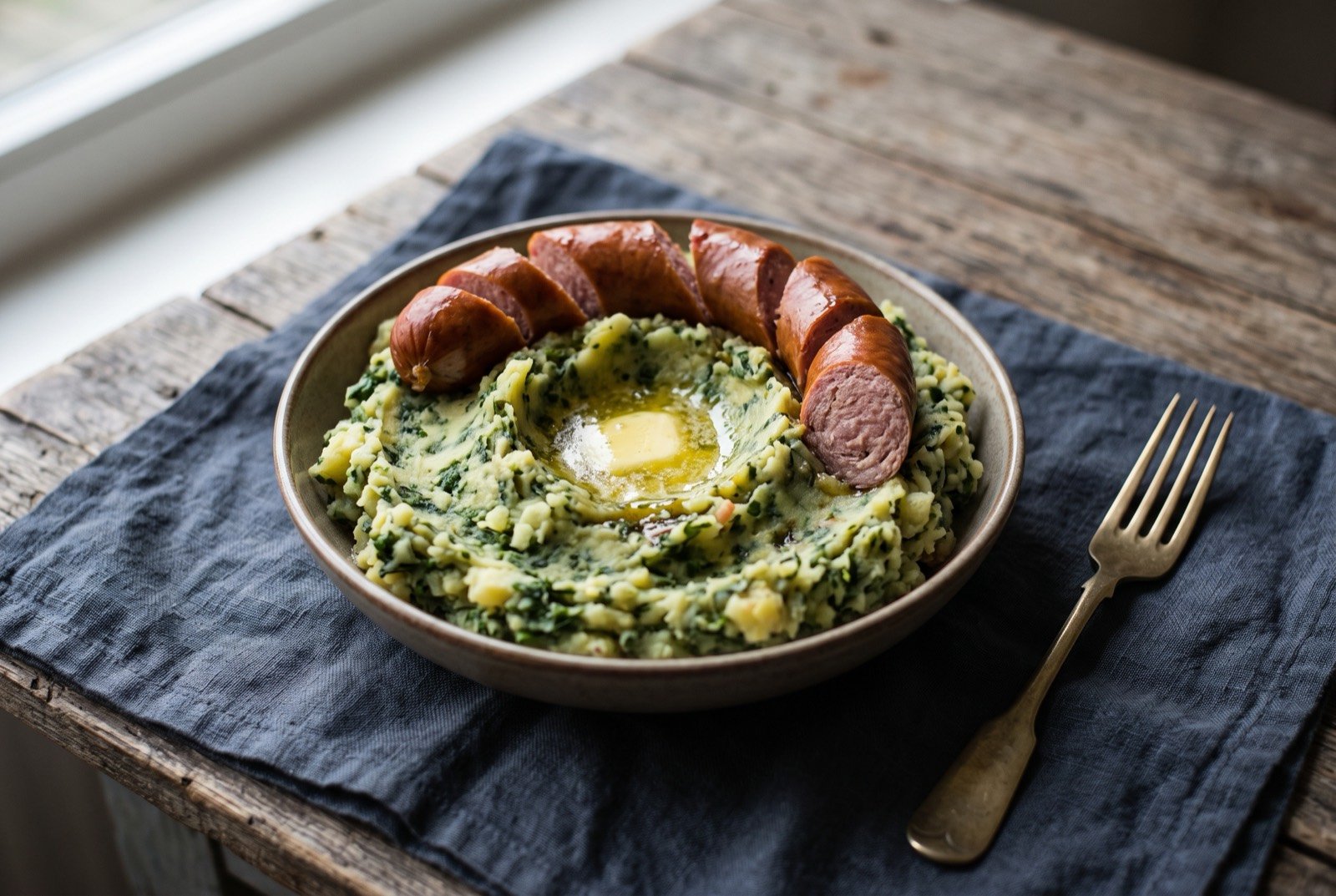
Stamppot met Boerenkool en Rookworst
The Netherlands
Illustration
- Time
- 30 minutes
- Researched
- 9 sources cited
A correction worth stating plainly rather than smoothing over. The nationalist picture of stamppot as an unbroken, centuries-old peasant tradition does not survive checking. Medieval and early modern Dutch "hutspot" and "potspijs" were one-pot boiled stews, not mashed dishes; a serious Dutch cultural history of the everyday meal, and a longer historical account building on it, both state that mashing itself appears in Dutch cookbooks only from the early twentieth century, with the specific mashing technique first described in a cookbook of 1880. A related but separate dish, hutspot met klapstuk, carrot, parsnip, onion and brisket without potato or mash, is genuinely tied to the 1574 relief of the Siege of Leiden and is still eaten on 3 October each year, but it predates and is distinct from the mashed stamppot family treated here.
As tradition built it
Serves 4. About 30 minutes.
Ingredients
- 600 g potato, peeled and chopped
- 300 g curly kale, boerenkool, roughly chopped
- a splash warm milk, a splash
- a generous knob butter, a generous knob
- a pinch a pinch of grated nutmeg
- 4 rookworst (smoked sausage)
- to taste salt and pepper
Method
- Put the potato and kale into one pan of salted water, and cook together 15 to 20 minutes, until both are tender.
- Meanwhile warm the rookworst gently in a separate pan of water, without boiling hard, about 15 minutes.
- Drain the potato and kale, reserving a little cooking water.
- Mash together, using a wooden masher rather than an electric beater, folding in warm milk and butter to a coarse, still-textured mash rather than a smooth purée.
- Season with nutmeg, salt and pepper.
- Serve with the rookworst sliced on top, and a well of gravy or mustard alongside.
What a modern chef changes
A traditional mash, judged on texture rather than gadgetry, plus one honest technique transplant
Rung 3, applied by analogy
Method
- Mash coarsely first, then fold, exactly as a serious Dutch kitchen already does it. Overworking the potato with a machine shears its starch and turns the whole dish gluey; a wooden masher and a light hand are the actual professional standard here, not a compromise.
- Char a portion of the kale directly over an open flame for a few seconds before folding it in, a Big Green Egg run hot for this one step, applying the same brief, surface-only Maillard char that a Flemish chef uses on other vegetables entirely, for a genuine smoked-green note through the mash. State plainly that this is a technique transplant from Belgian fine dining onto a Dutch dish, not a claim about how any named chef actually cooks stamppot.
- Smoke your own rookworst-style sausage, or a UK Cumberland-style substitute, on the Egg rather than relying on a shop-bought smoked link, for a cleaner, deeper smoke than an industrial casing reliably carries.