Central Europe · Volume 19, The Court, the Coffeehouse and the Alps Underneath It
Kaiserschmarrn
Vienna
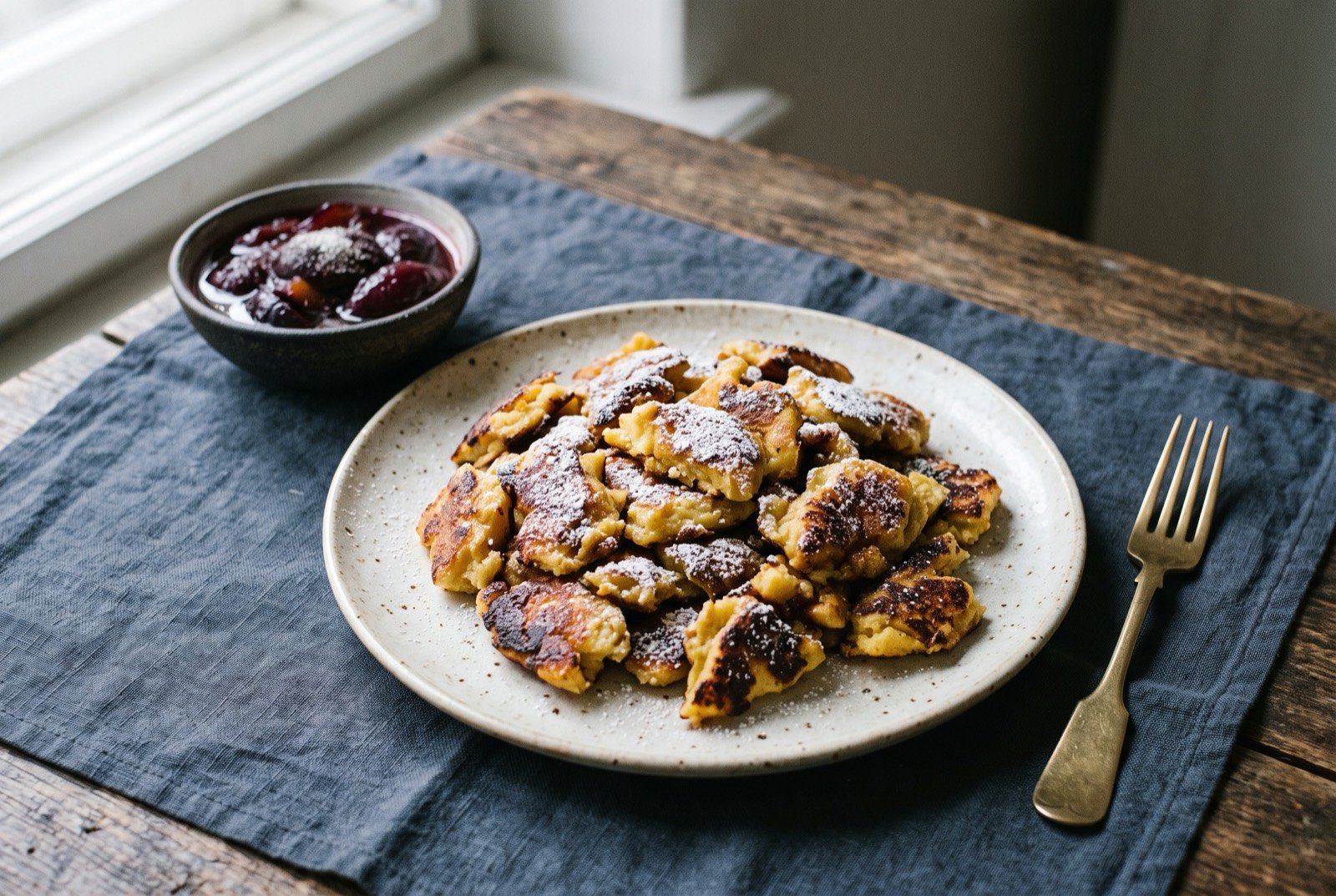
An illustration of the dish, not a photograph of it cooked.
- Time
- 20 minutes
- Reviewed
- Not yet reviewed from inside the tradition
- Cooked
- Not yet cooked and reported
Vienna. At least three competing origin legends circulate, all involving Franz Joseph or Empress Elisabeth, none attached to a primary document. The strongest correction is linguistic: "Kaiser" more plausibly derives from "Kaser", an Alpine hut, or Latin "casa", house, than from the emperor's own title. Treat the legends as legends.
As tradition built it
Serves 4. About 20 minutes.
Ingredients
- 4 eggs, separated
- 60 g sugar, plus extra for caramelising
- 1 tsp vanilla sugar
- 200 g flour
- 250 ml milk
- a pinch pinch of salt
- a generous knob, for frying Butterschmalz
- 50 g, soaked (optional) raisins, soaked (optional)
Method
- Beat the yolks with the sugar and vanilla sugar until pale and foamy. Whisk in the flour and milk to a smooth batter.
- Whip the egg whites with a pinch of salt to stiff, glossy peaks.
- Fold the whites gently into the batter, preserving as much air as possible. Do not stir once folded.
- Melt Butterschmalz in a large, heavy pan over medium heat. Pour in the batter, scatter raisins if using, and cook until golden underneath.
- Flip in large pieces, or invert and slide back in, to cook the other side.
- Tear into rough bite-sized pieces with two forks, scatter with a little extra sugar, and caramelise briefly over higher heat, about a minute, until the torn edges catch and turn faintly bitter-sweet.
- Serve at once, dusted with icing sugar, with stewed plums (Zwetschkenröster) alongside.
What a modern chef changes
Precision-timed folding and a controlled caramelisation, both direct extensions of Rung 4's core mechanism
Rung 4
Method
- Whip the egg whites to a very specific stiff-but-not-dry peak, checked by lifting the whisk rather than by time, since overwhipped whites lose the elasticity needed to fold cleanly and underwhipped ones deflate too fast once mixed. This is a judgement call the traditional method already relies on; naming it precisely protects the one step the whole dish depends on.
- Cook the batter in individual portions in a smaller pan rather than one large one, giving each portion a shorter, hotter cook and a higher proportion of caramelised torn edge to soft interior once quartered and finished, since edge surface area scales down with portion size.
- Torch the sugared, torn pieces briefly with a kitchen blowtorch rather than returning the whole pan to the hob for the final caramelisation. This gives more even, more controllable browning across every torn piece, rather than relying on the pan's own residual heat, which cooks unevenly once the schmarrn is already broken up.