Persia and the Caucasus · Volume 12, The South Caucasus and the Disputed Table
Shah plov
Azerbaijan
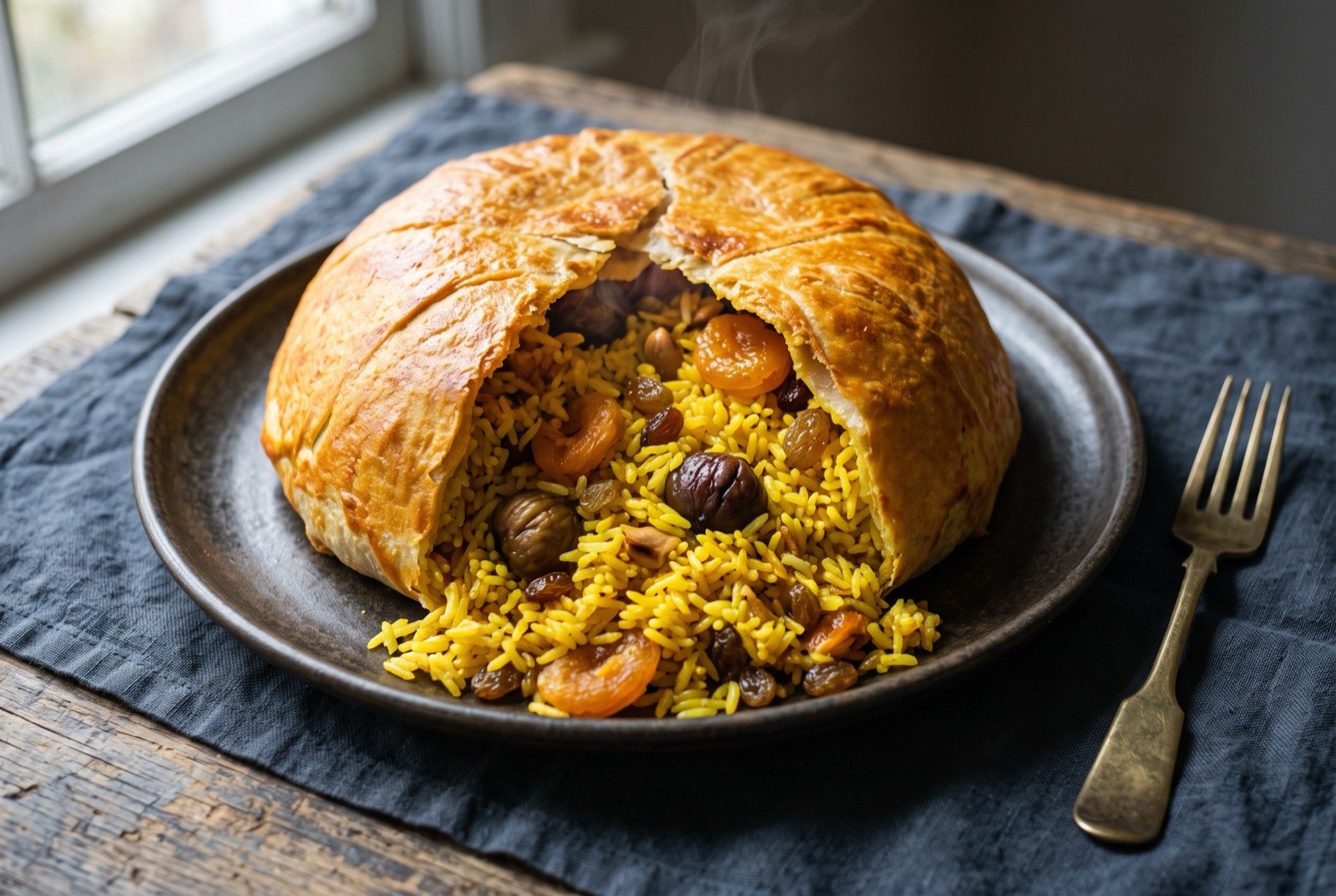
An illustration of the dish, not a photograph of it cooked.
- Time
- 3 hours
- Researched
- 8 sources cited
- Reviewed
- Not yet reviewed from inside the tradition
- Cooked
- Not yet cooked and reported
Explicitly called "the shah of Azerbaijani cuisine" in Azerbaijani food writing. A correction worth stating here rather than repeating an error elsewhere: Azerbaijan has roughly two hundred named varieties of plov, not the forty sometimes quoted in Western sources, per multiple independent Azerbaijani sources.
As tradition built it
Serves 6 to 8. About 3 hours.
Ingredients
- 4 cups long-grain rice
- 1 kg boneless lamb, pre-boiled
- 500 g carrot, peeled
- 3 onions
- 4 tbsp melted butter
- 1 cup raisins
- 10 dried apricots
- 10 dried plums, or sour alça
- ½ tsp saffron or turmeric
- to taste lemon juice
- to taste salt
- to taste pepper
- 2 cups flour, for the qazmaq crust
- 50 g butter, for the crust
- 2 eggs, for the crust
- 1 tbsp sour cream, for the crust
Method
- Fry the carrot in butter with salt. Fry the sliced onion until golden, then work in half a teaspoon of saffron.
- Fry the pre-boiled lamb in butter, finishing with lemon juice and pepper.
- Boil the rice in heavily salted water, 2 tablespoons salt per 5 litres, until half-cooked, then drain.
- Combine the flour, eggs and sour cream for the qazmaq into a firm dough.
- Line a pot with the qazmaq dough (or, in some regional and household variants, with lavash instead of a raw dough crust).
- Layer the rice into the lined pot with the saffron water and fried carrot.
- Bake at 180°C for approximately 2 hours, until the crust is deeply golden.
- Serve the crust alongside the rice, with the lamb, dried apricots, dried plums and raisins as the separate xuruş, not mixed through.
Notes
Recipe sources genuinely disagree on whether the crust is a proper laminated dough or a simple lavash lining; this chapter treats that as real regional and household variation, not a contradiction to resolve.
What a modern chef changes
The demleme mechanism understood, not just followed.
Rung 4
Method
- Test the parboiled rice by breaking a grain with a fingernail, tender outside, a hard opaque core, before draining; this is the actual endpoint the traditional method is aiming for, not a fixed number of minutes.
- Drain through a chinois to keep the grains intact and dry rather than waterlogged going into the crust stage.
- Run the final bake on a Big Green Egg at a stable low-to-moderate dome temperature with the pot on a heat deflector, an even, hands-off version of the traditional oven finish.