Asia · Volume 12
Armenia and Azerbaijan
The South Caucasus and the Disputed Table
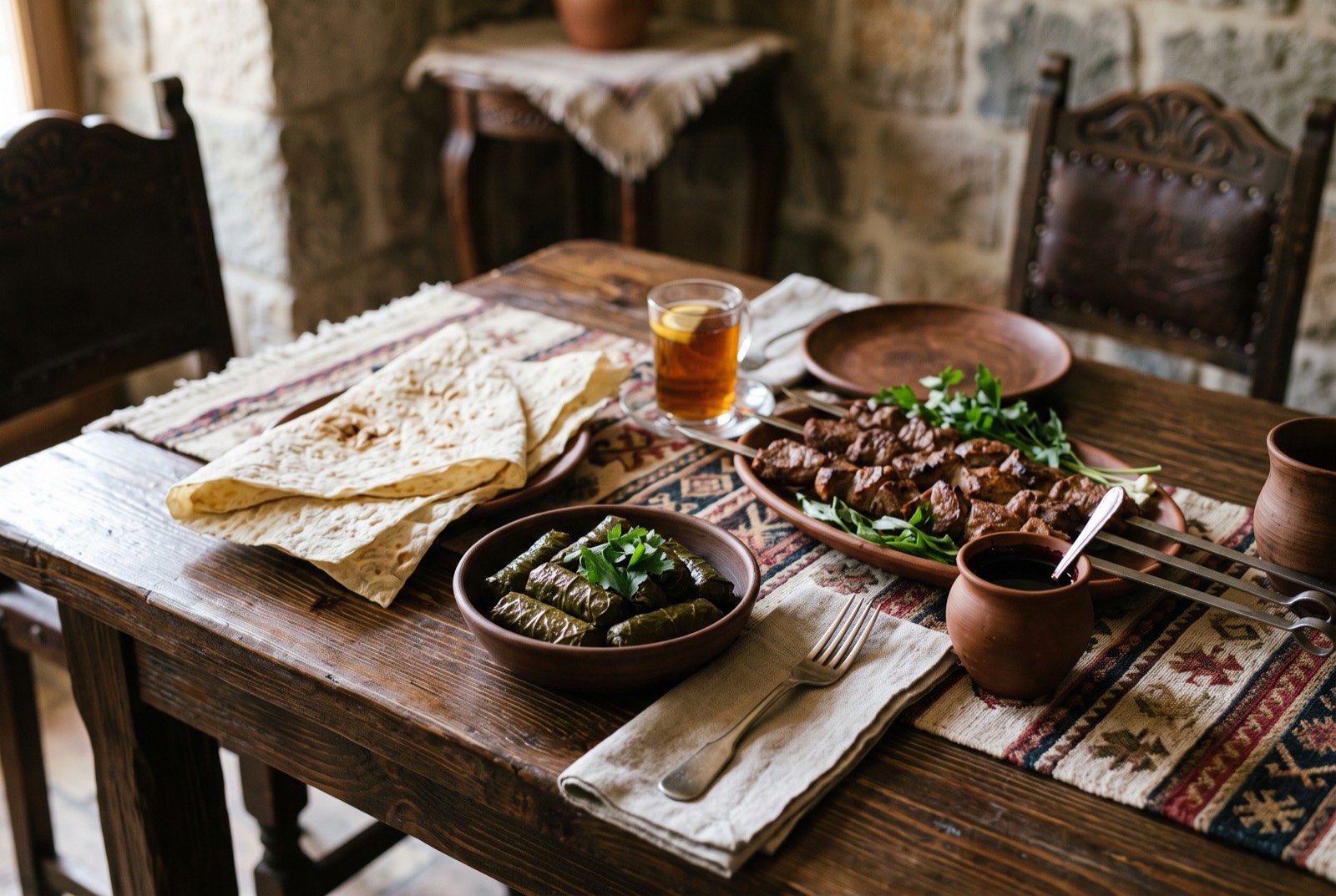
Two food worlds shaped by the same Persian court cooking and the same Ottoman-Russian imperial tug of war, sharing an unusual amount of dish vocabulary as a direct result, and this chapter's real job is naming who claims what rather than settling it. Every dish as tradition built it, then what a modern chef would change.
Sources and review · What this chapter does not assert · How we research · Spotted something wrong?
A Sense of Place
Armenia and Azerbaijan sit either side of the same highland and plateau country, separated by a border that is itself a scar from empire rather than an old ethnographic line, and their food shares a grammar, wheat and rice, fresh herbs eaten by the fistful, walnuts, dried fruit, saffron and sumac, grilled and slow-simmered meat, a whole culture built around a shared table, even where the two nations tell different histories about who taught it to whom. That shared grammar is not incidental. Both cuisines passed through the same Persian court kitchen and the same three-way pull between Ottoman, Persian and Russian power, and both carry a living, sometimes bitter argument over which dishes belong to which table, an argument this chapter reports rather than settles, following this atlas's own rule for contested food everywhere it appears.
Armenia: a highland kitchen, and a diaspora kitchen running alongside it
Armenia is landlocked and almost entirely mountainous. The Armenian Highland sits mostly above 1,000 metres, with the fertile Ararat valley, around 800 to 1,000 metres, as the lowland exception where intensive fruit and vegetable farming happens; villages toward 2,000 metres run a genuinely more pastoral kitchen, dependent on preserved, dried and fermented foods and on livestock products, cheese, dried meat, clarified butter, that survive a long winter, while lowland households historically had year-round access to a wider range of fresh produce. Both clarified butter, historically the wealthier household's fat, and oil, historically sesame, more recently sunflower and olive, appear across the tradition. Matzun, Armenian strained yoghurt, functions as a thickener across a huge range of dishes, soups, sauces, marinades, not only as a condiment, and lavash and wheat generally, bulgur, whole-wheat porridge, are the backbone starch; rice is a festive, historically Persian-inflected ingredient rather than an everyday one.
The fresh herb bundle is real, and it is a structural feature of the table, not a garnish. Armenian sources describe "kanachi," literally "the green things," a plate of raw fresh herbs eaten by hand alongside bread and cheese as its own course: tarragon, mint, basil and a wide range of cultivated and foraged wild herbs, with a repeated but unverified figure holding that Armenians traditionally use around 300 species of wild plants as food. Tarragon specifically is significant enough to flavour Tarkhun, the bright green tarragon soda that is a genuine Armenian soft-drink institution, worth naming here as a signal of how deep the herb goes into the culture rather than as trivia.
Lake Sevan carries a genuinely distinct identity, built on ishkhan, the endemic Sevan trout whose Armenian name means "prince," reportedly for its noble bearing and demanding habitat; its population collapsed under Soviet-era industrial fishing and lake-level manipulation, industrial fishing is now banned, and a current restoration effort aims to turn ishkhan into a national culinary brand again. Van and the wider Vaspurakan, historically Western Armenia and now Turkey, survives as preserved diaspora heritage rather than a place a cook can visit and eat in: kelekyosh, a spring dish of layered dried lavash, cooked lentils, hot broth and herbs, and bazrkani, a shepherd's dish, are both specifically Van-region, carried out by the survivors of 1915 and their descendants rather than practised continuously in place, a point this chapter returns to below. Karabakh and Artsakh were actively searched for as a distinct culinary identity in the research behind this chapter and none was found in Armenian-language sourcing; that is named as a real gap, not smoothed over with an invented regional character.
The Armenian Apostolic Church's fasting calendar structures a real share of the repertoire even where its own rules could not be pinned down in full: pasuts tolma, "Lenten tolma," replaces meat with lentils, beans, chickpeas and wheat; spas soup is historically a fasting dish; harissa is specifically an Easter dish; katnapour, an Ascension Day milk-and-wheat soup, carries a pre-Christian and Christian syncretism, its first portion traditionally offered to the fields as a harvest blessing.
Azerbaijan: nine climate zones, and a rice-and-herb south
Azerbaijani sources standardly explain the cuisine's range by the country running across nine climate zones packed into one small territory, and the explanation holds up: the Caspian coast has fed the table since antiquity, the Greco-Roman writer Claudius Aelian recording that communities there salted and dried sturgeon and carried it by camel inland, while industrial sturgeon and caviar fishing developed only under Russian and Soviet administration and has since collapsed roughly thirtyfold against 1980s levels, modern caviar on Azerbaijani tables now overwhelmingly farmed rather than wild.
Lankaran and the Talish lowlands, subtropical, wet and green, are Azerbaijan's rice, citrus and tea belt, and the region most associated with heavy fresh-herb cookery: spinach, mint, basil, tarragon and coriander used generously rather than sparingly. The region's signature dish, ləvəngi, takes its name from Talish rather than standard Azerbaijani, "ləvə" meaning belly, "ləvəngi" meaning "with a filled belly." Baku and the Absheron peninsula, semi-arid, hot and famously windy, are the saffron-growing district and the pastry-making centre, şəkərbura and Baku paxlava the Novruz confections most associated with it.
Karabakh, as a historic culinary region, independent of the current conflict, is genuinely well documented in Azerbaijani sourcing: a region shaped by lake and river fishing, standard regional cooking vessels, tandoor, clay oven, hearth, sac griddle, mangal, an absence of pork on religious grounds, and heavy use of wild and cultivated plants, with döşəmə plov, boyanalı aşı and qatıq aşı named as well known, and Shusha specifically credited with qırto, canına çəkmə, qalya and çolpalı plov. In 1882, at an All-Russian exhibition in Moscow, pastry with walnuts and mulberry and plum leather made by a daughter of the Karabakh khan were exhibited, an early instance of the region's confectionery reaching outside audiences. The Azerbaijani source describing all this contains no discussion of the region's present-day contested status; the political dimension surfaces instead in press material covered further down this chapter. Nakhchivan has a genuinely distinct bread culture, lavash historically made in months-long batches and stored wrapped in cloth for a harsher, more continental winter than the Caspian coast's, and a preserved-meat tradition, qovurma, meat cooked and stored under its own rendered fat, whose leftover cooking liquid carries several different names within Nakhchivan alone, real evidence of internal dialect variation inside one small province.
Across both countries, mutton fat, clarified butter and rendered meat fat are the primary fats; wheat, rice and legumes the primary starches and thickeners; the standard aromatic bundle runs on saffron, cumin, fenugreek, dill, parsley, tarragon, basil and thyme. A structurally important, near-universal Azerbaijani trait, worth stating plainly because it distinguishes the tradition from its neighbours: plov is deliberately unmixed. Rice is cooked and served separately from its accompanying meat or fruit stew, xuruş; the diner, not the cook, combines them at the table.
A table of peoples, logic and dishes
| Region | Defining logic | The dishes that carry it |
|---|---|---|
| Armenian highland and Ararat valley | wheat, dried and preserved goods, matzun as thickener | lavash, harissa, matzun, mothal |
| Lake Sevan | a single endemic fish, near-collapsed and now protected | ishkhan, lavash-wrapped trout |
| Western Armenia, in diaspora | Ottoman-territory dishes carried out by 1915's survivors | kelekyosh, bazrkani, ishli kyufta |
| Caspian coast and Baku/Absheron | saffron, sturgeon, Novruz pastry | shah plov, sturgeon kabab, şəkərbura |
| Lankaran and the Talish south | rice, citrus, tea, heavy fresh herb use | ləvəngi, dovga, göyərti küküsü |
| Karabakh | lake fishing, an absence of pork, its own named plov and pastry line | döşəmə plov, qırto, Karabakh basdırma |
| Nakhchivan | a harsher continental climate, distinct bread and preserve names | dəstəna, qovurma, month-batch lavash |
The Disputed Table
This is the volume's real subject, and this chapter takes the same position on all of it as this atlas takes everywhere a dish is claimed by more than one table: report who makes each claim and from where they speak, and adjudicate none of it.
Dolma and tolma
Armenian sources assert Armenian origin directly, sometimes dismissively of competing claims, "few know its true homeland is Armenia; Turks and Greeks claim it as their own," citing named scholars including the Armenian Turkologist Sevortyan, the German Altaicist Gerhard Doerfer and the Armenian linguist Hrachia Acharian. A countervailing fact is acknowledged even within the pro-Armenian source: the word "dolma" is Turkish, from "dolmak," to fill. The historian Pokhlyobkin, cited by the same Armenian source, splits the difference, arguing the dish "originated in Armenian cuisine, then transitioned into Turkish cuisine." Azerbaijani Wikipedia, on the other side, treats dolma as one of the core dishes of Turkic-Azerbaijani cuisine, later spreading via the Ottoman Empire, and lists over thirty named types. Azerbaijan submitted, and UNESCO inscribed, "Dolma making and sharing tradition, a marker of cultural identity" onto the Representative List of the Intangible Cultural Heritage of Humanity in December 2017.
The dispute is live and political, not a settled footnote. President Ilham Aliyev, speaking at Azerbaijan's Academy of Sciences in April 2011, said "if you ask an Armenian what 'dolma' means in their language, they won't be able to answer. It's like 'Karabakh' for them, a meaningless word," and declared dolma Azerbaijan's national dish the following year. In response, the Armenian NGO "Society for the Preservation and Development of Armenian Culinary Traditions" set up an annual tolma-making festival, held alongside the Golden Apricot international film festival, asserting the dish as part of a distinct Armenian heritage. Terminology is worth stating plainly and without taking a side in it: Armenians reserve "dolma" for vine-leaf-wrapped parcels and "tolma" for stuffed vegetables; Azerbaijanis use "dolma" for both; Turkish usage differs again.
Khash
Armenian sources describe khash as of Armenian origin, "probably" ceremonial in character, and originally widespread in Syunik, though that specific regional claim carries a citation-needed flag inside the Armenian source itself and should be read as plausible rather than established. Azerbaijani sources push back explicitly, tracing the word to the Oghuz Turkic verb "xaşlamaq," to boil, noting cognates across the Turkic language family, and citing the 15th-century Ottoman court chef Mehmed Şirvani's cookbook as containing khash recipes. The Azerbaijani article making this argument is not a neutral source, it explicitly concludes "all culture spread from Azerbaijan, from Anatolia to the Great Wall of China," advocacy rhetoric rather than measured scholarship, and is included here only as a real, identifiable Azerbaijani-side position. Khash sits inside a wider dispute pattern beyond just these two countries: this atlas's own Georgia chapter treats Tbilisi khash as a real, distinctly urban-adapted Georgian dish in its own right, built up with bay leaf, onion and herbs that rural Kakhetian khash does without, and London-based food writer Olia Hercules has referred to khash as Georgian in some contexts, producing pushback from Armenian commentators. This chapter does not resolve any of this. Khash is claimed, with real texture, by at least three tables, and that is the honest position to leave the reader with.
Basturma, basdırma, pastırma: the more genuinely interesting case
This is the most productively contested dish in the set, and worth reading closely rather than skimming past as another dolma-shaped argument, because on inspection it is not actually one. Classical Armenian attestation runs deep: the word "abukh" for salted, dried meat appears in the 5th-century Armenian Bible translation; the first recorded mention of a basturma-type product is placed in 95 to 45 BC, during the reign of Tigranes the Great; "Basturmajian," basturma-maker, became a genuine Armenian surname; in Caesarea/Kayseri, basturma production is described as having been run entirely by Armenians historically, regarded across the Levant as the tradition's most skilled makers. The modern name, though, is acknowledged even by pro-Armenian-origin sources to derive from Turkish "bastırma," to press or restrain, or possibly a Byzantine Greek term.
These two threads are not, on inspection, actually incompatible, and that is what makes this the cleanest case in the chapter. A food most sources agree is very old and specifically associated with Armenian communities historically carries a name that later Turkified as the wider region's cured-meat vocabulary consolidated under Ottoman and Turkic influence. This is not two nations fighting over the same dish; it is one technique with a documented Armenian lineage and a documented Turkish name, and the honest thing to do is hold both facts at once rather than force them into a contest neither side is actually having. On the Azerbaijani side specifically, this chapter's research could not confirm that Azerbaijani basdırma uses the same fenugreek chaman paste as the Armenian and Turkish versions; what turned up instead was a distinct marinated grilled kebab also called basdırma, and references to Karabakh basdırma as a cured meat without technique detail either way. This atlas's own Georgia chapter, elsewhere in this culinary region, does not treat a basturma-family dish at all, for what that absence is worth.
Lavash
UNESCO listed lavash to Armenia specifically in November 2014, under the title "Lavash, the preparation, meaning and appearance of traditional bread as an expression of culture in Armenia," inscribed over Azerbaijani objection. A separate, multinational nomination followed in December 2016, "Flatbread making and sharing culture: Lavash, Katyrma, Jupka, Yufka," jointly submitted by Azerbaijan, Iran, Kazakhstan, Kyrgyzstan and Turkey, and also inscribed. Armenia was not part of that second listing, and Armenian commentary has read it as a deliberate attempt to dilute the 2014 inscription. Nakhchivan's own bread culture, covered above, makes lavash and related breads, dəstəna, fətir, qalın, with real regional specificity on the Azerbaijani side too, worth carrying forward as evidence this is a genuinely shared baking tradition across the whole highland and plateau region, this atlas's own Iran chapter naming nan-e lavash as part of the same wider family, even though the 2014 UNESCO listing itself is Armenia-specific.
Baklava and pakhlava: the contrast case, deliberately included
Armenian sources describe pakhlava as common across Armenian, Greek, Bulgarian, Arab, Turkish, Iranian, Iraqi and Tatar cuisines, each with its own recipe, and name Gavar, a town in Armenia's Gegharkunik province, as the specific Armenian "home town" of the dish within Armenia, without claiming it as exclusively Armenian in the way tolma or khash are claimed. This is worth stating directly, because it proves the pattern above is not simply how Armenian or Azerbaijani sources always talk about shared food: not every dish is fought over, and here, at least, a shared inheritance is presented as exactly that.
"Western Azerbaijan" and Iravan cuisine: a second, sharper dispute
This is a live and current dispute, distinct from and sharper than the general dolma argument, and it may be the single clearest instance of active food nationalism this chapter's research encountered. Azerbaijani state and press sources use the term "Qərbi Azərbaycan," Western Azerbaijan, for the territory of the former Iravan Khanate, now inside the Republic of Armenia, the same territory the Treaty of Turkmenchay handed to Russia in 1828, and apply the term to cuisine as well as to land. Tahir Əmiraslanov, president of the Azerbaijan National Culinary Association, describes a documentation project that interviewed 1,500 people and recorded 413 recipes; the researcher Vasila Akbarova, who runs the "Iravan Cuisine" project, states directly, "Armenians claim our dishes belong to their cuisine... they change letters in dish names and present them worldwide as Armenian food," and further, "99% of what Armenians now present as their cuisine consists of Azerbaijani dishes," naming qovurma, "Iravan kətəsi," a foraged mountain plant called "qırxbuğum," pickled vegetables and heavy tarragon use as specifically Western Azerbaijani in her account.
This is reported here exactly as it should be: attributed to named Azerbaijani sources, and flagged plainly as carrying live political content, since the term "Western Azerbaijan" is itself a claim about Armenian sovereign territory, not a neutral geographic label. No Armenian-language rebuttal specifically addressing the Iravan-cuisine framing, as distinct from the older, general dolma dispute, was found in the research behind this chapter. That absence is a gap in what this chapter could reach, not evidence that the claim goes uncontested.
The History in Layers
Armenia: Urartu, the oldest known wine, and a genocide that scattered the kitchen
The Kingdom of Urartu, 9th to 6th century BC, centred on Lake Van, is repeatedly cited as the deep root of Armenian food culture, with excavations at Karmir Blur reportedly turning up grain storage vessels and evidence of barley brewing. The ancient wine claim is the strongest-sourced claim in this whole chapter and can be stated with confidence. The Areni-1 winery, a cave complex in Vayots Dzor province, was excavated from 2007 by a joint Armenian-Irish team, with UCLA and the National Geographic Society joining as sponsors from 2008. It dates to approximately 4100 to 4000 BC, making it, on current evidence, the oldest known wine-production facility in the world, roughly a thousand years older than the previous record holder, its finds including a grape treading basin, fermentation vessels and a drinking bowl, the grape identified as Vitis vinifera, the species still used for most wine today. This is confirmed independently by Armenian sources and by National Geographic and Wine Spectator.
The Ottoman layer and the Genocide's effect on transmission matter structurally to how Armenian food is now practised, more than any single dish does. Western Armenia, the historic heartland including Van, Karin/Erzurum, Kars and Zeytun, was under Ottoman rule for roughly four centuries before 1923. The 1915 Genocide displaced this population wholesale; survivors carried Van, Erzurum, Kars and Zeytun dishes into diaspora communities, chiefly Lebanon and Syria initially, then wider. Ishli kyufta is explicitly traced to Van, Karin and Kars specifically. A meaningful share of what is now cooked as "Armenian food," in Armenia and diaspora alike, is specifically Western Armenian and Ottoman-territory food, transplanted rather than continuously practised in place. The Smithsonian's Center for Folklife and Cultural Heritage frames food explicitly as a survival and identity-transmission mechanism after that displacement, a Western framing of an undisputed underlying fact, corroborated by Armenian-language sources on Western Armenia's history.
The Soviet era is the weakest-sourced part of Armenia's history in the research behind this chapter, and it is treated that way rather than papered over. Armenia was directed by Soviet planning toward brandy production rather than table wine, while Georgia and Moldova, see this atlas's own Georgia chapter, were directed toward wine; Armenia's brandy production was nationalised after 1920 and the Yerevan Brandy and Wine Trust held a production monopoly for over seventy years, vineyards collectivised, traditional wine production atrophying for most of the twentieth century. The wine renaissance began around the early 2000s, after independence rather than immediately in 1991, a real decade-plus gap worth naming rather than smoothing over. Agricultural collectivisation and periodic shortages also brought pork, buckwheat, potatoes, cabbage and Soviet pan-national dishes, piroshki, Olivier salad, chicken Kiev, into ordinary Armenian eating alongside the older tradition, not replacing it.
Azerbaijan: Turkic kinship, a real Persian layer, and a border drawn through a food world
Azerbaijani sources date grain-based cookery to 5,000 to 6,000 years ago, citing the survival of the çatan, a primitive stone grain mortar, and place Azerbaijani cuisine within a wider Turkic food family shared with Turkish, Tatar, Kazakh, Uzbek and Uyghur cooking, describing this as historical kinship rather than derivation from any one of them.
The Persian layer, checked rather than assumed, because this atlas's own house rule is to verify a cliché before repeating it. "Azerbaijan as the bridge between Persian and Turkic food worlds" is a real claim made by tertiary sources, not invented marketing copy, but genuinely thin on primary sourcing in the research behind this chapter, and a specific causal account attributing layered saffron rice to Safavid court cooking specifically could not be verified against a named academic source and is treated here as plausible rather than settled. What is better evidenced is linguistic: the herb-and-meat stew səbziqovurma borrows "sabzi," green, directly from Persian and has a documented Iranian sibling, ghormeh sabzi, this atlas's own Iran chapter covering the rice-and-stew grammar that dish sits inside from the other side of the border.
The Treaty of Turkmenchay, 1828, verified in detail, and the root of a live modern dispute. Signed near Tabriz between Russia and Qajar Iran, the treaty, together with the earlier Treaty of Gulistan (1813), split Azerbaijani territory along the Araz river: the Erivan and Nakhchivan khanates passed to Russia, and roughly 210,000 square kilometres south of the Araz remained under the Qajars, the basis of what Azerbaijani sources call "Southern Azerbaijan," inside modern Iran, this atlas's own Iran chapter treating Tabriz and Ardabil from that side of the same 1828 line, against roughly 130,000 square kilometres to the north under Russia. Iran paid a 10 million tuman war indemnity. The treaty's terms permitted three years of cross-border migration with a five-year grace period for disposing of property, and tens of thousands of Armenians resettled from Iranian territory into the newly Russian-controlled area; Russia created an "Armenian Province" from the acquired territory in March 1828. This resettlement is the historical root of the modern Armenian population distribution in the South Caucasus that underlies the Iravan-cuisine dispute below. Azerbaijani sources treat the treaty as a foundational national trauma, one calling it "the tragedy of a whole Azerbaijan."
The Soviet era is the weakest-sourced part of the Azerbaijan history layer too, a genuine research gap rather than a merely thin one. Nothing substantive was found in this chapter's research on how Soviet-era institutional food service, state agricultural planning or restrictions on private trade specifically reshaped Azerbaijani home cooking, plov culture or ingredient availability. What can be said with more confidence, predating the Soviet period, is that 19th-century Russian imperial contact introduced borshch, sup and kotlet into Azerbaijani vocabulary and kitchens, and that Baku's oil-driven growth around 1900 brought direct European contact.
The Flavour Arsenal
Armenia
Apricots are Armenia's signature fruit, and the etymology deserves careful, non-folk-etymology handling, because there are two competing, independently documented threads and flattering only one of them into "apricot literally means Armenia" is exactly the kind of claim this atlas exists to correct. Thread one, Armenian-sourced: Akkadians reportedly called Armenia "Armani," glossed as "the land of apricots," as early as the third millennium BC; the 10th-century Arab geographer Ibn al-Faqih named the apricot "the fruit of Armenia" in 903 AD; the Roman general Lucullus reportedly brought apricot seedlings to Rome from his campaign against Tigranes the Great, where they were called "Armenian apple"; the 18th-century botanist Lamarck later coined "Armeniaca vulgaris," giving the modern scientific name Prunus armeniaca. Thread two, genuinely disputed rather than fringe: Romans also called the fruit "early-ripening apple," a name that travelled through Byzantine Greek into Arabic and from there into the Romance languages, the documented route by which English "apricot" most likely arrived, meaning the everyday English word probably descends from the "early-ripening" thread, not the Armenia thread, even though the scientific species name genuinely does. State it plainly: the botanical name does derive from a belief in Armenian origin; the word in your own kitchen probably does not, and the two should not be collapsed into one clean fact.
Lavash is baked in a tonir, a clay oven sunk into the ground, traditionally by women and carrying pre-Christian sun-worship symbolism from the tonir's ritual role. Armenian cognac and brandy is a real food-culture item, not just a drink: the Yerevan Brandy Factory, now producing the Ararat brand, was founded in 1877, sold in 1899 to the Russian merchant Nikolay Shustov, and under Soviet planning brandy production was Armenia's designated regional specialisation, carrying real weight as a marker of "European-ness" within the USSR. Armenian cheeses include chanakh, Chechil, a stretched-curd string cheese, and mothal, aged inside a sheep's stomach lining, a genuine indigenous preservation technique distinct from Western rind-ageing. The Areni grape, Areni Noir, indigenous and genuinely central to the modern wine revival, is grown around the same village as the ancient winery site above.
Azerbaijan
Saffron was brought to Azerbaijan from Asia Minor in the 8th to 9th centuries, first cultivated around Derbent, Agdam, Salyan and Ganja before Absheron soil and climate proved best suited to it. Soviet-era output reached 100 to 120 kilograms of dried saffron annually in 1980 to 1985, Absheron then the only saffron-growing area in the entire USSR, peak mid-20th-century production exceeding 16 tonnes; mass cultivation collapsed after 1991, and a 23-hectare garden on former sovkhoz land is now the main preservation effort. This is an important corrective to any assumption Absheron saffron is currently a large industry: production has fallen drastically from Soviet-era peaks and survives mainly as heritage planting, not a commodity crop at scale. Saffron appears in over fifty savoury dishes and ten-plus sweets.
Rice is cooked three principal ways, daşma (steamed whole), süzmə (parboiled then drained), döşəmə (layered); süzmə alone is said to run to more than fifty sub-variants by topping. Narşərab, reduced pomegranate juice cooked down with basil, cinnamon, coriander and black pepper, is Azerbaijan's national culinary brand condiment, traditionally made from wild rather than cultivated pomegranate, Goychay district the centre most associated with it. Sturgeon kabab is cut into 40 to 50 gram pieces, salted, seasoned, rubbed with butter and grilled 7 to 10 minutes, served with tomato, onion, lemon, pomegranate juice and sumac. Azerbaijani tea culture was inscribed on UNESCO's Representative List in 2022, jointly with Turkey; the armudu glass, pear-shaped, is engineered so its narrow waist keeps the lower portion of tea hot while the wide top cools faster, letting tea be drunk at a stable temperature through the glass, sometimes read as evoking a seated woman's figure.
The Technique Ladder
The argument, from inside
Armen Qefilyan, Armenia's 2009 national khorovats champion, runs a restaurant near Haghpat monastery and is the clearest single reference point this chapter's research found for a tradition-first argument: he cooks over a mangal, a trough of charcoal embers with no grate, and checks fire temperature by holding his hand over it and counting to twelve, a genuine, transferable proxy for radiant heat at grate height, not folklore. In Baku, Chef Yagub Zeynalzade, trained in Croatia and Italy, converted his own flat into a small, reservation-based restaurant explicitly framed as "garden to kitchen," ingredients sourced from small regional producers and a menu built around traditional and half-forgotten dishes learned largely from his grandmother, the closest match this chapter's research found anywhere to the tradition-elevated-from-inside model this whole atlas returns to. The honest gap, again, sits with the smaller of this volume's two food-press profiles: Chef Yagub is documented only through Western and regional-outlet English-language coverage, and this chapter's research found no Azerbaijani-language press treatment of him specifically, a real thinness rather than a finding that no one else is doing comparable work.
Rung 1. Read the fire, not the clock
Qefilyan's mangal cooking runs slow, around 40 minutes, turning frequently, seasoning minimally, salt, paprika, black pepper, thyme, with lamb fat threaded between lean chunks on the skewer so rendering fat continually re-bastes the meat as it turns. He adds smoke deliberately, quince halves set on rose-hip branches over the coals, a controlled flavour input rather than an accident of the fuel, and explicitly contrasts his own controlled fire against others at the same event whose flames licked and charred the meat's outside while leaving the inside under-rendered. Heat control, not fuel choice alone, is what separates good khorovats from bad.
What a cook does with this rung. A mangal's suspended-skewer, no-grate geometry is close to what a Big Green Egg can do with the grate removed and skewers rigged across the rim, run at a genuinely moderate, stabilised 160 to 180°C rather than searing heat. The hand-and-count-to-twelve test translates directly. Quince or a rose-hip branch laid on the coals is a specific, un-generic move worth using rather than defaulting to wood chips.
Rung 2. Slap the dough against the wall, and keep a piece back
A tonir is heated until its clay walls are themselves very hot; dough, rolled thin, is stretched over a cushioned pad and slapped directly against the hot vertical wall, baking and bubbling within seconds from contact with the porous clay rather than from ambient oven heat. A genuinely contested authenticity point worth carrying directly into a reader's own kitchen: the Armenian Institute UK's own review of the Lavash cookbook states plainly that proper lavash needs old dough, a piece reserved from a previous batch and used as a starter and flavour carrier, and that omitting it, along with variable choices on salt and olive oil versus butter, is "the missing link" changing flavour and texture. Even within the tradition, lavash quality hinges on a technique most written recipes skip.
What a cook does with this rung. No home cook has a tonir, but the mechanism, a very hot, slightly porous near-vertical surface, direct dough contact, seconds not minutes, maps onto a Big Green Egg run very hot, 250°C plus, with an unglazed baking stone positioned as near-vertically as the setup allows, dough slapped on and watched in seconds rather than baked to a timer. Reserving a piece of dough from the previous batch, refrigerated, worked into the next day's, is directly replicable and worth building into a recipe rather than treating lavash as a simple flour-water-salt flatbread.
Rung 3. Salt, press, dry, then coat
Basturma's real method, best sourced from a thirty-year Los Angeles basturma maker whose technique descends from family makers in Armenia and Lebanon: fresh whole-muscle beef is covered entirely in salt for roughly two days, drawing blood and moisture out osmotically; wrapped and pressed under weight to force out remaining moisture; hung to air-dry two days to a week; then coated with a chaman paste, ground fenugreek, the dominant flavour and preservative element, mixed with paprika, garlic, cumin, cayenne and salt, thinned with cold water to a thick, pancake-batter consistency and spread in an even eighth-inch layer; re-hung a further two to three days, or three to five refrigerated, until the coat is firm and dry to the touch.
What a cook does with this rung. This maps directly onto the reader's own equipment: the salting, pressing and hanging sequence is standard whole-muscle charcuterie, achievable with a dehydrator running at a controlled low temperature and humidity rather than open-air hanging, safer and more consistent in a UK kitchen; a dedicated spice grinder is exactly the right tool for grinding fenugreek fresh rather than buying pre-ground, which loses aromatic intensity within months; the chaman paste mixed in a blender gives the same smooth, thick consistency the traditional hand-mixed paste aims for.
Rung 4. Parboil, then let the fat crisp underneath
Azerbaijani plov uses a two-stage method called demleme: rice is first parboiled in salted water until tender on the outside but with a hard, visibly opaque core, then drained. Separately, a fat, butter, sometimes an egg-and-yoghurt dough, sliced potato, or lavash, is laid in a clean, dry pot and fried briefly to render and crisp, forming the gazmaq. The parboiled rice is layered on top and the pot steamed gently to finish through residual heat, while the fat layer underneath continues frying against the hot pot base into a crisp, golden crust, mechanically the same principle as Persian tahdig, this atlas's own Iran chapter treating that side of the same idea. Meat, vegetables and fruit are cooked separately and served as a topping rather than mixed through the rice.
What a cook does with this rung. The parboil-then-steam method suits a home cook with good pot control; a chinois drains the rice cleanly without breaking grains. The crust-forming step, fat in a dry pot, rice layered on top, gentle finishing heat, is directly replicable on a domestic hob; a Big Green Egg run at a stable low-to-moderate dome temperature with the pot on a heat deflector gives an even, hands-off version of the final steaming stage.
Rung 5. Don't rush the soak, and let the gelatine do the work slowly
Cow or sheep feet are soaked in cold water in the refrigerator for 10 to 48 hours, the water changed roughly every two hours for the first 10, leaching blood and impurities so the final broth stays clear rather than muddy. Cooking is two-phase: an initial 40-minute simmer, that water discarded and replaced, then a long simmer of 6 to 8 hours, topped up hourly, until the trotters are completely soft. Extended low simmering breaks down collagen in the connective tissue into gelatine, the mechanism behind khash's characteristic body, a broth that sets to a soft jelly once cool.
What a cook does with this rung. This is straightforwardly a sous vide or long-braise candidate: the extended low simmer for gelatine extraction is exactly the kind of process a home cook can now run more precisely than the traditional stovetop method, a steady 90 to 95°C for eight or more hours, though the dish's cultural presentation, dried lavash, table-side garlic and vinegar, communal winter-morning eating, matters as much as the technique in isolation.
Rung 6. Wrap firm, not tight, and weight the pot
Fresh grape leaves, picked young and tender and blanched briefly, wrap and eat far better than jarred, brined leaves, which run oversized, tough and stringy, and carry a brine-driven sourness that displaces the leaf's own character. Wrapping: leaf vein-side up, stem towards the cook, a spoonful of filling near the stem end, sides folded in, rolled firmly but not tightly, since the rice inside needs room to expand as it absorbs liquid. Cooking: the pot lined with spare leaves to prevent sticking, rolls packed tightly in circular layers, and weighted down with an upturned heatproof plate to stop them unrolling as they cook.
What a cook does with this rung. A high-power blender is well suited to processing the rice-and-herb or rice-and-meat filling to a consistent, moist texture that holds together on rolling. If the reader can source fresh young grape leaves, a real constraint in the UK worth naming directly rather than defaulting silently to jars, this is one of the clearest cases in the whole chapter of the real ingredient simply being better, not just more authentic.
Rung 7. Seal the vessel, and serve it as two courses
Piti is assembled raw in small, individual, unglazed clay pots, each portion sized for one diner, the pots traditionally pre-seasoned by prior use rather than new, the porous clay itself carrying accumulated patina, close in principle to a well-used tagine or Chinese sand pot. Simmered gently, sealed, for eight to twelve hours. Serving is a strict two-course ritual, and it is the actual point of the dish socially, more than the cooking time. The broth is poured off first and eaten as a soup course, bread crumbled into a bowl and the broth poured over it, sumac shaken across the top; the solids left in the pot, lamb, chickpea, rendered fat, are then mashed together, again with sumac, and eaten as a second course with raw onion alongside to cut the richness.
What a cook does with this rung. The long, low, sealed cook in an individual vessel is achievable with individual lidded clay or cast pots in a very low Big Green Egg, used as an oven at a stable low dome temperature over many hours. The specific unglazed-clay mechanism, moisture exchange through porous walls, seasoning built up over repeated use, is genuinely hard to replicate with metal cookware, and that limitation is worth naming rather than papering over with a substitute.
Rung 8. Run it dry and hot on a convex surface
Qutab dough, thin, flour, water, oil, salt, is rolled very thin, a filling spread on one half, herbs and sumac the classic spring version, folded into a half-moon and pinched shut, then cooked on a dry, ungreased convex griddle called a saj, one to two minutes a side, until blistered and golden, finished with a brush of melted butter and a scatter of sumac once off the heat. The convex shape and the dry running are the mechanism: thin dough over a hot convex dry surface cooks fast and blisters unevenly, giving texture, rather than frying flat and greasy.
What a cook does with this rung. A dry cast-iron or carbon-steel pan, or a flat plancha attachment on a Big Green Egg run hot and used dry, replicates the saj's fast, dry, high-heat contact reasonably well; a domed or slightly convex griddle is closer still. One of the lower-equipment-barrier techniques in this whole chapter.
The Ferment and Preserve Bench
1. Basturma
Salt, press, dry, coat: covered in full at Rung 3 and Dish 5 above, a preservation technique as much as a finished dish.
2. Mothal cheese
Aged inside a sheep's stomach lining, a genuine indigenous ageing-vessel technique distinct from Western rind-ageing, confirmed across Armenian sources but without quantities or timings this chapter could verify.
3. Narşərab
Reduced wild pomegranate juice, cooked down with basil, cinnamon, coriander and black pepper into Azerbaijan's national condiment, distinct from the sweeter cultivated-pomegranate "narrub." No firm date for when production began or was commercialised was found; "ancient" is asserted without a specific period attached in the sourcing behind this chapter.
4. Qovurma
Meat cooked and then stored under its own rendered fat, a genuine winter preservation method rather than merely a dish name, documented in real detail for Nakhchivan specifically, where the leftover flavoured fat and liquid carries several different regional names, "təngov," "şorsu," "işgənə," "cıqata," within the province alone.
5. Lavashan
The tart plum-leather paste used as the souring element in ləvəngi's filling, functioning as a preserve, a dried fruit leather, as much as a flavouring.
Sourcing in Britain
Verified this research pass. Where a supplier could not be fully confirmed, that is said rather than smoothed over. The headline finding is an honest one: there is no dedicated Armenian or Azerbaijani grocery infrastructure in the UK comparable to the Turkish, Greek Cypriot or even Georgian communities. What exists is thin, and the realistic strategy leans on adjacent infrastructure, Georgian specialists for the closest culinary cousin, Persian and Iranian shops for the Persian-sphere ingredients Azerbaijani cooking shares, and the wider Russian and ex-Soviet retail network, rather than pretending a dedicated supply chain exists.
The ranked list: what decides great from grim
- Fresh-ground chaman for basturma over anything pre-made. No UK retailer selling ready-made chaman paste was found; it is normally made at home, and plain ground fenugreek is easy to buy at any well-stocked spice shop or Middle Eastern grocer.
- Genuine Persian saffron over Spanish, where Absheron's own is unreachable. Absheron saffron has no confirmed UK stockist at all. Sadaf and Sargol-grade Persian saffron, via Oasis Market and ASA Market, are the realistic substitute; Spanish saffron, widely available in UK supermarkets, is the fallback if neither is to hand, milder and less pungent, and the difference is worth naming rather than treating all saffron as interchangeable.
- Lebanese pomegranate molasses, reduced further, as an honest stand-in for narsharab. Mymouné, a family-run Lebanese producer, and Al Wadi are both credible and UK-available, but genuinely thinner and sharper than narsharab; a reader wanting to close the gap should reduce it further with a spoon of sugar and taste for balance.
- Armenian-recipe lavash from Babushka Deli, or better, baked fresh. Babushka Deli, based in Mansfield, ships UK-wide and stocks Armenian-style lavash, honestly Armenian-recipe bread made in Latvia rather than lavash from Armenia itself. For a reader with a Big Green Egg, per Rung 2, baking fresh dough against a hot stone gets far closer to the real texture than any packet.
- Turkish dried apricots for plov and stew work. Per UK bulk suppliers, the industry standard for quality, flavour and colour; Nuts in Bulk UK and Healthy Supplies stock them in bulk alongside prunes and quince.
- Georgian spice and sauce importers for the wider Caucasus pantry. Suneli Ltd, based in Reading and shipping UK-wide, is the strongest, most directly verified specialist in this whole sourcing list, and its stock genuinely overlaps with the Armenian and Azerbaijani larder even though it is Georgian.
- Sumac and walnuts, both well covered by mainstream UK spice houses and bulk suppliers. Steenbergs for sumac; Nuts in Bulk UK for walnuts, best bought fresh and stored cold, since they turn rancid quickly.
Tarragon, worth its own note
Georgian and wider Caucasus tarragon, tarkhun, is grassy and slightly bitter, closer to what is grown across the former Soviet Caucasus than to French tarragon's peppery, distinctly anise-forward character; crushing a leaf is the only reliable way to tell the two apart at a nursery. No source specific to Armenian or Azerbaijani tarragon use, as opposed to Georgian, was found; the tarkhun literature this chapter's research reached is overwhelmingly Georgian, and this chapter borrows it by geographic proximity rather than direct sourcing, a distinction worth naming plainly.
Genuine gaps, named rather than papered over
No dedicated Azerbaijani grocery shop of any kind, physical or online, was found anywhere in the UK. Multiple search angles returned only two Azerbaijani restaurants, no retailers. No confirmed address exists for any Armenian grocery shop in London beyond an unaddressed Facebook page; Ealing, home to the Centre for Armenian Information and Advice, is confidently identified as the community's centre of gravity, and a reader is better served searching South Ealing Road on the ground than trusting an unverified name. Armenian chanakh and motal cheese, and Armenian alani, dried stone fruit stuffed with ground walnuts and recognised by Slow Food's Ark of Taste, are not realistically available in Britain; a home cook wanting the idea of alani rather than the real thing could stuff halved dried apricots with a ground walnut and sugar paste, understood plainly as an invented approximation.
Armenian brandy is, by contrast, genuinely well supplied, and worth naming as a small, slightly poignant asymmetry: Ararat, from the Yerevan Ararat Brandy Factory since 1877, is available through Gerry's Wines & Spirits in Soho, and Noy, a second Armenian brandy house from the same factory, through DrinkSupermarket, both easier to buy well in Britain than almost any Armenian food ingredient.
Voices and Sources
From inside the tradition
- Armen Qefilyan, Armenia's 2009 national khorovats champion, whose hand-and-count-to-twelve heat test is the single most transferable piece of technique in this chapter.
- Chef Yagub Zeynalzade, Baku, converted his own flat into a small "garden to kitchen" restaurant built on tradition and half-forgotten regional dishes, the clearest Azerbaijani parallel to this whole atlas's animating idea, though documented only through Western English-language press.
- Karen Khachatryan, Renommée, Yerevan, running a genuinely seasonal Armenian tasting menu structured around the country's own harvest calendar.
- Harout Tashjian, Sahag's Basturma, Los Angeles, over thirty years' craft technique descended from family makers in Armenia and Lebanon.
- Tahir Əmiraslanov and Vasila Akbarova, whose documentation and advocacy work on Azerbaijani regional cuisine, including the contested Iravan-cuisine material, is covered in full in The Disputed Table above.
The UK diaspora
- Jakobs, South Kensington, an Armenian-Persian family-run café and deli serving London since 1996, growing its own herbs on an allotment.
- Land of Fire, King's Cross, apparently London's only dedicated Azerbaijani restaurant, unpretentious and letting the food, not a themed room, do the work.
- Lusin Mayfair, London's first Armenian fine-dining restaurant, opened 2023 under a Saudi hospitality group with a Monaco-based French-trained chef curating the menu, a genuinely useful case study in what imported gloss risks losing.
The gap, named
Armenian diaspora fine dining and serious craft food is documented across at least four countries in the research behind this chapter, with named chefs and independent press coverage. Azerbaijani diaspora food produced only one credible fine-dining example outside Azerbaijan, and no findable named-chef coverage in Moscow at all, despite a large community there. This reflects a smaller, more recently formed diaspora, not a less interesting cuisine, and this chapter states that plainly rather than manufacturing a false balance between the two.
Things this chapter has deliberately not asserted
- Which nation owns dolma/tolma, khash, basturma or lavash. Each claim is attributed to who makes it in The Disputed Table above. None is adjudicated, and none should be.
- The "Western Azerbaijan"/Iravan cuisine claim as either settled fact or as illegitimate. It is reported as a real, current, named Azerbaijani position with no Armenian-source rebuttal found addressing it directly. That absence is a gap in this chapter's own research, not evidence the claim goes uncontested.
- "Apricot" as a word that literally means Armenia. The scientific name Prunus armeniaca does derive from a belief in Armenian origin; the everyday English word more likely descends from a separate "early-ripening" Greek-to-Arabic-to-Romance route, and the two should not be collapsed into one clean fact.
- A specific causal account of Safavid court cooking producing Azerbaijani plov technique. Plausible and widely repeated, but not traced to a named academic source in the research behind this chapter.
- What Soviet-era institutional food service and state planning specifically did to Armenian or Azerbaijani home cooking. A genuine research gap in both directions, not a smoothed-over thin claim.
- Fenugreek and chaman as a confirmed ingredient of Azerbaijani basdırma. Confirmed for the Armenian and wider Turkish pastırma tradition; not confirmed for the Azerbaijani dish specifically.
- A distinct Karabakh/Artsakh, or Yerevan, culinary identity treated symmetrically on both sides. Karabakh is treated at real length in Azerbaijani sourcing with named regional dishes; a comparably distinct culinary identity for Armenian-administered Artsakh, or for Yerevan as opposed to Armenian cuisine generally, was actively searched for and not found in Armenian-language sourcing.
- Precise marinade ratios for khorovats, or a canonical harisa wheat-to-meat ratio and cooking time. Not found with the specificity this atlas's house style requires; real gaps, not filled with invented plausible numbers.
- A firm date for when narşərab or Armenian lavash began being made, beyond "ancient" claims that do not trace to a specific archaeological or documentary source.
Volume AS-12, the third volume of Persia and the Caucasus, Not Just Stew. Research briefs: AS-12-tradition.md and AS-12-modernist-sourcing.md. Sourcing verified August 2026.
Read the fire, not the clock
Qefilyan's mangal cooking runs slow, around 40 minutes, turning frequently, seasoning minimally, salt, paprika, black pepper, thyme, with lamb fat threaded...
Slap the dough against the wall, and keep a piece back
A tonir is heated until its clay walls are themselves very hot; dough, rolled thin, is stretched over a cushioned pad and slapped directly against the hot...
Salt, press, dry, then coat
Basturma's real method, best sourced from a thirty-year Los Angeles basturma maker whose technique descends from family makers in Armenia and Lebanon: fresh...
Parboil, then let the fat crisp underneath
Azerbaijani plov uses a two-stage method called demleme: rice is first parboiled in salted water until tender on the outside but with a hard, visibly opaque...
Don't rush the soak, and let the gelatine do the work slowly
Cow or sheep feet are soaked in cold water in the refrigerator for 10 to 48 hours, the water changed roughly every two hours for the first 10, leaching blood...
Wrap firm, not tight, and weight the pot
Fresh grape leaves, picked young and tender and blanched briefly, wrap and eat far better than jarred, brined leaves, which run oversized, tough and stringy...
Seal the vessel, and serve it as two courses
Piti is assembled raw in small, individual, unglazed clay pots, each portion sized for one diner, the pots traditionally pre-seasoned by prior use rather than...
Run it dry and hot on a convex surface
Qutab dough, thin, flour, water, oil, salt, is rolled very thin, a filling spread on one half, herbs and sumac the classic spring version, folded into a...
The dishes
- Khorovats Armenia
- Harisa Armenia
- Tolma Armenia
- Khash Armenia
- Basturma Armenia
- Ghapama Armenia
- Shah plov Azerbaijan
- Dolma / Yarpaq dolması Azerbaijan
- Piti Azerbaijan
- Qutab Azerbaijan
- Dushbara Azerbaijan
Sources and review
- Researched
- 8 sources cited
- Reviewed
- Not yet reviewed from inside the tradition
- Cooked
- Not yet cooked and reported
Where this volume comes from
3 research briefs on file for this volume, researched to the rules on How we research. Published 28 August 2026. Last changed 12 September 2026.
The brief's own account of its sources
Modernist pass. Roughly 30 web searches plus 6 direct page fetches. Strong in-tradition and diaspora sources actually used: the *Lavash* cookbook's own dispatches, built on real Armenia travel and interviews, including the Qefilyan khorovats material; the Armenian Institute UK (Naneh Hovhannisyan); Armenian Weekly, multiple pieces; Smithsonian Folklife's basturma piece, built on an interview with a named diaspora maker; Petrossian's own history and the diaspora outlet Zartonk Media; Renommée's and Dolmama's own sites plus a Mediamax interview with chef Karen Khachatryan; the Armenian