Asia · Volume 10
Iran
Rice, Reduction and the Country Beyond the Kebab House
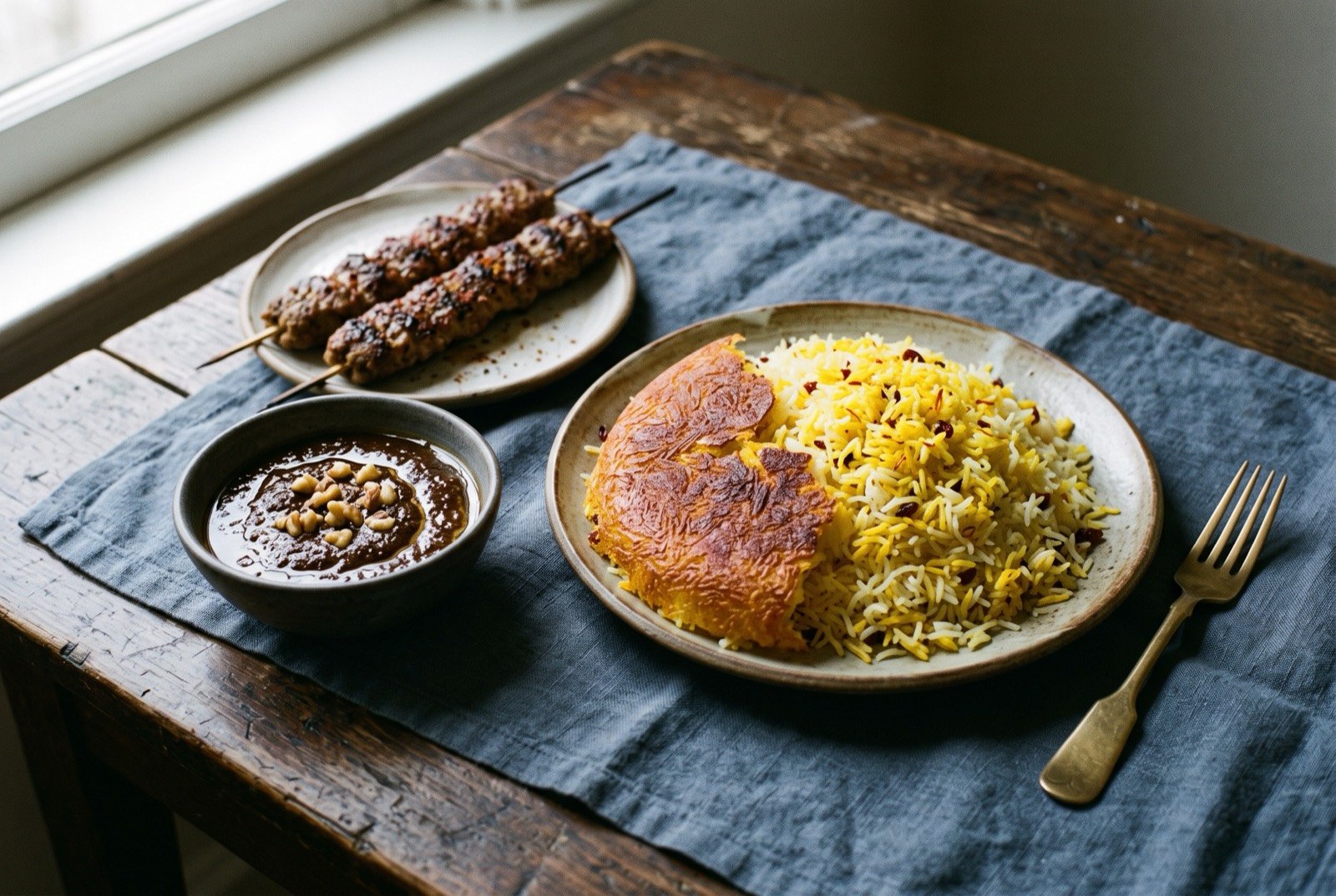
Ask most people outside Iran what Persian food is and they will describe one plate: rice, a skewer of minced lamb, a roasted tomato. It is a real dish, but it stands in for a country that actually contains at least three distinct food worlds: the qanat-fed plateau, the Caspian's rice-paddy north, and Khorasan's steppe and pilgrimage economy. Every dish as tradition built it, then what a modern chef would change.
Sources and review · What this chapter does not assert · How we research · Spotted something wrong?
A Sense of Place
Ask most people outside Iran what Persian food is and they will describe one plate: a mound of white rice, a skewer of minced lamb, a roasted tomato. It is a real dish, and a good one when made properly, but it is one dish standing in for a country that actually contains at least three distinct food worlds, and the flattening of the three into the one is itself part of this chapter's subject.
The central and southern plateau, Isfahan, Shiraz, Yazd and Kerman, is what most people mean when they picture Iranian food, and for good reason: it is the technical heartland, arid to semi-arid, ringed by the Zagros to the west and the Dasht-e Kavir and Dasht-e Lut deserts to the east, kept liveable for well over a thousand years by the qanat, a gently sloping underground channel that carries water from a mother well in the foothills to the surface by gravity alone, no pump, negligible evaporation, across open desert. The densest and oldest concentrations sit in Yazd and Kerman: the Zarch qanat near Yazd runs some 71 kilometres and is reckoned the longest known qanat anywhere, and it has done that work for over a thousand years. In 2016 eleven Persian qanats, most of them in this same zone, were inscribed together as a single UNESCO World Heritage listing, and the citation calls them exceptional testimony to a tradition of managing scarce water in an arid land. That underground water is the reason this desert supports walled orchard gardens, pistachio groves and pomegranate orchards rather than pure herding, and Kerman's Rafsanjan plain, roughly 130,000 hectares of it, is Iran's pistachio heartland on the strength of it. Yazd holds the country's largest Zoroastrian population and a genuinely distinct food culture, not a variant of Shia Persian cooking wearing a different hat, and this chapter treats that distinctness honestly rather than as local colour. Fat on the plateau is animal, mutton fat and ghee; starch is rice, alongside wheat flatbread; the aromatic backbone is dried lime, saffron and an advieh spice blend that has no single fixed recipe anywhere in the country; souring runs on pomegranate molasses, dried lime, verjuice and sour plum rather than fresh citrus. The rice-under-a-stew structure, khoresh over chelo, with a shatteringly crisp tahdig at the base of the pot, is the plateau's central technical idiom and, not coincidentally, the closest thing Iran has to a national dish shape.
One correction belongs here rather than left for later, because it changes how the whole zone should be read: the prestige aromatic long-grain rices that carry this entire polo tradition, domsiah and sadri, are not plateau crops. They are grown over 800 kilometres away, on the wet Caspian coast, where over 80% of Iran's rice-harvested land actually sits. The plateau's real contribution to the national rice tradition is the method, the parboil, the drain, the steam, the crust, not the grain itself. An Isfahani or a Shirazi cook did not invent domsiah rice. They invented what to do with it once it arrived.
The Caspian north, Gilan and Mazandaran, is the plateau's ecological opposite and, this chapter will argue, its cultural opposite too. The Alborz mountains trap moisture rolling in off the Caspian Sea and produce up to 2,000 millimetres of rain a year, the highest in Iran, mild winters, humid summers, forests, swamps and rice paddies where the plateau has desert and qanat. Gilaki and Mazandarani, the languages spoken there, are not regional accents of Persian. They are both Northwestern Iranian languages, genuinely distinct from Persian, which is Southwestern Iranian, and linguists group them into a Caspian language zone that unusually shares features with the languages of the Caucasus rather than with the rest of Iran. This is not decoration for the chapter's argument. It is the argument: a different people, speaking different languages, cooking a different ecology, whose food has been folded into "Persian cuisine" by a national and diaspora shorthand that the region's own cooks would not entirely recognise. The scholar who has written most seriously on Gilani cuisine specifically, Christian Bromberger, puts its logic in one line worth quoting directly: the base is rice, with a predilection for green, acid, eggs and fish, and the cooking methods are original within the Iranian world, built around browning, simmering and steaming rather than the oven and the open roast. Garlic, fresh herbs used by the fistful rather than the pinch, and sour flavourings, verjuice, sour orange, pomegranate, carry the zone's flavour, and its rice, not the plateau's, is what ends up under a plateau khoresh in most Iranian kitchens, inside Iran and out.
Khorasan, in the east, is the Caspian's opposite again: dry steppe and mountain, historically the meeting point of Iran, Central Asia and Afghanistan, and for a long stretch of history a through-route rather than a redoubt. This is also the one place where a popular assumption about this cuisine turns out to be simply true rather than needing correction: saffron and barberries really are grown here, in bulk, not merely traded through on their way somewhere else. Torbat Heydarieh is Iran's single largest saffron-producing city, and South Khorasan's Qaenat district, over 6,500 hectares of it, is the world's largest producer of seedless saffron. The same district produces roughly 97 to 98% of Iran's entire barberry crop. Ethnically Khorasan is a genuine mosaic rather than a Persian monolith: Persians, Khorasani Turks, Kurds (resettled here by the Safavid state as a deliberate frontier garrison, not an indigenous population in the way Gilaks are indigenous to Gilan, a distinction this chapter's history section takes seriously), Turkmen toward the Golestan fringe, Baluch and Sistani communities toward the south and southeast. Mashhad, the region's capital, holds the shrine of Imam Reza, the eighth Shia Imam, and is one of the Islamic world's great pilgrimage cities, a status with a direct and continuing effect on how the city feeds people, discussed below.
A table of peoples, logic and dishes
| Zone | Peoples | Defining logic | Carried by |
|---|---|---|---|
| Central and southern plateau | Persians; Yazd and Kerman's Zoroastrian minority | Qanat-fed oasis agriculture; rice imported, technique invented locally; souring by dried lime, pomegranate molasses and verjuice rather than fresh citrus | Chelo kabab, ghormeh sabzi, tahchin, dizi, kuku sabzi |
| Caspian north (Gilan, Mazandaran) | Gilaks, Mazandaranis (Tabaris), linguistically and culturally distinct from Persians | Rice paddy and forest ecology; herbs by the fistful; sour, green, egg and fish forward; browning, simmering, steaming rather than roasting | Mirza ghasemi, fesenjan (its real home), mahi shekam por, kateh |
| Khorasan | Persians, Khorasani Turks, Safavid-resettled Kurds, Turkmen, Baluch and Sistani communities | Steppe and pilgrimage economy; genuine saffron and barberry cultivation, not just trade; mass votive catering built around Mashhad's shrine | Sholeh mashhadi, shishlik, saffron and barberry itself |
The History in Layers
Start with a caution the country's own most serious food scholarship insists on. Encyclopaedia Iranica's own entry on cooking is candid that the pre-Islamic written and archaeological record for Persian food is thin: a handful of Avestan passages, a few Elamite tablets from Persepolis, and what Greek authors happened to notice. What survives that scrutiny is narrower than the popular story: saffron, rhubarb and spinach are credibly first domesticated on the Iranian plateau, and Sasanian royal cookery is understood, indirectly, through the much better documented Abbasid-era Arabic cookbooks that absorbed Sasanian court practice more or less wholesale after the conquest. What does not survive scrutiny is any claim that a specific modern dish, fesenjan, ghormeh sabzi, a named khoresh, is unchanged since Achaemenid or Sasanian times. No serious source supports dish-level continuity that old, and this chapter will not assert it, however often it gets asserted elsewhere.
The qanat is the plateau's actual precondition, not a colourful detail. A thousand years and more of gravity-fed underground water is what converted a hyper-arid basin into a fruit, nut and rice-cookery culture, and every dish this chapter treats from Isfahan, Shiraz, Yazd or Kerman sits downstream of that engineering.
Safavid Isfahan gives this chapter its clearest documented food history, and it is worth dwelling on because so much of the rest of Persian food history is thinner than people assume. Shah Abbas I, who reigned from 1588 to 1629, effectively re-routed the Silk Road through Isfahan when he made it his capital around the turn of the seventeenth century, and the wealthy court society that followed drove state monopolies on silk and carpet exports, largely brokered through Armenian merchant agents settled in the city's own New Julfa quarter. That wealth, and the royal gardens ringing the city, are the material basis for two genuinely dateable Isfahani dishes rather than folklore. Beryooni, minced lamb, traditionally including minced lung, seasoned with saffron and cinnamon and historically cooked in an underground tanur, is dated to roughly four hundred years, and the French traveller Jean Chardin left a near-contemporary account in the seventeenth century describing large chunks of meat roasted in the tanur with a pan beneath to catch the fat, a genuine primary source rather than a retrospective legend. By the Qajar period Isfahan reportedly had 68 beryooni shops trading at once, suggesting a real urban trade in the dish rather than a purely domestic one. Gaz, Isfahan's nougat, runs to roughly 450 years of production, tied historically to the sap of the local gaz-angebin shrub, harvested via the secretions of a small insect that feeds on the plant, before the industry moved to a manufactured base around a century ago under a named early producer, Mohammad Ali Shekarchian.
Chelo kabab, the country's closest thing to a national dish, has the best-documented single origin story in this whole chapter, and it is worth telling properly rather than leaving as received wisdom. Etemad al-Saltaneh's own court memoirs credit Naser al-Din Shah, the Qajar monarch who reigned from 1848 to 1896, with bringing the dish to wider Iran via his retinue from Tabriz, one of whom, a kabab cook, is said to have gone on to found Tehran's first chelo-kababi. Encyclopaedia Iranica's own Qajar cuisine scholarship independently states the dish was probably created in the Qajar period, describes the court version as fillet strips marinated overnight in onion and saffron, gently pounded flat, slow-broiled over charcoal and finished with butter, onion rings, fresh basil, sumac and a broiled tomato, and names it as part of Naser al-Din Shah's own regular diet. What later became the single-note "Persian restaurant plate" abroad started, in other words, as a specific nineteenth-century court dish with a traceable inventor's retinue behind it, not an ancient national inheritance.
Zoroastrian Yazd and Kerman deserve to be treated honestly rather than as quaint difference. Encyclopaedia Iranica's dedicated account of nineteenth-century Yazdi and Kermani Zoroastrians describes an everyday diet of coarse barley bread, pounded millet and seasonal herbs and fruit, and states plainly that this diet was shaped by discriminatory legal status: Zoroastrians were barred from handling moist food, meat or fruit in the market, for fear of ritually polluting it for Muslim buyers, and kept private household stores against hardship as a direct consequence. Two specific ritual foods survive from this community with real sourcing behind them: nan-e soruk, a fried flatbread made for Zoroastrian mourning and festival occasions, and sorkug, a paste of tahini and sugar prepared on the fortieth day and the six-month anniversary after a death, believed to carry the smell of death out of the house and shared with neighbours so they too are freed of the mourning. One popular assumption is worth correcting directly: ash-e shole ghalamkar, sometimes assumed Zoroastrian given its strong Isfahani association, has no verified Zoroastrian connection at all. Its consistent Persian-language origin story places it instead with the Qajar court, a legend that Naser al-Din Shah's own chef devised it as a restorative dish during a cholera outbreak roughly a hundred and fifty years ago, and its living use today is Shia Muharram and Ramadan votive cooking. This chapter does not call it a Zoroastrian dish.
Gilan's isolation was real and long-lived, and it explains why its food stayed its own thing. Hemmed in by the Caspian to the north and the double ridge of the Alborz and Qaflankuh to the south, Gilan was among the most physically isolated zones on the whole plateau at the start of settled history, and its practical link to the rest of Iran ran through one narrow, controllable corridor, the Anzali to Rasht to Sefid Rud valley route, rather than open steppe. Politically, Gilan kept real independent or semi-independent local dynasties until as late as 1567, despite nominally passing through Achaemenid, Seleucid, Parthian and Sasanian spheres of influence in turn. Four centuries and more of de facto autonomy on top of hard geography is plausibly why Gilani cuisine survived as its own thing rather than being absorbed into a generalised "Persian" cooking the way many other regions were.
Khorasan is the opposite case entirely: a through-route, and, at points, a deliberately engineered one. The historic Silk Road ran Merv to Sarakhs to Mashhad and Nishapur to Sabzevar to Shahrud to Damghan and on to Rey, with Nishapur specifically noted for its turquoise trade with China. And Mashhad's status as Imam Reza's burial place still shapes the city concretely today, not only historically: the shrine's own guesthouse serves roughly 7,000 meals a day across three sittings, funded through nazr, votive giving, with a standard menu running to chelo qeimeh, chelo qormeh sabzi and qeimeh badamjan, plus free tea and cold water service across the whole shrine complex. That is mass, civic-scale, votive catering as a going institution, with no real Caspian equivalent, and it is worth treating as part of Khorasan's food culture rather than a footnote about religion. The region's Kurdish population adds a genuinely different kind of history again: Kurds from west of Lake Urmia were resettled here under Shah Abbas I specifically to garrison the frontier against Uzbek, Turkmen and Mongol incursions, and, on some accounts, to simultaneously weaken Kurdish tribal power in the west by moving people out of it. The Zafaranlu tribe's relocation to Quchan is credited with reshaping that town's whole demographic and culinary structure. Some Kurdish presence in Khorasan predates this, so it is not an invented tradition from nothing, but the scale of today's Khorasani Kurdish population is substantially a sixteenth and seventeenth-century state-security transplant, a different kind of history layer from Gilan's long isolation, and worth naming as such.
The Flavour Arsenal
The souring agents that do the work fresh citrus does elsewhere
| Ingredient | What it is | Where and how it works |
|---|---|---|
| Limoo amani, dried lime | Unripe limes, sun-dried on the Hormozgan coast (Minab, Rudan, Bandar Abbas) until the interior blackens | Black dried limes go into abgoosht and ghormeh sabzi, yellow, less oxidised ones into gheimeh, a distinction Iranian cooks treat as an unwritten rule rather than an optional flourish. Whole, cracked or ground, contributing a fermented, faintly bitter sourness fresh citrus cannot replicate |
| Rob-e anar, pomegranate molasses | Pomegranate juice reduced slowly with a little sugar and lemon juice until thick enough to coat a spoon | Fesenjan's whole sauce is built on it; a real one is dark, thick and assertively tart, and Persian cooks themselves warn that cheap commercial versions are sometimes cut with plum paste rather than sold pure |
| Ab-ghooreh, verjuice | Pressed juice of unripe sour grapes | Used across the Caspian's stews and pickles specifically because it sours without fighting the dish's other delicate flavours the way a sharper vinegar or lemon can |
| Narenj, sour orange | The same species as the British Seville orange, used juiced or preserved | Central to Caspian fish and poultry dishes; genuinely the same fruit as a Seville, not an approximation of it |
Saffron, barberry and walnut, the plateau and Khorasan's signature three
Saffron, Iran's most prestigious spice, is tied historically to claims of ancient cultivation near Isfahan and Kashan, though the modern production centre, overwhelmingly, is Khorasan, where it is genuinely grown rather than merely traded through, Torbat Heydarieh above all. Used both dissolved as a cooking liquid, "saffron water," and as the colour and aroma finish on rice, meat and sweets alike.
Zereshk, barberry, a specific Iranian seedless cultivar rather than the ornamental barberry that grows wild in British hedgerows, comes overwhelmingly from South Khorasan's Qaenat and Birjand districts, briefly sautéed in butter with a little sugar to round its sharp acidity before it goes into rice.
Walnuts ground for fesenjan's sauce, and used whole or chopped through ash and kuku dishes across the country.
The plateau and Caspian's spice logic
Sabzi, fresh herb bundles, mean different things in different rooms of this house. On the plateau, parsley, coriander, dill, chive and fenugreek leaf underpin kuku sabzi and the herb-fried base of ghormeh sabzi, chopped fine and used with real intent but still, broadly, in a supporting role. On the Caspian coast the scale changes entirely: a single serving of torshi tareh can run to seventy grams each of coriander and parsley, a hundred grams of spinach and twenty of mint, a quantity that makes the herb the vegetable course rather than the garnish, carried by egg and rice rather than the other way round.
Advieh, the country's mixed spice blend, has no single fixed recipe anywhere in Iran. It varies by family, region and the dish it is going into, cinnamon, rose petal, cardamom, cumin, black pepper, ginger, nutmeg and clove all recur across different versions, but no single ratio is "correct," and this chapter treats that variability as a genuine finding rather than smoothing it into one authoritative formula.
Kerman keeps its own signature within the plateau: zire polo, cumin rice, is a Kerman speciality, with cumin held as warming and rice as cooling in the local reasoning, a pairing thought to suit the cold months specifically. Kerman's own version of abgoosht, boz ghormeh, adds kashk and garlic, marking it out from the Tehran-standard dish.
Caspian fish, and one honest warning
Kutum, Caspian white fish, is the Caspian coast's signature freshwater and coastal catch, found specifically in the Caspian itself and the rivers of Gilan and Mazandaran. Sturgeon and its caviar carry a real conservation crisis and this chapter will not pretend otherwise: Iranian state and financial press describe Caspian sturgeon populations as having suffered what is bluntly called a silent extinction, driven by decades of overfishing, pollution, climate change and unregulated riverbank construction, with Caspian littoral states beginning to ban recreational sturgeon fishing from around 2010 onward. Wild Caspian sturgeon and caviar have no place in this chapter's kitchen, sourced or otherwise. Where caviar appears at all below, it means farmed, certified stock, named as such.
The Technique Ladder
Six rungs, each doing real, explicable work, not folklore repeated because it is old.
Rung 1. Treat tahdig as controlled starch chemistry, not luck
The crisped rice crust at the base of the pot is not a happy accident of a particular cook's hand. It is a sequence: rinse and soak the rice to strip surface starch so the grains stay separate rather than gluing together; parboil in salted water to partially cook the grain and release further starch, then drain properly; lay a pool of hot fat, oil or butter, at the base of the pot before any rice touches it, since it is the fat, not the rice, that conducts heat fast enough to crisp that bottom layer while a cloth-wrapped lid traps steam to finish the rice mounded loosely above it. Only the bottom layer is pressed down into a dense base. The rest stays loose, because compacting the top defeats the entire point, the crisp-against-fluffy contrast the dish exists to deliver, and stirring at any point after the fat goes in reintroduces starch and ruins both textures at once. Heat sits in a narrow band, medium to medium-high: too low and the crust never forms in reasonable time, too high and it burns before the centre sets. A short rest before unmoulding lets the crust release cleanly rather than tearing.
Rung 2. Build koobideh's bind mechanically, never with filler
The single most consequential technical error in home and diaspora-restaurant kabab alike is reaching for egg, breadcrumb or baking soda to hold minced kabab together. Done correctly, none of it is needed. The bind is mechanical, not chemical: minced meat, ideally a leg and loin mix around 20% fat, double ground, kneaded by hand, continuously, until the meat's own proteins break down and the mixture turns tacky and cohesive, the same underlying mechanism a sausage emulsion or a well-made burger patty relies on to hold together without filler. A rest of at least four hours in the fridge, ideally overnight, lets that protein matrix properly set before the meat goes anywhere near a skewer. Skip the knead or skip the rest, and the mixture crumbles off the fire, which a home cook then blames on the fat ratio rather than the technique that actually failed.
Rung 3. Fry the herbs to near black before they are a stew, not a garnish
Ghormeh sabzi's whole character is decided before the meat is even added. The chopped herb mixture, parsley, coriander, fenugreek, spring onion greens, is fried separately in oil for twenty to forty minutes over gentle heat until every trace of visible moisture is gone and the colour has moved from bright green to a deep, near-black green, the point at which most of the dish's real depth is actually made. Push it past that point into genuinely burnt and it turns bitter, so the target is a specific, learnable colour, not an arbitrary cooking time. The stew itself then wants four to six hours minimum at a bare simmer. A rushed twenty-minute version made with barely wilted herbs and a short braise is not a lesser ghormeh sabzi. It is a different, thinner dish wearing the same name.
Rung 4. Smoke over open flame where the tradition specifies it, never the oven
Mirza ghasemi's aubergine must be charred directly over a naked gas flame or hot coals, never oven-roasted, because it is the actual smoke, not simply the softened flesh, that gives the dish its name-carrying character; oven-roasting cooks the aubergine through without ever imparting it. The skin needs to blacken enough to peel away cleanly. Iranian cooks themselves call this smokiness the dish's signature, and it is the one rung on this ladder where the fire itself, not a technique applied to the fire, is doing the flavour work.
Rung 5. Reduce toward gloss, not merely toward thickness
Fesenjan's sauce, walnuts ground fine and simmered slowly with pomegranate molasses, is not simply reduced until it stops being liquid. Properly made, the reduction is carried until the walnut's own oil begins to rise and shimmer visibly on the surface, the sign that the sauce has actually emulsified rather than merely thickened by evaporation. A sauce that is thick but flat and matte has been reduced for time rather than for that specific, visible endpoint, and it eats differently, heavier and less integrated, even at an identical consistency.
Rung 6. Let the diner finish the dish at the table where the tradition says so
Dizi, abgoosht's table name, is deliberately served in two acts rather than plated whole: the broth poured off first and eaten with torn bread, then the solids, meat, chickpea, potato, pounded by the diner themselves with a hand masher into a coarse paste, seasoned at that point with a pinch of salt so the chickpeas do not skitter out from under the masher. This is a genuine structural technique, not a quaint ritual laid over a finished dish: the dish is not actually complete until the diner has done that final piece of work, and serving it pre-mashed is not a shortcut, it is a different dish.
The Ferment and Preserve Bench
Limoo amani, dried lime. Made traditionally by boiling fresh limes briefly in brine, then sun-drying for weeks in an arid climate until the fruit hardens fully through, a process that does not translate directly to British humidity. A domestic dehydrator, blanching whole limes for sixty to seventy seconds first to preserve colour and reduce bitterness, then drying at roughly 57°C for around 48 hours continuous, is a genuine, meaningful upgrade in consistency and speed over windowsill drying, and this chapter recommends it as a real technique rather than a novelty. Colour is the real quality signal once dried: paler limes were dried for less time and taste milder, darker, near-black limes were dried longer, sometimes hotter, for a deeper, faintly smoky result. Store airtight, and they will keep well over a year.
Kashk, dried whey. Comes in two genuinely different forms, a ready-to-use liquid paste, sold in Britain as quroot, and a dried, hard curd that needs soaking and blending back to a paste before use. There is no honest substitute for its specific fermented, salty, aged-dairy character, not yoghurt, not sour cream, and this chapter does not pretend otherwise.
Torshi, the household pickle shelf. Vinegar and salt preservation runs across the whole country in the same broad way it does across the wider region, from mixed vegetable torshi to the specifically Gilani torshi tareh, which uses cooked rice as a thickener rather than vinegar alone, closer to a sour herb relish than a classic pickle.
Sourcing in Britain
Verified August 2026. Where a supplier could not be fully confirmed, that is said rather than smoothed over.
The ranked list: what decides great from grim
- Saffron, and specifically the grade you are actually buying. Sargol is the deep red tip of the stigma only, no yellow style, the everyday workhorse grade. Pushal carries some pale yellow style attached and tests ten to twenty percent lower in colouring strength, not fake, simply diluted by design. Negin is long, unbroken whole threads, the most visually impressive grade and the one restaurants plate with. Buy whole threads only; ground saffron cannot be inspected for adulteration, dyed corn silk and dyed safflower petals are the common fakes, and genuine threads have a flared, trumpet-shaped end and taste distinctly bitter, not sweet. Sara Saffron, Manchester, and The Persian Trader, Edinburgh, both state direct partnerships with named Khorasan-region farms and hold stock in the UK.
- Barberries, zereshk, and the specific cultivar problem. Real zereshk is a seedless Iranian cultivar, Berberis integerrima 'Bidaneh', not the ornamental barberry found in British hedgerows, and no amount of home drying converts one into the other. Buy dried, dark ruby red, dry but not brittle, unsweetened stock, avoiding anything dull brown, gritty or visibly sugar-coated.
- Dried limes, limoo amani, both colours. Buy whole rather than ground, and buy the bigger, darker ones for the deeper, smokier flavour; a UK Middle Eastern grocer will often stock only one colour, so check for both black and yellow if the recipe specifies.
- Pomegranate molasses, and a naming trap worth knowing. A genuine rob-e anar is thick enough to coat a spoon and assertively tart; several respected "no sugar" pomegranate molasses brands sold through Persian delis are in fact Lebanese, not Iranian, an honest and widely used substitute within the trade itself, not a compromise unique to British sourcing, but worth knowing rather than assuming the bottle is Persian-made.
- Rice: an honest substitute, not a lesser one. Domsiah and sadri, the Caspian's own prestige aromatic rices, are not realistically stocked in Britain outside specialist Iranian shops. A genuinely good aged basmati, Tilda Pure Basmati or a specialist grocer's own aged stock, behaves the same way for the parboil-and-steam method tahdig and kateh both need, and is what most of the diaspora, and plenty of cooks inside Iran without access to Caspian rice, actually cook with day to day.
- Golpar, angelica, and no honest substitute for it. Ground from Heracleum persicum seed, often mislabelled "angelica seeds" by Western retailers, a real and specific labelling trap worth knowing. There is no genuine substitute; do not swap it for celery seed or lovage.
- Kashk, liquid rather than dried, for a first attempt. The liquid paste form, sold as quroot, is more reliably stocked by verified UK retailers than the dried curd, which tends to be a US-facing product.
- Advieh, ground fresh rather than bought stale. No single recipe is correct, but pre-mixed advieh loses real brightness after around four months even stored well, and this reader's own dedicated spice grinder is better used on whole cinnamon, cardamom and cumin than left idle while a jarred blend goes flat in the cupboard.
Named shops and delis
Persepolis, Peckham, run by Sally Butcher, author of Persia in Peckham and Veggiestan, trades online as For a Taste of Persia with UK-wide delivery and is the single best starting point for a reader outside London: dried limes, liquid kashk and dried fenugreek leaf all directly confirmed in stock. Bahar (also trading as Super Bahar), Kensington High Street, a real, long-running family-run Iranian supermarket, butcher and patisserie. North Finchley, around Ballards Lane, is the genuine geographic centre of Persian retail in London, more than Peckham or Marble Arch, home to Mega Iranian Supermarket, Tehranpars Supermarket and Tehran Super. Green Valley, near Marble Arch, is a real and long-established Middle Eastern foodhall, since 1986, but is primarily a Lebanese operation rather than a Persian specialist, and a genuinely Persian shop will have deeper stock of the specific ingredients this chapter calls for.
General importers and online delivery
Sara Saffron and The Persian Trader for saffron directly (above). LemonSalt and ASA Market for general UK-wide Persian pantry delivery, including verified Anjoman-brand golpar. Treat this as a starting list rather than an exhaustive one, since UK Persian food retail is fragmented and unevenly documented online; check a shop's current stock and delivery terms directly before ordering rather than assuming a listing is current.
Voices and Sources
From inside the tradition
- Najmieh Batmanglij, the most senior figure in English-language Persian food writing, author of Food of Life and From Persia to Napa, whose documented tahdig method treats the crust as a controlled, checkpointed process rather than something achieved by instinct.
- Kian Samyani, chef-founder of Berenjak, London, Dubai and Los Angeles, whose stated approach reinterprets the hole-in-the-wall kabab houses of Tehran through seasonal British produce, built around an open kitchen with a live tandoor and mangal.
- Bijan Behzadi, founder of Kateh, London, whose direct, on-record critique, that Iranians, unlike the French or Italians, lack a shared public sense of their own regional food variety, and that most Iranian restaurants haven't changed, is this chapter's own strongest single diagnosis of what the flattened "Persian restaurant" plate actually gets wrong, and whose kitchen answered it with real regional specificity: pheasant standing in for fesenjan's own Gilani chicken, closer to the dish's roots than the diaspora standard.
- Nasim Alikhani, chef-owner of Sofreh, Brooklyn, who researched her menu by travelling Iran region by region, deliberately tracking how the same dish changes across the country's Turkish and Kurdish communities rather than defaulting to a Tehrani standard.
- Hoss Zaré, San Francisco, born in Tabriz, whose self-described "Persian fusion" project keeps authentic flavour while reframing it for diners unfamiliar with the cuisine, and who has taught Iranian cooking to culinary programmes across the United States.
- Andy Baraghani, Iranian-American food writer and James Beard Award winner, whose plain, on-record correction, that Persian food is delicate and herb-forward rather than heavily spiced, does real work against the generic "warm-spice Middle Eastern" misreading this cuisine often suffers outside Iran.
- Naz Deravian, author of Bottom of the Pot, whose framing of her own cooking as "accented food," carrying the accent of every place it travelled through, is a more honest account of diaspora cooking than any claim to unchanged authenticity.
- Sabrina Ghayour, British-Iranian author from Persiana onward, on record as unsentimental about strict authenticity while still treating the proper rinse, parboil and steam rice method as non-negotiable.
- Yasmin Khan, author of The Saffron Tales, who researched the book travelling Iran region by region, collecting recipes from artists, farmers, electricians and teachers rather than restaurant kitchens.
The gap, named rather than papered over
No named, primary-sourced chef inside Iran itself, in Tehran, Isfahan or Shiraz, turned up in this chapter's research with a documented technique or stated philosophy comparable to the diaspora voices above. Two Tehran restaurants, Hestooran and Divan, surfaced with real reputations but no named head chef and no primary interview behind either. This is treated here as a genuine, honest gap in what is searchable and documented, not as evidence that no such cooking exists inside Iran, and it would be the single most valuable thing to close before this chapter is revised.
Things this chapter has deliberately not asserted
- That any specific modern Persian dish descends unchanged from an identifiable Achaemenid or Sasanian recipe. Encyclopaedia Iranica's own scholarship is explicit that the pre-Islamic written record is too thin to support dish-level continuity claims, and this chapter has not made one.
- That fesenjan, ghormeh sabzi or any other named khoresh has a documented ancient origin date. No source found for this chapter supports a historically verifiable date for any of them older than general, undated tradition.
- That fesenjan is a plateau invention. It is a native Gilani dish, and this chapter states that plainly rather than repeating the more common, imprecise attribution.
- That ash-e shole ghalamkar is a Zoroastrian dish. Its best-documented origin story places it with the Qajar court and Shia votive cooking, not Zoroastrian tradition, despite its Isfahani association.
- That ashak is a documented Khorasani-Afghan crossover dish within Iran's own regional food literature. Every source found treats it as straightforwardly Afghan, present in Mashhad through that city's Afghan community, not as an indigenous or hybridised Khorasani dish, and this chapter has not included it as one.
- That kebab-e Torki is a distinct Khorasani speciality. No source found gives it a specific Khorasani attribution; shishlik, the region's genuinely documented signature kebab, appears in this chapter instead.
- That fake or substituted saffron is a documented problem specifically inside diaspora restaurants. This is plausible given saffron's cost and Iran's own well-documented domestic adulteration problem, but no source found for this chapter states it directly, and it is named here as a plausible, unproven suspicion rather than a fact.
- That sous vide, chinois, dehydrator or high-power blender applications anywhere in this chapter's Elevation sections are documented Iranian or diaspora-restaurant techniques. They are this chapter's own extrapolation of the technique ladder's underlying logic onto the reader's own kit, and are named as exactly that throughout, not attributed to any chef or source that did not actually say so.
- That UK sanctions law specifically restricts the import of Iranian saffron or other foodstuffs. No UK government source naming foodstuffs specifically was found; the friction actually documented in this research is banking-level, reported by a single, self-interested Iranian exporter, not confirmed against UK law directly.
- That Banu, Toronto, is currently open. It closed its physical restaurant in early 2025 with a stated intent to return that had not been confirmed as fulfilled at the time this chapter was researched.
- That domsiah or sadri rice can be reliably bought fresh in Britain, or that Kutum, Caspian white fish, can be bought at all. Both are named honestly as unavailable, with a stated, credible substitute in each case, rather than treated as sourceable when they are not.
Treat tahdig as controlled starch chemistry, not luck
The crisped rice crust at the base of the pot is not a happy accident of a particular cook's hand.
Build koobideh's bind mechanically, never with filler
The single most consequential technical error in home and diaspora-restaurant kabab alike is reaching for egg, breadcrumb or baking soda to hold minced kabab...
Fry the herbs to near black before they are a stew, not a garnish
Ghormeh sabzi's whole character is decided before the meat is even added.
Smoke over open flame where the tradition specifies it, never the oven
Mirza ghasemi's aubergine must be charred directly over a naked gas flame or hot coals, never oven-roasted, because it is the actual smoke, not simply the...
Reduce toward gloss, not merely toward thickness
Fesenjan's sauce, walnuts ground fine and simmered slowly with pomegranate molasses, is not simply reduced until it stops being liquid.
Let the diner finish the dish at the table where the tradition says so
Dizi, abgoosht's table name, is deliberately served in two acts rather than plated whole: the broth poured off first and eaten with torn bread, then the...
The dishes
- Chelo Kabab Koobideh
- Ghormeh Sabzi
- Fesenjan Gilan
- Tahchin-e Morgh
- Dizi (Abgoosht)
- Kuku Sabzi
- Mirza Ghasemi Gilan
- Mahi Shekam Por, Stuffed Caspian Whitefish, with Kateh
- Sholeh Mashhadi Mashhad, Khorasan
Sources and review
- Researched
- No outside sources linked
- Reviewed
- Not yet reviewed from inside the tradition
- Cooked
- Not yet cooked and reported
Where this volume comes from
3 research briefs on file for this volume, researched to the rules on How we research. Published 28 August 2026. Last changed 8 September 2026.
The brief's own account of its sources
Roughly tallying the sources actually used for factual claims above, not the raw search hits, many of which were discarded as recipe-farm content and not cited: Iranian academic sources (Encyclopaedia Iranica, cited throughout but recovered only via search snippet on nearly every article both passes tried, direct fetches returned HTTP 403 across the board; a Gonbad University fisheries-research journal article on kutum; Christian Bromberger's peer-reviewed Gilan cuisine scholarship, abstract only, full text paywalled on both Berghahn and ResearchGate) account for a meaningful share of the