Asia · Volume 11
Georgia
The Walnut and the Vine
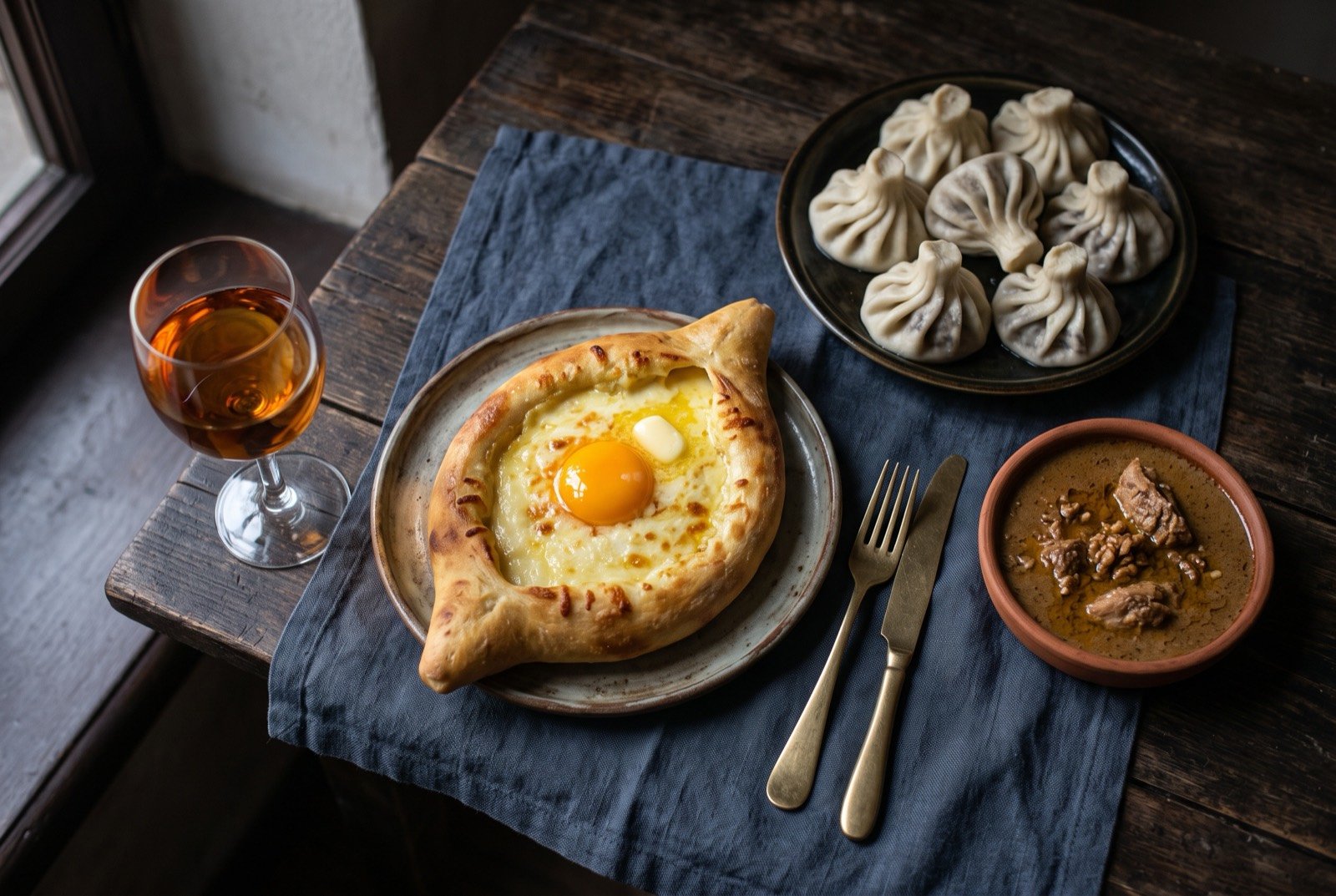
Georgia's two food worlds, the corn and walnut lowlands of the west and the wheat and wine country of the east, treated as the single, genuinely divided cuisine they are, and read against the wine culture and the feast structure that frame the whole table. Every dish as tradition built it, then what a modern chef would change.
Sources and review · What this chapter does not assert · How we research · Spotted something wrong?
A Sense of Place
Georgia sits where the Black Sea meets the Caucasus, and its cooking splits cleanly along that geography into two food worlds that a single national label flattens more than it explains. The west, ancient Colchis, is wet, low and corn country: walnut is the sauce base rather than a garnish, chilli is worked fresh rather than dried, and the staple starch is a cornmeal porridge that predates maize itself by name. The east, Kakheti above all, is dry, sun-baked wheat and vine country, and its food is organised around a wine culture old enough that the archaeology behind it changed the accepted date of winemaking worldwide. Between them sits Tbilisi, a crossroads city that has absorbed Persian, Ottoman, Russian and Soviet layers without ever quite becoming any one of them, and that difference, corn and walnut against wheat and vine, is the argument this chapter is built on.
West: the Colchis lowland, corn, walnut and the Adjaran subtropics
Western Georgia, Samegrelo, Imereti and Adjara, corresponds roughly to the territory of the ancient Kingdom of Colchis, with major historic settlements at Phasis, now Poti, and Dioscurias, now Sukhumi. The Colchis lowland was historically swampy, and its surviving wetland fragments are UNESCO-listed today as the Colchic rainforests and wetlands, a refuge for relict pre-glacial species. That wetness shaped the cuisine directly: a seventeenth-century Italian missionary, Archangelo Lamberti, who lived in Samegrelo and left a firsthand account translated into Georgian as Sacred Colchis, describes sun-dried flatbreads as the pre-maize bread substitute here, a preservation adaptation to a climate with limited dry fuel, alongside abundant river fish, a dairy economy built on sheep and goats rather than cattle, and a wine culture already old enough by his account to include a variety aged and named "seven-year."
Maize itself is a comparatively recent arrival, entering Georgian farming intensively from the seventeenth century and progressively displacing millet as the region's staple grain. This matters because the word for the cornmeal porridge eaten today, ghomi, is older than the crop: it originally named a millet dish, and the corn version is a post-Columbian substitution wearing an older name, the same pattern that recurs across the Atlantic-facing cuisines this atlas has already covered in Africa. Walnut, not dairy fat or clarified butter, is the region's defining richness, worked into sauces thick enough to coat poultry (satsivi), light enough to dress a plate of ghomi (bazhe), or bound into a cold vegetable paste (pkhali), three genuinely distinct preparations from the same nut that this chapter keeps carefully apart rather than treating as one "walnut sauce."
Adjara, the Black Sea coastal strip, is ecologically a different world again: subtropical enough to have supported a real tea and citrus economy. The first tea bushes in Georgia were planted in 1809 in a prince's garden; the industry was properly established under Russian imperial patronage from the 1890s by a Chinese specialist, Lau Djin Djao, who managed several coastal estates and took his own first harvest in 1918; Georgian tea won gold at the 1899 Paris Exposition, and the industry employed some 120,000 people at its Soviet peak before collapsing after 1991. Mandarins arrived by a similar route, a French gardener's orchard in Batumi becoming the seed of a citrus economy that, by the Soviet period, supplied the overwhelming majority of the USSR's open-ground fruit. Adjara's food carries that subtropical richness, and, distinctly from the rest of the west, a genuinely different religious history: two and a half centuries of Ottoman rule left it with a Muslim Georgian population that the rest of the country did not have to reckon with, see the history section below.
East: the Alazani Valley, wheat, wine and the Tbilisi crossroads
Kakheti occupies the Alazani river valley, bounded by the Caucasus to the north and the Gombori range separating it from the rest of eastern Georgia. Its loamy, well-drained valley floor and continental climate, hot dry summers, make it the country's premier grape-growing zone, and account for the majority of Georgia's vineyard area. Settlement in the valley dates to the third to second millennium BCE. Where the west's starch logic runs on corn and its richness on walnut, Kakheti's runs on wheat bread and wine itself as a structural, not merely social, ingredient: qvevri wine, buried clay vessels, extended skin contact, is not a pairing for the food here so much as a parallel fermentation tradition sitting directly alongside the kitchen, treated in full in the flavour arsenal and the ferment bench below.
Tbilisi is its own case, and a dedicated Georgian food-history source is explicit that the city's cooking is not simply Kakhetian cooking scaled up: its position on the Mtkvari river trade route made it a genuine crossroads, with dishes arriving from the Persian and Azerbaijani sphere to the east and south and others from Russia and the north, absorbed and adapted rather than imported wholesale. The city's historically mixed-ethnicity shared courtyards, Georgian, Armenian, Azerbaijani, Russian and Kurdish households living side by side, are named directly as the real mechanism of that fusion, a slower, older process than anything Soviet administration imposed on top of it. Tbilisi khinkali having cheese added to the mountain original, and Tbilisi khash being built up with bay leaf, onion and herbs that rural Kakhetian khash does without, are both cited as concrete, small, checkable examples of that urban habit of adaptation.
A table of peoples, logic and dishes
| Region | Defining logic | The dishes that carry it |
|---|---|---|
| Samegrelo, Imereti | corn starch, walnut richness, fresh chilli heat | elarji, khachapuri Imeruli, satsivi, badrijani nigvzit |
| Adjara | subtropical richness, Ottoman-era Muslim Georgian layer | khachapuri Acharuli, sinori |
| Kakheti | wheat, wine as a parallel craft, the supra as social frame | mtsvadi, chakapuli, lobiani |
| Tbilisi | crossroads, Persian and Russian absorption, urban adaptation | khinkali (cheese added), chakhokhbili, khash |
The History in Layers
Colchis and the Golden Fleece
The Kingdom of Colchis is dated from roughly the thirteenth century BCE in legend, the Argonaut era, through state consolidation around the sixth to seventh centuries BCE, to 164 BCE, when it came under Pontic and later Roman-sphere influence. It was renowned for gold, and excavation at Vani has shown wealthy elite burials with Greek-influenced artefacts and urban settlement evidence running from the Bronze Age through the Hellenistic period. The Golden Fleece legend is treated, via the ancient geographer Strabo, as folk explanation for a real, attested practice: sheep fleeces used to trap gold dust from Colchian rivers. This chapter does not go further than that: the deeper archaeological literature on Vani specifically was not consulted directly in the research behind this chapter, and the summary above rests on general-encyclopaedia-level sourcing rather than a primary excavation report.
The Neolithic wine find, and where it actually is
This is worth stating precisely, because popular Georgian and Western coverage alike routinely blur it. The archaeological basis for the widely repeated "eight thousand years of Georgian winemaking" is a 2017 peer-reviewed study in Proceedings of the National Academy of Sciences, a joint University of Toronto and Georgian National Museum project, dating pottery residue from two sites, Gadachrili Gora and Shulaveris Gora, to roughly 6000 to 5800 BCE, via tartaric acid signatures specific to the grape, corroborated by pollen, starch and epidermal plant remains. Both sites sit in Kvemo Kartli, around fifty kilometres south of Tbilisi, not in Kakheti and not in the western regions this chapter covers. Kakheti's real claim is to having become the dominant wine-growing economy of historic Georgia, not to hosting the earliest archaeological find; this chapter keeps those two claims separate rather than letting the older one lend false specificity to the younger.
The Ottoman layer in Adjara
Adjara's Ottoman period is genuinely longer and more consequential than the rest of Georgia's. An agreement in 1614 between Guria and the Ottoman authorities at Batumi forced the Gurian ruler to cede Adjara and accept Ottoman tax obligations, beginning roughly two and a half centuries of Ottoman rule that lasted until 1878. Islamisation was gradual and stratified by class: feudal lords converted in the second half of the seventeenth century while the peasantry mostly remained Christian for far longer, with conversion spreading through the Chorokhi valley and reaching the coastal village of Sarpi last, continuing well into the nineteenth century. Adjara returned to Georgia, then under the Russian Empire, after the Russo-Ottoman War of 1877 to 1878. This chapter treats Adjara's Muslim Georgian population and history as real and worth naming plainly, and does not go further into the region's genuinely contested twentieth-century identity politics than the culinary evidence supports: the sourcing behind this chapter is general-history level rather than the dedicated academic literature the subject deserves, and that gap is named rather than papered over.
Tbilisi, sacked and rebuilt
Tbilisi's food history carries the marks of repeated conquest. One documented episode: the 1522 sack of the city by Shah Ismail I of Iran, in which churches were plundered and a mosque built, with a Persian garrison installed in the city's fortresses. Tbilisi was sacked by Persian and other forces on more than one occasion across the sixteenth to eighteenth centuries, and this chapter names the 1522 episode specifically because it is the one the food-history sourcing behind this chapter actually cites, rather than asserting the more commonly referenced 1795 sack under Agha Mohammad Khan Qajar, which this chapter's research did not verify directly. Concrete dish-level evidence of that layered absorption: piti, a mutton and onion stew, arrived via the Azerbaijani and Persian sphere and was locally adapted; a dish carrying the Russian name "Tbilisian Ossetian solyanka" became, in practice, a genuinely distinct Tbilisi recipe; and Tbilisi khash, unlike the rural Kakhetian version, is built up with bay leaf, onion and herbs, wealthier households historically cooking it in milk.
Soviet Georgia and what survived it
The Soviet era left real, specific traces that this chapter can name without overreaching into the wider political history. From the 1950s, Tbilisi households in shared courtyards took turns with canning equipment in what one Georgian food writer calls a household "sterilised compote boom," a genuinely surviving memory tied to the city's older mixed-ethnicity courtyard culture rather than something Soviet administration invented from nothing. On wine specifically, roughly half of Georgia's total output through the Soviet period and after was semi-sweet wine made for the Russian market, a direct continuation of the Soviet-era Samtrest monopoly model, and Russia still buys around 60 per cent of Georgian wine exports by volume today. This chapter did not find good sourcing on the 1801 Russian imperial annexation's specific effect on food culture, or on collectivisation's effect on household food practice in Samegrelo, Imereti or Adjara specifically, and does not invent either.
The wine industry's Russian shadow, and its recent turn
One further point, genuinely useful and worth flagging as resting on a single specialist source rather than Georgian-language corroboration: the wine journalist Simon Woolf reports that traditionally made qvevri wine likely accounts for three per cent or less of Georgia's total wine production, the rest overwhelmingly the semi-sweet Russian-market style above, and that once qvevri wine became internationally fashionable, "the market exploded with rustic and sometimes impressively dirty wines," producers realising the word qvevri alone could sell a bottle regardless of quality. He credits the 2006 Russian wine embargo, a genuine, dateable geopolitical event, with forcing producers who wanted European and American markets to raise quality, since the old Russian market would take wine of any quality at all. This chapter treats this account as plausible and consistent with the wider Soviet-legacy narrative found elsewhere in the sourcing, but flags it as single-sourced to one Western wine writer, with no Georgian-language corroboration found.
The Flavour Arsenal
The walnut sauce family: satsivi, bazhe, pkhali
Western Georgian cooking runs on walnut the way Greek cooking runs on olive oil, and the sourcing behind this chapter is explicit that this is three structurally different preparations, not one sauce under three names. Satsivi is walnut, onion, garlic, an acid (vinegar or citrus) and a spice blend, let down with hot broth and cooked together with the meat itself, a genuinely cooked sauce, most associated with the New Year table. Bazhe is lighter and mostly uncooked: walnut, cilantro and garlic ground together, traditionally through a meat grinder, and served alongside ghomi, poultry or fish rather than simmered into the protein. Pkhali's walnut paste is different again, bound with a cooked, thoroughly drained vegetable, spinach or beetroot leaf most commonly, into a cold starter rather than poured as a sauce. A working satsivi ratio, corroborated across two independent recipes: walnut to onion roughly four to one by weight.
Khmeli suneli and the spice blend
The core western Georgian spice mix, khmeli suneli, is built from utskho suneli, blue fenugreek, a wild clover-like plant native to western Georgia and distinct from the fenugreek most UK cooks already know, alongside dried red pepper, parsley, celery or lovage, coriander, bay, mint and dried marigold petals, known locally as "yellow flower" or Imeretian saffron, used for colour rather than aroma. Utskho suneli is genuinely the load-bearing ingredient of this blend: substituting ordinary fenugreek changes the character of the whole spice mix in a way a British cook accustomed to other cuisines' fenugreek could easily do by accident.
Adjika, and the corruption worth naming
This is the single most important flavour-arsenal correction in this chapter. Genuine adjika, as made and named in Samegrelo, comes in two forms: red adjika, hot and sweet red peppers, seeded, ground fresh with garlic, cilantro, basil, parsley, dill and mint; and green adjika, the same method with green chillies and herbs, garlic and vinegar added after grinding. In Samegrelo these are called, respectively, "meat adjika" and "herb adjika," both built from whole fresh chillies and fresh herbs. One attested Megrelian variant does include walnut, worth naming so this chapter does not overstate a rule that isn't universal. What genuine adjika never contains, in any source this chapter's research could find, is dried paprika powder or tomato paste, both of which are what much internationally exported "adjika," including some sold in the UK, actually is. This chapter treats the paprika-powder version as a corruption of a fresh, herb-forward regional condiment, not a legitimate regional style in its own right.
Tkemali
A sour plum sauce built from unripe fruit, with real regional variation: Imereti's version boils the plums with herbs until soft, then grinds and lets down the paste with the reserved cooking liquid; Samegrelo's is notably more sour and hot, traditionally using dried rather than fresh cilantro; Kakheti's eastern version, by contrast, uses less acidic plum varieties, sometimes sugared, with mint standing in for pennyroyal.
Churchkhela and tklapi
Churchkhela, walnut or hazelnut threaded and repeatedly dipped in tatara, grape must thickened with flour, until coated, is genuinely regional in its base ingredients: eastern Georgia uses wheat flour in the tatara, western Georgia cornflour and hazelnut specifically. One source gives a rough production ratio, a kilogram of nuts yielding seventeen to eighteen finished pieces from four to five litres of grape must. Tklapi, dried fruit leather, shows real fruit variation by region, quince near the Black Sea coast, hawthorn further inland, but this chapter did not find strong sourcing pinning it as a western speciality as opposed to a pan-Georgian technique, and does not assert that framing as fact.
Saperavi and Rkatsiteli
Saperavi is a teinturier grape, red-fleshed as well as red-skinned, unusual among red grapes generally, producing near-black berries; it originated in the historic province of Shavsheti-Klarjeti near the Black Sea and spread eastward into Kakheti by the seventeenth century, where it is now the flagship red. Rkatsiteli is a native white variety originating in Kakheti itself, its name describing the reddish-chestnut colour of its young autumn shoots, well adapted to the valley's growing season, producing fruit-forward table wines and, held on its skins in qvevri, the amber wines this chapter returns to below.
Sulguni and imeruli cheese
Sulguni, the stretchy, brined pasta filata cheese that defines Megrelian khachapuri and elarji alike, is worked in hot whey or water, around 75 to 80°C, until the curd becomes plastic and stretchable, the same denaturing mechanism that makes mozzarella stretch, then brined. A properly made piece is meant to squeak slightly when bitten, though this chapter could not trace that specific claim to a named source and treats it as widely repeated rather than documented. Imeruli, the unsalted cheese used in Imeretian khachapuri, is softer and milder. Neither is currently importable to the UK with any verified reliability, see Sourcing in Britain below.
The Technique Ladder
The argument, from inside
Tekuna Gachechiladze, chef and owner of Café Littera and Khasheria in Tbilisi, is the single best-sourced and most explicit voice this chapter's research found on what elevating Georgian food actually means. Her stated position, from interviews and a TEDxTbilisi talk, is that "tradition is innovation, Georgian cuisine is fusion by nature, Georgia was fusion before fusion was fusion," pointing to khinkali's likely Central Asian origin and centuries of invasion and imperial rule as the mechanism by which Chinese, European and other technique already entered Georgian cooking long before any restaurant did it deliberately. This is a genuinely different framing from the standard "wrong ingredients" diagnosis of bad diaspora food, and it is the one this chapter's technique ladder is built around: not preserving a static dish, but doing the traditional mechanism properly, the same animating idea that runs through every volume of this atlas.
Rung 1. Rest the khinkali dough properly, and pleat it by hand
A stiff dough, warm salted water worked in, needs a genuine rest, thirty minutes at minimum and closer to an hour for a markedly better result, before it will roll thin enough to pass a windowpane test, light visible through a stretched scrap without tearing, while still holding broth through a rolling boil. The mechanism is the same gluten relaxation this atlas has already covered for hand-stretched filo: an under-rested dough tears under the combined stress of rolling and boiling. Pleat count is genuinely disputed even within Georgia itself, sources this chapter consulted give figures from twelve to fourteen at the low end up to nineteen, twenty one and even a poorly sourced twenty eight, and this chapter does not assert a single number as correct.
What a cook does with this rung. Give the dough its full rest and roll thinner than feels safe, then pleat by feel rather than chasing a specific count; a well-rested dough forgives more pleats than an under-rested one, so more pleats is a sign the dough is right, not an arbitrary craft target to hit regardless of dough condition.
Rung 2. Grind the walnut sauce in short pulses, and let it release its own oil deliberately
Walnuts are roughly two thirds fat by weight, and a food processor run continuously rather than in short, checked pulses over-releases that fat, breaking the intended fine emulsion into a grainy, separated paste. The traditional method for satsivi is explicit about the opposite instinct: the ground walnut paste is worked and kneaded by hand until the oil emerges, that released oil then reserved and used to finish or enrich the sauce rather than treated as a mistake to avoid.
What a cook does with this rung. Pulse a high-power blender in short bursts, checking texture between each, rather than running it to a smooth purée in one go; if oil does separate, do not panic and add liquid to re-emulsify, spoon it off and use it as the finishing drizzle the tradition already calls for.
Rung 3. Treat the tone as the model, and the Big Green Egg as its nearest domestic equivalent
The tone, the clay oven that bakes shotis puri and underlies the khachapuri tradition, is a cylindrical vessel fired from below and sealed hot enough that dough slapped against its inner wall sets its crust in minutes while the interior stays soft, a mechanism of extreme, near-instant radiant heat rather than slow, even oven heat. A domestic oven with a steel gets partway there; a Big Green Egg run hard, with a pizza steel added and preheated a full thirty to sixty minutes, gets considerably closer, since it can comfortably exceed what a conventional domestic oven reaches.
What a cook does with this rung. Preheat harder and longer than instinct suggests, and add a source of steam, a cast iron pan of boiling water added at loading, to mimic the tone's sealed, humid heat rather than a dry domestic bake.
Rung 4. Ferment adjika's heat, don't fake it with vinegar
Genuine adjika's tang comes from the fresh chilli and herb paste's own fermentation and the character of properly ripe Georgian peppers, not from added vinegar standing in for that acidity, and not, as much exported "adjika" does, from tomato paste or dried paprika substituting for fresh chilli altogether. Fermentation develops a rounder, more complex acidity across a wider range of acids and aromatic byproducts than a straight vinegar addition ever will, because lactic fermentation is doing real biochemical work that a splash of vinegar simply cannot replicate.
What a cook does with this rung. Ferment fresh red or green chillies, garlic and herbs at room temperature for forty eight to seventy two hours before finishing the paste with salt, using the same fermentation discipline a reader with a dehydrator already applies elsewhere, rather than reaching for vinegar as a shortcut.
Rung 5. Bury the vessel, hold it cool, and let time do the extraction
Qvevri winemaking works because a buried clay vessel holds a near-constant thirteen to sixteen degrees regardless of surface weather, letting fermentation and, for white wine, skin contact lasting from a week for reds up to the following spring for whites, proceed slowly with no mechanical intervention at all. The result, extracted tannin, phenolic structure and colour, is achieved entirely by stable temperature and patience rather than additive or equipment. This is not a kitchen technique a reader can directly perform, but it is the clearest illustration in this whole chapter of the atlas's founding idea, that traditional method is often already the most sophisticated available answer, not a primitive stand-in for one.
What a cook takes from this rung. Any home fermentation project, a ferment bench item below among them, benefits from the same principle: a stable, cool space held constant, a cellar, a buried container, a wine fridge run flat, and genuine patience, will outperform an unmanaged, temperature-swinging kitchen counter every time, no additive required.
Rung 6. Bank the coals for mtsvadi
Kakhetian mtsvadi is traditionally grilled over embers from grapevine cuttings or hazel wood, credited specifically with the meat's flavour and tenderness, though this chapter's sourcing on the exact mechanism is moderate rather than strong. Genuine grapevine cuttings are not readily available in a British garden, but the underlying principle, aromatic hardwood embers rather than commodity charcoal, transfers directly.
What a cook does with this rung. Use lump charcoal with a genuine proportion of fruitwood or vine prunings if any can be sourced, oak or apple wood otherwise, banked into a mound for a hot centre and a cooler holding edge, the same charcoal discipline this atlas's Mediterranean volume already established, and baste with wine or fruit juice while turning, the traditional finishing method for this specific dish.
The Ferment and Preserve Bench
1. Qvevri wine
The largest and oldest fermentation tradition in this chapter, and arguably in this whole atlas so far. Grapes, skins, pips and often stems included, are fermented and aged in buried clay vessels holding a near-constant 13 to 16°C regardless of surface weather. Red wine spends 7 to 10 days on its skins, up to two weeks; white wine stays on the skins, chacha, until spring, requiring stirring four to five times daily before fermentation completes. The method was inscribed on UNESCO's Representative List of the Intangible Cultural Heritage of Humanity on 4 December 2013, Georgia's first such listing. The English trade term "orange wine" was coined in 2004 by a British importer and is not a Georgian term; Georgians themselves say amber wine. The modern international skin-contact wine movement traces to two Friulian producers in the early 1990s who were directly inspired by seeing this Georgian technique, meaning the method is Georgian by a margin of roughly eight thousand years even though its current marketing category and name are a twenty-first-century Italian and British invention layered on top.
2. Adjika
Fresh red or green chilli, garlic and herbs, pounded or ground, traditionally fermented over roughly 48 to 72 hours before finishing with salt. See the Flavour Arsenal above for the corruption this chapter is most concerned to correct: the internationally exported dried-paprika-powder version bears little relation to the fresh paste actually made in Samegrelo.
3. Tkemali
Unripe sour plums boiled with herbs until soft, strained, then ground while gradually adding back the reserved cooking liquid, finished with garlic, chopped chilli and more herbs. Regional variation runs from Imereti's classic version through Samegrelo's sharper, dried-cilantro style to Kakheti's milder, sometimes sugared eastern take, see the Flavour Arsenal above.
4. Churchkhela and tklapi
Walnut or hazelnut threaded and repeatedly dipped in grape must thickened with flour until coated, then hung to dry; a related technique presses whole fruit into thin dried sheets, tklapi. Both are genuine preservation methods turning a seasonal grape or fruit harvest into a shelf-stable product, not confectionery invented for its own sake.
Sourcing in Britain
Verified August 2026. Where a supplier could not be fully confirmed, that is said rather than smoothed over.
The ranked list: what decides great from grim
- Real Saperavi and Rkatsiteli, bought as genuine qvevri-method Georgian wine, not a generic "Georgian red or white." The gap between a supermarket entry point and a producer such as Pheasant's Tears or Iago's Wine is the difference between a pleasant curiosity and understanding what the whole cuisine sits inside. VINVM's Pheasant's Tears range carries a genuinely deep, currently priced selection; Vinissimus stocks both Pheasant's Tears and Iago's Wine with 24 to 48 hour UK delivery; Georgian Wine Shop UK covers all five flagship varieties across nine wineries.
- Real adjika, checked against the corruption named above. Happy Adjika, a small Hampshire producer, sells genuine fresh raw chilli paste, red, green, walnut and Scotch bonnet variants, explicitly as a distinct product line from its own dried seasoning, which is itself useful confirmation that the producer treats fresh and dried as genuinely different things. Avoid mass-market "adjika" sold as a dried paprika seasoning; it is a different product wearing the same name.
- Fresh, high-oil walnuts, bought in shell and cracked to order. Satsivi, bazhe and pkhali are walnut dishes first; stale, pre-shelled bagged walnuts, the UK supermarket default, will taste of cardboard regardless of technique. No Georgia-specific importer was found; generic UK specialist nut suppliers such as Nuts Pick are the practical route.
- Utskho suneli, blue fenugreek, not ordinary fenugreek. A genuinely distinct plant, and available: Suneli.uk, a small Reading-based Georgian spice business, and Babushka Deli's Mimino range both stock it, alongside Spice Mountain.
- The cheese, honestly graded as the weakest point in UK sourcing. No verified genuine importer of sulguni or imeruli exists at the time of writing. The mozzarella and feta blend, roughly two to one, low-moisture mozzarella specifically, is a real and reasonably good workaround, not a substitute to apologise for, but this chapter says plainly that it is currently the only option.
- Imeretian saffron, dried marigold. Cheap, easy to get right and easy to skip by mistake since it does little dramatic to flavour; available from Spice Mountain and several UK marketplace sellers.
- Tkemali, worth making or buying rather than skipping. Happy Adjika's Blackberry Tkemali is a real UK-made option; Amazon.co.uk also stocks an imported version.
- Churchkhela, honestly the weakest link. No reliably active dedicated UK retailer was found; a reader wanting the real thing should look at Etsy or eBay UK listings shipping directly from Georgia, accepting the delivery time that implies.
Physical shops
Kartuli, 65 Lordship Lane, East Dulwich, is both a genuine Georgian restaurant and, reportedly, London's largest range of Georgian wine and chacha under one roof; it also serves as the click-and-collect point for Taste of Georgia. Little Georgia in Islington and Tbilisi restaurant are both long-running London Georgian kitchens, named repeatedly in food writing, though this chapter did not independently re-verify their current addresses. No dedicated Georgian grocery was found anywhere in the UK; for most ingredients, online ordering from the specialists above is currently the realistic route.
Kit substitution, honestly
A pizza steel or baking stone, or a Big Green Egg run hard, is the closest achievable domestic equivalent to a tone for shotis puri and khachapuri bases; a genuine tandoor, if the reader has one, is closer still, since tone and tandoor share the same root technology. A well-seasoned cast iron pot stands in for the ketsi clay pan in lobio and similar dishes; neither substitute fully replicates unglazed clay's heat behaviour, and this chapter says so rather than implying otherwise.
Voices and Sources
From inside the tradition
- Tekuna Gachechiladze, Café Littera and Khasheria, Tbilisi. The chapter's clearest and best-sourced voice on what elevating Georgian food actually means: not preserving a static dish but doing the traditional mechanism properly, in keeping with this cuisine's own long history of absorbing outside technique.
- Meriko Gubeladze, Shavi Lomi, Tbilisi. Widely credited with starting Tbilisi's contemporary restaurant movement in 2011.
- John Wurdeman and Gela Patalishvili, Pheasant's Tears, Sighnaghi, Kakheti. Qvevri winemakers working with over a hundred indigenous Georgian grape varieties, and a genuine reference point for this atlas's own argument that traditional method, done properly, is not a lesser answer.
- Iago Bitarishvili, Iago's Wine, Chardakhi, Kartli. The first Georgian producer to gain organic certification, in 2005.
- Barbare Jorjadze (1833 to 1895), the nineteenth-century Georgian princess and cookbook author whose 1874 collection underpins the restaurant Barbarestan directly.
- Archangelo Lamberti, seventeenth-century Italian missionary, whose firsthand account of Samegrelo remains one of the earliest detailed European descriptions of western Georgian foodways.
The UK diaspora
- Kinkally, Fitzrovia, London. Reached the Michelin Guide within four months of its December 2023 opening, built specifically around khinkali as a fine-dining vehicle, with a menu by chef David Chelidze.
- Kartuli, East Dulwich, London. A genuine Georgian restaurant and wine shop, and the closest thing to a physical Georgian grocery currently operating in the UK.
The gaps, named
No genuinely Georgian, as opposed to wider post-Soviet-adjacent, diaspora chef or food writer was found giving a first-person account of cooking Georgian food abroad, in either the UK or elsewhere. This is a real gap in the sourcing behind this chapter, not a finding that no such voice exists.
Things this chapter has deliberately not asserted
- Any single khinkali pleat count as settled fact. Three mutually inconsistent Georgian-sourced figures surfaced, twelve to fourteen, nineteen, twenty one and a poorly sourced twenty eight, and the commonly repeated Western figure of eighteen to twenty appears in no Georgian source this chapter's research could find.
- A distinct "Kakhetian" or "Tbilisuri" khachapuri style. Not found as a defined category in the sourcing behind this chapter; Tbilisi appears to consume the western regional styles rather than having generated a canonical style of its own.
- Sinori as a Kakhetian dish. Every source consulted places it firmly in Adjara; an earlier scoping document for this volume placed it in the east in error, and this chapter corrects that rather than repeating it.
- The Adjaran khachapuri boat-and-sun, Laz-fisherman origin story, as verified history. It comes from a single regional tourism source and is presented here, where mentioned at all, as a locally circulated folk narrative, not fact.
- A single dated figure for how supra toast structure dictates the order dishes are served in. The plausible mechanism, cold dishes surviving the table for hours while hot dishes arrive in toast-timed waves, is consistent with general knowledge of the supra but was not found stated by any source this chapter consulted, and is not asserted as documented fact.
- Chakhokhbili's pre-tomato original form, as more than a single-sourced claim worth naming.
- That real sulguni "squeaks" when bitten, as more than a widely repeated but untraceable piece of folk knowledge.
- Any specific effect of the 1801 Russian imperial annexation, or a direct causal link between the 2003 Rose Revolution and Georgia's wine or restaurant scene. The latter, if it exists, is this chapter's own plausible inference from adjacent facts, not a claim any consulted source makes directly.
- Simon Woolf's figure that traditionally made qvevri wine accounts for three per cent or less of total Georgian production, or his characterisation of the mid-2010s market as flooded with "dirty wines," beyond noting both as single-sourced to one specialist Western wine writer with no Georgian-language corroboration found.
- Any Michelin recognition for Chama Mama, New York, which could not be confirmed and is not repeated here as fact.
- That any named UK retailer beyond those given above currently stocks genuine sulguni or imeruli cheese. None could be verified, and this chapter treats the mozzarella and feta substitute as an honest compromise rather than implying a real alternative exists.
Rest the khinkali dough properly, and pleat it by hand
A stiff dough, warm salted water worked in, needs a genuine rest, thirty minutes at minimum and closer to an hour for a markedly better result, before it will...
Grind the walnut sauce in short pulses, and let it release its own oil deliberately
Walnuts are roughly two thirds fat by weight, and a food processor run continuously rather than in short, checked pulses over-releases that fat, breaking the...
Treat the tone as the model, and the Big Green Egg as its nearest domestic equivalent
The tone, the clay oven that bakes shotis puri and underlies the khachapuri tradition, is a cylindrical vessel fired from below and sealed hot enough that...
Ferment adjika's heat, don't fake it with vinegar
Genuine adjika's tang comes from the fresh chilli and herb paste's own fermentation and the character of properly ripe Georgian peppers, not from added vinegar...
Bury the vessel, hold it cool, and let time do the extraction
Qvevri winemaking works because a buried clay vessel holds a near-constant thirteen to sixteen degrees regardless of surface weather, letting fermentation and...
Bank the coals for mtsvadi
Kakhetian mtsvadi is traditionally grilled over embers from grapevine cuttings or hazel wood, credited specifically with the meat's flavour and tenderness...
The dishes
- Khinkali Mtiuleti, Pshavi and Khevsureti (mountain Georgia)
- Khachapuri Imeruli Imereti
- Khachapuri Acharuli Adjara
- Satsivi West Georgia
- Badrijani Nigvzit West Georgia
- Chakapuli Kakheti
- Mtsvadi Kakheti
- Chakhokhbili East Georgia
- Lobio Pan-Georgian
- Elarji Samegrelo
Sources and review
- Researched
- 8 sources cited
- Reviewed
- Not yet reviewed from inside the tradition
- Cooked
- Not yet cooked and reported
Where this volume comes from
3 research briefs on file for this volume, researched to the rules on How we research. Published 28 August 2026. Last changed 8 September 2026.