Central Europe · Volume 19, The Court, the Coffeehouse and the Alps Underneath It
Wiener Schnitzel
Vienna
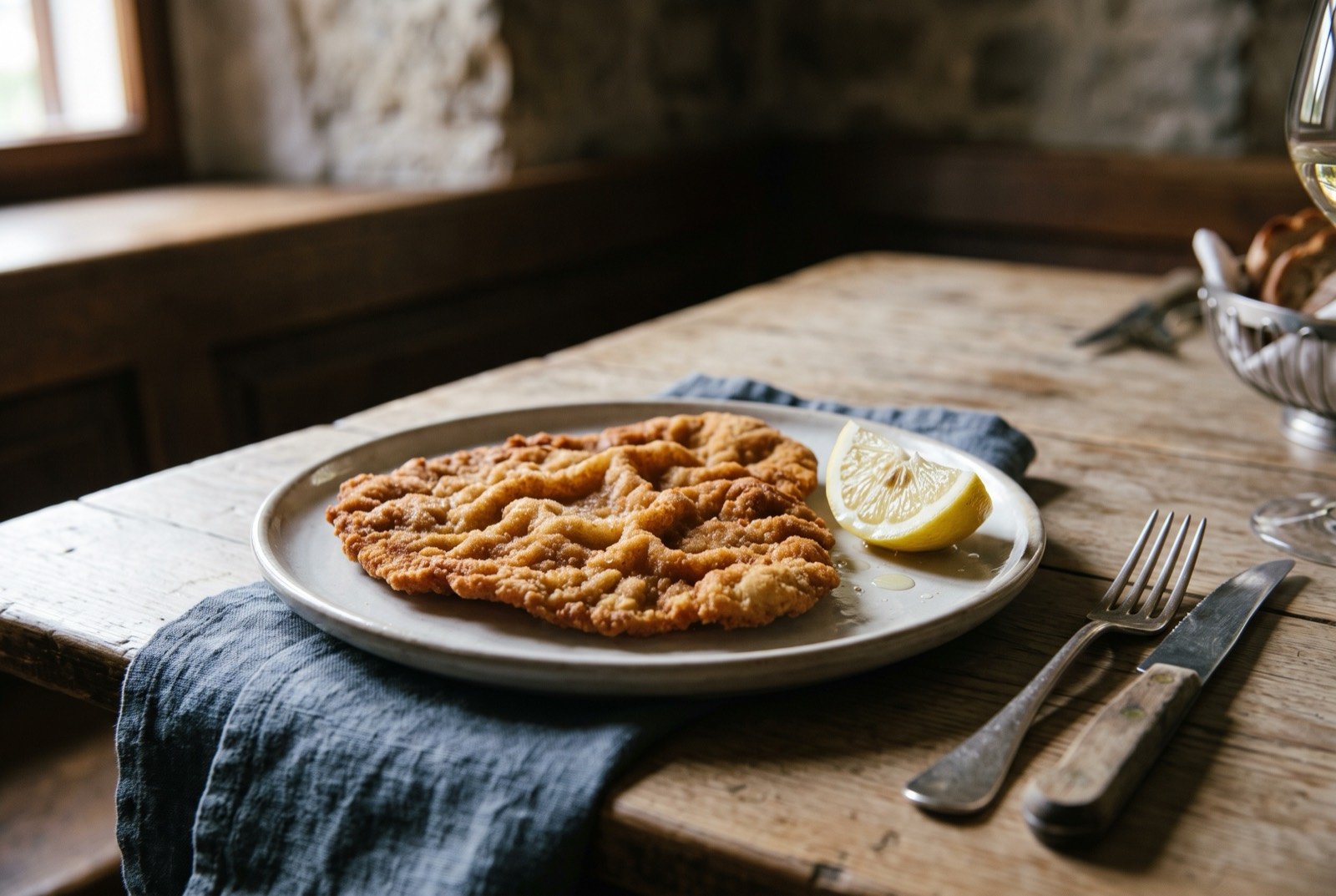
Illustration
- Time
- 30 minutes
- Researched
- Researched from 86 sources in the brief
Vienna. The name first appears in print in 1831; the frying-in-fat, breaded cooking method is attested in Austria as early as 1719, evidence it is genuinely native rather than an import from Milan. See the History above for why the Radetzky legend does not survive checking.
As tradition built it
Serves 4. About 30 minutes.
Ingredients
- 4 veal escalopes, from the leg (Kalbsnuss), beaten thin
- a light dusting flour, for dusting
- 2 to 3 eggs, beaten with a little water
- enough to coat fine dried breadcrumbs (Semmelbrösel)
- a generous depth, enough to shallow fry Butterschmalz, for shallow frying
- 4, to serve lemon wedges, to serve
- to taste salt
Method
- Beat the veal thin between sheets of film, then salt lightly.
- Dust each escalope in flour, shaking off the excess.
- Pass through the beaten egg, then lay gently in the breadcrumbs, pressing on loosely rather than firmly, so the coating stays a separate layer rather than bonding tight to the meat.
- Heat a generous depth of Butterschmalz in a wide pan to 170 to 175°C. The schnitzel should essentially float, not merely fry in a thin film.
- Lay the schnitzel in and immediately swirl the pan in a circular motion, continuously basting hot fat over the top surface, rather than flipping with tongs. Fry around 2 to 3 minutes a side, until deep gold and visibly blistered away from the meat.
- Lift out, drain briefly on paper, and serve at once with a lemon wedge. Never stack schnitzel on top of each other, the trapped steam will soften the crust.
What a modern chef changes
Precision-controlled frying and a deliberate steam trigger, both direct extensions of what soufflieren is already doing
Rung 1
Method
- Weigh and mist a measured amount of water onto the crumbed surface, roughly a fine spray rather than a soak, immediately before frying, rather than relying on incidental moisture from the egg wash alone. This gives a more even and reliable steam-lift across the whole surface than the traditional method's variable moisture, producing a more consistently blistered crust schnitzel to schnitzel.
- Hold the fat at a probe-verified 172°C throughout, not by eye. The traditional method already knows the right range; a thermometer removes the single biggest source of a soggy or too-dark crust in a home kitchen, where a domestic hob's heat is far less stable than a professional Viennese kitchen's controlled burner.
- Rest the fried schnitzel briefly on a wire rack, never on paper towel or a stacked plate, for the one to two minutes before serving. A rack lets residual steam escape downward rather than trapping it against the crust from below, protecting the soufflé structure the whole method exists to create.