Central Europe · Volume 17, The Herring Fleet and the Sausage Stand
Rollmops
Reported Berlin origin, now a pan-German coastal tradition
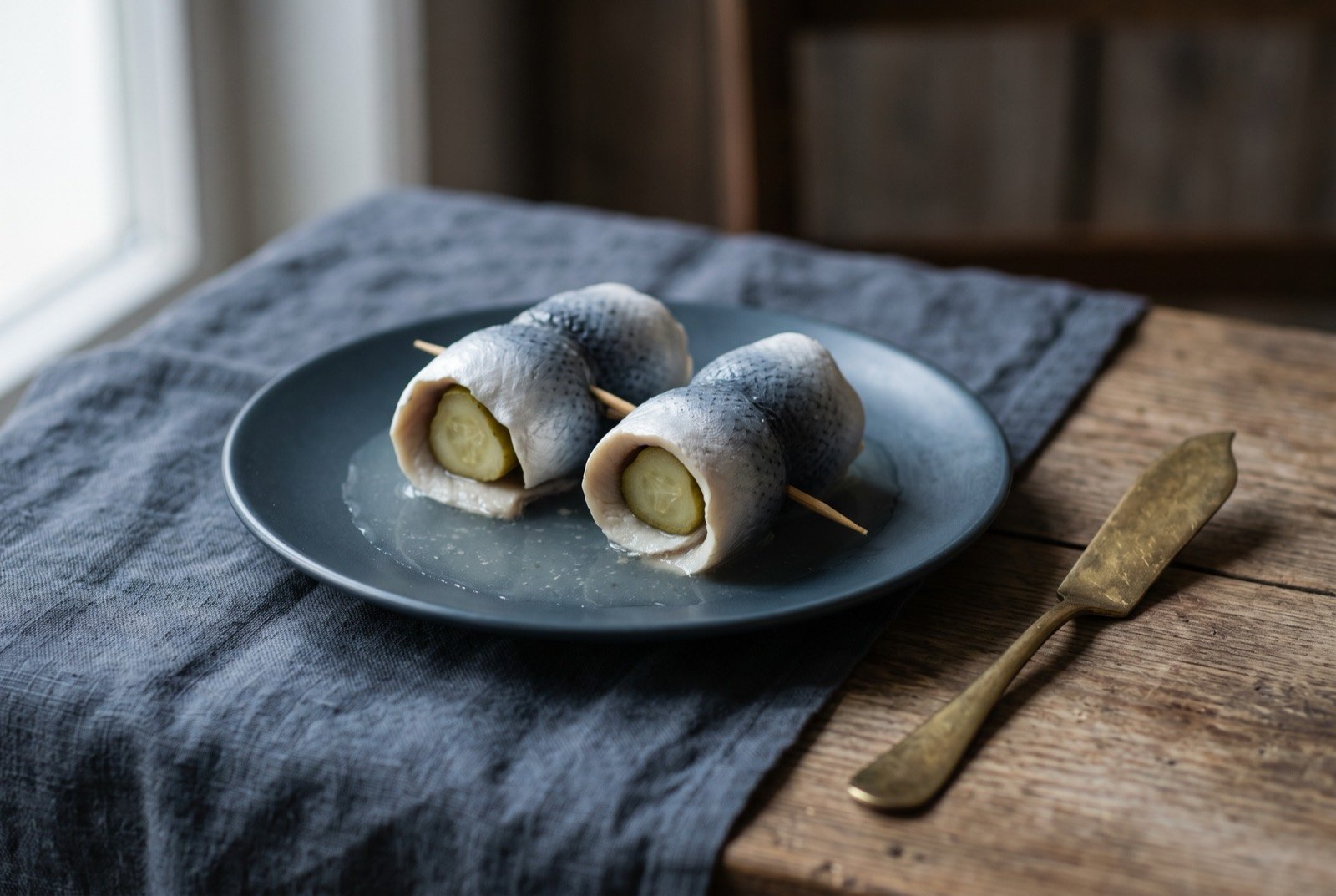
An illustration of the dish, not a photograph of it cooked.
- Time
- 30 minutes
- Reviewed
- Not yet reviewed from inside the tradition
- Cooked
- Not yet cooked and reported
Widely reported, though not rigorously sourced beyond retail and lexicon references, as a Berlin invention from the first half of the 19th century, the Biedermeier era, and not originally a Hanseatic port dish at all; its name is said to come from a visual resemblance to the pug dog breed. This chapter presents Rollmops the way it actually lives on this coast today: a pan-German, coastal herring product that belongs to the whole region rather than to any one port, adopted so completely into Hamburg and Kiel's own herring culture that a British reader would be forgiven for assuming it began there.
As tradition built it
Makes 12. About 30 minutes to prepare, then at least 35 days curing.
Ingredients
- 12 herring, filleted into paired fillets joined at the back
- 7% acetic acid, 14% salt vinegar-salt brine (see the ferment bench)
- 12 pickled cucumber, to fill each fillet
- a few, optional onion or a juniper berry, sometimes added to the filling
- 1 small wooden skewer, to fix each roll
Method
- Fillet the herring into paired fillets joined at the back, and cure raw in the vinegar-salt brine, roughly 7 percent acetic acid and 14 percent salt, for at least 35 days (see the ferment bench for the full brine).
- Fill each fillet with a piece of pickled cucumber, sometimes with onion or a juniper berry added.
- Roll each fillet by hand around the filling and fix with a small wooden skewer.
What a modern chef changes
A horseradish quenelle in place of the pickle, on dehydrated rye crispbread
Method
- The cure itself is not shortened; 35 days of proper brining is what dissolves the small bones and there is no honest shortcut to that chemistry.
- The pickled cucumber core is replaced with a quenelle of horseradish-spiked crème fraîche, piped in cold immediately before serving rather than cured inside the fish, giving a cooler, sharper contrast against the vinegar than a pickle alone provides.
- The rolled herring is served on a small disc of rye crispbread, dehydrated in-house from a thin rye dough at 60°C for four hours until properly brittle, rather than plain bread, and finished with a scattering of dill oil and micro herbs.
- The wooden skewer stays; there is no reason to lose the one piece of traditional presentation that already works perfectly.