The Nordics and the Baltic · Volume 24, The Swedish Crown, the Gulf of Bothnia and the Reindeer North
Gravad Lax
Sweden, and Finland's own graavilohi alongside it
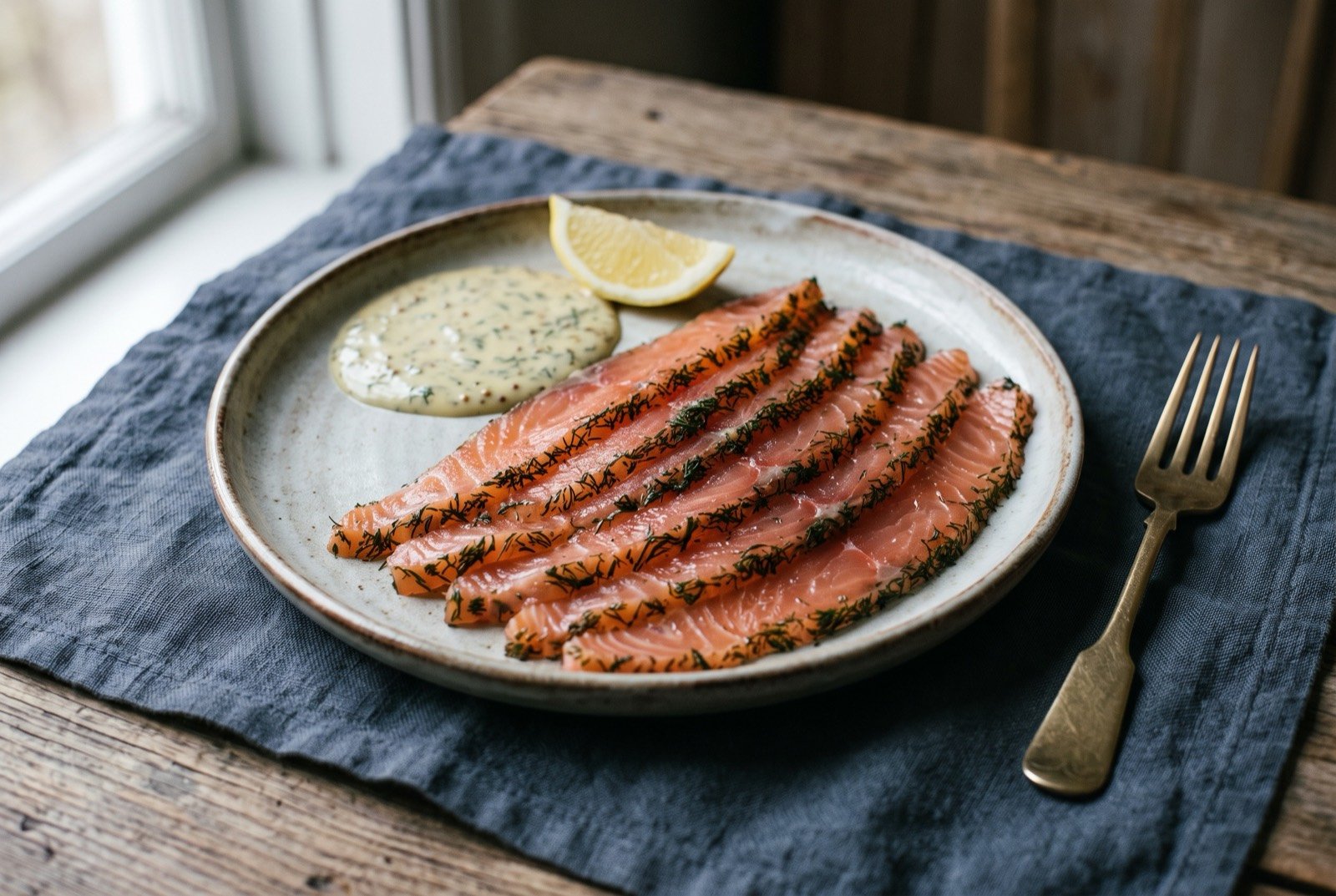
An illustration of the dish, not a photograph of it cooked.
- Time
- 72 hours
- Researched
- 13 sources cited
- Reviewed
- Not yet reviewed from inside the tradition
- Cooked
- Not yet cooked and reported
Both countries tell a similar medieval legend, fishermen preserving salmon by burying it in beach sand just above the tideline, fermenting lightly under its own weight. Whichever country's version is older cannot be settled from what this chapter's research found; what can be said is that the earliest actual written recipe for this style of cure appears in 1914, in Norwegian cook Henriette Schønberg's Stor Kokebok, a genuinely unexpected detail for a dish now branded Swedish or Finnish rather than Norwegian.
As tradition built it
Serves 6 to 8 as a starter. 48 to 72 hours curing, no cooking.
Ingredients
- 1 kg salmon, a whole side, skin on, pin-boned
- 100 g coarse salt
- 50 g caster sugar
- 2 tbsp crushed white peppercorns
- a large bunch fresh dill, roughly chopped, stalks and all
Method
- Mix the salt, sugar and crushed pepper together.
- Rub the mixture evenly over the flesh side of the salmon.
- Scatter the chopped dill thickly over the cure.
- Wrap tightly in cling film, place in a dish, and weight it down with something flat and heavy (a board and a couple of tins works well).
- Cure in the fridge for 48 to 72 hours, turning the fish and basting it in its own liquid every 12 hours.
- Scrape off the cure and dill, pat dry, and slice thinly on an angle, away from the skin.
- Serve with hovmästarsås (a mustard, sugar, vinegar and dill sauce) and rye bread.
What a modern chef changes
The cure's own chemistry controlled with real precision, rather than left to a domestic fridge's temperature swing.
Rung 5, applied by analogy
Method
- Vacuum-seal the cured fish rather than simply weighting it under cling film, so the cure penetrates evenly across the whole fillet rather than more heavily where the weight presses hardest, a real, checkable improvement over the traditional method rather than a gadget for its own sake.
- Hold the cure at a genuinely consistent fridge temperature, around 2 to 4°C, and check it daily rather than to a fixed 72-hour rule, since fillet thickness varies enough between fish that a rigid schedule under- or over-cures as often as it succeeds.
- Finish with a light crust of toasted, crushed juniper alongside the traditional dill, a genuinely Nordic aromatic this chapter's arsenal names repeatedly, rather than reaching for a non-regional pepper blend.