The Nordics and the Baltic · Volume 24, The Swedish Crown, the Gulf of Bothnia and the Reindeer North
Karjalanpiirakka with Munavoi
Karelia, carried across all of Finland by 420,000 displaced people after 1944
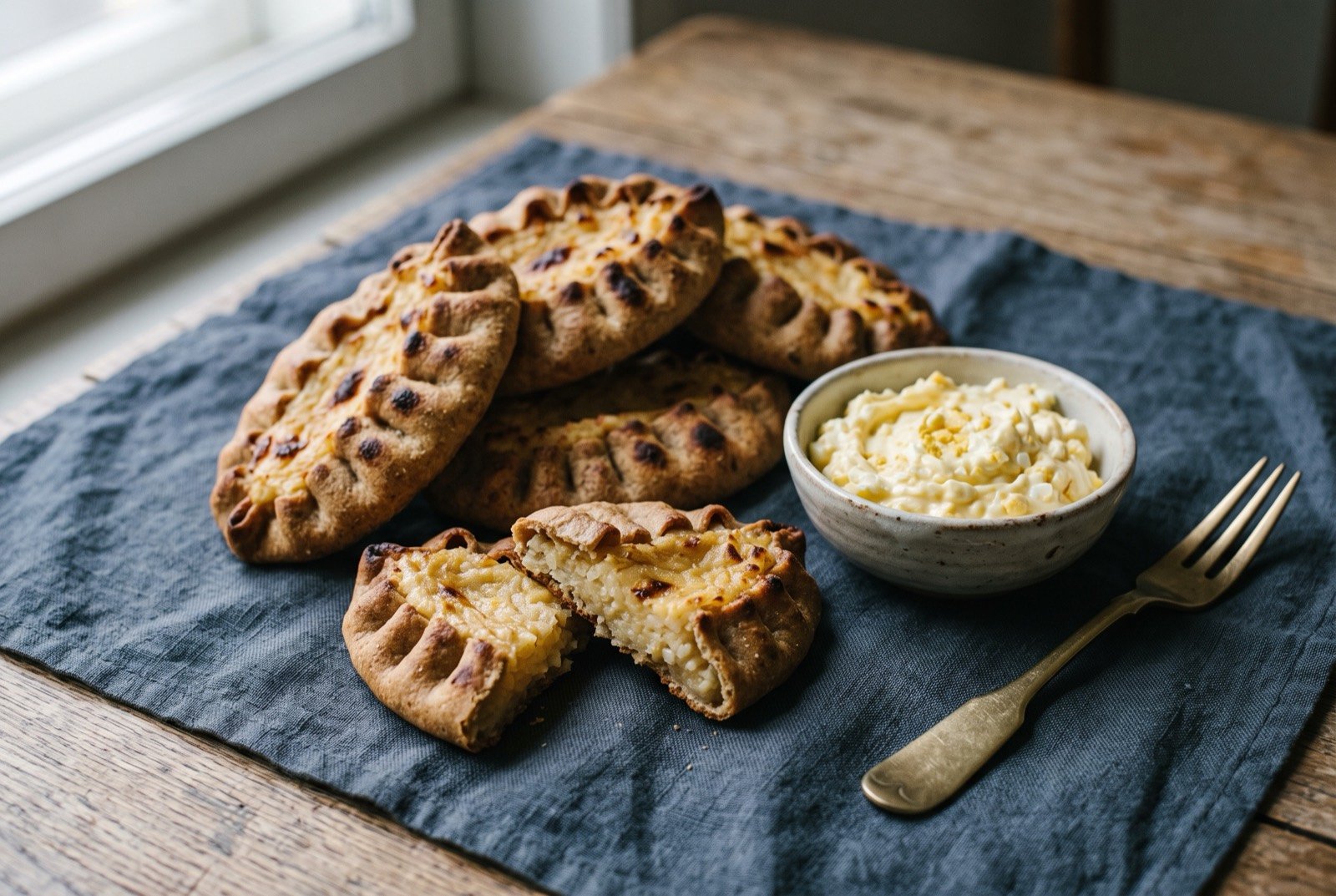
An illustration of the dish, not a photograph of it cooked.
- Time
- 1 hour 30
- Researched
- 13 sources cited
- Reviewed
- Not yet reviewed from inside the tradition
- Cooked
- Not yet cooked and reported
First documented in 1686, the dish's original fillings were barley and talkkuna (a toasted ground grain mix), not rice; rice porridge became standard only later, though barley and potato fillings persist regionally. Protected under the EU's Traditional Speciality Guaranteed scheme since 2003, which fixes the crust at more than half rye flour by law.
As tradition built it
Makes about 16. About 1.5 hours.
Ingredients
For the filling
- 8 dl (800 ml) water
- 2 dl (200 ml) short-grain rice
- 2 dl (200 ml) double cream
- to taste salt
- 1 egg, once the porridge has cooled
For the crust
- 300 g rye flour
- 100 g plain flour
- a pinch a pinch of salt
- about 200 ml water
For the munavoi
- 7 eggs, hard-boiled
- 150 g soft butter
- 1/4 tsp salt
Method
- For the filling, bring the water to the boil and stir in the rice, cooking gently until the water is absorbed.
- Add the cream, and simmer on low heat, stirring occasionally, about 40 minutes, until thick.
- Season with salt, cool completely, then stir through the egg. Make roughly 30% more filling than seems needed, since a too-thin filling is the most common failure.
- For the crust, combine the flours and salt, then work in the water to a firm dough. Rest 15 minutes.
- Roll thin, about 0.5 cm, and cut into ovals roughly 12 cm long.
- Spoon filling along the centre of each oval, and crimp the edges by hand, folding them inward in the traditional pleated pattern.
- Bake at 250 to 300°C for 15 to 20 minutes, until the crust is spotted brown and crisp at the edges.
- Brush generously with melted butter while still hot.
- For the munavoi, boil the eggs for 7 minutes, cool, peel, and mash with a fork. Mix in the soft butter and salt.
- Serve the pastries warm, topped generously with munavoi.
What a modern chef changes
The porridge given the precise, even heat this chapter's own ladder asks for, and the munavoi given real technique.
Rung 5, applied by analogy
Method
- Cook the rice porridge in a water bath rather than directly over a burner, at a steady, low simmer, for perfectly even starch gelatinisation with no risk of catching or scorching on the base of the pan over the long cook.
- Brown a portion of the butter for the munavoi before mixing it through, for a nuttier, more complex finish against the egg's richness, rather than using it plain.
- Crimp by hand, properly, rather than pressing the edges with a fork: the traditional pleated crimp is not decoration, it is what actually seals the thin dough against the wetter filling inside it.