Europe · Volume 24
Sweden, Finland & Sápmi
The Swedish Crown, the Gulf of Bothnia and the Reindeer North
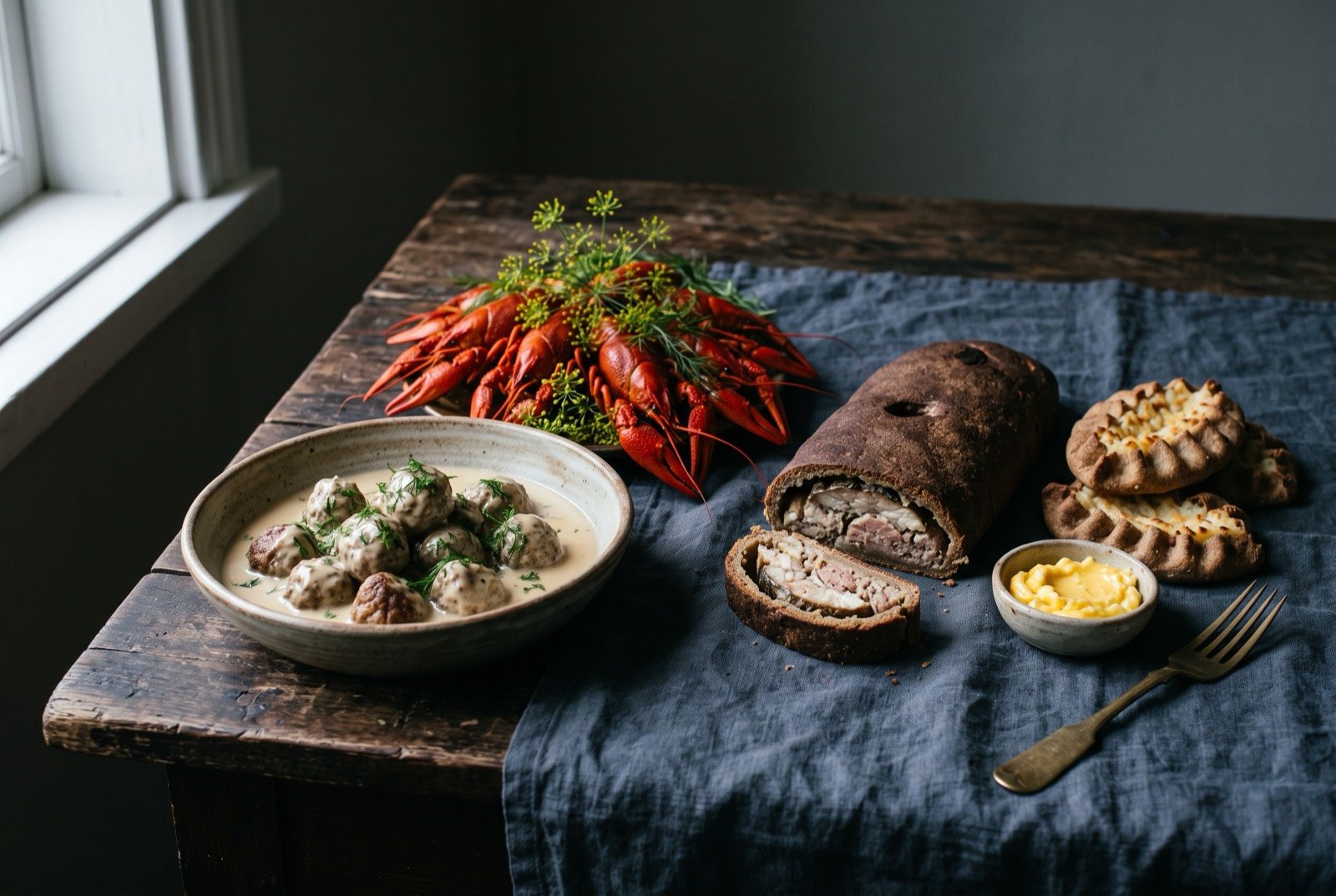
Sweden and Finland share a food logic that is not about a shared border: for six hundred years there was none, Finland the eastern half of the Swedish realm, then a Russian Grand Duchy for a century. Layered across the north of both is Sápmi, the reindeer-herding world of the Sámi people, treated as its own subject rather than a regional variant of either. Every dish as tradition built it, then what a modern chef would change.
Sources and review · What this chapter does not assert · How we research · Spotted something wrong?
A Sense of Place
Sweden: a long, thin country arguing with a long, dark winter
Sweden runs from the beech woods of Skåne, indistinguishable in feel from Danish farmland, to reindeer pasture above the Arctic Circle, and its food logic changes as sharply as its latitude. In the south and centre, butter and cream carry the fat, potato and rye the starch, and the thickener, where there is one, is a warmed cream-and-egg liaison rather than a built roux, the same husmanskost (home cooking) logic whether the dish is a Skåne eel supper or a Stockholm meatball. Dill is the dominant fresh aromatic, used with a restraint and precision that reads almost as a house style in itself. Further north, in Norrland, the whole grammar shifts toward preservation as the organising discipline rather than a seasonal flourish: salting, smoking, drying and fermenting against nine months of cold, reindeer as the defining protein once Sápmi's herding country is reached, and, on the Bothnian coast, a now largely vanished seal-hunting economy that supplied meat, fur and a household oil in the years before easy refrigeration. Gotland, an island trading hub since the Viking age, carries one genuine oddity, saffron, reaching the island through medieval trade centuries before it was common on the mainland.
Finland: a grain frontier, a lake district, and a border that moved
Finland's own internal map runs west to east as much as north to south. The west and south are Finland's rye belt, the country choosing rye bread as its national food in a 2017 public vote, a serious claim for a country that also eats a great deal of it. The lake district of Savo and central Finland runs on freshwater fish, above all muikku (vendace), whose roe is locally called Savonian caviar. The archipelago and Turku coast run on Baltic herring, salakka, salted, smoked and charred as three distinct named preparations rather than one generic "pickled fish" category. Karelia, in the east, is genuinely its own food world again, sitting, in the Karelian League's own description, at the meeting point of two cultures and two religions, Orthodox Karelian and Lutheran Finnish, its preservation logic built on drying, fermenting and salting rather than the smoking and freezing more typical elsewhere in Finland. Karelia's food culture is also, unusually for this atlas, a story about a border that moved within living memory: after Finland's 1944 withdrawal from East Karelia, roughly 420,000 displaced Karelians resettled across the rest of the country, carrying their own dishes with them, which is the specific, documented mechanism by which a once-regional pastry, karjalanpiirakka, became Finland's national one. A further, easily missed layer sits on the west coast: Finland's Swedish-speaking minority in Ostrobothnia (Pohjanmaa), whose own festive table, sallatti, leipäjuusto, ryynimakkara sausage, is a genuinely distinct strand rather than simply "Finnish food in Swedish."
Sápmi: a reindeer calendar across four countries, not a region inside any one of them
Sápmi runs as a narrow arc from the Røros and Idre districts of Norway and Sweden to the eastern tip of Russia's Kola Peninsula, crossing Norway, Sweden, Finland and Russia without regard for any of their borders. Roughly 100,000 Sámi people live across the whole area, about 10,000 of them inside Finland's own narrower official Sámi Homeland, the municipalities of Enontekiö, Inari and Utsjoki, plus part of Sodankylä. What organises Sámi food is not simply "reindeer" as a protein but a whole seasonal structure built around the herd: the siida, a flexible, kinship-based group of households herding together, moves reindeer through spring calving, summer coastal and island grazing, late-summer milking (a genuine, once-regular practice that largely ended after the Second World War), autumn rutting-ground movement, and winter pine-forest pasture, a cycle distinct in kind from the separately organised paliskunta cooperative system that developed among Finnish settler herders further south. Nothing eaten in Sápmi's traditional kitchen, meat, blood, marrow, milk, sits outside that calendar. This atlas treats Sápmi's food, honestly, as one culinary world running across four states, exactly the discipline it already applies to Aboriginal Australian and Māori food elsewhere.
The structural logic, at a glance
| Sweden | Finland | Sápmi | |
|---|---|---|---|
| Fat | Butter, cream | Butter, pork fat | Reindeer fat and suet |
| Starch | Potato, rye | Rye, barley, potato | Little; potato only where traded in |
| Thickener | Cream-and-egg liaison | Rice porridge, rye dough | Broth reduction, no built thickener |
| Aromatic | Dill, allspice | Dill, marjoram | Dried marjoram, birch |
| The sea and lake's contribution | Baltic herring, crayfish, salmon | Baltic herring, vendace, salmon | Little; a coastal Sámi minority fishes |
| The organising discipline | Preservation against winter | Preservation, plus a moved border | The herding calendar itself |
The History in Layers
Six centuries under one crown, then a century under another
Sweden ruled Finland from the twelfth century in earnest until 1809, when defeat in the Finnish War handed Finland to Russia as an autonomous Grand Duchy, a status it held until independence on 6 December 1917. This double inheritance is the single most important fact in this volume's history section, because it is what actually separates Finnish food from Swedish rather than an ethnic or ecological line: six hundred years of Swedish administration left Finland's own coastal and southern Swedish-speaking minority, its legal and educational institutions, and a great deal of shared vocabulary and technique, while the following century under Russia is visible in Finnish cooking specifically through Karelia, not through any direct St Petersburg court influence. Quark, thick soured cream and a whole family of filled pastries reached western Finland by this route, carried by Karelians rather than imported wholesale from Russian high cuisine, and a small but real translation trap sits inside this history: the Finnish "blini" is a thick disc closer to an American pancake than to the thin Russian blin, which Russians themselves would call oladyi. Vyborg's own sweet pretzel, viipurinrinkeli, actually predates this Russian century by five hundred years, tracing to fourteenth-century monastic and Hanseatic trade rather than nineteenth-century Russian rule, worth being precise about so the two different "Russian-ness" claims this region invites are not collapsed into one.
A border that moved within living memory
Karelia's food history is genuinely different in kind from most of what this atlas treats as "history," because the displacement that scattered it happened within living memory rather than centuries ago. Finland withdrew from East Karelia after a major Soviet offensive in June 1944, and by September the border had reverted to the line fixed in March 1940. Roughly 420,000 Karelian residents became permanently displaced inside a shrunken Finland, resettled by region, Isthmus evacuees mainly to Uusimaa, Kymi, Häme and Turku-Pori, Ladoga and Border Karelia evacuees to Central Finland, North Savo and North Karelia. The Karelian League's own account states plainly that evacuees "brought a piece of Karelia to their new living environments: their food culture, dialect, and other customs," and it is this mechanism, not gradual national adoption, that turned a food once specific to Ladoga Karelia and North Karelia, karjalanpiirakka, into what is now named, without much argument, Finland's best-known regional export. The dish's own name likely descends from the Russian "pirog," itself part of a filled-bread tradition running from Russia across to China, a genuine transmission story rather than folk etymology.
A national institution states a food myth as fact, and gets corrected
In 2018 the official Sweden account, @sweden, run by the Swedish Institute, tweeted that fried meatballs were "actually based on a recipe King Charles XII brought home from Turkey" during his 1709 to 1714 exile in Ottoman territory, adding, with unfortunate confidence, "now we're sticking to facts." The claim produced a real backlash, including strong Turkish social media reaction, and does not survive checking. Food historian Richard Tellström states plainly that "there is no historical evidence supporting the claim," and argues the köttbulle instead descends from frikadeller, present in Sweden from the mid-1600s, predating Charles XII's exile entirely, with a name that points toward France rather than Turkey. Historian Dick Harrison is similarly sceptical, though neither historian claims to have definitively disproved a royal import, only that no evidence supports one. What is actually documented: the word "köttbulle" first appears in print in 1755, in Hjelpreda i hushållningen för unga fruentimber, the foundational Swedish cookbook, in a recipe using veal, grated bread and egg, seasoned with pepper, salt and nutmeg, and containing no onion and no allspice at all. This is worth telling in full, an official state institution asserting an unverified and probably false national origin story as settled fact, because it is exactly the kind of tidy myth this atlas exists to check rather than repeat, the same discipline this volume's sibling chapters have already applied to Belgian witloof and Dutch stamppot.
Empire's other ledger: assimilation, named plainly
Sweden and Finland's own colonial record does not run through a distant tropical possession, as it does for the Netherlands or Portugal elsewhere in this atlas; it runs through Sápmi, inside their own borders. Norway pursued an explicit assimilation policy, fornorskning (Norwegianisation), from 1851, intensifying from the 1870s as official minority policy and continuing in various forms until the 1980s, its stated rationale that Sámi people would best be helped by giving up their own language, religion and dress, a paternalism its own modern educational material now names as such. Sweden pursued a parallel, more thinly documented policy, försvenskning, including a separate "nomad school" system for reindeer-herding Sámi children distinct from the ordinary Swedish school system; this chapter states that a separate system existed without asserting further detail its own research could not confirm. Finland's version, pakkosuomalaistaminen (forced Finnicisation), is most concretely documented through the boarding schools to which Skolt Sámi children were sent after Finland lost the Petsamo region, institutions a Finnish public broadcaster investigation describes researchers characterising, in plain language, as colonial in character. Finland's own Sámi Truth and Reconciliation Commission, appointed jointly by the Finnish state, the Sámi Parliament and the Skolt Sámi Siida Council in October 2021, consulted almost 400 Sámi people and commissioned 25 studies before publishing a 700-page final report in December 2025 with 68 proposals, including that Finland adopt ILO Convention 169 on Indigenous and Tribal Peoples; Prime Minister Petteri Orpo has said Finland should offer a formal state apology. This is recent, ongoing and unresolved, not settled history, and a chapter about Sápmi's food that left it out would be telling only the comfortable half of the story.
A plague, a substitute, and an accidental ecological mirror of Britain's own rivers
Sweden's crayfish party predates its most famous modern ingredient crisis by decades: the word "kräftskiva" only enters print in 1931, while the crayfish plague itself, caused by the water mould Aphanomyces astaci, arrived in Sweden in August 1907 via a shipment of live crayfish from Finland, and devastated the native European crayfish population across the following decades. Sweden's parliamentary answer, from the 1960s, was to introduce the North American signal crayfish, believed at the time to be immune. It was not: the newcomer turned out to be a chronic asymptomatic carrier of the same plague, spreading it further rather than replacing a lost stock cleanly, and roughly 98% of Sweden's native crayfish populations are now estimated lost. The genuinely striking part, worth stating plainly rather than treating as coincidence, is that the same species, imported into Britain from the United States in the 1970s for restaurant and farm stocking, is now Britain's own dominant invasive crayfish, driving the same collapse in native white-clawed crayfish here that it caused in Sweden. A British reader eating crayfish at a home-hosted kräftskiva is, in a real sense, eating the very same animal responsible for one of Britain's own live ecological problems, imported by the same restaurant-and-farming logic in both countries.
A manifesto, signed by twelve chefs, two of them from this volume
On 17 November 2004, twelve chefs met at the Nordic Kitchen Symposium in Copenhagen and signed the New Nordic Food Manifesto, drafted principally by restaurateur Claus Meyer. René Redzepi, about to open Noma, was one signatory; less widely told outside Scandinavia is that Sweden's Mathias Dahlgren and Finland's Hans Välimäki were signatories too, meaning both this volume's national kitchens were present at the movement's founding rather than later importers of a Danish idea. The manifesto's ten points are, in outline, a discipline rather than a style: build from what genuinely grows well in Nordic conditions, follow the seasons rather than override them, promote animal welfare and sound production across sea, lake and land, and combine local self-sufficiency with regional sharing of good produce, an argument this atlas would recognise from its own African volumes almost word for word. Two years later Meyer and Redzepi founded the Nordic Food Lab specifically to research the technical "building blocks" behind this discipline, and its most influential single decision, growing koji on barley rather than imported rice because barley is the actual Scandinavian grain, is the direct technical ancestor of the fermentation programme now visible in serious Swedish and Finnish kitchens: not a borrowed Japanese product, but a Japanese method rebuilt from local material, the exact principle this atlas's introduction states about every restaurant technique in a serious cuisine having an indigenous ancestor, applied here to a movement barely twenty years old rather than a centuries-deep one.
The Flavour Arsenal
Rye, the grain both kingdoms actually run on
Rye, not wheat, is the working grain of this whole volume. Finland leads the world in rye bread consumption per capita, ahead of even Poland and Estonia, and chose rye bread as its national food in a 2017 public vote. Two historically distinct forms mattered for different reasons: a round, thick limppu loaf meant to be eaten fresh, and a thin ring loaf, reikäleipä, its central hole made specifically for hanging the bread on a pole to dry for months of storage, a genuinely practical piece of food engineering rather than a decorative shape. A traditional homemade loaf ran to three or four kilograms, thirty centimetres across, baked only a few times a year in bulk and suspended from rafters between bakes. Sweden's own rye tradition runs the same logic into crispbread, knäckebröd, sold today across British supermarkets under the Wasa and Leksands names, a genuine survival of a preservation technology into an everyday snack.
Dill, allspice, marjoram and cardamom
Dill is this volume's dominant fresh aromatic on both sides of the Gulf of Bothnia, used in a crayfish boil's dillkronor (dill crowns, the flowering heads rather than the leaf), in gravlax's cure, in a lohikeitto salmon soup's finish. Allspice is the quiet, near-automatic seasoning of a Swedish meatball or a pickled cucumber, the kind of spice used so habitually it barely registers as a spice at all. Dried marjoram is named specifically as the characteristic seasoning of Sámi and Finnish blood dishes, blood sausage and blood pancake alike. Cardamom is Sweden's own baking signature, its fetisdagsbulle and its everyday fika buns both built on it, and it rewards exactly the discipline this atlas keeps returning to elsewhere: whole pods, cracked and ground fresh, since ground cardamom loses its volatile oil within weeks in a way whole pods simply do not.
Reindeer, and what "nothing wasted" actually names
Reindeer is Sápmi's defining protein and, further south, Lapland's borrowed one: poronkäristys, the thin-sliced fried reindeer dish most visitors to Finland actually eat, is a twentieth-century Finnish restaurant and home-kitchen dish built from Sámi-herded raw material, not a documented traditional Sámi preparation itself, a distinction this atlas's own sourcing states plainly and this chapter repeats rather than blurs. What is properly Sámi is the whole-animal discipline behind the meat: organs, bone marrow (luikku, rendered from boiled bones), sinews, hooves, tongue and even brain are all named, working parts of the traditional diet, not a folkloric flourish, and reindeer stomach was used as a genuine container for preserving milk. Suovas, cold-smoked salted reindeer, and a real, still largely uncommercialised blood sausage, maelie-goerve, sit alongside this whole-animal logic as its preserved, portable forms.
Baltic herring, sprat, and a name that lies to a British buyer
Baltic herring, strömming in Swedish, silakka in Finnish, is the working fish of both coasts, salted, smoked and, in Finland specifically, also charred as three genuinely distinct named preparations. A related, smaller fish, sprat, sits inside a naming trap worth flagging directly for a British cook: Sweden's tinned "ansjovis," the essential ingredient of Jansson's frestelse, is not anchovy at all but cured, spiced sprat, sold under a name that has nothing to do with the Mediterranean fish a British buyer would otherwise expect. Vendace, muikku, Savo's own small lake fish and the base of kalakukko, has no UK equivalent whatsoever; its closest British stand-in, sprat or whitebait, changes the dish's character rather than replicating it, and that difference is stated rather than smoothed over in this chapter's recipes.
Lingonberry and cloudberry
Lingonberry is this volume's constant tart counterpoint, cutting the cream and fat of a meatball sauce or a reindeer braise the way a good pickle does elsewhere in this atlas, genuinely closer in acidity to a sharp gooseberry than to a sweetened British cranberry sauce, which is not an honest substitute for it. Cloudberry, hjortron in Swedish, lakka in Finnish, is rarer and more prized again, foraged rather than farmed even inside Scandinavia because cultivation has never proved practical, and effectively unobtainable fresh in Britain at any price, a genuine gap this chapter states plainly rather than inventing a workaround for.
The Technique Ladder
The argument, from inside
Every technique in this chapter answers to the same climate: a winter long and cold enough that keeping food alive through it, by salt, smoke, cold and controlled rot, was never optional. What the New Nordic movement did from 2004 onward was not invent this discipline but formalise it, take techniques that had been kitchen habit for centuries and interrogate them with the same rigour a modern fermentation lab would bring to anything else, which is exactly why this volume's modernist rungs and its oldest traditional techniques so often turn out to be describing the same underlying chemistry from two different centuries.
Rung 1. Seal the crust, and let the food steam inside its own oven
Kalakukko's rye crust is not primarily a container to be eaten, it is a sealed vessel: baked hot first to set the crust, then dropped to a low, steady heat for hours, the crust itself steams and braises the fish and pork sealed inside it, softening even small fish bones over the long cook. This is the same logic, applied at a home-kitchen scale, that a modern sous vide bag applies with a pump rather than a rye dough: seal the protein away from direct heat and let a controlled, moist environment do the cooking.
Rung 2. Cold-smoke, and accept what the cold actually buys you
Suovas, cold-smoked salted reindeer, and Niklas Ekstedt's own restaurant practice both work on the same principle: smoke applied at a low enough temperature that the meat is flavoured and preserved without ever actually cooking through, a genuinely different result from hot-smoking, darker, saltier, more concentrated, and considerably slower to produce. Ekstedt's own published wood pairings, alder for fish, birch for lighter meats, oak for a stronger flavour against beef, are a directly transferable piece of technique for a British cook working a Big Green Egg, with the honest caveat that birch and juniper wood chunks specifically are not, at the time of writing, stocked by the mainstream UK barbecue trade, and alder, already sold for salmon, is the closest readily available substitute in character.
Rung 3. Build your own koji, rather than reach for an imported one
The Nordic Food Lab's founding decision, to grow koji on barley rather than rice because barley is the region's own grain, is the single most transferable modernist technique in this chapter: a home cook with a dehydrator and patience can inoculate cooked pearl barley with koji spores, hold it at a controlled warm temperature for roughly two days until it is fragrant and sweetly funky, and use the result as the base for a genuinely Nordic garum or a koji-cured protein, exactly the same fermentation chemistry a Japanese kitchen would recognise, built from a completely different grain. This is not decoration; it is the actual mechanism behind the umami depth in a serious modern Swedish or Finnish kitchen's food, and it is buildable at home.
Rung 4. Give it seconds of fire, not minutes
Ekstedt's restaurant runs on no gas or electricity at all, and its most transferable single lesson is restraint: a hot, direct flame applied for seconds rather than minutes lays down a Maillard crust on a nearly finished piece of food without cooking its interior any further, whether that food is an oyster, a piece of reindeer, or, applied here by analogy to a dish Ekstedt has never himself cooked, a batch of just-boiled crayfish given a final char before serving.
Rung 5. Hold the enzyme, not the clock
Mämmi's whole method depends on one precise piece of biochemistry: the malted rye mixture must reach and hold at least 60°C for its diastatic enzymes to convert starch to sugar properly, but must never boil, since boiling kills the very enzymes doing the work. A stovetop or domestic oven manages this only approximately; a sous vide bath, held exactly at 60 to 65°C, manages it with a precision the dish has always actually asked for, whether or not anyone making it traditionally had the equipment to give it that precision before now.
The Ferment and Preserve Bench
1. Suovas, Cold-Smoking Reindeer
Sámi cold-smoking, done in traditional smokehouses, at a low enough temperature that the meat is flavoured and preserved rather than cooked, using cuts including roast, shoulder, tenderloin and rib. No exact time or temperature specific to suovas itself could be verified in this chapter's research, only general reindeer cold-smoking parameters, salting below 10°C, then an extended low-temperature smoke, so a home version should be built from those general parameters, on a Big Green Egg with alder as the closest readily available UK substitute for birch, rather than from an invented precise figure.
2. Taikinanjuuri, Rye Sourdough Starter
The traditional leaven behind both ruisleipä and kalakukko's crust, before commercial baker's yeast became standard from the 1930s onward: flour mixed with warm water into a loose starter, fermented overnight, then built into the full dough the following day. A genuinely useful home technique, and the reason a serious rye loaf from this volume should never be made with commercial yeast alone if a proper sour, dense crumb is the goal.
3. Koji on Barley, the Nordic Food Lab's Own Innovation
Covered in full in the Technique Ladder above. Worth restating here as a genuine preserve-bench technique in its own right, not merely a modernist flourish: a home cook with a dehydrator can inoculate cooked pearl barley with koji spores and hold it warm for around two days to build a real, reusable fermentation base, the single most transferable piece of technique this whole modern movement has produced.
4. Surströmming, Buy It, Do Not Attempt It At Home
Not a home technique, and this chapter does not pretend otherwise: the fish ferments for months under specific, controlled brine conditions this chapter's own research could not fully pin down even from Swedish specialist sources, and the finished tin remains under real pressure, a genuine handling risk if mishandled. The same discipline this atlas applies to lambic beer in the Low Countries applies here: buy it from a specialist who has done this properly, rather than improvising a version that could be actively unsafe.
Sourcing in Britain
Verified August 2026. Where a supplier could not be fully confirmed, that is said rather than smoothed over.
The genuine gaps, stated plainly first. No confirmed UK stockist sells authentic Finnish leipäjuusto; no legal UK commercial supply of vendace (muikku) exists, since Britain's own tiny native population is a protected species found only in Derwentwater; fresh cloudberries are not commercially available in Britain in any meaningful sense; and birch or juniper smoking wood chunks specifically are not stocked by the mainstream UK barbecue trade.
The ranked list: what decides great from grim
- Reindeer, genuinely obtainable but thin and intermittent. Kezie Foods sells Finnish-sourced reindeer fillet steaks, though frequently out of stock; Swedish Wild ships reindeer and cured suovas-style reindeer into the UK. Where unavailable, venison is the honest substitute, reasoned in full in this chapter's Flavour Arsenal.
- Frozen lingonberries, not sweetened cranberry sauce. ScandiKitchen stocks genuine wild-harvested Nordic lingonberries; IKEA UK sells a jarred spread. Cranberry sauce is markedly sweeter and lacks the tart, resinous note this cuisine actually needs.
- Real Swedish tinned ansjovis, correctly understood as sprat. ScandiKitchen's Abba Grebbestad Ansjovis is the genuine article for Jansson's frestelse, cured sprat, not the Mediterranean anchovy the name suggests to a British buyer.
- Whole green cardamom pods, ground fresh. Steenbergs and Bakery Bits both stock proper whole pods; a dedicated spice grinder handles the rest.
- UK signal crayfish, the honest and genuinely appropriate choice. Simply Crayfish supplies wild-caught British signal crayfish, the same species, by real ecological accident, that Sweden itself now largely eats. Trapping your own requires an Environment Agency licence.
- Genuine dark rye flour, milled in Britain. Bacheldre Mill and Shipton Mill both mill proper stoneground wholegrain rye suited to a real ruisleipä or kalakukko crust.
- Surströmming, if you want the real thing. ScandiKitchen sells and couriers it within the UK. The only confirmed restriction is an airline transport ban; no UK postal ban specific to the product was found.
- Aquavit, well stocked in Britain. Master of Malt carries a genuinely good range, including Swedish Skåne Akvavit and Norwegian Linie.
- Finnish and Swedish crispbread, already on the supermarket shelf. Finn Crisp is stocked at Sainsbury's; Leksands and Wasa are both available via Ocado and specialist Nordic importers.
- Leipäjuusto's honest substitute. Yorkshire Dama Cheese, a British-made squeaky cheese with a genuinely comparable grilling texture, though a saltier, brinier flavour than the real thing.
Kit notes for this volume
A crayfish boiling pot, large enough for a proper kräftskiva batch, is the one piece of kit worth buying specifically for this chapter; Wildfoodie sells a Swedish-style pot alongside its crayfish traps. A Big Green Egg, run for a long, low cold-smoke with alder in place of unavailable birch, is the honest route to a home suovas. Sous vide earns its place both for the mämmi malting stage and for controlling gravlax's cure evenly. A dehydrator is the right tool for building a home batch of barley koji. Proper rye bread tins, sold in pairs by Rackmaster, suit both ruisleipä and a home-built kalakukko crust.
Voices and Sources
From inside the tradition
- Cajsa Warg (1703 to 1769), author of Hjelpreda i hushållningen för unga fruentimber (1755), the foundational Swedish cookbook.
- Tore Wretman (1916 to 2003), the central twentieth-century codifier of Swedish husmanskost, author of Svensk husmanskost, inventor of Toast Skagen.
- Richard Tellström, Swedish food historian, the named source correcting the Charles XII meatball myth.
- Magnus Nilsson, chef at the now-closed Fäviken, author of Fäviken and The Nordic Cookbook, whose stated philosophy of documenting technique rather than romanticising it shapes this chapter's own approach to Nordic preservation methods.
- Niklas Ekstedt, Ekstedt, Stockholm, author of Food from the Fire, the named source behind this chapter's open-fire and smoking-wood technique.
- René Redzepi and David Zilber, authors of The Noma Guide to Fermentation, the direct technical source for this chapter's koji-on-barley technique, cited as the shared regional reference point behind Swedish and Finnish practice rather than presented as Swedish or Finnish work itself.
- Anna-Maija Tanttu, Finnish food journalist and cookbook author active since the 1960s, honorary chair of the Finnish Gastronomes.
- Sasu Laukkonen, chef, Helsinki, co-author of Vihreä pöytä, an early and consistent advocate for organic and biodiversity-led Finnish cooking.
- Museovirasto, the Finnish Heritage Agency, and its Elävän perinnön wikiluettelo, the national inventory of intangible cultural heritage, the strongest single institutional source behind this chapter's Finnish material.
- Karjalan Liitto, the Karelian League, an organisation of displaced Karelians and their descendants, the primary in-tradition voice behind this chapter's account of the 1944 evacuation.
- Victoria Harnesk, confirmed Sámi author of Smak på Sápmi / Taste of Sápmi, produced by Slow Food Sápmi, the strongest genuinely Sámi-authored source available for this chapter and the anchor voice for its Sápmi material.
- Slow Food Sápmi, the Sámi food sovereignty organisation behind Smak på Sápmi and the first Indigenous Terra Madre conference, held in Jokkmokk in 2011.
- SámiSoster ry, a Finland-based Sámi welfare and cultural organisation, a genuine in-tradition voice for this chapter's material on Sámi whole-animal use.
Things this chapter has deliberately not asserted
- The Charles XII, Ottoman origin of Swedish meatballs. Asserted as fact by Sweden's own official institutional Twitter account in 2018, but disputed by named food historians and unsupported by any primary source found; this chapter treats it as a national myth worth naming, not a fact worth repeating.
- The exact date of the New Nordic Food Manifesto. One otherwise credible Swedish source gives 2010; the far better corroborated date, including the Nordic Council's own account, is 17 November 2004, used throughout this chapter, with the discrepancy noted rather than silently resolved.
- Surströmming's exact fermentation brine strength and staging. Commonly cited figures (around 12% salt, an initial warm period, several weeks cool) are directionally consistent across sources but not confirmed against a named primary or scientific source.
- The 1944 cookbook attribution for the modern onion-and-paprika köttbulle variant. Sourced only via a secondary citation trail, not independently verified against a primary cookbook.
- Gustav III's personal decree establishing Thursday pea soup. A popular and plausible attribution, but the strongest sources found describe the custom as older and more diffuse than a single royal order.
- Tore Wretman's "becalmed near Skagen" origin story for Toast Skagen. A family and restaurant anecdote, not independently documented, presented here as the traditional telling rather than verified fact.
- Kalakukko's precise first documented year. Sources disagree between 1772 and 1792 for the original district physician's report; this chapter uses 1792 as the more directly sourced figure, but the discrepancy is not resolved.
- Exact traditional quantities for bidos, gáhkku or reindeer blood sausage. No Sámi-authored source giving real quantities for any of these three dishes could be found. Rather than invent figures to fit this chapter's own house rule on real quantities and timings, this chapter names and describes all three fully but declines to give them the quantified "Dishes, Twice" treatment given to the eight Swedish and Finnish dishes above.
- Suovas's exact smoking time and temperature. Only generic reindeer cold-smoking parameters could be verified; suovas-specific figures were not found.
- A characterisation of academic criticism of "New Nordic" cuisine abroad as tweezers, microherbs and abstraction without substance. This rests on secondary aggregation of an academic paper this chapter's research could not access directly; treat the framing as plausible, not as a verified academic finding.
- Surströmming as Western media's favourite stunt or dare food, and stale, pre-ground cardamom as a specific documented failure point in diaspora baking. Both are widely believed and plausible, but no citable serious source making either specific argument could be found.
- A Finland-based, as opposed to Swedish Sápmi, Sámi cookbook author or food writer. None could be found in this chapter's research; its strongest Sámi voice, Victoria Harnesk, writes from Swedish Sápmi.
- The specific detail of Sweden's försvenskning policy toward Sámi children. Only thinly documented in this chapter's research, unlike Norway's fornorskning, which is well evidenced; this chapter states that a separate, discriminatory school system existed without asserting further detail it could not confirm.
- A UK postal or courier ban on surströmming specifically. The only confirmed restriction found is an airline transport ban; a specialist UK retailer currently couriers the product within Britain, which is treated as evidence against a broader ground-delivery ban rather than proof one couldn't exist.
Seal the crust, and let the food steam inside its own oven
Kalakukko's rye crust is not primarily a container to be eaten, it is a sealed vessel: baked hot first to set the crust, then dropped to a low, steady heat for...
Cold-smoke, and accept what the cold actually buys you
Suovas, cold-smoked salted reindeer, and Niklas Ekstedt's own restaurant practice both work on the same principle: smoke applied at a low enough temperature...
Build your own koji, rather than reach for an imported one
The Nordic Food Lab's founding decision, to grow koji on barley rather than rice because barley is the region's own grain, is the single most transferable...
Give it seconds of fire, not minutes
Ekstedt's restaurant runs on no gas or electricity at all, and its most transferable single lesson is restraint: a hot, direct flame applied for seconds rather...
Hold the enzyme, not the clock
Mämmi's whole method depends on one precise piece of biochemistry: the malted rye mixture must reach and hold at least 60°C for its diastatic enzymes to...
The dishes
- Wretman's Köttbullar Sweden
- Gravad Lax Sweden, and Finland's own graavilohi alongside it
- Kräftor i Dill och Öl Sweden
- Surströmmingsklämma Sweden's High Coast
- Kalakukko Savo, Finland
- Karjalanpiirakka with Munavoi Karelia, carried across all of Finland by 420,000 displaced people after 1944
- Poronkäristys Lapland, Finland
- Mämmi Finland
Sources and review
- Researched
- 13 sources cited
- Reviewed
- Not yet reviewed from inside the tradition
- Cooked
- Not yet cooked and reported
Where this volume comes from
3 research briefs on file for this volume, researched to the rules on How we research. Published 28 August 2026. Last changed 8 September 2026.
The brief's own account of its sources
Sweden section. Of roughly 25 to 30 distinct URLs consulted, the mix is a strong core of Swedish institutional and heritage sources, ISOF (the Swedish government's language and folklore authority), Nordiska museet (the national folklife museum), Levande Kulturarv (the official national inventory of intangible cultural heritage), Surströmmingsakademien (a dedicated industry/heritage body), SVT Nyheter and SVT Recept (Swedish public broadcaster), Umeå University's public-facing history feature, and the Gastronomiska Akademin via a news55.