Europe · Volume 25
Estonia, Latvia & Lithuania
Rye, Manor and the Fast Night Table
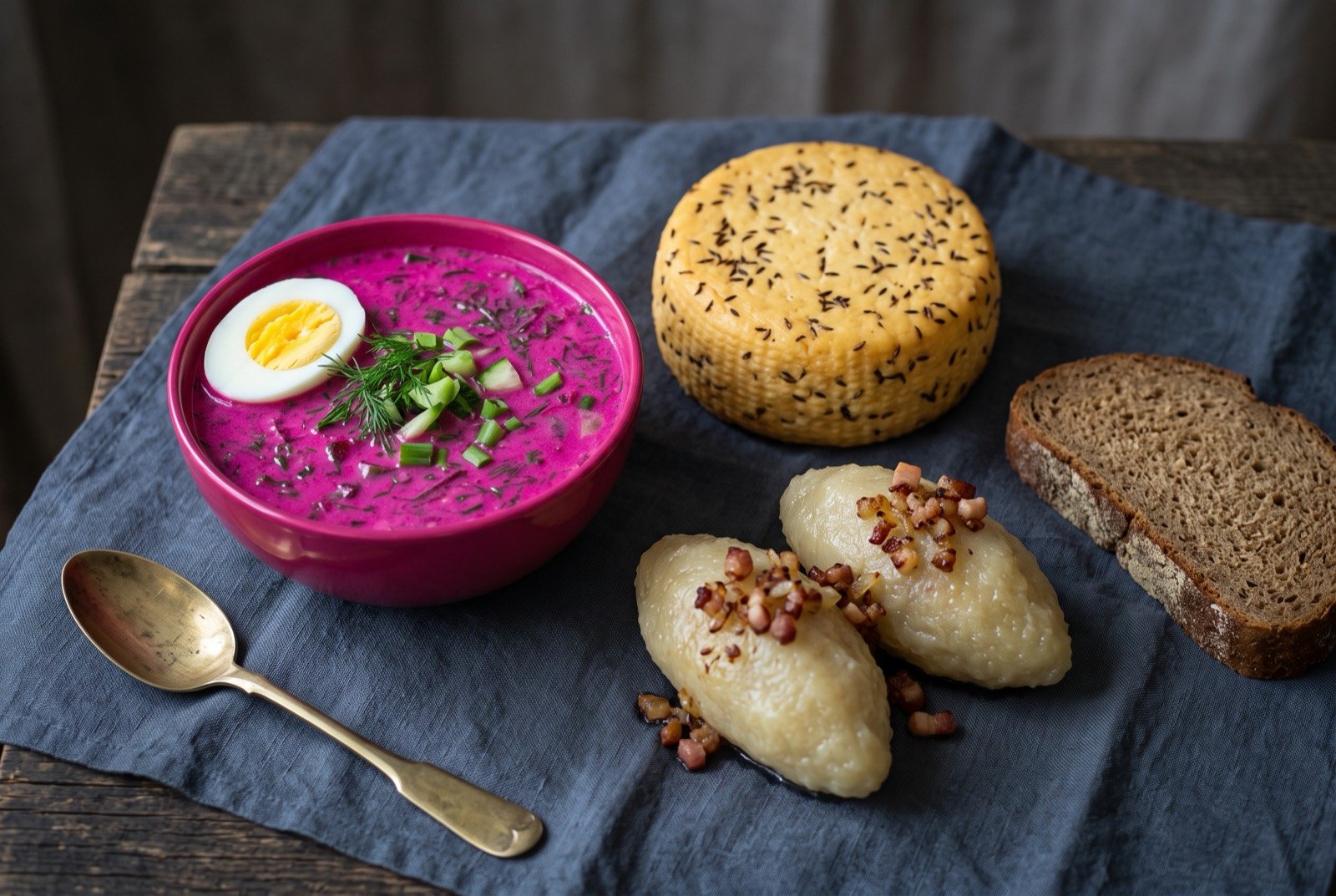
Three small nations pressed for seven centuries between Baltic German manorial estates, the Hanseatic ports of Tallinn and Riga, and fifty years under Soviet rule, sharing one rye-and-dairy table even where their languages, faiths and histories genuinely diverge. Every dish as tradition built it, then what a modern chef would change.
Sources and review · What this chapter does not assert · How we research · Spotted something wrong?
A Sense of Place
Rye and dairy sit underneath everything else on this table, and one plain ecological fact runs beneath the whole chapter: this far north, on the cold, flat, forested rim of the Baltic Sea, wheat has never been a serious option, and rye has been the working bread grain for the better part of a thousand years. In Estonia rye has been part of the diet since roughly the eleventh century and remained the dominant staple grain until the early twentieth. Latvia's own National Encyclopaedia dates rye and barley cultivation to the middle of the first century BCE, with leavened bread only becoming possible once hand mills and bread ovens arrived from the tenth century, and states plainly that butter became so valuable a dairy product across the whole northern European region that it functioned as a unit of tribute, trade and plunder in its own right, soured curd cheese only appearing once Hanseatic traders brought in salt for longer preservation. Both countries' rye bread now carries formal European recognition on different schemes: Eesti rukkileib under a Protected Geographical Indication application specifying a minimum of ninety per cent rye flour, and Latvia's sweetened rupjmaize under Traditional Speciality Guaranteed status since 2014, made in three unyeasted stages, souring, fermenting, baking, historically carried forward in a wooden trough, a "mother," that was never washed between bakes, so the resident lactic bacteria and wild yeast did the work of starting the next loaf themselves.
All three countries sit on the same sea and work the same fish: herring, sprat and salmon, taken by trap and net methods old enough that on islands such as Muhu they are now visibly dying out. Smoking, in cold, hot and an intermediate register, is the shared answer to keeping any of it through a winter with no refrigeration, sprat, herring, eel, cod and salmon all treated this way, and the tradition is at its most intact and most government-documented around the Curonian Lagoon and Curonian Spit in Lithuania, where a fourteenth-century office called the "fishmeister" enforced closed seasons to protect spawning stock, said to be the oldest such rules anywhere in Europe, and where a specific local practice, stintų bumbinimas, ice-fishing for smelt by lowering a board through a hole in the ice and driving fish into nets with wooden mallets, is recognised today as national intangible heritage in its own right.
Forest foraging is where this chapter has to resist a lazy flattening, because the three countries genuinely do not share one relationship to it. In Estonia, mushrooms held comparatively low status in peasant food historically, reflected starkly in how few vernacular Estonian names for individual mushrooms survive, and gathering and eating them was markedly more established in the country's eastern and southeastern reaches, apparently under the influence of Russian and Slavic neighbours across the border, than in the Lutheran mainstream. In Latvia, by direct contrast, mushroom foraging is described as close to a national pastime, passed down through families along with local names, beliefs and recipes. In Lithuania's southern Dzūkija region it is close to a full identity, an unusually extensive named mushroom vocabulary and a whole repertoire of preparation, fermented with sour cream and onion, salted, fried in butter, worked into dumpling filling, sat alongside festive dishes built specifically on mushroom broth. Three neighbouring peoples, the same forest, three genuinely different relationships to what grows in it.
Each country carries its own internal fault line as well, and none of the three is the single undifferentiated national cuisine a first pass might assume. Estonia's southeast holds Setomaa, home to the Orthodox, linguistically distinct Seto people, whose food runs on the Orthodox fasting calendar rather than the Lutheran one around it, meaning meat dishes are, counterintuitively, less common on a Seto table than on a mainstream Estonian one, not more. Latvia's east holds Latgale, historically Catholic rather than Lutheran and more Slavic-facing, bordering Belarus and Russia directly, with its own named dish family, guļbešnīki, krapavnīki, krupņiks, grūslis, that a Latvian culinary heritage body says once varied parish to parish, even homestead to homestead. And Lithuania holds five recognised ethnographic regions of its own: Žemaitija in the west, with its own dialect and its ancient churned dairy spread, kastinys, worked by hand for four to six hours; Aukštaitija in the eastern highlands, pancakes and beer; Dzūkija in the south, potato, buckwheat and the forest; Suvalkija in the southwest, smoked meat and the older name for the country's best-known dish; and Mažoji Lietuva, the Baltic coast around Klaipėda, genuinely the most historically distinct of the five, having spent centuries under German rather than Lithuanian political authority as East Prussia's Memelland.
| Region | Defining logic | Dishes and products that carry it |
|---|---|---|
| Setomaa, southeast Estonia | Orthodox, Finnic-related but distinct, fasting calendar runs the kitchen | Sõir, a fresh curd cheese; pliine, large pancakes; a genuinely lighter meat table than mainstream Estonia |
| Mainland Estonia and the Baltic German manorial belt | Lutheran, rye and dairy staple, manor kitchens as the channel for outside technique | Rukkileib, verivorst, kama, sült, rosolje |
| Latgale, eastern Latvia | Historically Catholic, Slavic-facing, bordering Belarus and Russia | Guļbešnīki, krupņiks, grūslis, murcovka; curd cheese heated in a wood oven rather than a pot |
| Rest of Latvia, the manorial and Hanseatic belt | Lutheran, rye and dairy, manor-kitchen cookbooks the channel for Western technique | Rupjmaize, sklandrausis, Jāņu siers, rasols |
| Žemaitija (Samogitia), west Lithuania | Its own dialect, fish and dairy, popularised cepelinai via German-ruled Lithuania Minor | Kastinys, šiupinys, didžkukuliai / cepelinai |
| Aukštaitija, eastern Lithuania | Highland dairy, brewing | Pancakes, ragaišiai, skryliai |
| Dzūkija, south Lithuania | Forest foraging as near-identity | Grybų rasalas, mushroom-filled dumplings, yeast pastries |
| Mažoji Lietuva and the Curonian coast | Centuries under German political rule, its own fishing law and lagoon economy | Cold-smoked eel, bream and perch; sour groats, borscht |
The History in Layers
An ecology that predates any of the empires that later ruled it
What is genuinely indigenous here is straightforward and worth stating plainly before the layers arrive: rye, barley and later oats as the grain base; cattle and small dairy husbandry giving butter, curd and cultured milk; the Baltic Sea's own herring, sprat and salmon, smoked and salted rather than fresh through most of the year; and, for the Curonian Lagoon specifically, a fishing economy old enough to be dated to the Stone Age by Lithuania's own national park authority. Everything that follows sits on top of this, not instead of it.
The manor kitchens, and what they actually changed
The single most useful correction this research produced is that the Baltic German nobility, who ruled the manorial estates of what are now Estonia and Latvia for the better part of seven centuries, from Hanseatic-era settlement in the thirteenth century through Swedish and Russian imperial rule until the interwar land reforms and the 1939 resettlement to Germany, did not mostly eat a separate cuisine from the peasantry around them. Estonian sources are direct about this: the manors ate broadly the same food, and what genuinely differed was reliable access to better ingredients, plus a channel through which Western European, chiefly French and German, technique and produce reached the wider table over generations. It is through this channel, not a wholly separate imported cuisine, that sült, rosolje, sausages, kringel and gingerbread, dishes every Estonian today would call unambiguously their own, actually arrived.
Latvia's National Encyclopaedia, in an entry signed by the specialist Ieva Pīgozne, gives the sharpest account of the mechanism anywhere in this research: until the mid-nineteenth century, Latvian peasant households were largely self-sufficient, buying only salt from outside, and innovation arrived "slowly and indirectly through the manors, whose kitchens reflected the cultural-historical influences of several European peoples." Farmers only began roasting and baking on proper stoves in the second half of the nineteenth century, and manor-kitchen cooking reached the peasant festive table specifically through published cookbooks and periodical recipes, translated down to peasant means. The documentary trail here is unusually precise for food history this far from a major archive: the first cookbook in the Latvian language, Tā pirmā pavāru grāmata, appeared in 1795 in Rubene, translated from German by a pastor named Christoph Harder; a second, more bluntly titled Latviska pavāru grāmata muižas pavāriem, "Latvian cookbook for manor cooks," followed a year later in Jelgava, addressed directly to the mostly ethnic-Latvian farmers who staffed manor kitchens with limited German. The first cookbook actually written, rather than translated, in Latvian did not appear until 1876, credited simply to "Zāle M., cook to the baron of Vāne." Rasols, a cold meat salad, filled pancakes and debesmanna, a whipped semolina and berry dessert, all trace to this exact channel and are still, in the encyclopaedia's own words, considered indispensable parts of Latvian cuisine today.
Marzipan sits at the edge of this same layer, and this chapter will name the argument honestly rather than pick a side in it. Tallinn's Café Maiasmokk tells a local legend of a Town Hall Pharmacy apprentice inventing marzipan in 1422, sold originally as medicine. The better-documented commercial history is narrower and later: a Swiss confectioner began production on the site in the early nineteenth century, moved to Riga in 1835, and the building passed in 1875 to Georg Stude, who supplied marzipan to the Russian imperial court; the marzipan figure tradition visitors see today was only revived at Maiasmokk in 2007. Lübeck makes an equally old, equally unresolved rival claim of its own, and the wider consensus traces marzipan's actual deep origin further back again, plausibly to Persia around the 1200s, which makes the whole Tallinn-versus-Lübeck argument read more as a town-marketing rivalry than as settled history. No Estonian scholarly or museum source was found directly adjudicating it, and this chapter will not adjudicate it either.
The Hanseatic ports, and what trade actually left behind
Tallinn joined the Hanseatic League around 1285. Trade brought woollen cloth from Flanders and England, craft goods from northern Germany, strong beer and sweet wine, and eastern spices in one direction, salted herring moving the other way; furs, wax, honey, flax, hemp and hide moved west via Tallinn and Tartu out of Novgorod. Salt was reportedly Tallinn's single most lucrative trade good, to the point that a medieval saying is said to have held the city was "built on salt." Riga, Livonia's leading Hanseatic city, sat at the mouth of the Daugava as intermediary between Western Europe and Russian territory, its most important partner Lübeck, cog ships bringing salt, herring, spices and tin upriver toward Polotsk and Vitebsk or overland toward Pskov and Novgorod. What this chapter will not do is hand a reader a specific inventory of which named spices, saffron, cinnamon, ginger, reached a wealthy Tallinn or Riga burgher's festive table. That is a reasonable inference from the general pattern of Hanseatic trade, not something independently documented for these two ports in the sources this research reached, and it belongs honestly in the gaps rather than in the claims.
Lithuania's different arc: a state that reached the Black Sea, and two minorities it carried home
Estonia and Latvia's history, for all its imperial turnover, Danish, Swedish, then Russian, was a history of being ruled. Lithuania's own arc, before any of that, was a history of ruling, and it is worth stating the scale plainly rather than letting "Baltic state" flatten it: the Grand Duchy of Lithuania, at its height under Vytautas the Great, reigning 1392 to 1430, stretched to the Black Sea coast, at the time the largest state in Europe. Two named communities entered Lithuanian food history directly through this expansion. The Lipka Tatars were settled near Vokė and Trakai from 1397, brought in for military service, diplomacy and guard duty; a single, uncorroborated source credits them with introducing new crops, cucumbers among them, and a nomadic-lifestyle meat-preservation technique, a claim this chapter holds at arm's length rather than states as fact. The Karaims, settled at Trakai after Vytautas's second Crimean campaign in 1398, are a smaller and better-documented case: an intermediate branch of Judaism recognising only the Old Testament, speaking a Kipchak Turkic language now on UNESCO's endangered-languages list with perhaps thirty living speakers worldwide, numbering just 192 people in Lithuania's own 2021 census. Kibinai, the half-moon, oven-sealed pastry filled with chopped lamb or beef and traditionally pork-free under Karaim dietary law, belongs specifically to this tiny community, not to the Tatars, and tourist copy that conflates the two, because both groups arrived from the same Crimean campaign, is simply wrong.
Whose legacy the wider Grand Duchy actually belongs to is itself a live, occasionally uncomfortable question that this chapter will name rather than settle. A Belarusian food historian writing as "Kuchmistras Vereščaka" has argued, in work carried on Lithuania's own state culinary-heritage platform, that the Grand Duchy's cuisine, krupnikas, a honey-and-spice drink descended from an old grain soup, his central example, belongs to the historical state as a whole, spanning modern Lithuania, Belarus and parts of Ukraine, Poland and Russia, rather than to the modern Lithuanian nation specifically. That is one named historian's position, offered from a Belarusian historiographical vantage on a shared medieval state, and this chapter reports it as exactly that rather than adjudicating a dispute that belongs, honestly, to Lithuanian and Belarusian historians rather than to a British-facing food atlas.
The dish this chapter will not let stand as ancient: cepelinai's real, mostly twentieth-century history
If this volume has one debunk worth carrying with real force, it is this one, and it is unusually well dated. The dish now sold to the world as Lithuania's national plate was, until the early twentieth century, called didžkukuliai, "great dumplings," and the cepelinai name, borrowed directly from Ferdinand von Zeppelin's airships for the dish's elongated shape, only entered use and popularised from Žemaitija via German-ruled Lithuania Minor around the turn of the century. The potato itself arrived far later than a national-dish myth would suggest: known in noble and manor gardens as a curiosity before the seventeenth century ended, documented as a "conventional vegetable" for ordinary Vilnius residents only by 1804, and not grown at any real peasant scale until after serfdom's abolition in 1861 forced an agricultural reckoning. Even then, the culinary historian Antanas Astrauskas states plainly, in his own published essays on Lithuanian culinary heritage, that potatoes had not yet become the staple of peasant diet before Soviet collectivisation. What actually made cepelinai the national dish was Soviet policy, not centuries of unbroken peasant practice: Moscow mandated standardised recipes across Soviet public catering in 1955, a 1956 cookbook, Valgių gaminimas, promoted potato-based dishes matched to what Soviet-era shops actually stocked, and by 1975 a survey of Elektrėnai factory workers found seventy eight per cent naming cepelinai as Lithuania's most authentically national dish, a status manufactured within roughly forty years of Soviet culinary policy, not by centuries of peasant tradition. This chapter tells the story properly below, because cepelinai is genuinely worth cooking well. It simply is not what it is usually claimed to be.
Kūčios: a ritual calendar that is younger, and less fixed, than it presents itself as being
Kūčios, Lithuania's Catholic Christmas Eve fast, is the volume's other major ritual thread, and its own honest history undercuts its own popular presentation in a similar way. The convention of exactly twelve dishes, one for each apostle or each month, is widely repeated, but the older, more genuinely folk-attested number, tied to a lunar-calendar symbolism, appears to have been nine, with twelve a later development, plausibly only nineteenth or twentieth century, coinciding with a fuller table becoming materially possible. The word "kūčia" itself, naming the grain-and-honey dish the whole feast is built around, appears in Latvian written sources from the sixteenth century but not in Lithuanian ones before the nineteenth, and Lithuanian national press covering the ritual states outright that its exact age cannot be established from the sources available. None of this makes Kūčios any less real a living observance today. It does mean the "unbroken since time immemorial" framing a British reader might expect does not survive checking, and this chapter will not assert it.
What is genuinely well documented, and worth taking seriously rather than treating as background colour, is how hard the Soviet state worked to suppress this particular meal. Families held Kūčios dinners behind drawn curtains specifically to avoid being seen; some were reported to authorities by neighbours or colleagues. The Christmas tree itself was denounced as a symbol of bourgeois life, and families decorated in secret, improvising ornaments from papier-mâché, knitting and sewing. The historian Algirdas Jakubčionis has concluded that this suppression "produced no results" and that Christmas instead became a wellspring of both religious and national resistance under occupation; the historian Arūnas Streikus has separately described Soviet holidays as functioning as pure ideological spectacle. What this research could not establish with confidence is precisely how or when Kūčios's full public revival unfolded after 1990, beyond the general pattern of a private ritual becoming openly celebrated again as the Sąjūdis independence movement gathered from 1988. That gap is real, and it is stated here rather than papered over.
What Soviet rule did to the everyday table, and what came back afterward
Collectivisation hit both the northern and southern halves of this chapter hard, and the sourcing is precise enough to state in real numbers rather than gesture at hardship in the abstract. In Estonia, meat was exported en masse toward Moscow while shops at home suffered chronic, worsening shortage; Soviet-era public catering pushed borscht, soljanka, rassolnik and pelmeni into everyday Estonian eating, and scarcity cooking leaned on home-grown produce alongside a paradoxical habit of excessive salt and vinegar as compensation for what wasn't otherwise available. Latvia's National Encyclopaedia gives an unusually exact account of the same period: an everyday table that stayed modest, beside a festive table that, within real limits, became genuinely abundant precisely because scarce items, rasols, fish delicacies, sparkling wine, were prized for being hard to get. The Bank of Latvia's own economic history states the kolkhoz system was thoroughly inefficient: pre-war meat and dairy production levels were only recovered in 1965, and by the 1980s food shortages had reached what the source itself calls catastrophic proportions.
What matters just as much is what came back once independence returned in 1991, because it names precisely what the Soviet period had actually suppressed. Latvia's own encyclopaedia lists it directly: sklandrausis, peas with bacon, caraway cheese, smoked fish, rupjmaize, bread soup, honey, kvass and birch sap all regained a status the Soviet period had quietly stripped from them. That list is, in effect, this chapter's own spine, told from the other direction.
The Flavour Arsenal
Rye. The bread grain across all three countries, and the base of every sour starter in this chapter; Estonian rukkileib carries a proposed Protected Geographical Indication specifying at least ninety per cent rye flour, while Latvian rupjmaize, Traditional Speciality Guaranteed since 2014, is built unyeasted in three stages, souring, fermenting, baking, historically carried forward in a never-washed wooden trough that let its own resident culture start the next loaf.
Kefir, buttermilk and soured cream (rūgušpiens, biezpiens, smetana). The universal cultured-dairy base, doing the work in cold soups, in kama, and in curd-cheese preparations, with a genuine regional wrinkle worth knowing: in most of Latvia soured-milk curd was traditionally heated in a pot over low heat, while in Latgale specifically it was heated in a wood oven once slightly cooled, a real technical difference along a real internal border.
Baltic sprat and herring (kilu, šprotes, silkė). The everyday preserved protein of the coast, smoked or tinned, and the standard meat-substitute on the Kūčios fast table.
Pig's blood. For verivorst and kraujiniai vėdarai, tied specifically to the household pig slaughter that also supplied fresh casing and fat, historically timed to Christmas.
Caraway (kimmel/ķimenes/kmynai). Structural rather than decorative wherever it appears: it is the defining note in Jāņu siers, the EU-registered Latvian Midsummer cheese, and runs through rye bread across all three countries. Its characteristic flavour comes from volatile carvone and limonene that begin fading within minutes of grinding, so the flavour a British kitchen actually tastes depends on grinding it fresh.
Beetroot. The base of külmsupp, aukstā zupa and šaltibarščiai, the shared cold-soup family that appears under three names and one structure across all three countries.
Potato. A genuinely late arrival everywhere on this table, not fixed as a peasant staple in Latvia until the nineteenth century nor in Lithuania until well after 1861, and the single ingredient this chapter is most insistent a reader hold loosely as "traditional."
Wild mushrooms. Present everywhere, but not evenly valued: comparatively low-status historically in mainstream Estonian food, close to a national pastime in Latvia, and close to an identity in Lithuania's forested Dzūkija region specifically.
Dill. The dominant fresh herb across every cold dish in this chapter, cold soup, smoked fish, curd cheese.
Honey. Central to Kūčios's own namesake dish and to the wider fasting-calendar table, alongside poppy seed, worked into aguonpienis, the poppy-seed "milk" that soaks kūčiukai on Christmas Eve.
The Technique Ladder
Rung 1. Fold the reserved starch back into raw-grated dough, or it splits
The single technical fact that decides whether a cepelinai, or any raw-grated-potato dish, holds together in boiling water: the liquid pressed out of raw grated potato is not waste, it is left to stand until its starch settles, then poured off and folded back into the dough, where it becomes the actual binder. Skip this step, or use a watery, low-starch summer potato variety instead of a properly starchy one, and the dumpling cracks or turns mushy the moment it hits a simmer, which is exactly the failure a rushed diaspora kitchen produces. A tablespoon of starch added to several litres of the cooking water itself further guards against splitting, and the water must only ever simmer, never boil hard.
Rung 2. Judge cultured dairy by nose and body, not by a printed time
Kefir, soured milk and smetana all work on live culture, and every source behind this chapter's cold soups and curd dishes gives a working method rather than a fixed clock: the finished product should smell clean and properly sour, and carry real body, not the thin, barely-cultured character of a standard UK supermarket "soured cream" at twelve to fifteen per cent fat. A British kitchen reaching for the highest-fat, most actively live-cultured dairy it can source, and trusting its own nose over an imported recipe's stated resting time, will consistently land closer to the Baltic original than one following a stopwatch.
Rung 3. Treat cold-smoking as a distinct, multi-day discipline, not a faster version of hot-smoking
The Baltic coast's fish preservation runs on two genuinely different techniques, not two speeds of the same one: hot smoking, run hot and comparatively fast, and cold smoking, run below roughly 30 to 40°C over many hours to several days, the method that actually gives Baltic sprat, herring and eel their character and their keeping quality. A Big Green Egg held at a genuinely low, controlled dome temperature over an extended session is the one piece of kit in this reader's arsenal built to do this properly at home, and it rewards patience over heat.
Rung 4. Read skilandis's cure as an engineering problem, and solve for Britain's climate rather than Lithuania's
Skilandis, cold-smoked at around 15°C for two to three weeks and then dried at 8 to 18°C and a controlled 75 to 90 per cent relative humidity for anywhere from a few weeks to several months depending on its size, depends entirely on cold, dry, stable autumn and winter air that the Baltic states have and Britain, reliably damp and rarely both cold and dry at once, does not. A dehydrator with real temperature and humidity control, or a wine fridge converted into a curing chamber, is the honest British substitute for a Lithuanian farmhouse's own winter air, not a workaround to apologise for.
Rung 5. Grind caraway to order, because it is structural, not a garnish
Caraway's flavour compounds begin fading within minutes of grinding and a pre-ground jar has typically lost most of its character within six months on a shelf. Because caraway carries real structural weight here, defining Jāņu siers outright and running through nearly every rye bread in this chapter, toasting whole seed briefly and grinding it to order in a dedicated spice grinder is not a chef's affectation for this cuisine specifically. It is the difference between a Jāņu siers that tastes of something and one that merely looks right.
The Ferment and Preserve Bench
Rye sourdough starter (juuretis / rūgusma). The living culture behind every rye bread in this chapter, historically kept going indefinitely within a family rather than started fresh each time, and treated in Estonian folk belief almost as a household member in its own right: a family with a strong, well-kept starter was said to keep an orderly, peaceful home. No single confirmed hydration percentage survives in the sources this research reached; judge by smell and bubble, per rung two, rather than trusting an imported number.
Cold-smoked Baltic sprat, herring and eel. The coast's answer to keeping fish through a winter with no refrigeration, run at temperatures low enough, roughly 18 to 40°C, and long enough, twelve hours to a full working week, to cure rather than merely flavour the fish; a Big Green Egg held at a genuinely controlled low dome temperature, per rung three, is the nearest thing in this reader's own kitchen to the traditional smokehouse.
Cultured dairy (kefir, rūgušpiens, biezpiens, smetana). The base of every cold soup and curd dish in this chapter, judged, as rung two insists, by nose and body rather than a printed clock; where a genuinely Baltic-cultured product isn't available in Britain, the highest-fat, most actively live-cultured smetana on sale is the honest substitute, not a thin, twelve-per-cent UK "soured cream."
Gira. A frugal household ferment built from toasted or dried rye bread soaked in hot water, cooled, then set fermenting with yeast and sometimes a few raisins for extra sugar, each family said to have kept its own version. The sourcing behind gira's own deep history is genuinely weak, and this chapter presents it as a real, currently-practised household ferment rather than claiming it a precise antiquity the evidence doesn't support.
Sourcing in Britain
UK, verified August 2026.
Rye flour, and the difference between the flour and the finished loaf. Shipton Mill's Organic Dark Rye Flour, Type 1350, and Bacheldre Watermill's Organic Stoneground Rye Flour are both genuinely dark, wholegrain rye rather than a merely wholemeal blend, and both are the right substrate for a home rye sourdough starter, even though both retailers' own marketing files them as suited to German and Scandinavian loaves rather than Baltic ones by name. For the finished article itself, Harvest Bakery in Peterborough bakes and names its bread explicitly, Rye Brick Bread as traditional Latvian bread, Ruginė as Lithuanian rye, alongside Palangos, Bočių and Venta; Karaway Bakery, trading at Borough Market and Westfield Stratford, has roots explicitly in the Baltics and Russia and has won more Great Taste Award stars for rye bread than any other UK bakery over the last five years. A bakery trading as "Baltic Bakehouse" also turns up in search but reads as a UK artisan sourdough operation using "Baltic" as a brand name rather than a genuine heritage claim, and is not recommended here on that basis.
Smoked fish. The Tinned Fish Market stocks Baltic Sea-caught, alder-smoked sprat; Baltic-branded tinned sprat brands such as Brīvais Vilnis turn up as a matter of course in the specialist delis below. For smoked eel, no verified UK business trades as "Barons," despite that name circulating; genuine, independently verified UK cold- and hot-smoke producers whose whole eel substitutes credibly for the Baltic tradition include Meadowland Smokery in Devon, Ash Smoked Fishes in Aldeburgh and The Port of Lancaster Smokehouse.
Kefir, sour cream and curd cheese. Biotiful Dairy and The Collective both sell genuinely live-cultured kefir from British milk, widely available through Tesco, Ocado and Waitrose; Freshly Fermented and The Kefir Company sell live starter grains for a reader who wants to culture their own. For sour cream, Piątnica Śmietana, Polish, eighteen per cent fat with live cultures and stocked at Sainsbury's and Morrisons, is a genuinely closer match to Baltic smetana than any standard UK own-brand soured cream at twelve to fifteen per cent; Babushka Deli stocks Russian and Latvian sour cream at twenty four to twenty five per cent fat for a still richer result. Curd cheese equivalent to varškė or biezpiens is available through the same Eastern European delis, and through Babushka Deli by weight.
Baltic delis. Skonis, in Bexley, southeast London, is a genuinely trading, independently reviewed Lithuanian and Baltic grocer stocking rye bread, smoked fish, kefir and cured meat; Q In Food Centre in Barking stocks Lithuanian bread and carries a strong independent review record; LatFood, based in Bognor Regis, and Europa Fresh both ship Baltic and wider Eastern European groceries UK-wide, though neither carries independent verification beyond its own site. A skilandis listing once carried by a Hereford charcutier now appears discontinued; the reliable route to genuine skilandis remains the Baltic delis above rather than a general UK charcuterie retailer.
Caraway, dill and juniper. Steenbergs, in Ripon, is a verified UK source for all three as whole seed, worth buying whole and grinding to order per rung five, since caraway in particular loses its defining flavour within months of pre-grinding.
Kit. A dehydrator with genuine temperature and humidity control, or a wine fridge converted into a curing chamber, is the honest British substitute for the cold, dry, stable Baltic winter air that skilandis and similar cures depend on, not a compromise to apologise for. No published sous vide adaptation of cepelinai exists in Baltic culinary literature; any sous vide use in this chapter, the confit pork filling above, or a low-temperature fish course, is this chapter's own adaptation rather than a borrowed technique.
What decides great from grim, ranked. First, real dark, wholegrain rye sourdough rather than a pale rye-wheat blend loaf, the single biggest tell between a genuine Baltic loaf and a UK supermarket approximation. Second, genuinely live, high-fat cultured dairy rather than a thin, sweetened "kefir-style" drink, which matters most in every cold soup in this chapter. Third, real air-dried, cold-smoked skilandis rather than a convenient Spanish or Italian cured-sausage substitute, since no other cured meat replicates skilandis's own particular fermentation and smoke character.
Voices and Sources
This chapter rests on Latvia's own National Encyclopaedia, its cuisine-history and cookbook-history entries signed by the named specialists Ieva Pīgozne and Astra Spalvēna; on Latvia's Ministry of Agriculture's own registered product specifications for Jāņu siers and rupjmaize; on Estonia's Rahvakultuuri Keskus, the Folk Culture Centre, for kama, verivorst, Setomaa and coastal fishing culture; on Lithuania's Ministry of Agriculture's own skilandis specification and the Kuršių Nerija National Park directorate's fishing-heritage material; on the Lithuanian culinary historian Antanas Astrauskas's own published essays on the real history of the potato and cepelinai; on the folklorist Jonas Vaiškūnas and the historians Algirdas Jakubčionis and Arūnas Streikus on Kūčios and its Soviet suppression; on Slow Food Foundation's Ark of Taste documentation for skilandis and kibinai; and on national and regional press across all three countries, Postimees, ERR, LRT, 15min.lt and TV3 among them.
On the modernist and sourcing side, this chapter draws on the working chefs Orm Oja (NOA, Rado, Tallinn), Matthias Diether (180°, Tallinn), Max Cekot (Max Cekot Kitchen, Riga) and Andrius Kubilius (Deep Roots, Vilnius), on Michelin's own current guides to all three countries, and on the UK food writers and critics who have covered this region's diaspora restaurant scene honestly, Foodism's long-read built on named interviews with Jan Woroniecki and Nick Vadasz, Vittles' EU8 restaurant guide, and Neil Sowerby's own reporting from Vilnius.
Things this chapter has deliberately not asserted
- That cepelinai is an ancient Lithuanian dish. It is not. The name is early twentieth century, the potato itself only became a real peasant staple after 1861, and the dish's status as the national plate was substantially manufactured by Soviet-era culinary standardisation from 1955, documented directly by name and date.
- That Kūčios's twelve dishes are an ancient, fixed number. Nine, tied to a lunar calendar, appears to be the older folk-attested count; twelve may only date to the nineteenth or twentieth century, and the word "kūčia" itself is not attested in Lithuanian sources before the nineteenth century.
- That grey field peas with fried bacon and onion belong on the Kūčios fast table itself, as opposed to Kalėdos, Christmas Day, or the wider festive season. No source resolved this, and serving fried fat on a meatless fast night is logically inconsistent with the fast's own stated rule.
- That skilandis is a shared Baltic dish. It belongs specifically to Lithuania, documented from the sixteenth century, and no Estonian or Latvian source, including from Latgale on Lithuania's own border, names it as a genuine local tradition.
- That the Tallinn-versus-Lübeck marzipan invention dispute is settled. It is not, no Estonian scholarly source adjudicates it, and the wider, older claim of a Persian origin around the 1200s undercuts either city's founding legend.
- That today's Michelin-recognised Baltic chefs consciously draw a line back to Baltic German manorial cuisine. The dishes themselves, aspic, cutlets, marzipan, demonstrably survive and are eaten; no contemporary chef in the sources this research reached cites that manorial lineage as a stated influence.
- That šaltibarščiai has one settled origin. One thread traces it to a named eighteenth-century royal court chef in Warsaw; a separate thread in Lithuanian sources traces it to much earlier Tatar and Karaim-mediated contact. Both are reported here; neither is resolved.
- That there is a serious, technique-driven Baltic restaurant scene currently operating in Britain. There is not. The two candidates that might once have qualified, Verru and Baltic, have both closed, and what remains trading is honest heritage and comfort food, not fine-dining technique. A dedicated UK food publication states plainly that there is "remarkably, almost no Estonian food" in London at all, and this chapter could not confirm a single currently-open, named Latvian restaurant in Britain either.
- That this chapter has fully worked through Estonia's genuine Finnic kinship with Finland. Sweden, Finland and Sápmi (EU-24) is now written elsewhere in this atlas and is the right home for that connection in full; it is named here honestly as real, but this chapter has not itself cross-checked its detail against EU-24's own text, which should be done in a later pass rather than assumed.
Fold the reserved starch back into raw-grated dough, or it splits
The single technical fact that decides whether a cepelinai, or any raw-grated-potato dish, holds together in boiling water: the liquid pressed out of raw...
Judge cultured dairy by nose and body, not by a printed time
Kefir, soured milk and smetana all work on live culture, and every source behind this chapter's cold soups and curd dishes gives a working method rather than a...
Treat cold-smoking as a distinct, multi-day discipline, not a faster version of hot-smoking
The Baltic coast's fish preservation runs on two genuinely different techniques, not two speeds of the same one: hot smoking, run hot and comparatively fast...
Read skilandis's cure as an engineering problem, and solve for Britain's climate rather than Lithuania's
Skilandis, cold-smoked at around 15°C for two to three weeks and then dried at 8 to 18°C and a controlled 75 to 90 per cent relative humidity for anywhere from...
Grind caraway to order, because it is structural, not a garnish
Caraway's flavour compounds begin fading within minutes of grinding and a pre-ground jar has typically lost most of its character within six months on a shelf.
The dishes
- Verivorst Estonia
- Kama Estonia
- Külmsupp / Aukstā zupa / Šaltibarščiai Estonia, Latvia and Lithuania
- Sklandrausis Latvia
- Jāņu siers Latvia
- Cepelinai Lithuania
- Kūčiukai and aguonpienis Lithuania
- Skilandis Lithuania
Sources and review
- Researched
- No outside sources linked
- Reviewed
- Not yet reviewed from inside the tradition
- Cooked
- Not yet cooked and reported
Where this volume comes from
3 research briefs on file for this volume, researched to the rules on How we research. Published 28 August 2026. Last changed 8 September 2026.
The brief's own account of its sources
Overall balance. Pass A (Estonia and Latvia) is the stronger-sourced half of this brief, drawing on signed encyclopaedia entries from named specialists (Ieva Pīgozne, Astra Spalvēna), Latvia's own Ministry of Agriculture EU specification documents, Estonia's Folk Culture Centre, and EU Geographical Indication and Traditional Speciality Guaranteed registrations, estimated at roughly 65 to 70 per cent genuinely local-language or in-country institutional sourcing.
1 dish here carries a time estimated from comparable dishes in this atlas, because no source states one.