Europe · Volume 23
Denmark, Norway & Iceland
The North Atlantic under the Danish Crown
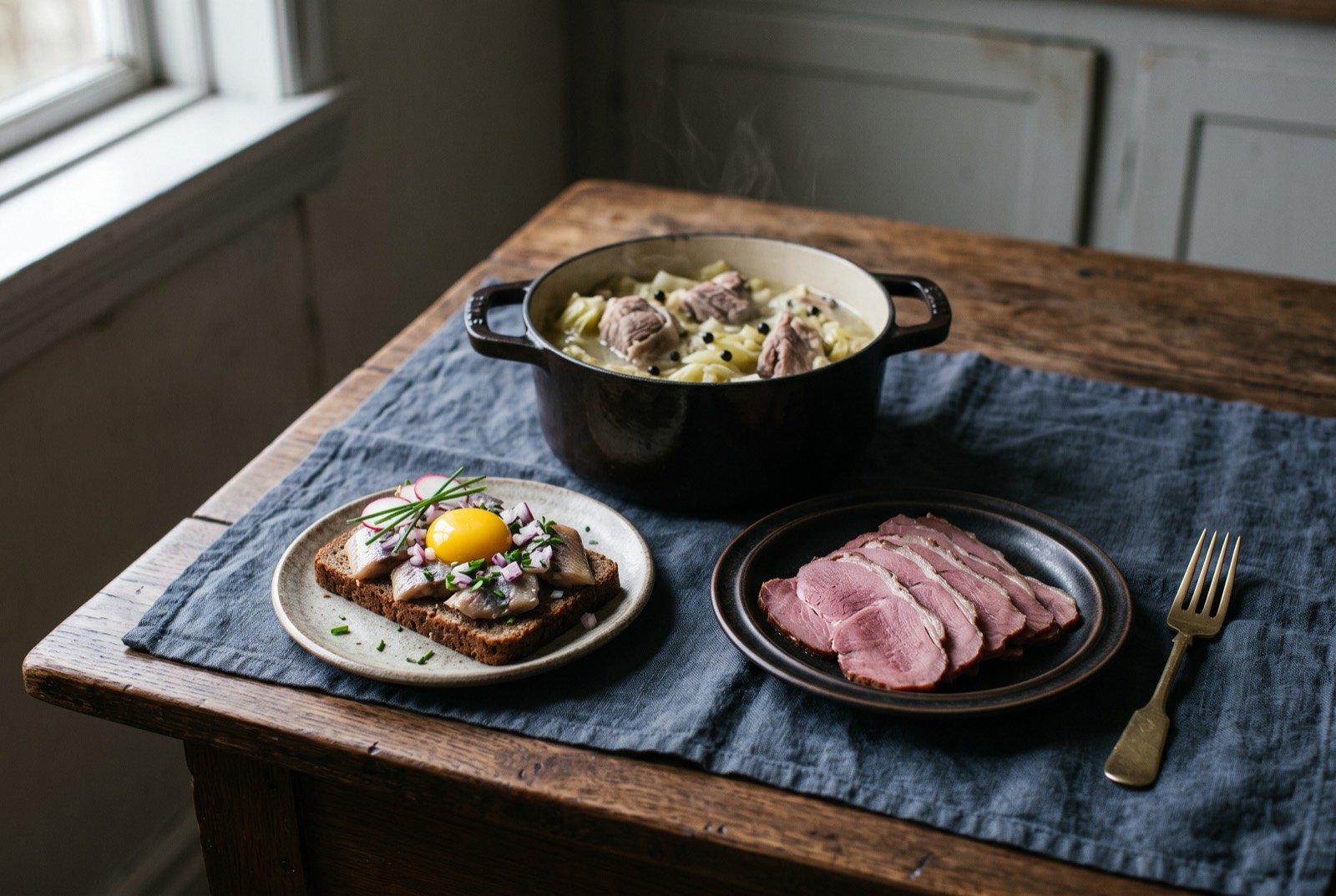
Denmark, Norway and Iceland, bound not by geography but by roughly three centuries under a shared Danish crown. What that crown produced at the table is not one cuisine but a single discipline: how to keep protein edible through nine months of dark and cold, using salt, smoke, cold air and, in Iceland, the ground itself. Every dish as tradition built it, then what a modern chef would change.
Sources and review · What this chapter does not assert · How we research · Spotted something wrong?
A Sense of Place
Denmark: the rye field that fed an empire's bacon trade
Denmark is the flattest, most fertile of the three, a country of glacial lowland whose staple grain has always been rye rather than wheat, since rye tolerates the cooler, wetter, less generous soil that wheat does not. The fat is butter and pork fat; the aromatic is dill above almost everything else, with caraway close behind; the thickener, where the kitchen wants one, is a butter and flour roux in the French manner, or a simple bread base doing the same job under an open sandwich. What actually shapes Danish cooking as it exists today, though, is not medieval at all. It is an 1880s trade decision: when European grain prices collapsed, Denmark deliberately rebuilt its entire farming economy around exporting bacon, butter and eggs to Britain, and a purpose-bred Danish landrace pig, crossed with Yorkshire boars from the 1890s onward, is the animal actually responsible for what a Danish butcher's counter looks like today. Frugality shaped this kitchen, but it was Lutheran only in the narrowest, most literal sense, a fasting calendar abolished by law in 1536. The plainness that followed owes at least as much to an export economy built around Victorian English breakfast tables.
Norway: a fjord coast that cures against the calendar
Norway's ecology is defined by what a fjord coast will and will not grow. Sheep and goats work the steep, thin-soiled hillsides where cattle cannot graze at scale; the sea supplies cod, herring and trout in quantities the land could never match on its own. The whole logic of Norwegian home cooking follows from a short, brutal calendar: an autumn slaughter, because there is not enough winter fodder to overwinter every animal, and a race to salt, dry or ferment the catch before the fjord freezes shut. Norway's other defining fact is trade rather than ecology: from the 1600s, Dutch and Scottish merchants built Kristiansund into Europe's klippfisk capital, and Norwegian salt cod has been shipped to Portugal for more than five centuries and to Brazil for around two and a half, a genuinely global trading relationship built entirely on one preserved fish.
Iceland: an island where curing wrong can kill you
Iceland has almost no native grain-growing capacity and, since the Norse settlers exhausted the island's birch and willow woodland within a few generations of arrival, it has spent most of its history desperately short of fuel as well as farmland. Sheep are the one animal the island's grass genuinely supports at scale, and the sea, again, supplies the rest. What sets Iceland apart from Norway and Denmark within this volume is not ecology alone but the sheer unforgiving stakes of getting preservation wrong: a Greenland shark's flesh is toxic when fresh, its tissue saturated with urea and trimethylamine oxide that the animal's body diffuses through itself in place of a proper urinary system, and only weeks of controlled fermentation renders it safe. That single fact, more than any other, is the clearest possible statement of this volume's whole argument: every technique here was built by necessity first, and only later, if at all, elevated into a dish worth choosing rather than enduring.
The structural logic, at a glance
| Denmark | Norway | Iceland | |
|---|---|---|---|
| Staple grain | Rye | Barley, imported wheat and rice for festival dishes | Almost none native; rye imported for baking |
| Fat | Butter, pork fat | Butter, fish oil historically | Butter, lamb fat |
| The preserving discipline | Salting and smoking | Salting, drying and fermenting | Drying, fermenting, and the ground itself as an oven |
| Aromatic | Dill, caraway | Juniper, dried herbs | Dill, little else historically available |
| The winter answer | Rugbrød and pickled or smoked fish | Klippfisk, rakfisk, pinnekjøtt | Harðfiskur, hangikjöt, skyr |
The History in Layers
A herring market that built a medieval superpower
Denmark's own great medieval fact is a fish migration. From the second half of the 1100s through roughly 1450, vast seasonal herring shoals passing through the Øresund strait each August to October were caught, barrel-salted and exported across Europe, founding the Skånemarkedet, one of northern Europe's largest medieval marketplaces, sited on what was then Danish territory. By the mid-1200s the Hanseatic League, above all Lübeck, which controlled the salt mines the whole trade depended on, had taken commercial control of the fishery, exporting close to three hundred thousand barrels of herring a season at its height and drawing tens of thousands of fishermen, merchants and innkeepers to a market town that existed for a few weeks a year and for no other reason. It is worth being plain about what this means for how this chapter should be read: Denmark's herring trade was, for two centuries, run largely for and by German merchant capital, not a purely national achievement, however completely the fish itself has since been absorbed into Danish identity.
A fasting calendar, abolished by law, not by taste
The medieval Catholic Church mandated fasting roughly one hundred and eighty days a year across Denmark and Norway alike: every Wednesday and Friday, and the stricter forty days before Easter, when even butter, cheese and eggs were forbidden. This is the real, dated, structural reason salted and smoked fish sat so permanently at the centre of this table, not as an export commodity alone but as devotional necessity. In 1536, the Lutheran Reformation formally abolished the Catholic fasting calendar across the Danish crown's territories by law. What is worth stating carefully, because popular writing overreaches on this point constantly, is that fasting itself did not vanish that year: it persisted for a long period afterward as popular custom rather than church obligation, and the frequently repeated broader claim that Lutheran theological frugality directly shaped the plain, undecorated character of everyday Nordic home cooking has no solid source behind it beyond that one specific, dated legal change. The abolition of fasting is documented. A causal line from Luther's theology to the taste of a Danish Sunday dinner is not, and this chapter declines to assert one.
The bacon pig that rebuilt a nation's farms
The single best-evidenced turning point in this whole volume is agricultural, recent and precisely dated. From around 1880, as international grain prices collapsed, Denmark deliberately re-tooled its entire export economy away from grain and toward animal products, above all bacon, butter and eggs, sold overwhelmingly to England: by the 1880s over half of Danish exports went to Britain, and a further, sharply specific push came from Germany's 1887 ban on live pig imports, which redirected Danish farmers even more decisively toward the English bacon trade. From 1896, fifteen state-approved breeding centres were established nationwide to systematically create a purpose-bred bacon pig, Danish landrace sows crossed with Yorkshire boars, following a Danish agronomist's 1895 study trip to England. The measurable result of decades of this breeding programme: average carcass length rose from 88.9 centimetres in 1926 to 96.9 centimetres by 1970, while back fat thickness fell from 4.05 to 2.24 centimetres over the same period. Cooperative dairies, spreading rapidly across Denmark through the 1880s, fed the resulting skimmed milk straight back to farmers, directly subsidising the pig sector's growth alongside it. This is also the moment fresh pork, not only preserved pork, entered ordinary Danish households for the first time, and the same period's new domestic technology, the cast-iron stove and the hand-cranked meat grinder, is precisely what made frikadeller and leverpostej, both built from ground meat, viable everyday home dishes rather than professional kitchen work. Denmark's plain, pork-and-rye table is not an ancient inheritance. It is, in large part, a nineteenth-century trade decision that happened to work.
A fjord's oil economy, before it was ever a delicacy
Iceland's shark fishery makes the same point from the opposite direction. Shark hunting is documented from the fourteenth century, but hákarl's real cultural and economic peak came far later, in the seventeenth to nineteenth centuries, driven not by anyone's appetite but by the European market for shark liver oil as street lamp fuel. At its height dozens of decked sailing vessels pursued the fishery and annual oil exports reached roughly thirteen thousand tunnur, a traditional cask measure; the whole trade collapsed after 1860 once petroleum replaced shark oil in European lamps. Curing the meat, rather than simply extracting the liver, was always a way of not wasting an animal that would otherwise have been caught, boiled down for its oil and discarded. The dish now sold to tourists as an ancient national delicacy has its clearest documented roots in a nineteenth-century industrial oil trade, not a saga-era feast.
Norway's own borrowed cabbage pot
Fårikål is Norway's own best example of a national dish whose actual paper trail runs the other way from its reputation. The earliest recognisable recipe appears in Karen Dorothea Bang's Fuldstendig Norsk Kogebog of 1835, itself an adaptation of an older Danish dish, preserved goose in white cabbage, with mutton substituted once the dish reached the Danish-influenced bourgeoisie of Christiania. It did not become common in rural Norway until well into the twentieth century, since cabbage itself was not yet a reliably traded rural good before then. Fårikål was voted Norway's national dish twice by public poll, once in the early 1970s and again in 2014, and both votes are exactly what they sound like: popular, informal, and telling of what Norwegians have chosen to claim, not a record of what medieval Norwegians actually ate.
Three centuries under one crown, and where independence actually fell
Norway passed under the Danish crown in 1537, following the Reformation, and stayed there until 1814, when it was ceded to Sweden after the Napoleonic wars, achieving full independence only in 1905. Iceland's path was slower still: a Danish possession from the fourteenth century in one form or another, it gained home rule in 1874, sovereign status under the Danish crown in 1918, and full republican independence only in 1944, during the Second World War, while Denmark itself was under German occupation. This three-way political history is the actual mechanism, not ecology alone, behind why this volume groups Denmark, Norway and Iceland together rather than folding Norway in with Sweden or Iceland in with a wider North Atlantic grouping: three centuries or more of shared administration, shared trade routes and, for long stretches, a shared language of government left a genuine, traceable family resemblance in how each country cures, smokes and dries its way through winter, even where the specific dishes diverge sharply.
Faroe and Greenland, named honestly and not absorbed
The Faroe Islands and Greenland are, as of this writing, both still constituent territories of the Kingdom of Denmark, and both share this volume's underlying fermentation and curing ecology closely enough that they cannot simply be left out. The Faroese ræstur fiskur, wind-fermented fish hung in open sheds, and skerpikjøt, similarly wind-cured mutton, sit in exactly the same technical family as Iceland's hákarl and hangikjöt. But naming them honestly means resisting the temptation to fold them silently into "Danish food," since neither is Danish in any meaningful culinary or cultural sense, and Greenland's food culture in particular, built on seal, whale and muktuk, is ecologically and culturally part of Arctic Indigenous America rather than Scandinavia at all. The Faroe Islands' pilot whale hunt, the grind, is also genuinely, currently politically contested in a way this chapter has no wish to flatten into a footnote. Both territories are named here as belonging to this volume's crown-territory history, and both are flagged as deserving their own full future treatment rather than a diluted paragraph inside someone else's chapter.
The Flavour Arsenal
Rye, the grain that decided everything
Rye tolerates poor, wet, acid soil in a way wheat never has, which is the entire reason it, not wheat, became the staple grain of Denmark and much of Norway. By the late Middle Ages, sourdough rye bread was the essential food of the common population, while wheat remained a luxury the nobility ate in imitation of southern European fashion. Rugbrød's own modern method, a two-day sourdough process building from a live starter through a long overnight rest to a dense, dark, syrup-sweetened final dough, is essentially unchanged from that logic: a slow, patient fermentation extracting flavour and keeping quality from a grain that will not give you either quickly.
Dill, caraway and juniper, the region's three working aromatics
Dill is the dominant fresh herb across all three countries, doing the work in this cuisine that basil or coriander does elsewhere, most visibly in gravad laks's thick dill crust and rakfisk's onion-and-dill garnish. Caraway sits underneath aquavit, brunost and the darker, denser end of the rye family. Juniper is the smoking wood of choice wherever a lighter, more aromatic smoke than oak or alder is wanted, and, distilled, gives Norwegian akevitt its other characteristic flavour alongside dill and caraway, a genuine EU-regulated distinction: an aquavit's dominant flavouring must legally be caraway, dill, or both, so the two styles taste meaningfully different rather than being interchangeable bottles under one word.
The cured and smoked fish family
Herring, cod and salmon between them carry most of this cuisine's protein history. Herring is eaten pickled, above all in Denmark's smørrebrød tradition; salted and dried as klippfisk, Norway's five-century trading relationship with Portugal and, more recently, Brazil; and, in Iceland specifically, dried into harðfiskur, wind-cured on open racks for four to six weeks and eaten torn into strips with butter, running roughly eighty to eighty five per cent protein by weight once fully dried. Lutefisk, dried whitefish rehydrated through a lye treatment, sits in a category of its own: a genuinely Nordic-specific technique, distinct from the plain drying and salting that klippfisk and harðfiskur both rely on, documented as already established by 1555 and therefore roughly five to six centuries old rather than the millennium sometimes claimed for it.
Skyr and brunost, two ways of not wasting milk
Skyr is not a yoghurt, whatever the label convention on a British supermarket shelf implies: it is a cultured, rennet-set fresh cheese, strained of its whey, and the distinct yeasts that thrive at its comparatively low fermentation temperature, not the straining alone, are what genuinely separate it from yoghurt at a bacterial level. Its Icelandic pedigree is textually real, not folklore: skyr appears by name in Egils saga, Njáls saga and several other sagas, a settlement-era continuity attested in writing rather than assumed. Brunost, Norway's whey cheese, works on an entirely different principle, not fermentation at all but a slow caramelisation of milk sugar, whey simmered for hours until it reduces to a thick, sweet, deep brown paste, a nineteenth-century farmhouse answer to what to do with the liquid a dairy would otherwise throw away.
Lamb and mutton, the one animal the land will reliably give you
Sheep run through Norwegian and Icelandic cooking in a way cattle never quite manage on either country's thin, steep or volcanic ground: fårikål's mutton, pinnekjøtt's salted ribs, hangikjöt's smoked leg. The specific cuts chosen for each dish, shoulder, back and neck for fårikål, the rib rack for pinnekjøtt, are chosen deliberately for fat and bone content, since a simmering bone is what actually builds a broth worth eating.
Hákarl, named honestly as a flavour arsenal entry rather than a home recipe
Fermented Greenland shark belongs in this arsenal as the clearest possible illustration of the volume's whole argument, but it does not belong among this chapter's cookable dishes, and this chapter says so rather than forcing a recipe onto an ingredient no British kitchen can responsibly reproduce. Gutted, headless shark is buried under pressing stones in gravelly ground, sources vary meaningfully on exactly how long, anywhere from several weeks to several months, then hung to dry in a ventilated shed for a further four to five months. The chemistry is genuinely well evidenced: a Greenland shark has no proper urinary system, so urea diffuses through its living tissue by osmosis; after death this breaks down into ammonia, and trimethylamine oxide breaks down into trimethylamine, together responsible for both the smell and the toxicity of the fresh meat, strong enough to have reportedly killed polar bears that scavenged shark carcasses. Curing works because fermentation by naturally occurring yeasts breaks these compounds down further, the ammonia gassing off through the curing pit rather than staying locked in the flesh. Iceland's own national food research institute, Matís, has stated plainly that a widely repeated claim, that hákarl is traditionally cured by human urination, is a straightforward misconception with no factual basis: the shark's own natural urea content is more than sufficient, and no such practice is needed or historically documented.
The Technique Ladder
The argument, from inside
Every technique in this chapter answers the same question in a slightly different register: how do you keep protein safe and worth eating through a winter with no refrigeration and, in Iceland's case, almost no fuel. None of it is decorative. Salt draws water out because water is what spoils meat. Smoke works at a low temperature because heat cooks the surface shut before the smoke can do its real, slow, preserving work on what is underneath. A shark is buried, not simply salted, because burial is the only method that gives a genuinely toxic animal enough time and enough contained space to detoxify itself. A technically capable home cook with real kit can reproduce most of this properly, but only by respecting exactly what the constraint was solving for, not by treating any of it as a flourish.
Rung 1. Salt first, then everything else
Danish frikadeller are built on a specific, load-bearing sequence: the minced meat is worked with salt alone before any egg, flour, onion or milk goes in, since salt draws out myosin and that myosin is what actually lets the mixture bind the liquid that follows. Skip the sequence, or work the mixture hard once the liquid is in, and the result is the dense, heavy frikadelle this technique exists specifically to avoid. The same discipline, salt doing its structural work before anything else is added, underlies gravad laks's dry cure and rakfisk's initial salting stage.
Rung 2. Ferment in the cold, and give it real time
Rakfisk is this chapter's cleanest example of controlled fermentation done properly, and Norway's own state food research institute, Nofima, has documented it in genuine microbiological detail: fish salted to a controlled four to six per cent salinity, submerged in the brine its own salt produces, held at three to eight degrees Celsius for anywhere from three to twelve months, with brine pH dropping to around 5.3 within three to four weeks as lactic acid bacteria take over. Reproducibility, Nofima's own research shows, depends on tightly controlling salinity and temperature, not on leaving the process to chance, and this is exactly the discipline a sous vide-adjacent, temperature-controlled fridge space can bring to a home version.
Rung 3. Give smoke time, not heat
Hangikjöt's own stated aim, in the words of one of Iceland's major producers, is maximum smoke and minimum fire, a genuine cold smoke rather than a hot one. The choice of fuel, birch in some households and producers, dried sheep dung in others, is a live, still-unresolved regional and personal split rather than a single correct answer, and dung's role specifically traces to a documented ecological fact: Iceland's Norse settlers exhausted the island's birch and willow within a few generations of arrival and turned to their sheep's own dried dung as a renewable smoking fuel out of necessity, not preference. A Big Green Egg, fitted with a cold smoke generator and held at or below thirty degrees Celsius, ideally nearer twenty, is a genuinely workable UK equivalent for birch smoking specifically; there is no honest domestic substitute for the dung-smoked style, and this chapter does not pretend otherwise.
Rung 4. Build the crackling by thermometer, not by luck
Flæskesteg's crackling depends on three steps done in the right order and nowhere else: the skin scored through but not into the meat, at roughly half-centimetre intervals; salt rubbed into every groove once the skin is genuinely dry, since salt only draws water from skin that starts dry; and the joint roasted to an internal temperature, not a fixed time, since thickness rather than weight is what actually governs how long a joint needs. A probe thermometer removes the guesswork a Danish grandmother once did by eye and long practice.
Rung 5. Respect the rise, and don't rush the strain
Rugbrød's flavour depends on the same slow sourdough fermentation as any serious bread anywhere, and skyr depends on an analogous patience at the other end of the dairy case: milk heated to eighty five to one hundred degrees Celsius, cooled to around forty, cultured and rennet-set, then left to coagulate for hours before its whey is strained away, traditionally through cloth and today, just as honestly, through a chinois. Rush either process and the result is thinner, blander and less distinctly itself than the version built with real time.
The Ferment and Preserve Bench
1. Rugbrød's Sourdough Starter
Covered in full above. The one culture in this chapter worth keeping alive indefinitely, refreshed from every loaf's own reserved dough, rather than bought fresh for each bake.
2. Rakfisk's Long Fermentation
Also covered above, and the chapter's clearest example of a fermentation genuinely reproducible at home given real temperature control and real patience, and real caution around food safety guidance for a multi-month raw ferment.
3. Hákarl, Understood but Not Attempted
Not a home technique, and this chapter does not pretend otherwise: a genuinely toxic raw ingredient, months of controlled burial and drying, and no responsibly sourceable Greenland shark reaching a UK kitchen. Worth understanding for what it explains about the whole region's relationship to necessity, worth buying finished and cured if it can be found at all, never worth attempting from scratch.
4. Brunost, Whey Reduced to Caramel
A slow, hours-long reduction of whey and cream over low heat until the milk sugars caramelise into a thick, sweet, deep brown paste, poured into a mould to set. Genuinely reproducible at home with a heavy pot, real patience and close attention against scorching, and a natural use for the whey skyr-making leaves behind.
5. Lutefisk, Named Honestly as a Gap
This chapter does not give a recipe for lutefisk, and says so rather than inventing one. Its chemistry is well understood, a lye treatment that swells the fish and roughly halves its protein content into a gelatinous texture, but no source behind this chapter could establish a complete, reproducible, in-tradition method at the level of detail this atlas otherwise insists on. Buy it cured, where it can be found at all, rather than treating any recipe offered here as tested.
Sourcing in Britain
Verified August 2026. Where a supplier could not be fully confirmed, that is said rather than smoothed over.
The genuine gaps, stated plainly first. No UK stockist of fresh, reliably in-stock day-boat herring for home curing was confirmed; Billingsgate Market, wholesale only, is the realistic route for a cook determined to cure their own. Lutefisk is effectively unobtainable fresh or frozen in the UK on demand; rakfisk has no confirmed UK stockist at all. Hákarl sits in a genuine grey area: one Icelandic specialist importer, TrueIceland, lists the UK as a delivery destination and will ship it, but the customs and personal-import legal position for a fermented shark product entering Great Britain from Iceland, an EEA and EFTA country outside the EU, was not confirmed against current Border Force or APHA rules, and this chapter recommends checking that position directly before ordering rather than assuming either that it is freely importable or flatly forbidden.
The ranked list: what decides great from grim
- Genuine Icelandic-cultured skyr, not a "skyr-style" yoghurt imitation. Arla Skyr, made under licence using Icelandic culture, is confirmed currently stocked at Sainsbury's, Tesco, Morrisons and Asda; Ísey Skyr, licensed from MS Iceland Dairies, also has UK distribution.
- Proper Danish-style dark rye flour and a real method to bake with it. Shipton Mill sells organic dark rye flour direct and publishes its own Danish rugbrød method; several small UK bakeries, including Dansk Gypsy, sell baked Danish-style rye, though stock and delivery days vary and should be checked before relying on any one of them.
- Sashimi-grade salmon for gravad laks, genuinely well served. The Fish Society runs a graded sashimi section with next-day delivery; FreshestFish.co.uk supplies Wester Ross Scottish salmon suitable for home curing.
- Tine's genuine brunost, not a supermarket guess. ScandiKitchen currently stocks Tine Gudbrandsdalen and Tine Ekte Geitost; some Synnøve lines are currently out of stock with a waitlist, a real, current gap rather than a hypothetical one.
- Aquavit chosen for its actual flavouring, not bought blind. Master of Malt and The Whisky Exchange both stock Linie, Aalborg Taffel and other genuine aquavit; check the label for whether caraway or dill leads, since EU rules require one or both, and they taste meaningfully different.
- Ready-made pickled herring, an honest substitute for home curing, not a lesser one. IKEA UK's SILL range and ScandiKitchen's own selection are both currently, confirmedly in stock.
- Icelandic harðfiskur and hangikjöt, importable but not stocked on a UK shelf. TrueIceland and Topiceland both ship refrigerated to the UK via DHL, typically one to three days' transit.
- Birch and juniper smoking wood for a Big Green Egg, genuinely easy to find, contrary to any assumption they'd need importing. Borniak birch chips and Landmann or Hot Smoked juniper chips are both stocked by multiple UK barbecue retailers, marketed specifically for fish.
Kit notes for this volume
A poffertjespan-equivalent, in this case a dedicated æbleskivepan, is the one piece of specialist kit worth buying specifically for this chapter; UK cookware retailers stock proper cast-iron versions. A Big Green Egg fitted with a cold smoke attachment held below 30°C is the single most useful tool in the whole chapter, doing genuine, honest work for the smoked herring, pinnekjøtt and hangikjöt entries alike. Sous vide earns its place for both rakfisk's temperature-controlled fermentation and fårikål's evenly braised mutton. A chinois is not a luxury here but the literal traditional tool skyr-straining depends on, cloth or chinois making no real difference to the result. A dedicated spice grinder is worth using for fårikål's cracked peppercorns and for grinding your own caraway or dill seed if experimenting with a home akevitt infusion, though distilling spirit itself sits outside what this chapter covers.
Voices and Sources
From inside the tradition
- René Redzepi, Noma, Copenhagen. The single most influential voice behind the New Nordic movement's real doctrine, on record that fermentation, not foraging, is the actual pillar of his kitchen, "much more than foraging, by which people usually identify us."
- Rasmus Kofoed, Geranium, Copenhagen. Three Michelin stars, a meat-free, biodynamic and foraged approach built on non-endangered seafood.
- Nicolai Nørregaard, Kadeau, Copenhagen. Newly promoted to three Michelin stars in 2026, built specifically around the terroir of Bornholm, this chapter's own smokehouse island.
- Gunnar Karl Gíslason, Dill, Reykjavik. Iceland's first Michelin star, built explicitly on what Icelandic scarcity actually offers: foraged, farmed, fished, then dried, smoked, pickled or fermented depending on the season.
- Mikael Svensson, Kontrast, Oslo. Two Michelin stars and a Michelin Green Star, turning the kitchen's own waste stream into fermented condiments, a genuinely transferable idea for any serious home cook.
- Nofima, Norway's state food research institute, the primary source behind this chapter's real understanding of how rakfisk's fermentation actually works.
- Matís, Iceland's national food research institute, the primary source behind this chapter's real understanding of hákarl's chemistry, and the body that has publicly and firmly corrected the myth that hákarl is traditionally cured with human urine.
- Vísindavefurinn, the University of Iceland's public science answer service, a genuinely excellent, citable source used throughout this chapter's Icelandic sections.
The UK diaspora, honestly assessed rather than assumed
Snaps + Rye, on Golborne Road in London, is repeatedly and consistently described in UK reviews as genuinely, classically Danish, built around proper rye bread and provenance-led cookery rather than a themed pastiche, the standard this chapter would point a reader toward. Set against that, Aquavit London, sister restaurant to New York's long-established original, won a Michelin star within ten months of opening in 2016, lost it in 2021, and closed entirely in 2023, a real and sobering data point on how thin the UK market for serious Nordic dining still is, not evidence that no one is trying. ScandiKitchen and Totally Swedish are both confirmed currently trading in London, pan-Scandinavian rather than country-specific, and remain the most reliable physical starting point for a UK cook working through this chapter.
Things this chapter has deliberately not asserted
- Smørrebrød as a continuous Viking-era tradition. The ingredients are old; the composed, named, menu-driven genre is a documented product of 1880s Copenhagen restaurant culture, and this chapter treats those as two separate claims rather than one.
- Fårikål as an ancient, purely Norwegian dish. The earliest recognisable recipe is a Danish adaptation from 1835, and the dish did not reach rural Norway in real numbers until the twentieth century.
- Rødgrød med fløde as an ancient peasant dessert. The Danish food ministry's own published history dates it to the early 1700s, and its original form used red wine, not garden berries; cream only became standard around 1900.
- Hákarl as a continuous, ancient Viking food. Shark hunting is documented from the fourteenth century, but the practice's real cultural and economic peak is the seventeenth to nineteenth centuries, driven by the European market for shark liver oil as lamp fuel, not by anyone's appetite.
- Lutefisk as a thousand-year-old tradition. The earliest documented description dates to 1555; the dish is more credibly five to six centuries old, not a millennium.
- A direct causal line from Lutheran theology to the plain character of everyday Danish home cooking. Only the narrow, dated 1536 abolition of the Catholic fasting calendar is solidly evidenced; the broader claim was not found supported by any primary or academic source.
- Any currently surviving, named Danish fermented-fish tradition comparable in scale to Norwegian rakfisk or Faroese ræstur fiskur. None was found; Denmark's dominant fish-preservation tradition is salting and smoking, not fermentation, and this chapter says so rather than forcing a parallel that does not exist.
- A single correct fuel for hangikjöt. Birch and dried sheep dung are both genuinely, currently practised, and Icelandic sources disagree with each other; this chapter presents both rather than choosing a winner.
- Rakfisk's precise founding date, or the exact date the buried-barrel method of gravad laks gave way to today's dry cure. Neither could be established from the sources behind this chapter, and both are stated as open questions rather than resolved with an invented date.
- The legality of importing hákarl into the United Kingdom. One Icelandic retailer will ship it here, but the customs and personal-import position was not confirmed, and this chapter recommends checking directly rather than assuming either answer.
- A complete, reproducible method for lutefisk's lye treatment. The chemistry is well sourced; a citable, step-by-step in-tradition method was not found, and no recipe for it appears in this chapter as a result.
- The claim that hákarl is traditionally cured with human urine. Iceland's own national food research institute has stated plainly that this is a misconception with no factual basis, and this chapter repeats that correction rather than the myth.
Salt first, then everything else
Danish frikadeller are built on a specific, load-bearing sequence: the minced meat is worked with salt alone before any egg, flour, onion or milk goes in...
Ferment in the cold, and give it real time
Rakfisk is this chapter's cleanest example of controlled fermentation done properly, and Norway's own state food research institute, Nofima, has documented it...
Give smoke time, not heat
Hangikjöt's own stated aim, in the words of one of Iceland's major producers, is maximum smoke and minimum fire, a genuine cold smoke rather than a hot one.
Build the crackling by thermometer, not by luck
Flæskesteg's crackling depends on three steps done in the right order and nowhere else: the skin scored through but not into the meat, at roughly...
Respect the rise, and don't rush the strain
Rugbrød's flavour depends on the same slow sourdough fermentation as any serious bread anywhere, and skyr depends on an analogous patience at the other end of...
The dishes
- Rugbrød med Sol over Gudhjem Denmark
- Frikadeller Denmark
- Stegt Flæsk med Persillesovs Denmark
- Æbleskiver Denmark
- Gravad Laks Shared across the whole North Atlantic crown
- Fårikål Norway
- Rakfisk Norway, above all Valdres
- Pinnekjøtt Norway, above all Vestlandet
- Hangikjöt Iceland
- Skyr Iceland
Sources and review
- Researched
- 5 sources cited
- Reviewed
- Not yet reviewed from inside the tradition
- Cooked
- Not yet cooked and reported
Where this volume comes from
3 research briefs on file for this volume, researched to the rules on How we research. Published 28 August 2026. Last changed 8 September 2026.
1 dish here carries a time estimated from comparable dishes in this atlas, because no source states one.