Central Europe · Volume 17, The Herring Fleet and the Sausage Stand
Labskaus
Hamburg and Kiel
Illustration
- Researched
- Researched from 5 sources in the brief
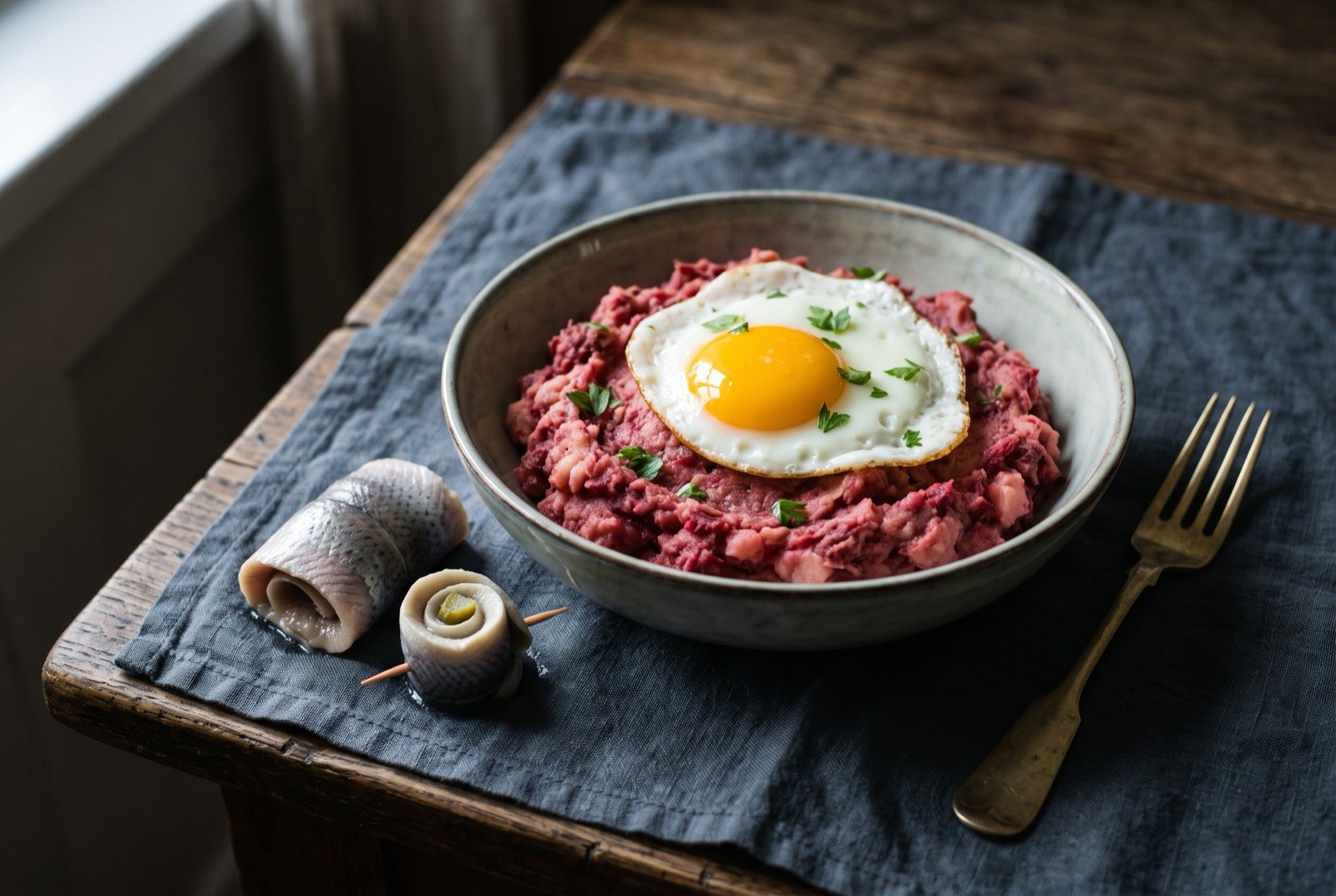
Labskaus is not, whatever a Hamburg restaurant menu might imply, an original Hamburg invention; multiple sources say so directly, and no original recipe survives at all. Its name most likely derives from English "lobscouse", a salted-meat, onion and ship's-biscuit stew served aboard British and Scandinavian trading vessels, first recorded in English in 1706; the German maritime dictionary attestation of "Labskaus" itself comes later, in the 18th century. What Hamburg and Kiel both genuinely developed is a distinctive serving style: corned beef, pickled beetroot, onion and potato mashed together, topped with a fried egg and served with Matjes and a Rollmops alongside. Whether the herring should be mixed into the mash or kept separate is, per Hamburg's own tourist authority, debated as heatedly as only a taste question can be; this recipe keeps it separate, so the diner chooses.
As tradition built it
Serves 4.
Ingredients
- 400g tinned corned beef, broken into rough chunks
- 500g floury potatoes, peeled and cut for boiling
- 200g cooked or vac-packed beetroot, diced
- 1 large onion, finely diced and softened in butter
- 4 Matjes fillets
- 4 Rollmops
- 4 eggs, fried
- a splash the beetroot's own pickling liquid
- to taste salt
- to taste white pepper
- a grating nutmeg
Method
- Boil the potatoes until tender, roughly 20 minutes, and mash roughly, not smooth.
- Fold in the corned beef, the softened onion and the diced beetroot, loosening with a splash of pickling liquid until the whole mash takes on the beetroot's colour throughout, not just in patches.
- Season with salt, white pepper and nutmeg rather than black pepper, which reads wrong against the sweetness of the beetroot.
- Serve each portion with a fried egg on top, a Matjes fillet and a Rollmops laid alongside, and let the diner decide whether to cut the herring into the mash or eat it apart.
What a modern chef changes
Home-cured brisket, riced potato and a sous vide egg
Rung 5
Method
- The corned beef is replaced with a home-cured brisket: brined for 5 days in a 6 percent salt solution with juniper and bay, then cooked sous vide at 74°C for 18 hours, shredding to the same texture as the tin but with real beef flavour underneath the salt (rung 5, slow rendering, applied to beef rather than pork).
- The potato is not mashed but pressed through a ricer and finished with a little of its own cooking water and a spoon of the beetroot pickling liquid whisked through at the end, giving a lighter, glossier base than the traditional rough mash.
- The beetroot is roasted whole in foil rather than boiled, concentrating its sugars before dicing, a small change that makes the finished colour and flavour noticeably deeper.
- The Matjes is home-cured using the quick method from the ferment bench rather than bought jarred, and the egg is cooked sous vide at 63°C for 45 minutes to a custard-soft yolk rather than fried, plated whole and broken at the table over the mash.