Korea and Japan · Volume 54, The Kingdom, the Battle and the Base
Okinawa Soba
Okinawa
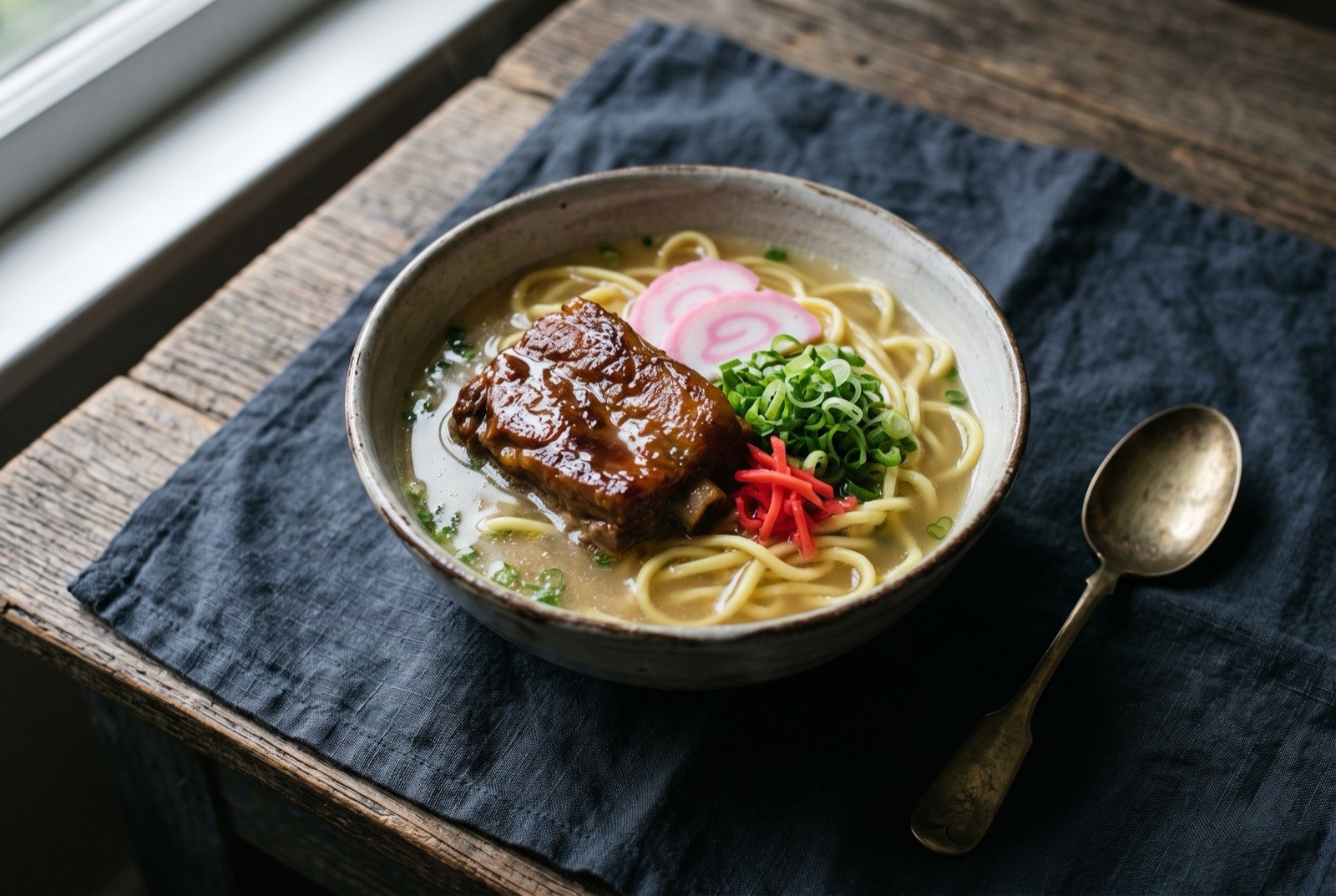
An illustration of the dish, not a photograph of it cooked.
- Time
- 4 hours
- Reviewed
- Not yet reviewed from inside the tradition
- Cooked
- Not yet cooked and reported
Okinawa soba's single most important fact is one its own trademark holder had to fight the Japanese state to protect: it contains no buckwheat whatsoever, its yellow colour and springy chew coming from kansui or traditional wood-ash lye, not from soba flour. In 1976 Japan's Fair Trade Commission ruled that a noodle needed at least 30% buckwheat to legally use the word "soba"; the Okinawa Fresh Noodle Cooperative fought this for two years, winning conditional approval in 1977 and full nationwide rights on 17 October 1978, a date the cooperative still marks as Okinawa Soba Day. The dish is said to descend from Chinese-style noodle shops run by Chinese residents of Naha from the Meiji period, when wheat flour was itself a luxury good, though the specific shop most often named for this could not be verified beyond a single unconfirmed source.
As tradition built it
Serves 4. About 4 hours for the broth.
Ingredients
- 1.5 kg pork bones (rib and knuckle), plus 500g pork belly or rib meat
- 2 litres water
- as available bonito flakes, a generous handful
- 500 g fresh wheat noodles made with kansui (or a thick, firm udon, see sourcing)
- 8g spring onion, finely sliced
- 40g kamaboko (fish cake), sliced
- 25g pickled red ginger (beni-shōga)
Method
- Blanch the pork bones and meat briefly in boiling water, then rinse clean of scum.
- Place in a large pot with the water, bring to the boil, then reduce to a low simmer and cook for 3 to 4 hours, skimming regularly, until the broth is rich and the meat is tender.
- Remove the meat, slice, and set aside.
- Strain the broth, return to a clean pot, add the bonito flakes, and simmer a further 10 minutes before straining again.
- Season lightly with salt.
- Cook the noodles according to type until just tender, drain, and divide between bowls.
- Ladle over the hot broth, top with the sliced pork, kamaboko, spring onion and a little pickled ginger.
What a modern chef changes
The meat finished sous vide apart from the bones, and the broth passed twice through the chinois
Four named variables
Method
- The pork bones and meat are pressure-reduced conventionally for the first hour, then the meat is finished sous vide at 68°C for a further 18 hours separately from the bones, which continue simmering for full collagen extraction, before the two components are recombined. This gives a fully clarified, deeply flavoured broth alongside meat that holds a cleaner, more precise texture than meat simmered the whole time alongside the bones.
- The broth is passed through a chinois twice, the second time through a fine cloth, for a clarity closer to a proper consommé than the traditionally cloudier, richer style, a deliberate, named departure the chapter states plainly rather than presenting as more authentic.
- A small amount of dried bonito is ground fresh in the spice grinder and finished directly over each bowl at the table, rather than only simmered into the broth, adding a fresh top note the simmered flakes alone cannot supply.
- The pickled ginger is made in-house, thin-sliced and quick-pickled, rather than bought pre-made, giving a sharper, fresher heat than most commercial versions.