Asia · Volume 54
Okinawa and the Ryukyu Islands
The Kingdom, the Battle and the Base
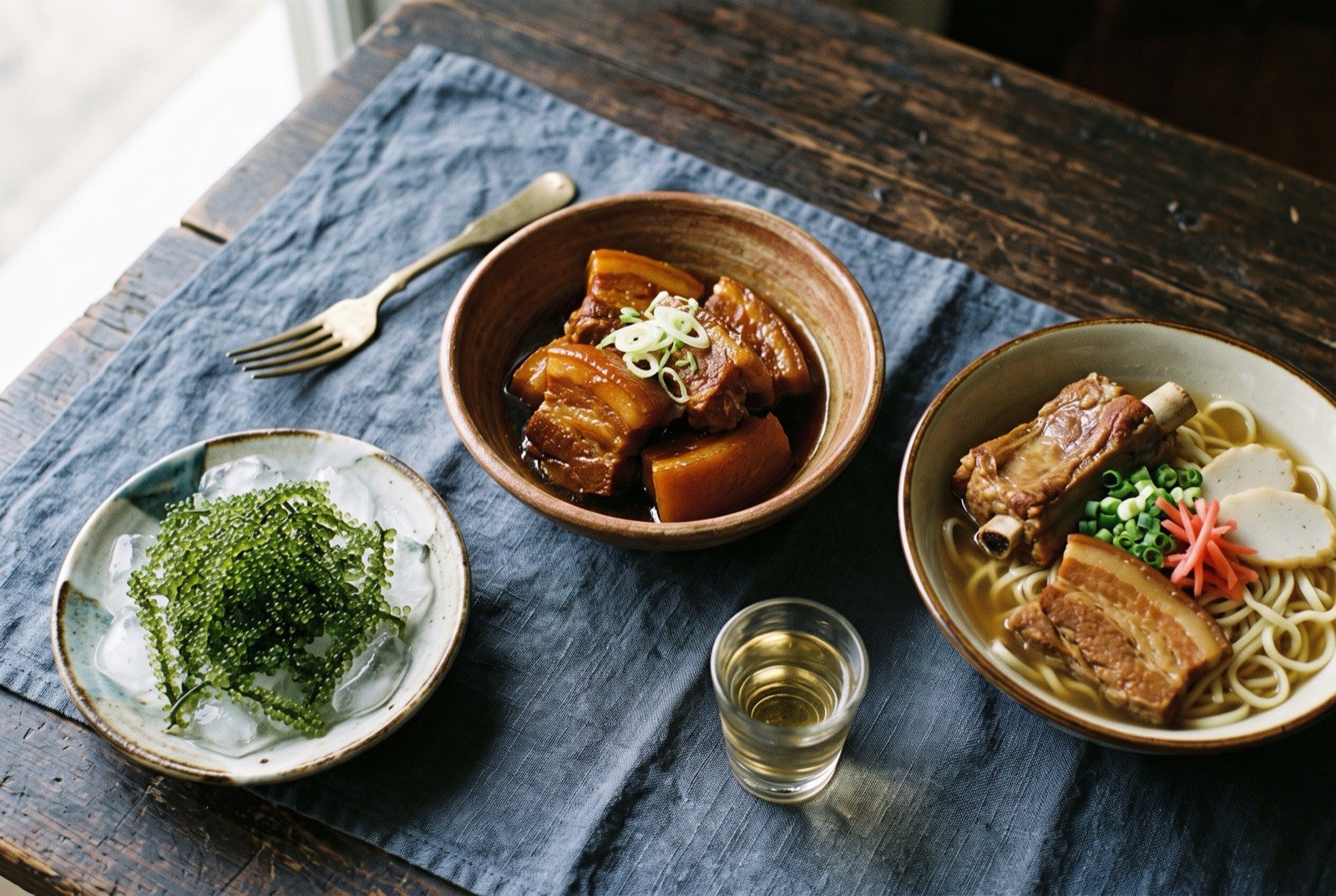
Okinawa is routinely folded into "Japanese food" on British menus, filed alongside ramen and okonomiyaki as a regional variation on a single national cuisine. It is not that. For four and a half centuries, from 1429 to 1879, the Ryukyu Islands were an independent kingdom that faced China and Southeast Asia, not the Japanese mainland, and then, in the twentieth century, Okinawa absorbed a second history the rest of Japan did not share: the bloodiest land battle of the Pacific War, twenty-seven years of direct American military administration, and a base presence that still occupies roughly a seventh of its main island today. This chapter treats the tribute-kingdom past and the base-town present as two distinct layers rather than blending them into a single soft-focus "Okinawan food" story, and every dish as tradition built it, then what a modern chef would change.
Sources and review · What this chapter does not assert · How we research · Spotted something wrong?
A Sense of Place
An island chain, not a Japanese region
The Ryukyu archipelago runs roughly 1,200 kilometres from Kyushu to Taiwan, and Okinawa's main island sits closer to Taipei than to Tokyo. Subtropical, coral-reef-fringed, with a growing season mainland Japan does not have and a typhoon season it deals with far more directly, the islands' ecology never matched the wheat and rice logic of Honshu. What it matched, for four centuries, was a trading position between two larger worlds. The kingdom's own inscription on the great bell it cast for Shuri Castle in 1458 called Ryukyu the "bridge between all nations" (万国津梁), and that self-description was not boasting: Ryukyuan ships carried Chinese porcelain and silk south to Siam and Java, and Southeast Asian goods, pepper, sappanwood, and, this chapter argues below, a still, north to Japan and Korea. Okinawa's food logic follows directly from this position. Pork, not fish, is the meat that defines the cuisine, despite the surrounding reef. Rice shares the table with wheat noodles that a mainland trade body legally could not call "soba" for two years. The defining spirit is distilled with a mould found almost nowhere else on earth. None of this reads as regional Japanese cooking with local seasoning; it reads as its own food world that happened to end up, by conquest rather than kinship, inside Japan's borders.
The structural logic, at a glance
| Staple starch | Rice, alongside wheat noodles (Okinawa soba) that carry no buckwheat at all |
| Fat | Lard, and pork's own rendered fat, the base seasoning long before soy sauce arrived |
| The thickener | Reduction and time, not a starch slurry: awamori and sugar reducing into a braise |
| Aromatic | Awamori itself, used as a cooking spirit as much as a drink; black sugar; ginger |
| The feast technology | The kingdom's court kitchens (お料理座) for state banquets; the household kazan-style pot for everyday chanpuru |
| The postwar layer | American base rations and PX access, absorbed into an already pork-centred cuisine rather than replacing it |
The Blue Zone claim, stated honestly before the rest of the chapter leans on it
A British reader arrives at Okinawan food today carrying one piece of received wisdom above all others: that this is the world's foremost "Blue Zone," the place people live longest, and that a specific traditional diet explains it. That claim needs qualifying before it does any more work in this chapter. Saul Justin Newman, a University College London demographer who won the 2024 Ig Nobel Prize in Demographics for the research, argues the entire Blue Zone framework tracks poor birth-record keeping more reliably than it tracks lifestyle; Japan's own 2010 government audit found over 230,000 registered centenarians nationally had already died, and by the same government's own dietary survey Okinawa currently ranks last of Japan's 47 prefectures for vegetable consumption and carries the country's highest BMI. Okinawa Prefecture itself ranks only 28th among Japan's prefectures for centenarian count, behind Shimane, Kochi and Kagoshima, and has the country's lowest average income. Newman's work remains an unpublished preprint, not a peer-reviewed refutation, so this is a live dispute, not a settled debunking. What survives it, on the account of Makoto Suzuki, an Okinawa-based cardiologist who has studied the island's longevity directly, is a social rather than dietary explanation: moai, durable mutual-support networks, and ikigai, a sustained sense of purpose. Wellness tourism built on the diet-miracle version of this story is now a genuine part of Okinawa's economy, even as younger Okinawans increasingly eat fast food rather than the dishes being sold to visitors as the secret. This chapter is not a longevity manual. It is a chapter about a kingdom's food and a battle's aftermath, and it treats the Blue Zone story as exactly what the evidence supports: contested, partially social rather than culinary, and not the reason to read on.
The History in Layers
The kingdom that faced south and west
The Ryukyu Kingdom's foreign relations rested on investiture and tribute (冊封・進貢) with Ming and then Qing China: the Chinese emperor conferred legitimacy on the Ryukyuan king, and in return Ryukyu sent tribute missions bearing gifts and receiving trade goods, holding unusually favoured status among China's tributaries, permitted annual missions others were not (Japan Heritage portal). Chinese investiture envoys, sappōshi, arrived as delegations of 400 to 500 people who stayed six to eight months at a time, and feeding a party that size is directly credited by the Japanese Cabinet Office's own reversion-history page with driving the kingdom's entire pork economy: those missions are recorded as consuming roughly twenty pigs a day, a demand so large the kingdom sourced extra animals from Amami and Okinoerabu to meet it (Cabinet Office). Southeast Asian trade, Siam above all, is credited across Okinawan sources with bringing distillation technology into the kingdom in the late fourteenth or fifteenth century, the root of awamori, discussed in full below. This was not incidental contact. It was the kingdom's actual foreign policy, and its kitchens were built to entertain it: a court cuisine, okansen ryōri, developed specifically to host these missions, with seven grand state banquets serving over thirty Chinese-style dishes each, the kingdom sending its own cooks to China to train, food served on vermilion Ryukyu lacquerware at purpose-built villas such as Shikinaen (Japan Heritage portal). Kippan, the candied-citrus sweet now sold as an everyday souvenir, chinsuko biscuits, nakami-jiru and tofuyo all trace their lineage directly to this court kitchen, only reaching ordinary tables after the kingdom's fall scattered its chefs into civilian life.
Two ruptures bookend this independence, and this chapter states both plainly rather than softening either. In 1609, Satsuma domain invaded with roughly 3,000 troops, seeking control of Ryukyu's trade profits after its own defeat at Sekigahara left it in financial distress. King Shō Nei was taken captive to Kagoshima and then Edo; the shogunate allowed the kingdom's nominal survival but bound it to pay tribute to Satsuma as well as China, a dual subordination that lasted 270 years. In 1879, Meiji Japan ended even that fiction. After Ryukyu refused Tokyo's 1875 demand to cut its tribute relationship with China, Japan's "disposition officer," Matsuda Michiyuki, marched on Shuri Castle on 27 March 1879 with 160 police and 400 Kumamoto garrison troops and announced the kingdom's abolition; King Shō Tai was ordered to Tokyo that June and made a marquis, ending a kingdom that had run unbroken for more than 450 years (Okinawa Prefectural Archives). Okinawa Prefecture is currently pursuing UNESCO Intangible Cultural Heritage recognition for Ryukyu cuisine, timed to the completion of Shuri Castle's rebuilt main hall, which itself burned down in 2019 and is being restored specifically as this kingdom's monument, not a generic Japanese castle.
The Siam claim: a real crossover, stated with the hedging it deserves
This chapter's clearest link to a region the atlas has not yet reached runs through the bottle, not the plate. Okinawa's own awamori industry body states that black-koji distillation reached the kingdom from Siam, present-day Thailand, in the late fourteenth to fifteenth century, the still, the technique and the storage jars arriving as a package, with the earliest prototype "thought to have originated as early as 1470" (Okinawa Prefecture Awamori Distillers' Association). The Ryukyu Shimpo and the Agency for Cultural Affairs' own Japan Heritage portal repeat the same account. This is worth taking seriously: it is not a Western guess about Asian trade routes, it is the standard story Okinawan institutions themselves tell about their own defining spirit. It is also, on the sources' own admission, not archivally proven. Japanese Wikipedia's own careful phrasing states plainly that "it is unclear when distilled spirits using rice as a raw material came to be produced in Okinawa," and names a specific scholarly proposal, that a Thai still called "Laolon" is the technical ancestor, explicitly flagged in the same source as speculative rather than settled. At least four competing theories exist in the Japanese-language scholarship for how distillation reached Japan at all, Siam via Ryukyu among them but not alone, and a claimed 1477 Korean court record describing Okinawan distillation "due to constant trading with Thailand" could not be independently verified in researching this chapter. So: awamori's black-koji technique is told, by Okinawans, as a Siamese import, probably fifteenth century, and that telling is repeated too consistently across the kingdom's own institutional memory to dismiss. It is not told as a documented fact with a paper trail, and this chapter does not pretend otherwise. One later point is worth holding separately from the technique's origin, since the two are often run together: the Thai rice awamori is distilled from today only became the standard grain in the 1920s, four centuries after the kingdom is said to have learned the technique itself. Before that, Chinese, Korean, Vietnamese, Burmese and Taiwanese rice all had turns as the working grain, as availability and price shifted.
The battle that ended the pig economy, and the occupation that outlasted the mainland's by twenty years
The Battle of Okinawa, April to June 1945, was the Pacific War's bloodiest land campaign and the only one fought substantially on Japanese civilian soil. Roughly 94,000 Okinawan civilians died in it, alongside a similar number of Japanese military dead, many of them Okinawan conscripts, and around 12,500 Americans, against a prewar prefectural population of about 490,000: close to one in four Okinawans killed. The kingdom's food economy took a direct, measurable hit alongside the human one. Okinawa's pig population, 140,000 head in 1938, had collapsed to under 14,000 by 1946; a relief shipment of pigs from Hawaii in 1948, organised in part by the islands' own diaspora, began rebuilding the stock that centuries of tribute-mission demand had built up. Black koji strains for awamori were likewise largely destroyed in the fighting, and Sakimoto Brewery is credited, in Japanese-language sources, with reviving the culture afterwards.
What followed the battle was not the same occupation the rest of Japan experienced. Mainland Japan's occupation ended with the San Francisco Peace Treaty on 28 April 1952, roughly seven years after the war's end. Okinawa was explicitly carved out of that treaty and remained under direct US military administration for a further twenty years, until reversion on 15 May 1972, twenty-seven years of occupation in total, during which Okinawa had no political recourse to Tokyo at all. From April 1953, the US Civil Administration began forcibly expropriating land for new bases with armed troops and bulldozers, an episode remembered in Japanese as "bayonets and bulldozers" (銃剣とブルドーザー), provoking organised Okinawan resistance under the Ryukyu government's own "Four Principles for Land Protection." At reversion, Okinawa Prefecture held close to 59% of all US-military-exclusive facility land in Japan; today the figure is commonly put at roughly 70%, inside a prefecture that is 0.6% of the country's land area, with bases still occupying something like 15% of the main island itself. This chapter treats the postwar American base layer that follows as a direct consequence of this specific, unusually long and unusually total occupation, not as a generic footnote about American cultural influence in postwar Asia.
Two names for the same wartime meat, and how they got there
Immediate postwar Okinawa was a population feeding itself from an American military supply chain, by design and by theft alike. Distributed rations, chiefly Hormel's Spam and the Danish company Tulip's own tinned pork, entered a population whose pig stock the battle had just wiped out, and slotted into a diet where pork, not this specific meat, was already the dominant protein; access varied by proximity to bases rather than reaching the whole prefecture evenly. Some of what reached Okinawan kitchens arrived by less official routes: 戦果アギヤー, senka agiyā, "one who scores war trophies," is the term for Okinawans who broke into American warehouses in the desperate immediate postwar years and shared or resold what they found, some remembered locally as folk heroes for it, a genuine, mixed memory recently revisited in the film Takarajima rather than a settled, comfortable nostalgia. Mainland Japan received some of the same rations in the same period and did not keep them: pork luncheon meat was largely forgotten there within a decade, only returning to mainland attention in the twenty-first century as part of a wider "Okinawa boom." In Okinawa it stayed, and is still called, regardless of maker, simply "pōku." One frequent misattribution is worth correcting directly: Spam musubi, the block of rice topped with grilled Spam and wrapped in nori now sold across the Pacific, is a Hawaiian invention, most credibly traced to Barbara Funamura, a Japanese-American Hawaiian of Kauai, not an Okinawan one. The connection between the two islands is real, Hawaii's large Okinawan diaspora population, but it runs through shared history and shared ingredient, not shared invention; Okinawa's own pork-and-egg rice dishes, discussed below, developed in parallel rather than by import.
A base town's own dish, invented at least twice
Taco rice, Tex-Mex-seasoned mince, cheese, lettuce and tomato served over Japanese short-grain rice rather than a tortilla, carries the clearest and best-documented story of this whole layer, and it is more complicated than the version usually told. The popular account credits Gibo Shōzō, who opened Parlor Senri outside Camp Hansen's gate in Kin town in 1984, deliberately positioning his shop to catch Marines returning after curfew from bars that had already closed their kitchens. A 2020s essay by the sociologist Michiko Miyatake, drawing on Gibo's own account, reads real weight into his design choices: cheap, filling, eaten by hand with no cutlery, in portions Miyatake connects to his own memory of surviving the aftermath of the Battle of Okinawa by foraging and sharing food equally with companions. That is the founding myth, and it is genuinely well sourced. It is also not the whole story. Okinawa Times reporting in 2021 turned up direct testimony from Tokutomi Seiji, second-generation owner of the New York Restaurant in Koza, that his kitchen was serving taco meat over rice as an off-menu staff meal in the 1960s, twenty years before Gibo, without the cheese, lettuce or tomato that were too expensive to add until later. The researcher who found this, Fukazu Moeka, concludes the dish most likely arose independently at several base-adjacent kitchens during Okinawa's 1950s and 60s steakhouse boom rather than being invented once. This chapter keeps both: Gibo's shop as the commercial birthplace that actually built the dish's fame and its surviving business, King Tacos, and the Koza precedent as a real, locally reported complication rather than a tidy single-origin story. Not every Okinawan voice is celebratory about it, either. Katsuta Masanobu, who runs a competing taco stand in Koza and pointedly does not sell taco rice, is on record dismissing it as a shortcut that skips the real skill of making a tortilla by hand. By the 1990s the dish had entered Okinawan school lunch menus, and it is now described locally less as base-town novelty than as, in one magazine's words, "the king of ordinary people's food."
The steakhouse economy and the drive-in that only Japan's furthest-south prefecture kept
Two further base-town institutions round out this layer, both directly economic rather than merely cultural. Establishments wanting to serve American servicemen legally needed a US military "A-sign" (Aサイン) certification, involving strict, unannounced American health inspections, and the earliest Okinawan steakhouses, opened in Koza around 1950 and 1951 by immigrants from Kikai Island, expanded through franchising into a network that trained a generation of Okinawan restaurateurs; after 1972 reversion, preferential tariff treatment on imported beef kept prices below mainland levels, letting a serviceman's niche become a genuinely mass Okinawan habit, and the prefecture is reported to carry roughly three times the national rate of steakhouses per head today. A&W root beer arrived in 1963, before reversion, and survives in Japan only in Okinawa: its mainland ventures failed twice, in 1972 and again decades later, while its Okinawan base gave it twenty-seven years to become genuinely local before reversion even happened, known affectionately today as "endā."
The Flavour Arsenal
Awamori and kusu. Japan's oldest distilled spirit, dated by its own industry association to 1429, made using black koji (Aspergillus luchuensis), a mould found almost nowhere else in Japanese brewing, which produces citric acid during fermentation, suppressing spoilage bacteria in a climate that would otherwise defeat a gentler mould. Aged awamori, kusu, is matured in unglazed clay jars whose mineral content is credited with catalysing its slow oxidative change; the kingdom itself kept awamori under strict state control, reserved for entertaining tribute envoys rather than general drinking.
Island tofu (島豆腐, shima-dōfu). Firmer and denser than mainland Japanese tofu, made with seawater rather than the usual coagulant in some traditional production, sold hot and unrinsed. Anjushi Junko, director of the Ryukyu Cuisine Preservation Association, states plainly that a stir-fry without this tofu is not a chanpuru at all, whatever else is in the pan; it has its own separate name, tashā, once tofu is absent.
Goya (ゴーヤー, bitter melon). The island's defining vegetable and its most argued-over one: too bitter for some visitors on first contact, and the ingredient every home cook has an opinion about tempering, whether by salting, blanching, or simply cutting it thinner.
Agu pork (アグー). Okinawa's heritage pig breed, descended from stock brought from Fujian roughly six hundred years ago onto a much older native pig-keeping tradition. The Battle of Okinawa reduced the breed's population by roughly 90%; only 300 to 350 purebred animals are raised each year today, split across two registered lineages, a genuine conservation story rather than a marketing one, and a direct casualty, still being recovered from, of the same battle discussed above.
Kokuto (黒糖). Unrefined whole-cane black sugar, boiled down more slowly and less completely than muscovado, carrying real smoke, liquorice and toasted-fruit depth that a more refined sugar cannot supply. Central to rafute's braise and to the wider sweetening logic of a cuisine that otherwise uses sugar sparingly in savoury cooking.
Shikuwasa. A small, sharply sour, faintly bitter Okinawan citrus, closer to a very acidic lime than to yuzu's floral sweetness, used across dressings, drinks and glazes.
Umi budo (海ぶどう, sea grapes) and mozuku. Two seaweeds with real but geographically narrow older roots, umi budo eaten traditionally in the Miyako region under its own dialect name, ンキャフ (nkyafu); mozuku recorded in Ryukyu court medicinal cookery under the name スヌイ (sunui). Both are, honestly, largely a story of the late twentieth century as everyday, prefecture-wide foods: umi budo's spread outside Miyako dates to a 1989 cultivation breakthrough at Onna Village, and mozuku's dominance, Okinawa now supplies 95 to 99% of Japan's entire mozuku harvest, follows a 1975 to 1977 aquaculture programme at the same village. Real older ingredients, made everyday by a very recent industry.
Black koji and red koji. The same mould family that makes awamori possible also cures tofuyo, the kingdom's most prestigious ferment (see the ferment bench below), a single fungal technology doing two entirely different jobs, one liquid, one solid, across the cuisine.
The Technique Ladder
The argument, from inside
Almost everything in this chapter answers one of two pressures. How do you build deep flavour and safe preservation into a hot, humid, subtropical climate that punishes anything left half-finished? And how do you feed, honestly and without romance, a population that has twice had its food economy destroyed in living memory, once by a battle, and made do since, first with tribute-mission austerity, then with base-town rations. Nothing here is decorative. Soy sauce goes into rafute in three separate additions because a single dose either sits on the surface or over-salts before the sugar and spirit have done their work; koji goes into two completely different ferments because the mould's own chemistry, not tradition for its own sake, is what keeps both safe in a climate that would otherwise spoil them within days.
Rung 1. Add flavour in stages, and let each stage finish before the next begins
Rafute's soy sauce goes in three separate additions, roughly ten minutes apart, rather than all at once, each simmered down before the next joins it. This is not fussiness: a single large addition of soy sauce this early in a long braise either sits unabsorbed on the surface of an already-fatty liquid or, added too soon, dominates and salts the meat before the awamori and sugar have had time to do their own separate work of tenderising and sweetening. Layering the seasoning in matches the addition to what the braise can actually absorb at each stage, and it is the single technique this chapter found repeated most consistently across every source on the dish.
Rung 2. Sear the tofu alone, first, and build the pan around it
Chanpuru's defining move, on the word of the Ryukyu Cuisine Preservation Association's own director, is cooking island tofu hard and alone in hot oil until its surface turns reddish-brown, removing it, building the rest of the stir-fry in the same pan, and only returning the tofu at the very end. Frying it with everything else at once steams rather than sears it, since the vegetables and any meat release water the tofu's own crust needs to avoid. Searing it separately first, then folding it back in only once everything else is nearly done, is what gives a good chanpuru its particular contrast: a browned, slightly chewy tofu exterior against vegetables that never lost their own high-heat char.
Rung 3. Trust the offal's own washing, not the seasoning, to do the cleaning
Nakami-jiru's pork intestine and stomach are repeatedly washed and boiled with rice bran or wheat flour before they ever meet the clear broth they are finally served in, a mechanical, patient cleaning process, not a seasoning one. The dish's eating experience is built to be about texture, a clean, faintly springy chew, rather than about masking offal's flavour with a heavy broth; a nakami-jiru that leans on strong seasoning instead of proper pre-cleaning has skipped the actual technique the dish depends on.
Rung 4. Let the mould, not the cook, decide the timeline
Awamori and tofuyo are both, at bottom, projects in trusting a specific fungal culture to do work no amount of active cooking can substitute for. Black koji's citric acid production is what makes fermenting rice safe in this climate at all; red koji, doing an entirely different job on tofu, is what turns a preserved food into the kingdom's most prized delicacy over roughly six months, not six days. Kusu's own ageing technique, shitsugi, the cascading top-up of older jars from younger ones, exists for the same reason: it lets a cook maintain a living, blending system across decades rather than treating a single sealed jar as the whole of the ageing process. None of this compresses. A dehydrator can approximate a slow, controlled temperature elsewhere in this chapter's kit list; nothing in a modern kitchen shortens what koji itself needs to do its work.
Rung 5. Pre-boil in the spirit, not just the water
Ashitibichi's trotters and rafute's pork belly are both pre-simmered in awamori before the main braise proper begins, not as a flavouring flourish but as a working step: the alcohol carries fat-soluble aromatics further into the meat at this early stage than a purely aqueous simmer would, and it begins the same deodorising, tenderising work that the dish's much longer main simmer will finish. A cook who skips this step and adds the awamori only at the end is using it as seasoning rather than as technique, and loses the deeper penetration the tradition recipe is actually built around.
Ferment and Preserve Bench: Awamori Kusu and Tofuyo
Two ferments, both built on koji, doing entirely different jobs, and together the clearest example in this whole chapter of technique the kitchen cannot rush.
Awamori kusu
Ferment rice inoculated wholly with black koji in one continuous fermentation, distinct from sake's more limited koji portion and parallel multiple fermentation, then single pot-still distil. To age, transfer into unglazed clay jars and store somewhere cool and stable. The technique that actually defines serious kusu is shitsugi: keep a cascading series of jars of different vintages, and whenever spirit is drawn from the oldest jar for drinking, top it up from the next-oldest jar, which is itself topped up from the next, and so on down the line, so no single jar is ever fully static or fully drained. This is how genuinely old kusu, decades and in rare cases a century or more, was maintained before the Second World War, and it is described by the industry's own association as found nowhere else in the world outside Okinawa. A reader without the years this properly takes should buy real kusu (see sourcing) rather than attempt to fake its age.
Tofuyo
Dry firm island tofu, or the closest UK substitute, until much of its surface moisture is gone; a dehydrator at a low setting over several hours does this reliably. Steep the dried tofu in a mash of red koji (Monascus mould), rice koji and awamori, with salt, and leave to ferment at room temperature for roughly six months, checking periodically. The Ryukyu court's own innovation on the Chinese fermented tofu this dish descends from was pairing it specifically with awamori and koji together as a spoilage-preventing cure suited to Okinawa's climate, rather than the Chinese method's separate mould-inoculation step. This chapter names tofuyo's technique honestly, and stops short of a full home recipe. Reliable red koji culture is not something a spice grinder or blender solves, it needs sourcing as a live culture from a specialist fermentation supplier, and the margin for error over a months-long anaerobic ferment of a dairy-adjacent-texture protein, attempted for the first time without the generations of practised technique Okinawan producers carry, is genuinely narrow. Buy real tofuyo if it is ever found, and treat this as a dish to understand rather than to attempt, in the same spirit this atlas has already applied to a handful of dishes elsewhere that carry real spoilage risk for a first attempt at home.
Sourcing in Britain
Verified September 2026. Where a supplier could not be fully confirmed, that is said rather than smoothed over.
Awamori
Genuinely buyable, but from one specialist rather than the obvious names. Tengu Sake (tengusake.com), a UK-registered company, had two awamori in stock and orderable when checked in September 2026: Harusame Kari, from the Miyazato distillery, a genuine three-year kusu, and Yokka Koji, from Chuko, a distillery that also maintains its own detailed shitsugi documentation. The Whisky Exchange, Master of Malt and Dekantā all list awamori but showed every checked line out of stock at the same date; Japan Centre does not carry the category at all. Buy from Tengu Sake while the stock is there rather than assuming general spirits retailers will have it. For cooking rather than drinking, where the real thing cannot be found, a light unaged Thai rice whisky, or a decent white rum cut with a splash of sake, gets closer than shochu or sake alone.
Goya
Genuinely easy. Fresh bitter melon is stocked by Tuk Tuk Mart (tuktukmart.co.uk) and by Wing Yip, the UK's largest Chinese supermarket chain, and turns up under names including karela at most South and Southeast Asian grocers. WASO (waso.uk) sells a frozen, pre-sliced version for convenience.
Agu pork
Unobtainable, and this chapter says so plainly rather than pretending around it. The honest substitute is Mangalitsa, sourced from The Woolly Pig Company (Dalry, Scotland), Beal's Farm Charcuterie (Sussex) or Penlan Heritage Breeds (Wales), chosen not for any historical link but because its heavy marbling and high intramuscular fat behave the way this cuisine's long braises need a pork breed to behave. Gloucestershire Old Spot or Berkshire, from any UK heritage-breed butcher, is the more accessible second choice.
Kokuto
Genuinely available: SushiSushi (sushisushi.co.uk) stocks it directly, 270g for under £10, and The Wasabi Company carries it within a wider Japanese sugar range. If unavailable, dark muscovado is the honest fallback, though it reads flatter and more purely molasses-sweet than kokuto's own smoke and liquorice complexity.
Umi budo and mozuku
Both realistically available preserved rather than fresh, which is honestly exactly how they are eaten even in Japan outside Okinawa itself. The Wasabi Company stocks umi budo in brine; Japan Centre, WASO and Soldeli all carry mozuku, frozen or vinegar-dressed.
Shikuwasa
Fresh fruit is not realistically importable. Bottled juice is available through Japanese Taste and via Amazon listings with the usual marketplace caveats. A genuinely useful find for cooking with real shikuwasa character: La Okinawa Shikuwasa Citrus Liqueur, stocked by the Whisky Exchange and Master of Malt, both mainstream UK drinks retailers. Where none of this is to hand, fresh lime juice cut with a little yuzu juice or zest is the closest honest substitute.
Okinawan sea salt
Marketplace-only, no dedicated UK stockist found; a low-priority substitution, since a good flaky sea salt does the actual seasoning job just as well.
Okinawa soba noodles
The named product is not stocked by mainstream UK Japanese grocers. A thick, firm wheat udon, Japan Centre's Banshomen Udon or a Sanuki-style equivalent, is the honest substitute; it will not be identical, but it is the right family of noodle, unlike buckwheat soba, which would genuinely miscategorise the dish.
Tofuyo
Unobtainable to buy, and, per the ferment bench above, not recommended as a first home ferment either.
UK restaurants
None found. No dedicated Okinawan restaurant currently trades in Britain; a Whitechapel takeaway trading under the name "Okinawa Sushi" turns out to serve generic pan-Japanese food with nothing Okinawan on the menu, and should not be cited as one. The single real point of contact is London Okinawa Day, an annual community event run by the London Okinawa Sanshinkai, offering food and craft stalls once a year rather than a place to eat this food on any given week.
Kit
Nothing in this cuisine demands new capital equipment beyond what the reader already owns. The Big Green Egg covers the slow, indirect heat rafute and ashitibichi's elevations use as well as any specialist vessel would; the sous vide is arguably more useful here than anywhere else in the atlas so far, given how many of this chapter's dishes depend on long, precisely controlled collagen breakdown; the dehydrator is what makes even naming tofuyo's technique properly possible; the blender and chinois cover everything from clarified consommé to quick emulsified dressings.
Ingredients that decide great from grim, ranked
- Kokuto over muscovado, wherever the recipe calls for it: the ingredient most dishes lean on repeatedly, and genuinely buyable in the UK.
- The pork breed for any long braise: Mangalitsa or Old Spot over supermarket pork, the single highest-leverage substitution in the chapter.
- Real awamori from Tengu Sake, rather than assuming the category is unbuyable and reaching for shochu or sake instead.
- Umi budo and mozuku as genuine purchases rather than skipped ingredients: both are realistically obtainable and distinctive enough to be worth the small extra effort.
- Honesty about tofuyo and about the UK's restaurant scene: naming both gaps plainly protects the chapter's credibility against a reader who goes looking and finds them anyway.
Voices and Sources
Institutional and government sources
The strongest tier in this chapter's own research: the Japanese Cabinet Office's Okinawa Reversion 50th Anniversary history pages; MAFF's official regional cuisine registry, used for rafute, goya champuru, ashitibichi and nakami-jiru; the Agency for Cultural Affairs' Japan Heritage portal; the Okinawa Prefectural government's own cultural heritage pages and archives; the Okinawa Prefecture Awamori Distillers' Association; the Okinawa Fresh Noodle Cooperative, holder of the Okinawa soba trademark.
Okinawan press and named practitioners
Ryukyu Shimpo and Okinawa Times, Okinawa's own newspapers, cited repeatedly throughout, including the Times' own dedicated "Okinawa Steak History" reporting series. Anjushi Junko, director of the Ryukyu Cuisine Preservation Association, quoted directly via Ryukyu Shimpo on the defining rule of chanpuru. Matsumoto Kayoko of the Matsumoto Cooking School, a working Ryukyu-cuisine teacher whose own recipe site distinguishes court from household technique. Sociologist Michiko Miyatake, whose essay in Shinchōsha's Kangaeru Hito webzine is the best single source on taco rice's real, complicated human history. Graduate researcher Fukazu Moeka, whose Tsuda University thesis research, reported by Okinawa Times, first surfaced the 1960s taco rice precedent.
Academic sources
A peer-reviewed article in the journal of the Japanese Society of Mycology on tofuyo's history and fermentation science. Daisuke Yasui, Kyoto University sociology, on ethnic food and tourist palate adjustment. Saul Justin Newman, UCL, on the contested demography behind the Blue Zone claim, a preprint rather than a peer-reviewed source, and stated as such throughout.
On the contemporary restaurant scene
Honestly a thinner tier than the historical material above: GOETHE magazine's reporting on Okinawa's emerging French and Italian-technique fine-dining cluster; Michelin Guide's own pages, which confirm rather than support the existence of an Okinawan star selection; the Fondazione Slow Food's Ark of Taste entry on the agu pig, an international body working with named local producer data rather than a generalist food-media source.
Things this chapter has deliberately not asserted
- That Okinawa has its own Michelin Guide edition. It does not. Every source checked, including Michelin's own site, confirms Okinawa has only the unrelated Green Guide for attractions; what reads locally as "Michelin recognition" is mainland-starred restaurants opening branches there, not an independent Okinawan selection.
- That the Blue Zone longevity claim is settled science. It is a live, credentialed dispute. This chapter states both the popular diet-miracle version and the strongest available critique of it, and does not adjudicate between them beyond noting which claims rest on which government's own data.
- A single, settled etymology for rafute. Two genuinely competing readings exist and neither could be confirmed as scholarly consensus over folk tradition.
- A precise date for goya champuru's establishment as a named household dish, beyond the general framing that it developed during the Ryukyu Kingdom period and spread to ordinary households afterwards.
- That the awamori-from-Siam story is an archivally documented fact. It is the consistent account told by Okinawa's own institutions, stated here with the same hedging those institutions themselves use, not as a settled historical record with a primary source behind it.
- That Spam musubi is an Okinawan dish. It is Hawaiian, most credibly invented by Barbara Funamura; the connection between the two food cultures is real but runs through shared diaspora and shared ingredient, not shared invention.
- That taco rice has one clean inventor. Gibo Shōzō's 1984 shop built the dish's fame and its surviving business, but a documented 1960s precedent at a different Koza restaurant makes a single-origin story dishonest.
- That Okinawa soba's specific Meiji-era origin shop can be confirmed. It rests on a single unverified source and is named here as a claim in circulation, not a settled fact.
- A currently trading Okinawan restaurant in Britain. None was found. A Whitechapel establishment trading under an Okinawan-sounding name serves generic pan-Japanese food and is not cited as one.
- A workable home recipe for tofuyo. The technique is described honestly; a first attempt at home carries real spoilage risk this chapter is not willing to understate for the sake of completeness.
Add flavour in stages, and let each stage finish before the next begins
Rafute's soy sauce goes in three separate additions, roughly ten minutes apart, rather than all at once, each simmered down before the next joins it.
Sear the tofu alone, first, and build the pan around it
Chanpuru's defining move, on the word of the Ryukyu Cuisine Preservation Association's own director, is cooking island tofu hard and alone in hot oil until its...
Trust the offal's own washing, not the seasoning, to do the cleaning
Nakami-jiru's pork intestine and stomach are repeatedly washed and boiled with rice bran or wheat flour before they ever meet the clear broth they are finally...
Let the mould, not the cook, decide the timeline
Awamori and tofuyo are both, at bottom, projects in trusting a specific fungal culture to do work no amount of active cooking can substitute for.
Pre-boil in the spirit, not just the water
Ashitibichi's trotters and rafute's pork belly are both pre-simmered in awamori before the main braise proper begins, not as a flavouring flourish but as a...
The dishes
- Rafute Okinawa
- Ashitibichi Okinawa
- Nakami-jiru Okinawa
- Goya Champuru Okinawa
- Okinawa Soba Okinawa
- Umi Budo Okinawa
- Taco Rice Okinawa
- Pōku Tamago Okinawa
Sources and review
- Reviewed
- Not yet reviewed from inside the tradition
- Cooked
- Not yet cooked and reported
Where this volume comes from
3 research briefs on file for this volume, researched to the rules on How we research. Published 3 September 2026. Last changed 8 September 2026.
The brief's own account of its sources
Roughly 70 distinct sources underlie this brief across both parts. Local and in-tradition (Japanese-language, Okinawan-institutional, or first-party Japanese government), the large majority of the total: Japanese government and prefectural bodies: the Cabinet Office's Okinawa Reversion 50th Anniversary history pages, MAFF's regional cuisine registry (used for rafute, goya champuru, ashitibichi, nakami-jiru, mimiga), the Agency for Cultural Affairs Japan Heritage portal, Okinawa Prefecture's own cultural-heritage and tourism pages, the Okinawa Prefectural Archives, the National Archives of