Asia · Volume 53
Hokkaido and Kyushu
The Grill, the Broth and the Sealed Port
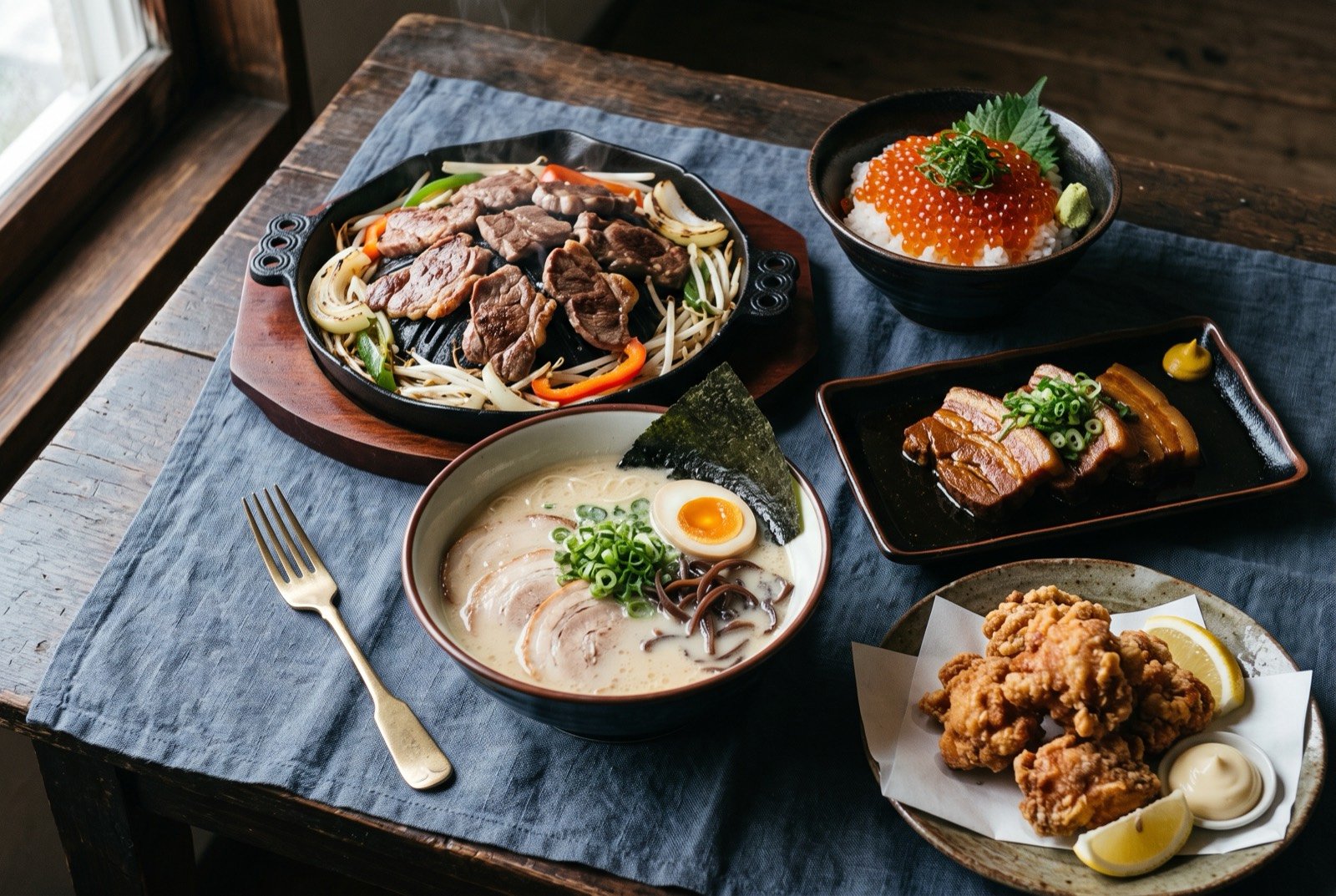
Japan's own dashi and soy grammar, the quiet stock of kombu and katsuobushi, the careful balance of usukuchi against koikuchi shoyu that runs through Honshu's Kansai and Kanto kitchens, does not survive intact at either end of the country. At the northern tip, Hokkaido was not part of Japan's culinary story at all until the Meiji government annexed it in 1869: it was, and remains, Ainu Mosir, the land of the Ainu, whose cooking runs on fermented millet, foraged mountain plants and salmon treated as sacred rather than seasoned into a stock. What most people now call Hokkaido food, Jingisukan lamb, Sapporo miso ramen, dairy so rich it needs no dressing up, is a second layer entirely: a settler cuisine built by American agricultural advisors, wool policy and railway money inside a single working lifetime, on land the Ainu were never fairly compensated for and are, as this chapter is written, still fighting a losing legal battle to fish. At the southern tip, Kyushu tells a different story about the same problem, a food culture built not by isolation but by three centuries of the one door Japan kept open to the outside world: Portuguese Jesuits, then a walled Dutch trading post, then a resident Chinese merchant quarter, all funnelled through Nagasaki while the rest of the country was sealed. Both frontiers earn the same conclusion from opposite directions: neither is a peripheral footnote to Honshu's cooking, and treating either that way would misdescribe what actually happened. Every dish as tradition built it, then what a modern chef would change.
Sources and review · What this chapter does not assert · How we research · Spotted something wrong?
A Sense of Place
Hokkaido before Japan: Ainu Mosir
Before 1869, the island now called Hokkaido was Ainu Mosir, "the quiet land," home to the Ainu, whose language, cosmology and food system are not a regional variant of Japanese culture but an entirely separate one. The Ainu economy ran on salmon, called kamuy-cep, "the divine fish," or sipe, "the true food," caught in the fierce autumn runs and preserved by freezing, drying and smoking to last the winter; on deer, hunted and dried the same way as bear, itself known as kimun kamuy, "god of the mountains"; and on a wide range of foraged mountain plants, among them pukusa, a wild garlic whose harvest was timed to the magnolia's flowering. Grain, chiefly millet, was fermented into tonoto, a sacred drink brewed by women and offered to the kamuy before anyone drank it themselves, and boiled into sito, dumplings soft enough, by the Ainu's own description, to feel like an earlobe. None of this used miso, soy sauce or sugar, all of which appear only in versions of Ainu cooking adapted after Japanese settlement. This was, and where it survives still is, a complete and sophisticated food system on its own terms, not a simpler version of anyone else's.
The settler frontier: dairy, wool and the potato baron
What replaced it, or rather what was built alongside it and then allowed to stand in for it in the popular imagination, was constructed with startling speed. The Hokkaido Development Commission, the Kaitakushi, was founded in 1869, the same year Meiji Japan formally annexed and renamed the island. Within four years an American agricultural advisor, Edwin Dun, had arrived with cattle and sheep and made Hokkaido's first cheese; within seven, William S. Clark had opened Sapporo Agricultural College to train the colonising workforce; within nine, the first tondenhei, soldier-settler farming households, were breaking ground outside Sapporo. By 1908 a baron named Kawada Ryukichi had selected the potato variety that still carries his title. Within a single working lifetime, land with no dairy cattle, no sheep and no Western potato cultivar became the province that would define modern Japan's milk supply. That speed is the whole story of Hokkaido's settler cuisine in miniature: not a slow accretion of tradition, but a fast, state-directed transplant, and this chapter treats it as exactly that rather than dressing it in the timelessness the word "Hokkaido cuisine" tends to imply.
Kyushu, the one door left open
Kyushu's defining fact runs in the opposite direction. While the rest of Japan sealed itself off under the Tokugawa shogunate's sakoku policy, Nagasaki stayed open, and stayed open to three different outside worlds in overlapping sequence rather than one. Portuguese traders and Jesuit missionaries arrived first, from the 1550s, expelled in 1639. The Dutch took over the artificial island of Dejima from 1641 and held Japan's sole sanctioned window onto Europe for the next two centuries. A resident Chinese merchant community, confined from 1689 to the walled compound of Tojin Yashiki, ran in parallel throughout. Nagasaki calls the cuisine this produced wakaran, wa for Japanese, ka for Chinese, ran for Oranda, Holland: three centuries of genuine culinary overlap in one small port city, not a vague gesture at "East meets West." Further south and inland, Kyushu's other defining logic is volcanic: Sakurajima's ash gave Kagoshima soil too poor for rice but perfect for sweet potato, which built an entire shochu culture around a crop planted originally to prevent famine, and a black koji mould borrowed from Okinawan awamori because Satsuma's heat and humidity spoiled the yellow koji that worked further north.
The structural logic, at a glance
| Ainu Hokkaido | Settler Hokkaido | Fukuoka and Kurume | Nagasaki | Kagoshima and southern Kyushu | |
|---|---|---|---|---|---|
| Fat | Fish and game fat | Dairy butter and cream | Rendered pork bone and skin | Lard, sesame oil | Pork fat, sesame oil |
| Starch | Millet, foraged root and bulb | Wheat, dairy, the potato | Low hydration wheat noodle | Wheat noodle, rice | Sweet potato, rice |
| Aromatic | Wild garlic, kelp | Onion, dairy sweetness | Garlic, sesame, chilli | Ginger, spring onion, soy sweetened with sugar | Black koji, citrus vinegar |
| Protein | Salmon, deer, bear | Lamb, dairy, farmed salmon | Pork bone, pork belly | Pork, chicken, fish | Pork, chicken, horse in Kumamoto |
| Defining logic | A complete indigenous system, not a variant | Fast state-directed transplant onto taken land | Emulsion as the whole technical argument | Three centuries of one open door | Volcanic soil forcing sweet potato and a borrowed koji mould |
The History in Layers
The land taken twice: the 1899 Act and a court ruling from this year
The Hokkaido Development Commission's work did not stop at agriculture. The 1899 Hokkaido Former Aborigines Protection Act, modelled explicitly on the United States' 1887 Dawes Act, granted Ainu households land framed as protection, up to five hectares each, but the total granted amounted to roughly 0.1 per cent of Hokkaido, most of it unsuitable for farming. The law stood until 1997. Salmon fishing, the Ainu's own staple, was restricted by Meiji era resource protection law from the late nineteenth century, and for roughly a century afterward only formal commercial licence holders, in practice not individual Ainu households, could legally catch salmon in Hokkaido's rivers. This is not closed history. Raporo Ainu Nation, a community in Urahoro on Hokkaido's Pacific coast, sued the national government and Hokkaido prefecture in August 2020 for legal recognition that salmon fishing in their own river is an indigenous right under the United Nations Declaration on the Rights of Indigenous Peoples. Both the Sapporo District Court and, on 2 July 2026, the Sapporo High Court on appeal ruled against them; by 8 July 2026 the community had confirmed it would not appeal further. The same river system the settler economy turned into Hokkaido's proudest culinary signature, the salmon of Ishikari nabe and kaisendon, was within that same historical span made illegal for Ainu people to fish under their own name, and as this chapter is written that has still not been resolved.
Wild garlic as an insult, and its reclaiming
The politics of Ainu food did not stay abstract or historical. Pukusa, the wild garlic gathered each spring, became during the assimilation era a marker of ethnic discrimination in its own right: non-Ainu neighbours, put off by its strong smell, renamed it "Ainu negi," Ainu onion, as an insult, and many Ainu avoided eating it in public specifically to avoid the association. It was only reclaimed as a point of pride from the 1980s, as cultural revitalisation took hold, led by figures such as Koichi and Miwako Kaizawa, who worked with the anthropologist Masami Iwasaki-Goodman on a community-led food culture project in the Saru River region, and by groups such as Menoko Mosmos, whose modern Ainu bento sold out within an hour of its first public sale at a Sapporo food festival in 2017 and went on to represent Ainu food at Slow Food's Terra Madre in Turin the following year. An ingredient's presence or absence on a plate carried, and in living memory still carries, a real social cost, and this chapter treats that as central rather than incidental.
The million sheep plan and the pig that started white
Two of the settler kitchen's best known dishes were themselves accidents of twentieth century policy, not inherited technique. During the First World War, Japan's wool imports were disrupted, and in 1918 the government launched the Menyo Hyakuman-to Keikaku, the million sheep plan, a national push for wool self sufficiency with breeding stations at five sites, two of them in Hokkaido. The stations needed a market for the meat left over once the wool was taken, and Jingisukan, cooked on a domed skillet in a style explicitly modelled on Chinese roast mutton, emerged from that research through the 1920s, formally named by a Sapporo Agricultural College graduate turned Manchukuo civil servant, Komai Tokuzo, who borrowed the Genghis Khan name as marketing rather than inherited history. Hakata's tonkotsu ramen has an equally unglamorous origin story. The style began clear, at a Kurume yatai called Nankin Senryo in 1937. The now famous milky white broth arrived roughly a decade later purely by accident, when a stall called Sankyu in the same city over boiled a batch of stock far harder than intended and found the cloudy, emulsified result tasted better than the clear original. Neither dish is ancient. Both are twentieth century inventions this chapter treats as exactly that, not as timeless craft dressed up for a modern audience.
Nagasaki's three doors, in sequence
Nagasaki's food culture is inseparable from the specific mechanics of three overlapping periods of contact, not a single vague "opening to the West." Portuguese ships had called at Hirado from 1550, relocating to Nagasaki itself after a violent 1561 incident, with the first Portuguese ship reaching the port on 30 May 1571; the local daimyo, a Christian convert named Omura Sumitada, formally donated the surrounding area to the Jesuits in 1580, and Portuguese traders were expelled by shogunal edict in 1639. Dejima, an artificial island built in 1636 specifically to contain the Portuguese and their missionaries, stood empty for two years after their expulsion until the Dutch trading post relocated there from Hirado in 1641, holding Japan's sole sanctioned point of European contact until the country reopened in 1859. Running throughout both periods was Tojin Yashiki, a walled Chinese merchant quarter built from 1688 after a surge in Qing era Chinese arrivals and smuggling, housing up to two thousand people at a time for 179 years until it was dismantled in 1868. It was this three way overlap, not any single wave, that produced shippoku ryori's round table communal service, imported directly from Chinese banquet custom into a rigidly hierarchical Edo period society where a shared table with no head or foot position was itself a genuinely unusual, levelling gesture. It also produced, via the Jesuits specifically, castella cake, this chapter's clearest and best documented cross regional thread: named directly from the Portuguese pao de Castela, bread of Castile, brought to Nagasaki in the sixteenth century and never generically absorbed into "Western cake," but kept as a distinct, named, traceable import to this day. That lineage runs directly to Volume EU-10, this atlas's Portugal chapter, and specifically to pao de ló, the plain Portuguese sponge cake castella descends from; it is named here rather than re-treated there, and the connection deserves a short cross-reference note in both volumes in time.
The postwar moment: yatai, black koji and a chain that recycles its own bones into fertiliser
Two of this volume's most distinctive institutions are twentieth century civic choices as much as culinary ones. Fukuoka's yatai stalls grew rapidly from 1945, run largely by people who had lost family, homes or work in the war and needed a way to survive; from around 1949, under Allied Occupation policy, the national government pushed to eliminate street stalls nationwide on hygiene grounds. Fukuoka's yatai operators organised, argued the stalls were culture worth protecting rather than a nuisance to clear, and won: the city passed an ordinance formally licensing yatai, making Fukuoka the only Japanese city to protect street stall culture this way by law, and it is why roughly a hundred still trade along the Naka river and through Nakasu and Tenjin today. Kagoshima's black koji mould has an equally specific twentieth century author. Kawachi Genichiro, born in Kagoshima in 1883, imported the black koji used for Okinawan awamori because Satsuma's heat and humidity made the citric acid it produces far more reliable against spoilage than the yellow koji used on Honshu; a spontaneous mutation of his own black koji strain in 1924 produced the white koji now used across much of Kyushu's shochu industry, and the company he founded still supplies koji starter to roughly eighty per cent of Japan's shochu producers today. And where craft ends and industrial discipline begins, Ichiran's own account of its supply chain is worth naming plainly: the chain filters every drop of its process water through commercial filtration, and recycles the spent pork bone sludge left over from its broth into a fertiliser it uses to grow the spring onions it then serves, a closed loop that is genuine technical discipline at scale, not marketing colour.
The Flavour Arsenal
Kombu, the kelp that is mostly Hokkaido's
The great majority of Japan's kombu comes from Hokkaido's cold coastal waters, and it is the base of the dashi grammar this volume's two frontiers each depart from in their own direction, Ainu cooking layering it onto sito rather than steeping it for stock, Kyushu leaning it into a lighter, sweeter shoyu rather than Kansai's usukuchi. Professional practice holds kombu at a controlled 60 degrees Celsius rather than a full boil, since higher heat draws out bitter alginic compounds that coarsen the flavour; a cold steep overnight in the refrigerator is offered as an even cleaner alternative.
Hokkaido dairy, worked hard rather than treated as a novelty
Edwin Dun's 1876 cheese at Makomanai began an industry that now supplies the majority of Japan's milk, and a genuine artisan cheese sector, documented by the prefecture's own Milkland Hokkaido network, has grown up around small producers such as Furano Cheese Kobo and Shiawase Cheese Kobo. Danshaku, the baron potato bred at Nanae in 1908, remains the province's most planted variety and the closest thing Hokkaido cooking has to a defining starch beyond rice.
Black and white koji, the mould that decides Kyushu's whole grammar
Where Honshu's fermentation runs on yellow koji, Kagoshima and much of southern Kyushu runs on the black koji Kawachi Genichiro imported from Okinawa and the white koji that mutated from it in 1924. The choice of mould, not just the base ingredient, is what actually separates a Kyushu ferment from a Honshu one, and it is worth a reader understanding that distinction before they ever open a bottle of shochu.
Amakuchi shoyu, Kyushu's own sweetened soy
Kyushu soy sauce, amakuchi, is genuinely sweeter and darker than Honshu's usukuchi or koikuchi styles, sweetened with sugar or, in some makers' versions, liquorice, and it is not an inferior or a regional imitation of "real" soy sauce but a distinct, deliberate style suited to the region's own cooking. Conflating it with usukuchi, a paler, saltier Hyogo style used as a seasoning rather than a table sauce, is a genuine and easy mistake worth naming plainly.
Kurozu, vinegar aged in open jars on a volcano's shoulder
Kagoshima's black vinegar is made at Fukuyama, on Sakurajima's sheltered northeast side, by layering steamed rice, rice koji and water directly into large earthenware jars left standing outdoors in fields running to tens of thousands of pots at scale. Uniquely among vinegars this chapter is aware of, saccharification, alcoholic fermentation and acetic fermentation all proceed in the same single vessel without transfer, over three to six months of fermentation followed by six months or more of further ageing, the amber colour developing only across that long outdoor maturation.
Shochu, four regional grammars under one word
Imo jochu, sweet potato shochu, is Kagoshima and Miyazaki's own, built on a crop that arrived from Ryukyu in 1705 via a boatman named Maeda Riemon specifically as insurance against famine on soil too poor for rice. Mugi jochu, barley shochu, has two genuinely distinct claims: Iki island's older, sixteenth century tradition, born of barley's exemption from the harsh rice tax that stripped the island bare, and Oita's much more recent, industrial scale mainland tradition, driven from 1973 by Nikaido Shuzo's first hundred per cent barley shochu and popularised from 1979 by Sanwa Shurui's Iichiko. Kome jochu, rice shochu, is Kumamoto's Kuma tradition, legally protected since 1995 with the same status as Champagne or Scotch, distinguished technically by its use of white rather than black koji since around 1970. Kokuto shochu, black sugar shochu, is legally unique to the Amami islands, the one place Japanese liquor law permits sugar as a shochu base at all, and only when fermented alongside rice koji, a specific tax law exception with roots in Satsuma's nineteenth century confiscation of the islands' entire sugar harvest as tribute.
Kibinago and Miyazaki wagyu, the two proteins this chapter cannot pretend the UK can match
Kibinago, a small herring family fish eaten as sashimi in a chrysanthemum fan cut with sweetened vinegar miso, deteriorates so fast after catch that genuinely fresh kibinago sashimi is, honestly, confined to Kagoshima and its immediate coast; a UK cook should treat any recipe using it as aspirational reading rather than a shopping list. Miyazaki wagyu, by contrast, having won Japan's top prize at the five yearly national wagyu competition across four consecutive contests, is genuinely, traceably buyable in Britain today under its own Kagoshima A5 relatives, one of the few places in this whole chapter where the real regional product, not a substitute, sits on a UK butcher's counter.
The Technique Ladder
The argument, from inside
Every technique below answers the same underlying question in a different register: how do you get more out of an ingredient, whether that ingredient is a pig's bone, a piece of kelp, a fresh caught salmon egg or a jar of fermenting rice left outdoors for a year, than a casual cook would think to ask for. None of it is decorative, and all of it transfers cleanly onto a kitchen already holding a Big Green Egg, a sous vide bath, a dehydrator, a high power blender, a chinois and a dedicated spice grinder.
Rung 1. Tonkotsu is an emulsion problem, not an extraction problem
The single most misunderstood piece of technique in this chapter. A gentle simmer, however long, produces a clear stock, exactly as it did at Kurume's original 1937 yatai. What actually turns tonkotsu white is a hard, violent, rolling boil that mechanically smashes bone and cartilage against the pot and each other, releasing collagen and gelatin that emulsify the water and the rendered fat together rather than letting them separate. Pig's trotters are added specifically because their extra gelatin load stabilises that emulsion against breaking on standing, the exact quality control problem a service kitchen has to solve for hours of holding. A home cook fixated on boiling twelve, or eighteen, or twenty hours is chasing the wrong variable: the boil has to be hard enough to agitate, not merely long enough to extract.
Rung 2. Controlled low heat, where a traditional kitchen never had it
Kombu dashi held at a steady 60 degrees Celsius, never a boil, avoids drawing out the bitter alginic compounds a hotter steep releases, and Suigetsu's 1905 mizutaki method takes the same logic further, a hard two hour simmer followed by a full two hour cooling rest to let collagen and umami migrate fully before the pot is reheated for service. Sous vide makes both of these trivial to hold precisely where a traditional kitchen could only approximate them by feel, a genuine case of a restaurant technique with an indigenous ancestor rather than an import from anywhere else.
Rung 3. Curing at controlled salinity
Hokkaido Gyoren's own published method for ikura specifies a salt water solution of roughly 0.5 per cent, gentle enough to separate the eggs from the membrane sac by hand without rupturing them; too strong a brine and the roe loses flavour into the liquid before it ever reaches the table. This is precisely executable with a scale and patience, and a dehydrator, used carefully, can push a semi dried variant further than the standard shoyu zuke soy cure most home cooks default to.
Rung 4. Open vessel, single pot, three fermentations at once
Kurozu's method, saccharification, alcoholic fermentation and acetic fermentation proceeding together in one open earthenware jar rather than moved between separate tanks, is genuinely unusual even within Japan, and the underlying principle, that a slow, uncontrolled, open environment can be a deliberate choice rather than a failure of control, is worth carrying into a home cook's own vinegar or koji experiments rather than reaching automatically for a sealed, sterile setup.
Rung 5. Fire as a finishing tool, not only a cooking method
Commercial Hokkaido producers torch fresh uni briefly with a light savoury glaze specifically to firm the exterior while keeping the interior soft, concentrating sweetness through controlled heat rather than treating the ingredient as raw only material. A kitchen torch, or the Big Green Egg's own high, direct heat for a few seconds a piece, does the same job at home, and the same logic, controlled surface heat over a few seconds, is worth applying to Jingisukan lamb once it has had time to marinate rather than only ever grilling it hard from cold.
Rung 6. Two mould strains, two different jobs
Black koji's citric acid resists spoilage in heat and humidity; the white koji mutated from it gives a cleaner, gentler ferment better suited to rice shochu and, in a home kitchen, to a milder shio koji or amazake. Knowing which strain does which job, rather than treating "koji" as one undifferentiated ingredient, is the single most transferable piece of fermentation literacy this chapter can offer a reader who already keeps their own cultures at home.
The Koji and Ferment Bench
Every fermentation in this chapter answers to the same two moulds, black and white koji, doing different jobs in different climates, and it is worth a home cook keeping both rather than treating koji as one undifferentiated culture. Shio koji, salted fermented rice koji, is the simplest entry point: combine equal parts by weight cooked rice koji and water with koji's own weight again in salt, roughly a quarter that combined weight, and leave at room temperature, stirring daily, for seven to ten days until it smells sweet rather than sharply salty; use it as this chapter's ramen tare uses miso, in place of a portion of it, for a rounder depth. Kurozu, if a reader wants to attempt a genuine version rather than buy one, needs patience this chapter will not pretend a home kitchen can shortcut: a year from sowing to finished vinegar, in an open earthenware vessel, is the real timeline, and a Kilner jar left somewhere warm and undisturbed for several months is the closest reasonable approximation, understanding plainly that it will not be Fukuyama's product. Ikura curing at 0.5 per cent salinity, detailed in dish five above, is itself a preserve as much as a preparation, extending fresh roe's life by several days under refrigeration. Ruibe, salmon frozen and eaten without thawing, is Hokkaido's own oldest preservation method and the simplest thing in this entire chapter to reproduce: a domestic freezer set below minus 20 degrees Celsius for 48 hours, the standard advice for sashimi grade safety anywhere, gives a genuinely close result. Tonoto, the Ainu's own sacred fermented millet drink, is deliberately not given a home recipe here. It is brewed by Ainu women specifically, offered to the kamuy before it is drunk, and its preparation belongs inside that living ceremonial context rather than as a curiosity for a British kitchen to attempt; understood and respected, not converted into content.
Sourcing in Britain
No single UK retailer specialises narrowly in Hokkaido or Kyushu produce; the trade runs through a handful of general Japanese grocers who between them cover most of what this chapter needs. Japan Centre and its Ichiba food hall at Westfield London is the largest operation, with a dedicated ramen noodle category and, notably, a Hokkaido style ramen served alongside Tokyo styles at its own Showaken counter. Atariya, a fishmonger led chain with five London shops, sells frozen Grade A wild Alaskan ikura, a genuinely good stand in for Hokkaido's own salmon roe. SushiSushi carries Yokoi's three year aged kurozu and a proper Japanese bowls range. Yutaka and Starry Mart both stock Kuro Kirishima imo shochu and iichiko mugi shochu, the two honkaku styles a UK reader can actually buy and understand; kome and kokuto shochu are, honestly, close to unobtainable here and should be read about rather than shopped for. Sous Chef stocks kombu, katsuobushi and unpasteurised barley miso from Clearspring, aged one to two years in cedarwood, a genuine quality benchmark. The Wasabi Company, growing fresh wasabi in Dorset watercress beds by the traditional sawa method, is arguably a better product for this chapter's purposes than any imported frozen alternative, and worth naming as a real British win rather than only ever a substitute.
Real Hokkaido milk, live scallops and fresh uni cannot be shipped to Britain in any usable form, so this chapter is honest about what stands in for them. Jersey and Guernsey butter and double cream, named by breed rather than a single brand, are the closest analogue to Hokkaido's own rich dairy. Scottish and Orkney hand dived king scallops, diver caught rather than dredged, are not a compromise substitute for hotate but a genuinely excellent ingredient in their own right. Uni is this chapter's weakest link: what UK retailers sell as fresh sea urchin is overwhelmingly frozen Canadian roe, and no commercial UK caught supply chain exists to match it, a gap worth stating plainly rather than dressed up. Tonkotsu bones are, happily, no import problem at all: any UK butcher, and specifically The Ethical Butcher, will sell pork trotters and neck bones for exactly this purpose, and Borough Broth sells a ready made organic tonkotsu broth from British high welfare farms for a reader who wants the honest shortcut. Fresh, non instant ramen noodles are a genuine home cook's gap: the one UK maker, Komugi, trades wholesale only, so making noodles from scratch with kansui and bread flour is, at present, the only route to the real thing at home. A jingisukan grill can be bought from specialist Japanese kitchenware importers, but a Big Green Egg fitted with a flat plancha or cast iron griddle insert is the honest, more accessible substitute most readers will actually use.
Ranked, the ingredients that decide whether a home version reads as genuinely good rather than a pale copy: tonkotsu bones and boil discipline first, since the technique matters more than any single import; proper kombu and katsuobushi for dashi; amakuchi, not generic dark soy; unpasteurised, aged mugi miso; genuinely diver caught Scottish or Orkney scallops; a real honkaku shochu, imo or mugi, drunk and understood correctly; kurozu where a recipe calls for it, not a generic Chinese black vinegar substitute; and, last, honest uni sourcing, ranked last not because it matters least to flavour but because no amount of careful buying gets a UK reader genuinely Hokkaido grade uni, so the only real discipline available is naming what it actually is.
Voices and Sources
This chapter leans heavily on Japanese language sources throughout: the Ministry of Agriculture, Forestry and Fisheries' own regional and traditional dish databases, which supplied real quantities and timings for Jingisukan, Ishikari nabe, karashi renkon and champon; the city and prefectural governments of Nagasaki, Kagoshima, Fukuoka and Kumamoto; and the working restaurants and producers whose own institutional histories anchor this chapter's origin stories, among them Shikairo, Toyoken, Fukusaya, Kawachi Genichiro Shoten, Hakutake Shuzo and Nikaido Shuzo. For Hokkaido's Ainu material specifically, the strongest single source is Masami Iwasaki-Goodman's peer reviewed FAO and McGill CINE case study, written from research led by the Ainu community leader Koichi Kaizawa and co-researcher Miwako Kaizawa, the one place in this chapter's research where Ainu voices appear directly quoted rather than described by others. Tomoko Keira's bilingual memoir The Spirit of Huci and Mieko Chikappu's essay "Salmon Coming Home in Search of Sacred Bliss," in the anthology First Fish, First People, are genuinely Ainu authored works this chapter's research identified but could not access in full within its working time, and are recommended reading ahead of any future revision. For the modernist and technique material, Ichiran's, Shoryu's and Kanada Ya's own published accounts, Japan's Michelin newsroom, and the Hokkaido prefectural fisheries federation's own ikura curing method were the strongest sources; Shoryu's founder Tak Tokumine, who grew up inside Hakata ramen culture before opening the UK's most established Hakata style ramen bar in 2012, is this chapter's clearest diaspora reference point, in the same spirit this atlas elsewhere treats Ikoyi, Akoko and Chishuru: a real practitioner worth naming, not a template to copy.
Things this chapter has deliberately not asserted
- That Hokkaido's salmon and scallop fisheries were built on Ainu labour or transferred Ainu ecological knowledge. Plausible given the Ainu's prior mastery of these fisheries, but not documented with a source this chapter's research could stand behind.
- A precise founding date, inventor or first restaurant for kaisendon or ikura-don. Genuinely not found in the sources reached; treated here as a real gap rather than filled with a plausible sounding invention.
- That mefun, fermented salmon kidney, was historically presented to the Japanese imperial court. Found once, on a single non-academic source, with nothing to corroborate it.
- Any first person Ainu account of iyomante's food dimension. What this chapter describes comes from Japanese language reference works, not an Ainu authored source, and that gap is named rather than papered over.
- A single, canonical tare ratio for Hakata tonkotsu ramen. It genuinely varies shop to shop between shio and shoyu bases; any specific ratio in this chapter's recipe is illustrative, not a historic shop's guarded formula.
- That Kato Kiyomasa's Korean campaign, food shortage origin story for Kumamoto's basashi is verified history, as opposed to the account Kumamoto tells about itself. It recurs across many sources with no cited primary evidence, and is presented here as the region's own telling, not settled fact.
- The claim, sometimes repeated in English language food writing, that karaage originated in Usuki, Oita. This chapter's research could not locate that claim in any Japanese source. The real, documented and still unresolved dispute is between Usa and Nakatsu, and both are named here rather than one invented winner.
- Whether Shimazu Nariakira or Ryukyuan chiki-agi is the true origin of satsuma-age. Kagoshima's own city government presents both without choosing, and this chapter follows that lead rather than adjudicating a dispute the region itself has not settled.
- Any current Michelin star count for a restaurant in Sapporo, Fukuoka or Nagasaki. Michelin's own regional coverage here has not been updated since 2017 for Hokkaido and 2019 for Fukuoka, Saga and Nagasaki; any star named in this chapter is a historical snapshot at the time of that guide, not a live rating, and a reader checking today should expect the picture to have moved on.
Tonkotsu is an emulsion problem, not an extraction problem
The single most misunderstood piece of technique in this chapter.
Controlled low heat, where a traditional kitchen never had it
Kombu dashi held at a steady 60 degrees Celsius, never a boil, avoids drawing out the bitter alginic compounds a hotter steep releases, and Suigetsu's 1905...
Curing at controlled salinity
Hokkaido Gyoren's own published method for ikura specifies a salt water solution of roughly 0.5 per cent, gentle enough to separate the eggs from the membrane...
Open vessel, single pot, three fermentations at once
Kurozu's method, saccharification, alcoholic fermentation and acetic fermentation proceeding together in one open earthenware jar rather than moved between...
Fire as a finishing tool, not only a cooking method
Commercial Hokkaido producers torch fresh uni briefly with a light savoury glaze specifically to firm the exterior while keeping the interior soft...
Two mould strains, two different jobs
Black koji's citric acid resists spoilage in heat and humidity; the white koji mutated from it gives a cleaner, gentler ferment better suited to rice shochu...
The dishes
- Cep ohaw, Ainu salmon and mountain vegetable soup Ainu Hokkaido
- Jingisukan, Hokkaido's settler grilled lamb Hokkaido
- Ishikari nabe, salmon and miso hot pot Hokkaido
- Sapporo miso ramen Hokkaido
- Ikura-don, cured salmon roe over rice Hokkaido
- Hakata tonkotsu ramen Kurume and Hakata, Fukuoka
- Karaage, Kyushu's fried chicken Oita, Kyushu
- Nagasaki champon Nagasaki, Kyushu
- Nagasaki kakuni, slow braised pork belly Nagasaki, Kyushu
- Karashi renkon, Kumamoto's mustard stuffed lotus root Kumamoto, Kyushu
- Kasutera, Nagasaki's castella cake Nagasaki, Kyushu
Sources and review
- Reviewed
- Not yet reviewed from inside the tradition
- Cooked
- Not yet cooked and reported
Where this volume comes from
3 research briefs on file for this volume, researched to the rules on How we research. Published 3 September 2026. Last changed 8 September 2026.