Asia · Volume 52
Honshu and the Kansai-Kanto Spine
The Koikuchi Line, the Kombu Coast and the Kaiseki Counter
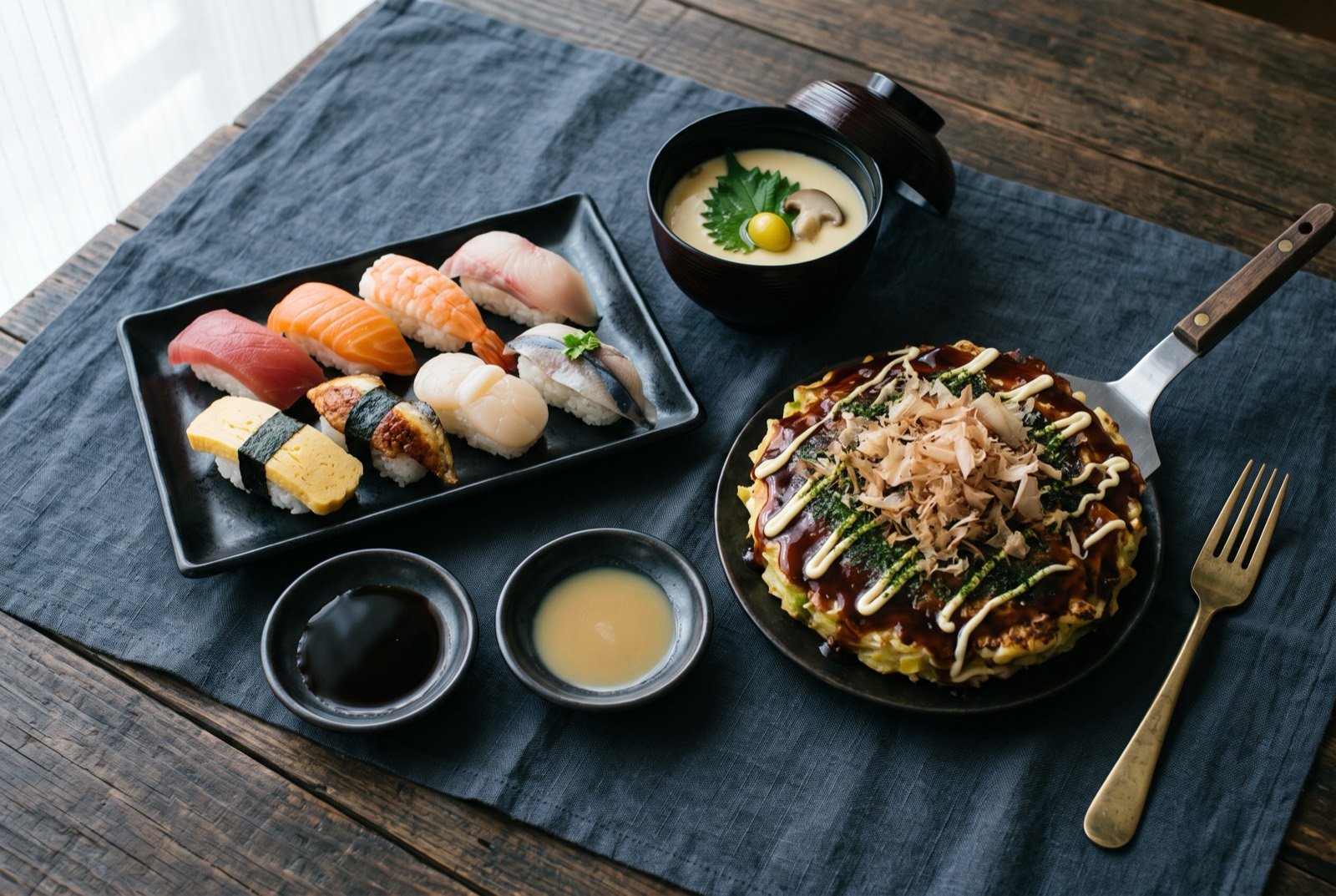
Two cities built two different versions of the same island's cooking, and the fault line between them still runs through every bowl of dashi in Japan: Tokyo's dark soy and bonito on one side, Osaka and Kyoto's pale soy and kelp on the other, and neither one is a variant of the other. Every dish as tradition built it, then what a modern chef would change.
Sources and review · What this chapter does not assert · How we research · Spotted something wrong?
A Sense of Place
Most food writing outside Japan treats "Japanese food" as a single register, sushi, miso, soy sauce, dashi, spoken of as though one Tokyo restaurant could stand for the whole archipelago. It cannot, and the failure to notice that is this chapter's actual subject. Honshu, Japan's main island, carries a genuine east west fault line running straight through its cooking, and the fault line has a name in every professional kitchen on either side of it: Kanto in the east, built around Tokyo and Edo Bay, and Kansai in the west, built around Osaka and Kyoto. The two regions do not merely prefer different flavours. They built different soy sauces, different dashi, different knives, different pan shapes and, in more than one case, entirely different accounts of what a shared dish is even for.
Kanto's ecology is Edo Bay first and the Kanto plain second. Edo, renamed Tokyo only in 1868, grew from a modest castle town into one of the largest cities on earth under Tokugawa rule, and its food culture is the food culture of a fast growing, dense, working population fed from a specific, nearby body of water. Edo Bay's own productivity had a genuinely local cause: as the city's population rose, nutrient rich domestic wastewater draining into the bay fed the plankton growth that in turn fed the shellfish and fish that made the bay's catch good eating, a feedback loop between the city and its own water rather than a natural abundance that predated the city. Early sushi toppings were drawn specifically from that water and its estuarine edges, shirauo icefish from around Tsukuda Island, river shrimp, conger eel, gizzard shad, all named as archetypal Edomae items in the Edo period source Morisada Manko. Inland, the Kanto plain's cooler climate and thinner, poorer soil favoured buckwheat over wheat, which is the specific agronomic reason Edo became a soba city rather than an udon one, buckwheat's optimal pollen germination sits under 20°C and its yield and quality both suffer past roughly 28°C, a plant genuinely better suited to Kanto's cooler uplands than to Kansai's warmer, better wheat growing soil. And Kanto's water itself is comparatively hard, which extracts katsuobushi's inosinate more readily than it extracts kombu's glutamate, a fact this chapter will return to because it may be the single most consequential ecological detail in the whole volume.
Kansai is two cities doing two different jobs, Osaka the merchant port and Kyoto the thousand year capital, and both built their cooking on the same one resource Kanto never had cheap access to: kombu. Kombu's growing region was, and is, Hokkaido, nearly the whole length of the country away from either Kyoto or Osaka, and what made it Kansai's defining ingredient rather than a rare import was a specific trade route, the kitamaebune, merchant ships running from Ezo down through the Hokuriku coast and the Seto Inland Sea to Osaka from roughly the mid eighteenth century into the Meiji era, a route Edo never had the same access to. Osaka grew into "tenka no daidokoro," the nation's kitchen, on the strength of exactly this position: the Yodo and Yamato rivers connected it inland toward Kyoto and Nara, a dense canal grid moved bulk goods efficiently through the city, and the Dojima rice exchange, formally recognised by the shogunate in 1730, set the standard rice price for the entire country from a market inside Osaka itself, described by Japanese sources as a genuine precursor to modern commodity futures trading anywhere in the world. Kyoto, thirty miles inland and landlocked, ran on a different logic entirely: a millennium as imperial capital drew tribute produce and superior seed stock from across the country toward its court, its temples and its pilgrim traffic, which is the specific, documented reason Kyoto prefecture today still designates thirty seven traditional pre Meiji vegetable varieties, Kamo eggplant, Shogoin turnip, Kujo negi among them, a concentration of horticultural variety no ordinary regional town accumulated. Kyoto's food logic is also, unusually among the world's great cuisines, a genuinely vegetarian logic running underneath the meat and fish dishes that sit on top of it: shojin ryori, Buddhist temple cooking, still feeds visitors at working temples today, and it is the direct ancestor, alongside the tea ceremony's own cha kaiseki, of the formal kaiseki tradition the whole world now associates with Kyoto.
A table of zones, logic and dishes
| Zone | Defining logic | Carried by |
|---|---|---|
| Kanto (Tokyo, Edo Bay, the Kanto plain) | Fast growing merchant city fed by its own bay; hard water favouring katsuobushi extraction; buckwheat over wheat; koikuchi, dark, assertive soy developed to season stronger tasting fish and carry through a bold dashi | Nigiri-zushi, zaru soba, tempura as Edo street food, kabayaki, tamagoyaki (sweet, sugar forward) |
| Kansai, Osaka (merchant port, tenka no daidokoro) | Kitamaebune kombu trade; a mercantile, quantity minded city that turned cheap, abundant ingredients, octopus, wheat batter, offal cuts, into a genuine street food culture | Okonomiyaki, takoyaki, kushikatsu, Osaka style sukiyaki |
| Kansai, Kyoto (imperial capital, temple city) | A thousand years of court and temple demand; usukuchi, pale soy developed specifically not to darken a delicate dashi; the formal kaiseki tradition, descended jointly from cha kaiseki and honzen ryori | Kaiseki ryori, dashimaki tamago, hamo with hone kiri, obanzai |
The fault line has not closed in the era of the Michelin Guide; if anything, it has sharpened into two separate, actively competing scenes. Tokyo carries 160 starred restaurants in the 2026 guide, twelve of them three star, and its sushi world alone runs from Sushi Yoshitake, the city's only three star sushi counter, through to Sushi Saito and Sushi Sawada, both of which have withdrawn from public booking entirely and now take reservations only through existing patrons. Kyoto and Osaka's own 2025 guide recommended 469 restaurants, 172 of them starred, with Kikunoi's Yoshihiro Murata standing as the clearest living primary voice for what kaiseki actually is, since he has published directly on the subject rather than being described only through critics. Both scenes are genuinely contemporary, not museum pieces, and this chapter's modernist material below treats them that way.
The History in Layers
Before either city as we know them existed, sushi itself began as a preservation method, not a dish. The earliest forms, narezushi, fermented fish in salted rice over weeks or months, the rice discarded and only the preserved fish eaten, are the deep ancestor of everything nigiri-zushi later became, and the shift from that ancient fermentation logic to a fast, vinegar seasoned, freshly assembled food is itself the Edo period's own invention, not a continuous unbroken tradition running back to antiquity. Funazushi, crucian carp fermented in rice for months, survives today specifically as a living relic of that older method, still made and eaten, and this chapter treats it as exactly that, a fossil beside the living animal rather than the same animal.
The Portuguese arrived at Nagasaki in the 1540s, and the technique they brought there changed Edo's food a century and a half before Edo mattered to the story at all. Firearms reached Japan through the same channel in 1543, and not long after, Portuguese missionaries and traders brought a fasting day frying method, tempora, tempora referring to the Ember Days of the Catholic calendar, when fish rather than meat was eaten, often fried in a thick, egg and sake enriched batter closer to Iberian peixinhos da horta than to anything a modern diner would recognise as tempura. This is the same Portuguese Jesuit trading network, and largely the same historical moment, that carried battered and fried fish technique into Portugal's own kitchen at Nagasaki's other end of the exchange, a crossover this atlas's Iberia volume on Portugal (EU-10) documents from the receiving side. The technique spread from Nagasaki to Kansai by around the seventeenth century, thinning into tsuke-age, and from Kansai on to Edo by the Anei era, 1772 to 1781 at the latest, where it became, alongside soba and sushi, one of "Edo's three flavours," a street stall food sold from skewers dipped in a shared tsuyu, illustrated in the Edo period scroll Kindai Shokunin Zukushi Ekotoba, held at the Tokyo National Museum. Tempura did not arrive in Japan as refined restaurant food. It arrived as a foreign fasting technique, was thinned and Japanised twice over on its way east, and only became elevated cuisine centuries after it was Edo street food, a genealogy worth stating plainly against any assumption that a dish this refined must always have been treated with the reverence it gets today.
Edo's own soy sauce did not travel from Kyoto. It grew up specifically to replace Kyoto's soy sauce, on the strength of two towns and one river system. Noda and Choshi, both in Chiba, became the Edo period's two dominant soy production centres because both sat on the Tone River and Edo River water transport network, a route engineered deliberately: the Tone River Eastward Diversion project, from the Shinkawa channel's opening in 1621 to its completion by 1654, created a water corridor running through Choshi, Sekiyado and the Shinkawa and Onagigawa channels directly into Edo. Higeta, founded 1616 in Choshi, is candid in its own company history that its earliest product was closer to a miso tamari style condiment, and that the deliberate addition of wheat, refining the method into what became koikuchi, dark soy, is what found favour with Edo residents and became foundational to Edo food culture, sushi and tempura both included. Yamasa, founded 1645, also in Choshi, received the shogunate's own top grade soy producer designation in 1864. As Noda and Choshi's koikuchi steadily displaced Kansai made soy sauce in the Edo market across the eighteenth century, Edo built an entirely new, assertive, dark, sweetened flavour grammar on top of it, one genuinely different from the pale, salt forward soy that had reached Kyoto's kitchens by an entirely separate route.
That separate route ran through Tatsuno, in Hyogo, and it was built to solve a specific problem Edo never had: how to season a delicate court dashi without darkening it. Usukuchi, pale soy, is dated by Higashimaru, Tatsuno's largest producer, to 1666, and the company's own history states plainly that as it came to be used in Kyoto's shojin ryori and kaiseki cooking, it evolved into the refined, pale style known today, a soy sauce developed for what it visually would not do to a dish, not for raw strength. Usukuchi is, despite the name, saltier than koikuchi, roughly 16% against koikuchi's 14.5%, because more salt in the mash suppresses fermentation and keeps the colour pale, a genuinely counterintuitive fact worth stating directly: Kansai's "lighter" soy sauce is the saltier one.
The Meiji Restoration, 1868, opened Japan's kitchens to beef for the first time in over a millennium, and Kanto and Kansai answered the new ingredient in two genuinely different ways, which is why sukiyaki exists in two structurally different forms today rather than one. Sukiyaki itself is credited with a Kansai, mid Edo period origin, "suki" naming a farm implement blade repurposed as an improvised grill plate, the older lineage of the two. The Kanto version descends instead from gyunabe, a specifically Meiji era beef hot pot devised because raw beef's smell was considered strong and off putting to palates unused to it, simmered with green onion and miso or soy to make it palatable, a genuinely newer, beef specific adaptation of older nabe technique built around a premixed warishita sauce rather than direct pan searing. Sukiyaki is not, in other words, one old dish with two regional accents. It is one older Kansai grilling technique and one newer Kanto simmering technique that both happen to share a name and an occasion.
Nigiri-zushi's own popular history compresses two very different centuries into one, and the compression is worth undoing. The commonly repeated story credits the first Hanaya Yohei, in Ryogoku, with inventing nigiri during the Bunsei era, 1818 to 1830, and the story survives specifically through a written record by the haiku poet Koizumi Ugai, the younger brother of the man who inherited the Hanaya Yohei name two generations later, a family transmitted account rather than a contemporary, independent one, and multiple Japanese sources note plainly that the actual inventor is unknown even while crediting Yohei as the person who perfected and popularised the form. What that popular story leaves out entirely is more consequential than the attribution question: nigiri-zushi did not become sushi's dominant national form until after the Second World War, when a rationed rice exchange system let citizens trade a small rice ration for sushi at regulated shops, pushing the nigiri format nationwide for the first time. Before that, for well over a century, nigiri was essentially a regional Edo speciality, sold from stalls at around eight mon a piece, comparable in relative terms to a modern kaiten zushi plate, everyday food for a working population, described in one mainstream Japanese paper as Edo's own hot dog stand, not the fine dining form it is internationally understood as today.
The newest layer of this history is not in Japan at all, and it is worth naming before this chapter turns to technique. London now carries a genuine, verifiable scene of Edomae and kaiseki technique transmission rather than token borrowing, three cases of it with a clear, sourced training lineage back to Japan. Marty Lau, UK born, apprenticed under Mitsuhiro Araki for over nine years across London, Hong Kong and Tokyo before becoming head chef of The Araki's Mayfair counter in 2015, close to a decade of in-person training inside a Japanese kitchen hierarchy, by his own account a genuinely bewildering process at times, rather than a short stage or a cookbook derived borrowing. Endo Kazutoshi, a third generation sushi chef from Yokohama, spent four years immersed in Edomae technique at one of Tokyo's top omakase counters before a chance meeting in Madrid brought him to London, where he now runs his own counter after years cooking a more fusion oriented "modern Japanese" register elsewhere. Toru Takahashi opened Sushi Tetsu, a seven seat Clerkenwell counter, in 2012, and is widely described in London food criticism as the city's most authentically Edomae sushi experience. None of the three is reproducing Japanese food from outside the tradition. All three trained inside it, and this chapter's own Voices section below returns to them directly.
The most recent layer inside Japan, still visible in a single bowl of oden, is a literal reconstruction after catastrophe. The 1923 Great Kanto Earthquake displaced craftspeople between the two regions during reconstruction, and Kansai's own distinct unfried dengaku style, ingredients warmed through in kombu dashi with sweet miso, which Kansai itself had specifically nicknamed "Kanto daki" to distinguish from their own dish, was reintroduced into Kanto during that rebuilding, bringing seasonings and ingredients not previously used there. The oden most Japanese people eat today is a post 1923 Kanto Kansai hybrid, not an unbroken Edo period tradition, a genuinely useful correction to carry into the rest of this chapter's habit of treating Kanto and Kansai food as cleanly separable: by the twentieth century they were already borrowing from each other, sometimes under duress, and the fault line this chapter documents was never a wall.
The Flavour Arsenal
The two soy sauces the whole spine rests on
| Soy sauce | Home | Salt | Character and use |
|---|---|---|---|
| Koikuchi, dark soy | Choshi and Noda, Chiba (Kanto) | Roughly 14.5% | Made from roughly 1:1 soybean to wheat, brined and fermented six to eight months in honjozo brewing; strong, dark, assertive, developed to carry and mask the stronger, oilier fish historically caught in Edo Bay |
| Usukuchi, pale soy | Tatsuno, Hyogo (Kansai) | Roughly 16% | A shorter fermentation, roughly 30% shorter than koikuchi's, and a heavier salt load in the mash specifically to suppress colour development; seasons a dish without darkening it, the soy sauce a delicate dashi needs |
Dashi's two grammars
Katsuobushi, dried, fermented, smoked bonito, is Kanto's own dashi backbone, its umami compound primarily inosinate, a nucleotide. Kombu, dried kelp from Hokkaido, is Kansai's, its umami compound primarily glutamate. Combined, the two produce a flavour intensity well beyond either alone, a real, measurable synergy effect recognised in food science, not merely a chef's turn of phrase: Kikunoi's own Yoshihiro Murata gives it as "when you add kombu, which has glutamic acid, to bonito, which has inosinic acid, then one plus one equals eight." Extraction should not exceed roughly 60°C, since higher heat and boiling releases mucilaginous, bitter compounds from kombu; clean glutamate extraction begins around that temperature and should be held there, which is reportedly Kikunoi's own kombu soaking practice, one hour at 60°C. Kombu itself carries real grade distinctions worth a home cook understanding: ma-kombu, from the Tsugaru Strait, is the sweetest and highest in natural glutamate, historically Osaka's own preference; rishiri produces a cleaner, more refined dashi, historically preferred in Kyoto style cooking; rausu is richer and more amber; hidaka is a softer workhorse grade used whole in simmered dishes as well as dashi.
Niboshi, dried whole anchovies, is the third, humbler dashi component, used across both regions for a stronger, fishier stock than katsuobushi alone gives, and it is genuinely the weakest sourced of the three in Britain, discussed under Sourcing below.
Mirin, sake and vinegar
Hon mirin, true mirin, is genuinely fermented and contains real alcohol, commonly around 13 to 14% ABV, taxed and regulated in Japan as an alcoholic beverage; it is the only version that produces the correct glossy lacquer finish on a glazed dish. Mirin fu chomiryo, mirin style seasoning, is not fermented at all, near zero alcohol, sweeteners standing in for the complex sugars real fermentation produces, and gives a flat, one dimensional glaze. The two are trivially told apart by the label's ABV figure, a distinction this chapter treats as one of the highest leverage purchasing decisions in the whole volume. Cooking sake, by contrast, differs from drinking sake mainly by law: Japanese manufacturers are required to salt dedicated cooking sake, around 2 to 3%, specifically to make it undrinkable, which lets it be sold without an alcohol licence, and an ordinary drinking sake works perfectly well for cooking in its place. Rice vinegar carries no such trap, Mizkan is the country's own leading brand and is straightforwardly what most professional kitchens reach for.
Miso and koji
Koji, steamed grain inoculated with spores of Aspergillus oryzae, is the single organism underneath soy sauce, miso and sake all at once, and the only fungal species considered fully domesticated by humans. Its enzymes do two jobs at once: protease activity breaks proteins down into amino acids, the source of a dish's savoury body, while amylase activity releases fermentable sugars for the accompanying yeast fermentation. Shiro (white), aka (red), saikyo and awase miso all descend from the same organism worked to different lengths of fermentation and different salt ratios, pale and sweet at the short end, dark and assertive at the long end, a spectrum that maps, not coincidentally, onto the same koikuchi to usukuchi logic running through this chapter's soy sauce.
Kyoto's own vegetable register
Kyo yasai, Kyoto's thirty seven officially designated pre Meiji vegetable varieties, include Kamo eggplant, central to shibazuke pickles alongside shiso and Kyo myoga; Shogoin daikon and turnip; and Kujo negi, whose documented cultivation in the area runs back roughly 1,300 years. Yuba, tofu skin, arrived from China in the Kamakura period specifically into shojin ryori practice, prized by Zen monks forbidden meat and needing a genuine plant protein source, and Hanbei Fu, the city's oldest fu, wheat gluten, maker, founded 1689, is still the only house permitted to use the trademarked name Kyo fu. Wasabi, properly Wasabia japonica, and yuzu, the citrus, both belong nominally to the whole country rather than either region specifically, but both matter enormously to this chapter's sourcing section, since both are widely faked or substituted even inside Japan. The green paste sold beside supermarket sushi almost everywhere, in Japan and Britain alike, is overwhelmingly horseradish, mustard powder and green colouring rather than the real rhizome, because genuine wasabi needs cool shade and constant clean flowing water, exacting conditions that are rare and expensive to reproduce anywhere, Japan included. It is worth stating plainly rather than treating as a footnote: almost nobody eating "wasabi" with their sushi, anywhere in the world, is eating wasabi.
Chirimen and the everyday small fish table
Beyond the headline dashi ingredients sits a whole register of small, salted, dried or lightly cooked fish, chirimen sansho, tiny dried whitebait cooked with sansho pepper, and niboshi's own occasional table use beyond stock making, that supply a household's everyday protein without ever becoming a named, plated dish. This register rarely gets written about outside Japan precisely because it resists the single dish, single recipe format most food writing wants, but it is a real and constant presence on both regions' everyday tables, closer in spirit to a British kitchen's own relationship with tinned fish than to anything this chapter's own dish list can properly capture.
The Technique Ladder
Six rungs, each doing real, explicable work.
Rung 1. Read the dashi divide as water chemistry, not preference
Kansai's traditionally soft water extracts kombu's glutamate cleanly; Kanto's comparatively hard water does not extract kombu as effectively, which is a real, mechanistic reason, not merely an inherited habit, that Kanto cooking leans on katsuobushi's inosinate and on koikuchi's own assertive flavour to compensate. This is not an armchair claim: Kikunoi's own Murata ships well water from Kyoto to his Tokyo branch specifically because Kanto tap water will not produce the same dashi from the same kombu, a working chef's practical confirmation of the same mechanism food writers describe from the outside. Treat the whole koikuchi versus usukuchi, katsuobushi versus kombu split as downstream of this one water fact, not as two arbitrary regional tastes that happen to differ.
Rung 2. Season shari hot, and understand what the vinegar is actually doing
Sushi rice vinegar, traditionally, in the strict Edomae style, carries no sugar at all, a roughly 1:10 ratio of vinegar to rice by the old sho and go measure; sugar's addition is a home cooking adaptation, not the professional standard, valued mainly because it also slows the rice from hardening as it cools. The seasoning must be folded into the rice while it is still hot, roughly 71 to 82°C, so the acetic acid penetrates the starch structure before it fully sets, and the rapid evaporation of the vinegar's water content during fanning is what leaves the thin, glossy surface coating that gives shari its characteristic sheen. Serve it at body temperature, roughly 35 to 40°C, warm enough that the vinegar's own aroma volatilises properly and any fat in the fish topping softens slightly on contact, which is a genuine part of why sushi eaten immediately at the counter tastes different from the same components eaten cold from a box.
Rung 3. Keep tempura batter cold and undeveloped, never worked
Use low protein flour and mix briefly and lightly, since gluten develops readily once flour meets water and is worked, and a developed gluten structure is precisely what tempura must not have. Keep the mixing water genuinely near freezing, since gluten forms more readily at higher temperatures even with minimal mixing, a standard method measures 200cc of water into a 300cc cup then tops up to the line with ice. Fry at roughly 170 to 195°C, sources across both the tradition and modernist research converging on this as the professional working range rather than a single fixed number, hot enough that the moisture inside the food, capped at 100°C by water's own boiling point, escapes as steam fast enough to bubble and lighten the batter shell around it before the shell itself burns. The professional check drops a fleck of batter directly into the oil and reads how it behaves, considered more reliable than reading bubbles off a dipped chopstick, since it tests the actual coating material rather than a proxy.
Rung 4. Grill kabayaki by the region's own logic, steam east and sear west
Kanto style eel is opened from the back, boned, skewered, briefly grilled over charcoal, then steamed in a covered vessel for fifteen to twenty minutes before a final glaze and grill pass, the steaming step the defining intervention: it renders subcutaneous fat while retaining moisture, producing the soft, almost falling apart texture associated with Edo style unagi, and Kanto kitchens use a hinged grill purpose built for that steaming stage between grilling passes. Kansai style eel is opened from the belly and grilled directly over a flat grill with no intervening steam stage, for longer total time, sometimes called nagayaki, producing crisper skin and chewier flesh precisely because none of the fat rendering, moisture preserving effect of steaming is present. This is among the most mechanism explicit regional divergences in the whole cuisine, and it belongs on this ladder because the why, rendering against direct grilling, is stated in the sourcing rather than merely asserted.
Rung 5. Steam custard under temperature control, never a boil
Chawanmushi's egg and dashi mixture, roughly one part egg to three parts dashi by volume for a soft set, must steam at 80 to 90°C, not a rolling boil, held there by leaving the steamer lid ajar or a cloth placed under it to absorb condensation. A rolling boil at 100°C curdles and pits the custard, the coarse, spongy texture called su, holes, instead of the smooth, silken result kaiseki service requires, roughly twenty minutes total, until the custard reaches an internal temperature of around 71°C. Pass the beaten egg and dashi through a fine sieve before steaming and skim any surface bubbles, since trapped air is exactly what produces the coarse texture the temperature control is fighting.
Rung 6. Understand tare and tsuyu as reductions built by ratio, not by eye
Kaeshi, the concentrated soy base diluted with dashi for soba's dipping sauce, runs to a standard ratio of soy sauce to sugar to mirin of 5 to 1 to 1, a ratio Ninben, the katsuobushi and dashi specialist, gives as the standard professional figure. Teriyaki style tare, a soy, mirin and sake reduction, runs closer to equal parts soy and mirin against a smaller measure of sake, simmered fifteen to twenty minutes to concentrate, then brushed onto the grilling protein repeatedly through cooking rather than applied once, building the lacquered layers a single basting step cannot produce. Both are exercises in the same underlying discipline: a Japanese glaze or dipping sauce is a small, deliberately proportioned reduction, not a splash of soy sauce improvised at the pan's edge.
The Ferment and Preserve Bench
1. Kaeshi
Soy sauce, sugar and mirin warmed together, never boiled, and rested at least overnight, ideally a full week, before diluting with dashi for soba's tsuyu. It keeps well refrigerated for weeks and is the single most useful thing a home cook working this chapter's soba dish can make ahead.
2. Tsukudani
Small fish, seaweed or vegetables simmered slowly in soy sauce, mirin and sugar until the liquid is fully absorbed and the result is dense, dark and intensely savoury, a genuine Edo Bay preservation technique with a documented Tokugawa era origin, and a good use for the trimmings and offcuts other dishes in this chapter generate.
3. Tsukemono
The pickle bench running under both regions: shiozuke, salt alone; suzuke, vinegar; misozuke, buried in miso; shoyuzuke, cured in soy. A simple vinegar and sugar brine needs a minimum of thirty minutes refrigerated, overnight for full penetration, and is the fastest route into this chapter's whole pickling register for a reader without months to spare on a proper nukazuke bran bed.
4. Kombu, kept a second time
Once spent from a first dashi extraction, kombu does not go in the bin in either region's kitchen. Kansai's own trade in it, built on the same kitamaebune route that made the region kombu forward in the first place, generated a whole register of secondary kombu preparations worth a home cook keeping in mind: tororo kombu, kombu shaved into fine, curling threads, used as a garnish or dissolved into hot water for an instant, savoury drink; oboro kombu, a softer, thicker shaving, often layered pink and white when made from two grades together; and shio kombu, spent or fresh kombu simmered slowly in soy sauce and mirin until dark, sticky and intensely savoury, closer in spirit to this chapter's own tsukudani than to a garnish. Any of the three turns a first extraction's spent kombu into a second, genuinely useful ingredient rather than kitchen waste.
Sourcing in Britain
Verified September 2026. Where a supplier could not be fully confirmed, that is said rather than smoothed over.
The ranked list: what decides great from grim
- Katsuobushi provenance, understood correctly. Genuine Japan made katsuobushi cannot legally be sold in the UK or EU: its traditional smoking process generates polycyclic aromatic hydrocarbons that exceed EU regulation (Commission Regulation (EU) 2015/1125), a limit Japan has no domestic equivalent for. Real katsuobushi sold here is therefore made in Europe, to the same Japanese method, by Japanese trained producers: Makurazaki France, a Concarneau, Brittany factory, sold through Japan Centre, and Wadakyu, made in northern Spain, sold by The Wasabi Company. This is not a downgrade. It is very often the only lawful route to genuinely fermented, properly smoked bonito flakes in Britain at all, and getting this backwards is the single easiest way to mislead a reader building this chapter's dashi.
- Hon-mirin versus mirin-fu. The ABV check, near 0% against 13 to 14%, takes ten seconds on a UK shelf, and the difference in the finished glaze is dramatic. Takara Hon Mirin, via Sous Chef or, usefully, Ottolenghi's own shop, is the specific, easy fix.
- Real usukuchi, not diluted koikuchi. Given this chapter's entire spine is the Kanto Kansai soy split, buying actual Tatsuno brewed Higashimaru usukuchi via SushiSushi rather than watering down dark soy is the difference between demonstrating the chapter's central argument in your own kitchen and merely reading about it. This is genuinely available in the UK.
- Kombu grade. Ma-kombu against rishiri against a basic own brand kombu produces genuinely different dashi character; SushiSushi's aged Komi range, running to a ten year aged white bay kombu, gives access to a tier most Western food writing assumes does not exist outside Japan.
- Fresh wasabi against paste. The vast majority of "wasabi" sold in Britain, in tubes, as powder, alongside supermarket sushi, is horseradish, mustard and green colouring, not Wasabia japonica at all. The Wasabi Company farms genuine wasabi in Dorset and Hampshire, the first successful UK commercial grower, and sells fresh rhizome for grating to order.
Named shops and delis
Japan Centre (Shaftesbury Avenue and Westfield White City), trading since 1976, is the broadest, most reliable single stop for this chapter's whole store cupboard, dashi components, soy by maker, miso, mirin, sake. SushiSushi is the specialist to reach past Japan Centre for, the aged kombu range and the confirmed Higashimaru usukuchi both live there. The Wasabi Company is the standout for fresh wasabi and Rishiri kombu specifically. Sous Chef curates a smaller, well chosen range with reliable next day delivery, a good starting point for a reader who wants a curated set rather than the full Japan Centre catalogue. Atari-ya (Swiss Cottage, Finchley and other London branches) is the genuine article for fish, a fishmonger and sushi bar group supplying some of London's most respected Japanese kitchens, and the correct place in London to buy fish for this chapter's raw and lightly cured dishes.
Outside London
Manchester: Out of the Blue Fishmongers, Chorlton-cum-Hardy, states directly that its on site sushi chefs select sashimi grade fish. Edinburgh: Sanpo Yoshi, Gorgie Road, is a dedicated Japanese and Korean grocer; Eddie's Seafood Market, Marchmont, markets salmon and tuna specifically as sushi grade. Bristol: Tsubaki Ippinya, in The Galleries, opened recently as a genuine Japanese focused seafood market, sushi counter and grocery. Birmingham: no dedicated Japanese specialist grocer was found, a real and honest gap; Wing Yip's general Pan-Asian stock is the fallback there.
What "sushi-grade" actually means, and the freezing rule that actually matters
"Sushi-grade" is not a legally defined standard anywhere, the UK, the US or Japan; it is a trade term describing a seller's own assessment, not a certified grade. What is legally binding in the UK is a freezing requirement for parasite control: fishery products intended to be eaten raw must be frozen to at least minus 20°C for not less than 24 hours, or minus 35°C for not less than 15 hours, confirmed directly by the Food Standards Agency's own guidance, an exemption applying to farmed salmon assessed as low parasite risk. Ask a fishmonger directly whether a fish has been through this treatment before eating it raw, rather than trusting a label.
Honest gaps
Niboshi is the weakest sourced dashi component in this whole chapter, with no confirmed dedicated UK-shipping branded retailer found; expect to check current stock directly or substitute a general Asian dried fish supplier's own dried anchovy. Fresh yuba, as opposed to dried, has no single confirmed UK stockist. Real hamo and real eel for the two fish dishes above are genuinely hard to source fresh in Britain; a good sea bass or bream stands in credibly for hamo's hone-kiri technique, and a well sourced UK eel, still available from specialist fishmongers despite European eel's conservation status, is the honest substitute for unagi, sourced only from a supplier who can confirm sustainable, non-endangered stock.
Voices and Sources
From inside the tradition
- Yoshihiro Murata, third generation chef-owner of Kikunoi, Kyoto, three Michelin stars, whose published account of kaiseki as a synthesis of court, tea ceremony, temple and home cooking, and whose own dashi practice, shipping Kyoto well water to his Tokyo branch, is this chapter's clearest single primary voice on what the Kanto Kansai water divide actually means to a working kitchen.
- Zaiyu Hasegawa, chef of Den, Tokyo, whose own book states his aim plainly, to open the door of traditional Japanese cuisine to the new generation, and whose direct critique of the ryotei model's uniform portioning is this chapter's sharpest documented account of what modern kaiseki is actually reacting against.
- Seiji Yamamoto, chef of Nihonryori RyuGin, Tokyo, whose eleven year training under Hirohisa Koyama gave him a classical kaiseki foundation before he layered food science technique onto it, "molecular kaiseki" by his own description.
- Hiroshi Sasaki, chef of Gion Sasaki, Kyoto, whose installation of a Western brick oven inside a ninety year old wooden house, alongside a traditional charcoal brazier, is the clearest Kyoto example of departing from tradition while staying rooted in its counter service and seasonal logic.
- Yoshihiro Narisawa and Hiroyasu Kawate, Tokyo, both openly build on French technical training applied to Japanese and foraged ingredients, a genuinely different, more openly fused lineage than Murata's or Hasegawa's, and this chapter names the distinction rather than collapsing it.
- Marty Lau, The Araki, London, apprenticed under Mitsuhiro Araki for over nine years across London, Hong Kong and Tokyo, as close to genuine, multi-year, in-person Edomae technique transmission as exists in Britain.
- Endo Kazutoshi, Endo at the Rotunda, London, third generation sushi chef from Yokohama, trained four years at a top Tokyo omakase counter before coming to London, where he now practises classic Edomae style on his own terms.
- Toru Takahashi, Sushi Tetsu, London, widely described in London food criticism as the city's most authentically Edomae sushi experience, aged fish, warm shari, an unhurried, individually presented sequence.
The gap, named rather than papered over
No Japanese language interview transcript, chef statement read in the original, or long-form Japanese food journalism was reached directly in this chapter's research. Genuine Japanese-language search for the modernist strand of this chapter consistently surfaced restaurant-directory portals, tabelog and ikyu among them, rather than editorial food writing, and every chef quotation attributed above, while genuine and correctly sourced, arrives through English-language secondary reporting rather than a Japanese primary transcript this chapter's research read itself. This is a real and honest gap, not smoothed over: a reader wanting Murata's or Hasegawa's own words in the original would need to go to dancyu magazine or a comparable Japanese food-journalism source this research did not reach.
Things this chapter has deliberately not asserted
- That nigiri-zushi was invented by Hanaya Yohei in the Bunsei era, as a settled historical fact. The attribution survives through a family transmitted written account by a descendant two generations later, not a contemporary, independent record, and multiple Japanese sources themselves state the actual inventor is unknown.
- That nigiri-zushi has been Japan's dominant sushi form since the early nineteenth century. It was, for well over a century, a regional Edo speciality; nigiri only became the national standard after the Second World War, through a postwar rationed rice exchange system.
- That oden is an unbroken Edo period Kanto tradition. The version most Japanese people eat today crystallised only after the 1923 Great Kanto Earthquake, when Kansai's own "Kanto-daki" style was reintroduced into Kanto during postquake reconstruction.
- That Tatsuno's soft water is the confirmed reason usukuchi developed there. This explanation is widely repeated in English language food writing, but this chapter's research could not confirm it against a Japanese primary source, and an on-topic Osaka prefectural government document that likely resolves the question could not be read in this research pass, an image based PDF this session's tools could not extract text from.
- That usukuchi's method includes amazake in every case. This specific claim, repeated in some Western accounts of usukuchi brewing, could not be sourced or confirmed at all in this chapter's research.
- That obanzai is an ancient Kyoto folk term. The cooking style is genuinely old and rooted in thrift and seasonality, but the word itself is substantially a 1964 Asahi Shimbun newspaper branding exercise; actual Kyoto households mostly call the same food okazu, as anywhere else in Japan.
- That the Kanto and Kansai knife shape divergence, takobiki against yanagiba, is caused by seated against standing working posture and cutting board height. This is a specific, internally consistent explanation from knife trade sources, but it rests on a single source family, and no second, independent confirmation was found.
- That "London's only authentic Kyoto-style kaiseki restaurant" is a verified, sourced claim rather than a restaurant guide's own description. Roketsu, Marylebone, is named in London food writing this way, but deeper sourcing on its own chef training and technique was not reached in this chapter's research.
- That any of this chapter's sous vide, dehydrator, high-power blender or chinois applications in the Elevation sections are documented Japanese or diaspora restaurant techniques, except where a specific chef and restaurant are named directly, Sushi Yoshitake's aged vinegar and Tamaya's lobster shell dashi among them. Everywhere else, they are this chapter's own extrapolation of the technique ladder's logic onto this reader's own kit, named as exactly that.
Read the dashi divide as water chemistry, not preference
Kansai's traditionally soft water extracts kombu's glutamate cleanly; Kanto's comparatively hard water does not extract kombu as effectively, which is a real...
Season shari hot, and understand what the vinegar is actually doing
Sushi rice vinegar, traditionally, in the strict Edomae style, carries no sugar at all, a roughly 1:10 ratio of vinegar to rice by the old sho and go measure...
Keep tempura batter cold and undeveloped, never worked
Use low protein flour and mix briefly and lightly, since gluten develops readily once flour meets water and is worked, and a developed gluten structure is...
Grill kabayaki by the region's own logic, steam east and sear west
Kanto style eel is opened from the back, boned, skewered, briefly grilled over charcoal, then steamed in a covered vessel for fifteen to twenty minutes before...
Steam custard under temperature control, never a boil
Chawanmushi's egg and dashi mixture, roughly one part egg to three parts dashi by volume for a soft set, must steam at 80 to 90°C, not a rolling boil, held...
Understand tare and tsuyu as reductions built by ratio, not by eye
Kaeshi, the concentrated soy base diluted with dashi for soba's dipping sauce, runs to a standard ratio of soy sauce to sugar to mirin of 5 to 1 to 1, a ratio...
The dishes
- Nigiri-zushi Tokyo
- Tempura Nagasaki, by way of Kansai, elevated in Edo
- Zaru Soba Edo
- Sukiyaki Kansai and Kanto
- Unagi no Kabayaki Edo
- Chawanmushi Kyoto
- Dashimaki Tamago Kyoto
- Okonomiyaki, Osaka Style Osaka
- Takoyaki Nishinari, Osaka
- Hamo with Hone-kiri Kyoto
Sources and review
- Researched
- No outside sources linked
- Reviewed
- Not yet reviewed from inside the tradition
- Cooked
- Not yet cooked and reported
Where this volume comes from
3 research briefs on file for this volume, researched to the rules on How we research. Published 3 September 2026. Last changed 8 September 2026.
The brief's own account of its sources
Language mix. Both research passes ran genuine Japanese-language search as their primary method, entering real Japanese query strings (e.g. 江戸前寿司の歴史, 華屋与兵衛 握り寿司, 濃口醤油 野田 歴史, そばの歴史 江戸, つくだ煮 起源, 薄口醤油の歴史, 京料理・懐石の構造, お好み焼きとたこ焼きの歴史, 昆布と北前船) rather than English queries with a token Japanese word. Roughly 25 to 28 distinct Japanese-language queries were run for the Kanto pass and roughly 25 for the Kansai pass, with the great majority of cited URLs resolving to Japanese-language pages read and translated for these notes.