Korea and Japan · Volume 52, The Koikuchi Line, the Kombu Coast and the Kaiseki Counter
Hamo with Hone-kiri
Kyoto
Illustration
- Time
- 40 minutes
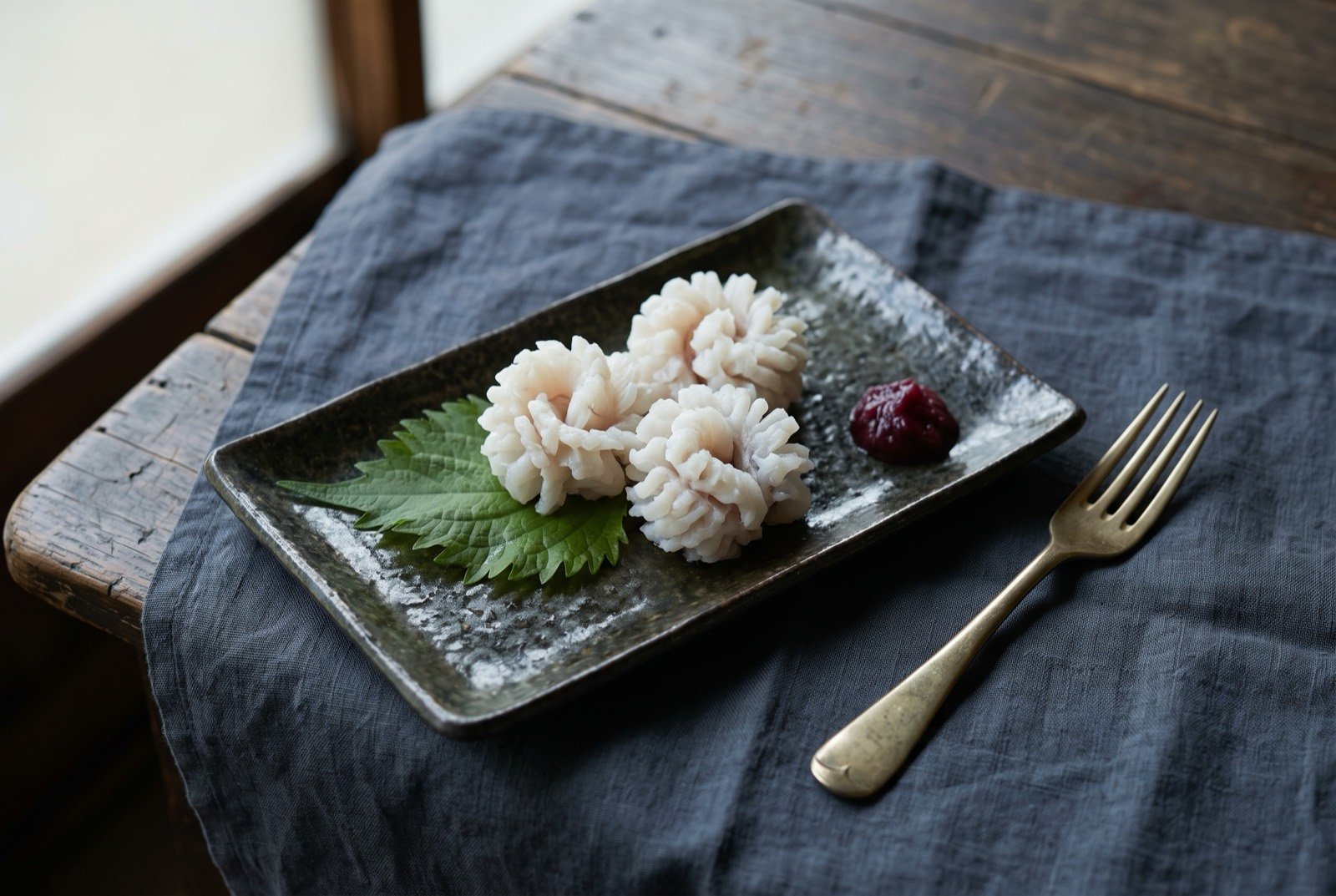
Hamo, pike conger, peaks in July and August, coinciding precisely with Kyoto's Gion Matsuri; the fish became the city's defining summer catch specifically because its unusual vitality and toughness let it survive live transport inland from the coast in an era before refrigeration, when almost no other fresh fish could make that journey. Its flesh is riddled with fine bones no amount of careful filleting removes, which is what the Kyoto specific technique of hone-kiri, extremely fine, closely spaced cuts through the bones while leaving the skin intact, was developed to solve; bone-cut hamo dipped briefly in hot water curls open into a flower shape and is traditionally served with plum paste.
As tradition built it
Serves 4 as a kaiseki course. About 40 minutes, most of it knife work.
Ingredients
- 1 hamo fillet, skin on (or a good UK substitute, see Sourcing)
- to taste ume plum paste
- 1 per portion shiso leaf, to garnish
Method
- Lay the fillet skin side down and, with a very sharp, thin knife, make extremely fine, closely spaced cuts through the flesh and its network of small bones, stopping just short of cutting through the skin, roughly twenty five cuts per 3cm of fillet.
- Portion the bone-cut fillet into serving pieces.
- Dip each piece briefly into just boiled water, a few seconds only, until the cut flesh curls open.
- Refresh immediately in ice water, then drain well.
- Serve chilled or at room temperature, with ume plum paste and a shiso leaf.
What a modern chef changes
A precision temperature bath, and a plum paste built properly rather than bought
Rung 1's dashi logic applied to the accompaniment, not the fish itself, since the fish's own technique is already the elevation
Method
- Hold the hot water dip at a measured, consistent temperature using a sous vide circulator's own precision rather than a kettle judged by eye, so every piece curls to the same degree, a genuine, checkable improvement over doing this by feel.
- Reduce a fresh ume plum paste from scratch, umeboshi worked with a little sugar and mirin to the tare logic of rung 6, rather than a bought paste, since the accompaniment is simple enough that the reduction discipline this chapter applies elsewhere pays off directly here.
- Serve alongside a small dashi jelly, a clean 60°C extraction set with a little agar, a genuinely modern kaiseki restaurant device rather than a traditional accompaniment, offered here as a named, current technique rather than an invented tradition.