Korea and Japan · Volume 52, The Koikuchi Line, the Kombu Coast and the Kaiseki Counter
Zaru Soba
Edo
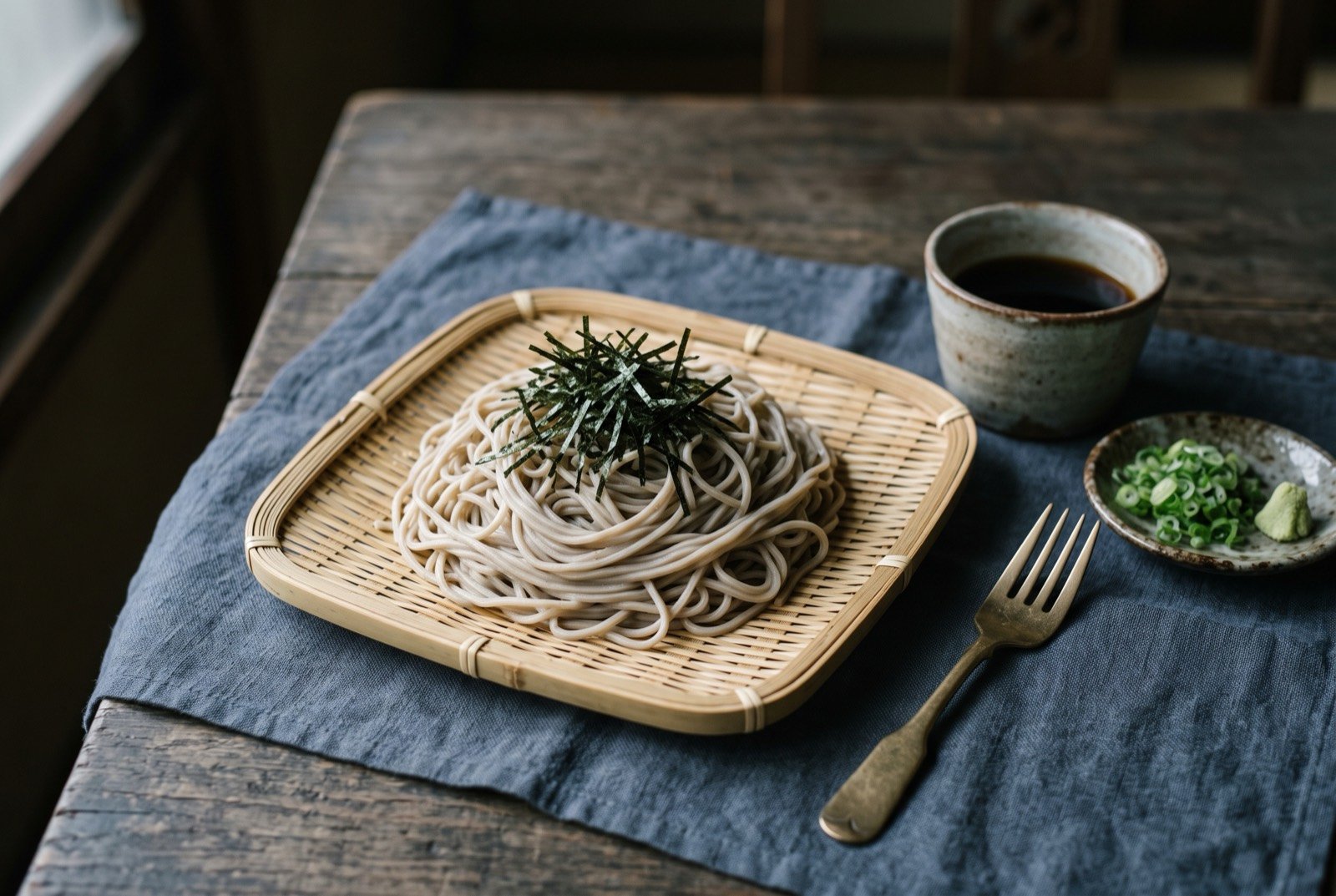
An illustration of the dish, not a photograph of it cooked.
- Time
- 40 minutes
- Researched
- No outside sources linked
- Reviewed
- Not yet reviewed from inside the tradition
- Cooked
- Not yet cooked and reported
By 1860, soba shops in Edo reportedly numbered 3,763, a scale of noodle culture with no real Kansai equivalent, where udon, better suited to the region's warmer, wheat friendly climate, was the everyday noodle instead. Nihachi, the standard eight to two buckwheat to wheat ratio, has a genuinely contested name: before 1865, "nihachi" was wordplay on price, soba selling at sixteen mon a bowl and two times eight equalling sixteen; only after that date does the name reliably mean the flour ratio itself, since soba's price varied too much before then for the pun to hold consistently.
As tradition built it
Serves 4. About 40 minutes, plus resting.
Ingredients
- 400 g buckwheat flour
- 100 g plain flour (the nihachi 8:2 ratio)
- 220 ml cold water
- a scatter nori, shredded, to serve
- 150 ml soy sauce
- 30 ml mirin
- 30 ml sugar (kaeshi, ratio 5:1:1)
- 600 ml katsuobushi dashi
Method
- Make the kaeshi: warm soy sauce, mirin and sugar together just enough to dissolve, do not boil, and rest, ideally overnight.
- Combine the two flours, work in the water gradually (mizumawashi), then knead and rest the dough 30 to 40 minutes total.
- Roll thin and cut into fine strands.
- Boil briefly, one to two minutes, then shock in ice water and drain well onto a bamboo zaru.
- Dilute the kaeshi with the dashi, roughly one part kaeshi to three parts dashi, to taste.
- Serve the noodles topped with shredded nori, tsuyu alongside for dipping.
What a modern chef changes
A cleaner kaeshi and a controlled dashi, the noodle itself left alone
Rungs 6 and 1
Method
- Age the kaeshi properly rather than using it fresh, resting it a full week in a cool, dark cupboard before diluting, since the flavour genuinely rounds and integrates over that time in a way an hour's rest cannot replicate.
- Extract the dashi in two passes, an ichiban, first extraction, dashi for the tsuyu itself, held at rung 1's 60°C discipline, and a niban, second extraction, from the same spent kombu and katsuobushi for any accompanying simmered side, so nothing is wasted and the tsuyu carries the cleanest possible flavour.
- Serve the dip warm rather than cold in winter, a genuine, documented seasonal variant, kake soba's own hot broth logic borrowed onto the dipping format, offered here as a named adaptation rather than a claimed ancient practice.