Korea and Japan · Volume 52, The Koikuchi Line, the Kombu Coast and the Kaiseki Counter
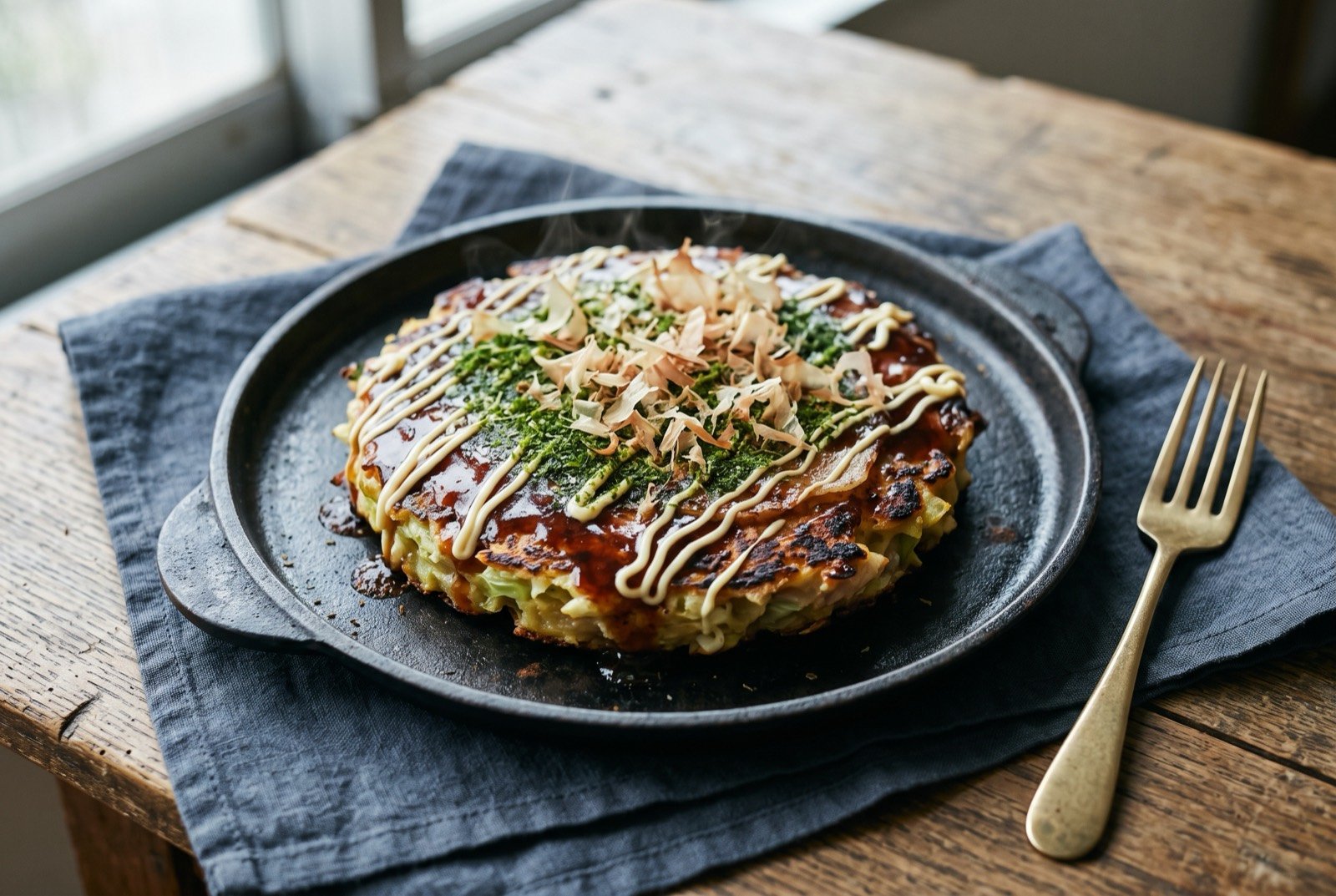
Okonomiyaki, Osaka Style
Osaka
Illustration
- Time
- 20 minutes
The most credibly sourced origin narrative dates okonomiyaki to Osaka's Tsuruhashi black market district in the immediate postwar period, poor residents wanting to fill their stomachs cheaply, with deeper roots in earlier Taisho era street snacks, chobo-yaki and rajio-yaki, a thin batter poured onto a dimpled iron plate and filled simply. It only became a widespread restaurant dish from the 1950s onward, as shops multiplied through the city, a genuinely recent dish wearing an old street food's clothes.
As tradition built it
Serves 2. About 20 minutes.
Ingredients
- 80 g plain flour
- 100 ml water
- 30 g grated yamaimo (mountain yam)
- 2 g dashi powder or a splash of concentrated dashi
- 300 g cabbage, finely chopped
- 10 g spring onion, chopped
- 80 g pork belly, thinly sliced
- 2 eggs
- 20 g tenkasu (tempura scraps)
- to taste pickled red ginger, okonomiyaki sauce, mayonnaise, aonori and bonito flakes, to finish
Method
- Whisk flour, dashi and water with the grated yamaimo until foamy, the yam's own mucilage giving the batter its bind.
- Fold in cabbage, spring onion, tenkasu, ginger and egg gently, with air incorporated rather than beaten flat.
- Pour onto a hot griddle at roughly 2cm thickness and cook about 3 minutes.
- Flip, lay the pork slices over the top, cover and steam roughly 4 minutes.
- Flip again and cook uncovered a further 3 minutes to drive off moisture.
- Finish with sauce, mayonnaise, aonori and bonito flakes.
What a modern chef changes
A dehydrated cabbage trick and a proper dashi, the pancake itself left largely alone
Not a numbered rung; the chapter's own extrapolation onto a dish whose own tradition is already deliberately unfussy
Method
- Salt and briefly dehydrate a portion of the cabbage before folding it in, drawing off excess water so the finished pancake holds its structure without needing the full three minute uncovered drying stage to work as hard, a genuine use for this reader's own dehydrator on a dish that would otherwise never call for one.
- Build the dashi component properly, a real katsuobushi and kombu extraction rather than powder, folded through the batter at the rung 1 discipline, for a base note the powder cannot match.
- Make the sauce from scratch, a reduction of Worcestershire sauce, ketchup, oyster sauce and sugar approximating Otafuku's own commercial blend, since the bottled sauce, however authentic to the everyday dish, is the one component of this pancake most improved by a kitchen that already reduces sauces properly elsewhere in this chapter.