Korea and Japan · Volume 53, The Grill, the Broth and the Sealed Port
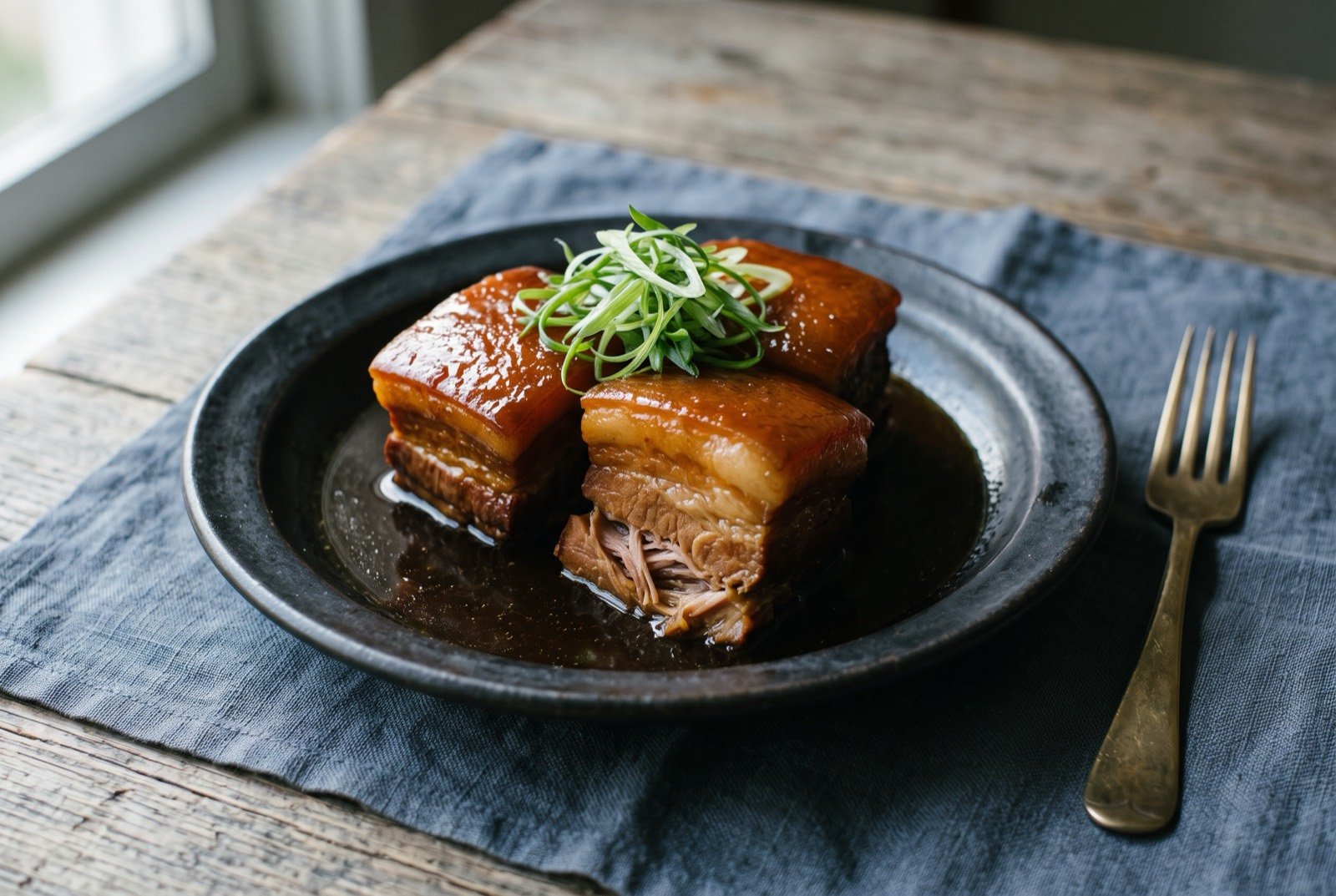
Nagasaki kakuni, slow braised pork belly
Nagasaki, Kyushu
Illustration
- Time
- 3 hours
- Researched
- Researched from 87 sources in the brief
Nagasaki's toba-ni is explicitly linked in Japanese food history to Dongpo pork, the Song dynasty dish attributed to the poet and statesman Su Shi, arriving via the resident Chinese merchants of Tojin Yashiki and adapted with a defatting step and softer seasoning for Japanese taste; where the Chinese original is braised as a whole block, the Nagasaki version is cut into cubes.
As tradition built it
Serves four to six. 40 to 50 minutes, or 2 to 3 hours for the longer traditional method.
Ingredients
- 1kg pork belly, cut into roughly 3cm cubes
- 4 slices ginger, sliced
- 1, mostly the green part spring onion
- a little sesame oil
- 200ml sake
- 40ml dark soy
- 40ml light soy
- 60g coarse sugar
Method
- Brown the ginger and spring onion in sesame oil.
- Sear the pork cubes until coloured on all sides.
- Add the sake, dark soy, light soy and coarse sugar.
- Bring to a simmer, skimming carefully.
- Cover and simmer gently for 40 to 50 minutes until the pork is tender but still holds its shape.
Notes
For a more traditional, longer method, pre boil the meat two to three hours to render fat and tenderise, straining and skimming the stock, then add Shaoxing wine, soy and sugar for a further hour's simmer, a genuine two to three hour cook overall either way.
What a modern chef changes
A sous vide braise finished over direct ember heat
Method
- Sear the pork belly hard, then cook it sous vide at 72 degrees Celsius for eighteen hours, for a texture the stovetop method cannot reach without breaking the meat apart.
- Reduce the braising liquid separately to a tight glaze once the meat is cooked.
- Finish the pork under the Big Green Egg's direct heat for two minutes a side, basting with the glaze, for real caramelisation rather than a purely braised finish.
- Dust with five spice, ground fresh in the spice grinder.
Notes
The five spice dusting nods honestly at the dish's Chinese ancestry rather than pretending the lineage was never there.