Korea and Japan · Volume 53, The Grill, the Broth and the Sealed Port
Karashi renkon, Kumamoto's mustard stuffed lotus root
Kumamoto, Kyushu
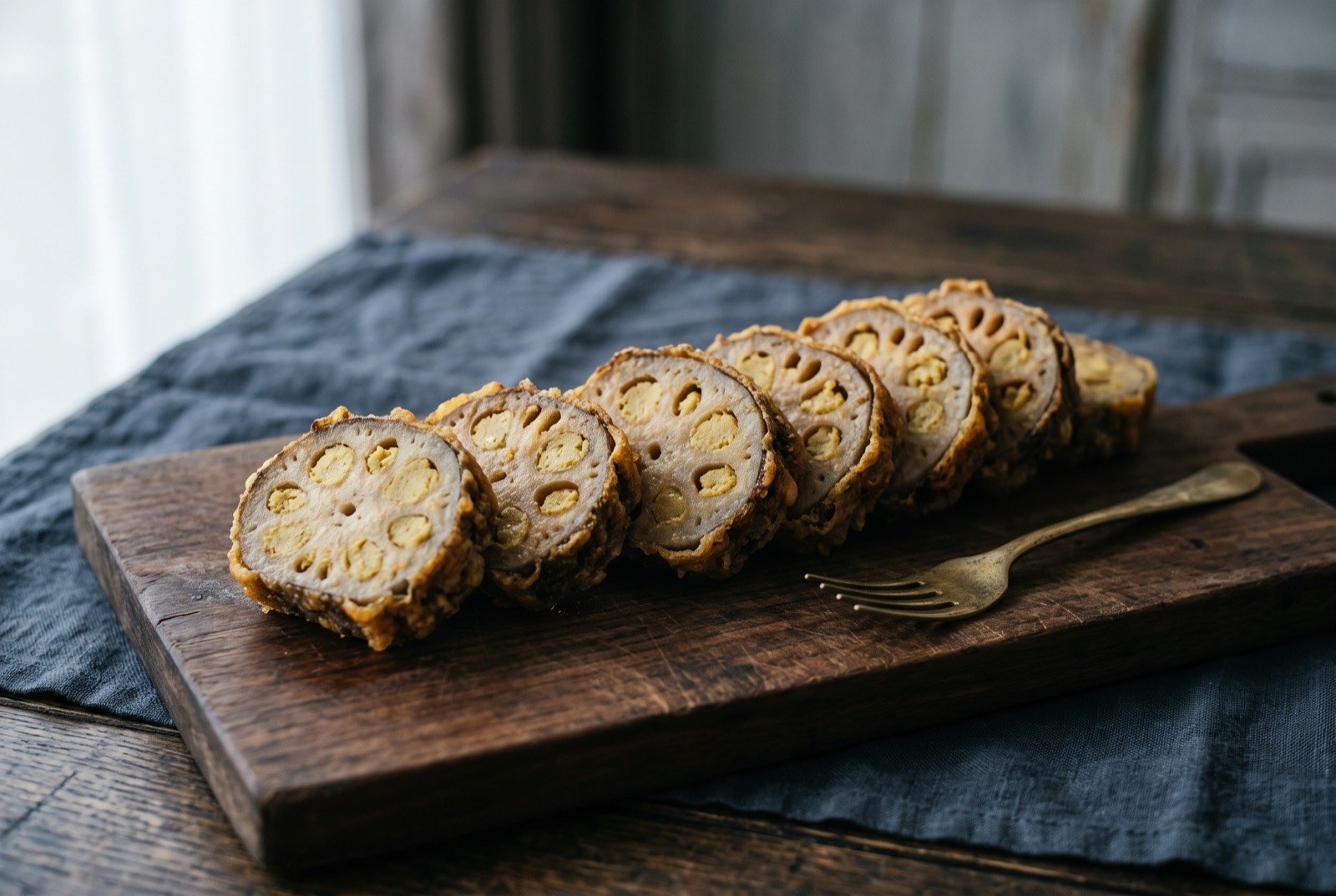
An illustration of the dish, not a photograph of it cooked.
- Time
- 1 hour 30
- Reviewed
- Not yet reviewed from inside the tradition
- Cooked
- Not yet cooked and reported
Dated to 1632 and credited to a monk named Gensaku, who devised the dish for the ailing daimyo Hosokawa Tadatoshi from lotus root planted in Kumamoto Castle's moat as an emergency food source; the sliced cross section resembles the Hosokawa clan's crest, and the recipe was kept a closely guarded family secret until after the Meiji Restoration.
As tradition built it
Serves four to six. About 1 hour 30 minutes, including resting.
Ingredients
For the lotus root
- 2 lotus root sections, peeled and trimmed, holes kept intact
- 100g white miso
- 2 tbsp Japanese mustard powder
- a little a little water, to loosen
For the batter
- 1 egg yolk
- 50g wheat flour
- 30g broad bean flour
- as needed water, to loosen
- as needed oil, for deep frying
- a little extra mustard, to serve
Method
- Mix the white miso with the Japanese mustard powder, loosened with a little water to a thick paste.
- Pipe the paste firmly into the lotus root's holes from both ends, packing tightly.
- Rest for at least an hour so the paste sets.
- Make a batter from the egg yolk, wheat flour and broad bean flour, loosened with water to a thick coating consistency.
- Dip the stuffed lotus root in the batter and deep fry in oil at 170 degrees Celsius for six to eight minutes, turning occasionally, until deep golden.
- Rest briefly, then slice into rounds to show the crest pattern.
- Serve with a little extra mustard on the side.
What a modern chef changes
A vacuum fill, a mustard miso dust and a double fry
Method
- Vacuum the mustard miso paste into the lotus root's holes under pressure rather than piping by hand, for a denser, more even fill with no air pockets.
- Dehydrate a portion of the stuffing separately, then grind it fresh in the spice grinder into a fine mustard miso dust.
- Coat the outside of the finished slices with the mustard miso dust for a second, sharper hit of the same flavour that carries the filling.
- Fry in two stages, a lower first temperature to cook the lotus root through, then a hard final blast at 190 degrees Celsius for colour and crunch.
Notes
That double fry logic is the same one used for karaage above, applied here to a dish that has never traditionally used it.